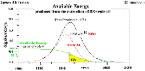
New findings on peak oil timing and impacts to be presented at Houston Conference$this->bbcode_second_pass_quote('', 'O')n Wednesday night at this week's Houston Oil Conference, Aage Figenschou will report on the changing date of Peak Oil as predicted by the IFP, the French Petroleum Institute. He says that in 2001 IFP predicted oil would peak in 2020. But in 2006, IFP said the year would be 2015; and in June of 2007, they had moved the peak year forward to 2010.
But more important than the date predicted for peak are the dates when impacts will be felt and the date mitigation steps are taken, say Conference organizers. Many energy analysts believe that $80 oil is creating impacts right now, and that mitigation steps are being taken very slowly, if at all.
"In the context of world oil," Hirsch says, "relatively small percentage changes are hugely meaningful." He notes that "a 1% change in current world oil production equates to over 800,000 barrels per day (bpd), which represents a huge volume." To save that level of consumption through increases in the efficiency of the world's light vehicle fleet, he says, would require more than a decade, assuming the implementation of a crash program.
His new study has resulted in three scenarios for mitigation of Peak Oil impacts:
1) Best Case Scenario - where maximum world oil production is followed by a multi-year plateau before the onset of a monatomic decline rate of 2-5% per year.
2) A Middling Case - where world oil production abruptly reaches a maximum, after which it drops into a long-term, 2-5% annual decline; and finally ...
3) A Worst Case, where the sharp peak of the Middling Case is degraded by oil exporters withholding product, leading to world oil shortages growing more rapidly than 2-5% per year, creating the most dire world economic impacts.



PeakOil is You
Houston Oil Conference: New findings on peak oil timing
14 posts
• Page 1 of 1
Houston Oil Conference: New findings on peak oil timing
 by Graeme » Tue 16 Oct 2007, 17:31:42
oilonline
Human history becomes more and more a race between education and catastrophe. H. G. Wells.
Fatih Birol's motto: leave oil before it leaves us.
Fatih Birol's motto: leave oil before it leaves us.
-

Graeme - Fusion

- Posts: 13258
- Joined: Fri 04 Mar 2005, 04:00:00
- Location: New Zealand
Re: New findings on peak oil timing
by roccman » Tue 16 Oct 2007, 17:43:13
Well I go with #4
Bone crushing thud
Cantarell declining at 15-20%
KSA at 4-6%
Forty's Field 6-8%
North slope 6-8%
Then chuck in ELM at 2-5%
Then top it off with "above ground factors" - 2-5%
and we are at 30% decline rate.
We are screwed.
Bone crushing thud
Cantarell declining at 15-20%
KSA at 4-6%
Forty's Field 6-8%
North slope 6-8%
Then chuck in ELM at 2-5%
Then top it off with "above ground factors" - 2-5%
and we are at 30% decline rate.
We are screwed.
"There must be a bogeyman; there always is, and it cannot be something as esoteric as "resource depletion." You can't go to war with that." Emersonbiggins
-

roccman - Light Sweet Crude

- Posts: 4065
- Joined: Fri 27 Apr 2007, 03:00:00
- Location: The Great Sonoran Desert
Re: New findings on peak oil timing
by turmoil » Tue 16 Oct 2007, 17:45:54
$this->bbcode_second_pass_quote('Graeme', '3')) A Worst Case, where the sharp peak of the Middling Case is degraded by oil exporters withholding product, leading to world oil shortages growing more rapidly than 2-5% per year, creating the most dire world economic impacts.
Worst case for current wasteful lifestyles, best case for fast changes, lowered GHG output, and meaningful reduction of environmental degradation.
Personally, steep oil decline looks better by the day.
Bring on ZPG...
"If you are a real seeker after truth, it's necessary that at least once in your life you doubt all things as far as possible"-Rene Descartes
"When you have excluded the impossible, whatever remains however improbable must be the truth"-Sherlock Holmes
"When you have excluded the impossible, whatever remains however improbable must be the truth"-Sherlock Holmes
-

turmoil - Heavy Crude

- Posts: 1088
- Joined: Fri 13 Aug 2004, 03:00:00
- Location: Richmond, VA, Pale Blue Dot
Re: New findings on peak oil timing
by dukey » Tue 16 Oct 2007, 18:00:25
north sea has seen some steep declines
13% ish
13% ish
-

dukey - Intermediate Crude

- Posts: 2248
- Joined: Sun 20 Feb 2005, 04:00:00
Re: New findings on peak oil timing
by aflurry » Tue 16 Oct 2007, 18:55:55
$this->bbcode_second_pass_quote('roccman', 'W')ell I go with #4
Bone crushing thud
Cantarell declining at 15-20%
KSA at 4-6%
Forty's Field 6-8%
North slope 6-8%
Then chuck in ELM at 2-5%
Then top it off with "above ground factors" - 2-5%
and we are at 30% decline rate.
We are screwed.
Bone crushing thud
Cantarell declining at 15-20%
KSA at 4-6%
Forty's Field 6-8%
North slope 6-8%
Then chuck in ELM at 2-5%
Then top it off with "above ground factors" - 2-5%
and we are at 30% decline rate.
We are screwed.
i agree with the thud prediction, but umm, you can't add the decline rates of those fields together... that don't make no sense.... you got to take a weighted average.
-
aflurry - Tar Sands

- Posts: 824
- Joined: Mon 28 Mar 2005, 04:00:00
Re: New findings on peak oil timing
by roccman » Tue 16 Oct 2007, 18:58:56
My bad...50% decline.
"There must be a bogeyman; there always is, and it cannot be something as esoteric as "resource depletion." You can't go to war with that." Emersonbiggins
-
roccman - Light Sweet Crude
- Posts: 4065
- Joined: Fri 27 Apr 2007, 03:00:00
- Location: The Great Sonoran Desert
Re: New findings on peak oil timing
by PeakingAroundtheCorner » Tue 16 Oct 2007, 19:01:18
$this->bbcode_second_pass_quote('aflurry', '')$this->bbcode_second_pass_quote('roccman', 'W')ell I go with #4
Bone crushing thud
Cantarell declining at 15-20%
KSA at 4-6%
Forty's Field 6-8%
North slope 6-8%
Then chuck in ELM at 2-5%
Then top it off with "above ground factors" - 2-5%
and we are at 30% decline rate.
We are screwed.
Bone crushing thud
Cantarell declining at 15-20%
KSA at 4-6%
Forty's Field 6-8%
North slope 6-8%
Then chuck in ELM at 2-5%
Then top it off with "above ground factors" - 2-5%
and we are at 30% decline rate.
We are screwed.
i agree with the thud prediction, but umm, you can't add the decline rates of those fields together... that don't make no sense.... you got to take a weighted average.
Please feel free to make the more reasonable calculations. Thanks! =)
-
PeakingAroundtheCorner - Tar Sands
- Posts: 522
- Joined: Sun 08 Apr 2007, 03:00:00