Donate Bitcoin

Donate Paypal


PeakOil is You

PeakOil is You

Is Ovshinsky delusional?

Discussions of conventional and alternative energy production technologies.

Is Ovshinsky delusional?

Postby JRP3 » Fri 27 Oct 2006, 16:19:59

$this->bbcode_second_pass_quote('', 'E')ven though Ovshinsky’s technologies would marginalize fossil fuels, the need for them wouldn’t be eliminated. “We’re not saying that oil is going to be irrelevant. It certainly has its place,” he says. “We’re not anti-anything. We want to solve problems with realistic solutions.”

So far, Ovshinsky has support from some unexpected places. For example, Texaco paid $67.3 million in May 2000 for a 20 percent stake in ECD Ovonics. (Texaco later merged with Chevron.) That investment allowed Texaco to work with ECD Ovonics on commercializing technologies such as its solid hydrogen storage and regenerative fuel cell. “They said: ‘Stan, we don’t want to change you. We want you to change us,’” Ovshinsky says.

Texaco’s conversion reflects Ovshinsky’s ability to sell renewable energy, even to those who’ve made their fortunes in oil. “He’s a visionary and a missionary,” says Frank Jamerson, a retired General Motors executive who’s known Ovshinsky for 30 years, and worked with him on electric vehicles in the 1990s. “He’s been inventing products that do exactly what I was hoping to do: eliminate fossil fuels, both with batteries and photovoltaics.”



Link
User avatar
JRP3
Tar Sands
Tar Sands
 
Posts: 768
Joined: Mon 23 Oct 2006, 03:00:00

Re: Is Ovshinsky delusional?

Postby The_Toecutter » Fri 27 Oct 2006, 19:57:06

Delusional? Nah. The oilies having Ovshinski pussy-whipped is a more likely explanation for his words.


I'm sure you're aware of Chevron having control of the Ovonic NiMH battery, and sitting on it...

This is the battery that would allow 150 mile range EVs with no special attention to efficiency(200-300 miles or more with attention to efficiency), cost $220/kWh in mass production, has no capacity loss in cold weather, and could potentially outlast a car's chassis two times over. Shelf life of Nickel based batteries is usually in decades, and while typical NiMH do not last that long, Ovonics have so far proven their longevity.

The oil company doesn't want us driving EVs. This antiquated 1990s technology made them viable then. Ovshinski came up with it.

A few famous quotes of his, in italics:

"They tried to stop us from going to California. They threatened us! I said to them, ‘Look, the Communist Party no longer runs the world. A party line cannot be imposed upon people who don’t believe in it. The consortium is set up to make sure the American public has an electric car. It was not set up to fight the mandate. We are a battery company, and we’re not going to lie to the public.'" ~The Car That Could: The Inside Story of GM’s Revolutionary Electric Vehicle, by Michael Shnayerson, page 203.

The story behind the above quote is that basically Ovshinsky wanted to reveal at a conference the state of EV battery technology, and GM and the USABC threatened him. This battery had allowed a Solectria Force(a converted Geo Metro sedan) 180-200 miles range at 60 mph highway speeds in 1996. Theoretical life was at least 100,000 miles(later fleet studies by Southern California Edison shown no degridation, peak power loss, or capacity loss after 150,000 miles. Entire packs have yet to fail in their RAV4 EV fleet. Some think max life may be around 250,000 miles or so, but none of their EVs have been driven that long yet.)

Also interesting, about the USABC, Dan Sperling, PhD at the Institute of Transportation Studies at the University of California, noted that the automakers had repeatedly attempted to use the USABC to suppress information on and development of battery technology. He talked about Valence being forced by contract with GM not to reveal any battery technology advances.

"The people who are saying that battery technology isn’t ready are absolutely wrong. It’s part of the party line. It’s self-perpetuating. It’s very sad. You tell a lie big enough and long enough, and people start to believe it. The fact of the matter is volume. That’s the only reason batteries are the cost that they are."

When Ovshinsky made that quote, the NiMH did 50 Wh/kg specific capacity, 300 W/kg peak power, and > 800 cycle life to 100% discharge. For a 500 kg pack in a 170 Wh/mile car, this was viable for a 150 mile range EV with a pack life of 120,000+ miles and 200 peak battery horsepower. Voila, we have the NiMH EV1, more or less. Cost parity with gas cars at most, $1.30/gallon if everything was done ni similar volume, but since all the cars are crushed, we won't ever know. Te RAV4 EVs are a good basis to compare. Further, in mass production at the time, cost would have been $150/kWh in volume for 20,000 cars per year, but this was the 1990s. Today, cost would be closer to $220/kWh.

The newest generation of NiMH did 60 Wh/kg, 400 W/kg peak power, and UC Davis claims 1,750 cycles to 100% discharge.

Now we have Li Ion. It has much more power and far more range per unit weight, but so too is its cost higher and its longevity leaves more to be desired. To get Li Ion to be affordable for EVs, you will need a much greater production scale than Ovonic NiMH, making the barrier to entry that much more difficult to surpass(unless you are a big automaker with lots of money, but in that case, you probably don't want people driving EVs anyway). Li Ion is 400-500 cycles to 100% discharge, degrades 2-4% per year if properly managed, 500 W/kg of peak power, 150-180 Wh/kg specific capacity, and if produced in automotive volume, $250-300/kWh. If electronically managed properly, a Li Ion pack could feasibly last about 7 years or 100,000 miles, whichever comes first, before it only delivered 80% of its original range. In order for a mass produced Li Ion battery EV to compete with a gas car, gas needs to be at least $2.50/gallon.

Given the longevity of Ovonic NiMH, cost parity for that would be under $1/gallon gas, but studies that assumed 100,000 mile life and $150/kWh in mass production placed cost parity at $1.30/gallon. In reality, as the RAV4s are showing, these last well over 150,000 miles. While the RAV4s don't use Ovonics and instead Panasonics, the basic principle remains the same. Large size NiMH are far more robust than small size.
The unnecessary felling of a tree, perhaps the old growth of centuries, seems to me a crime little short of murder. ~Thomas Jefferson
User avatar
The_Toecutter
Intermediate Crude
Intermediate Crude
 
Posts: 2142
Joined: Sat 18 Jun 2005, 03:00:00

Re: Is Ovshinsky delusional?

Postby Mesuge » Sat 28 Oct 2006, 05:21:14

Toe> Exactly, I've seen in some EV1 related video with the electric car program manager at Edison speaking about their RAV4 fleet and how happy they are about the longevity of the NiMh packs etc..

I'm wondering isn't there some way around the ban on high capacity NiMh batteries and so to speak possible to outfox the oily shills? Wouldn't be possible to get at least near the price/Wh performance by making hybridized paralel and serial batt. strings from smaller NiMhcells?

For instance, there have been some diy conversions and experiments using the smaller cells from scrapyard hybrids exactly in this fashion..

Image
http://www.hackaday.com/2006/10/19/electric-7-ev/

EV NiMh Lotus 7 home page:
http://www.electric7.com/


About the NiMh pack, from this:
link to image

to this:
link to image

[url=http://www.electric7.com/IMG_2431.jpglink to image[/url]

details here:
http://www.electric7.com/construction.html


And don't forget to download the videos from the front page,
especially the second one - the onboard video with the humming
Siemens motor inverter combo inside, sounds like symphony..
DOOMerotron: at all-time high [8.3] out of 10..
User avatar
Mesuge
Heavy Crude
Heavy Crude
 
Posts: 1500
Joined: Tue 01 Nov 2005, 04:00:00
Location: Euro high horse bastard on the run

Re: Is Ovshinsky delusional?

Postby JRP3 » Sat 28 Oct 2006, 09:42:36

$this->bbcode_second_pass_quote('The_Toecutter', '
')
I'm sure you're aware of Chevron having control of the Ovonic NiMH battery, and sitting on it...


Yes I've been peeling back the layers on this whole tragedy, (much thanks to you and your information), I just couldn't believe his comments. I guess they forced him to drink the coolaid.
It's really quite frustrating.
I'd start building my own EV tomorrow if these Ovonics were readily available, or some equivalent technology.
Maybe the new foam-lead acid battery will come into existence.
http://www.greencarcongress.com/2006/01 ... ergy_.html
User avatar
JRP3
Tar Sands
Tar Sands
 
Posts: 768
Joined: Mon 23 Oct 2006, 03:00:00

Re: Is Ovshinsky delusional?

Postby JRP3 » Sat 28 Oct 2006, 09:58:06

$this->bbcode_second_pass_quote('Mesuge', '
')
I'm wondering isn't there some way around the ban on high capacity NiMh batteries and so to speak possible to outfox the oily shills? Wouldn't be possible to get at least near the price/Wh performance by making hybridized paralel and serial batt. strings from smaller NiMhcells?


My guess is that expense goes up quite a bit having to piece together all those smaller batteries.
Those packs do look interesting though.
User avatar
JRP3
Tar Sands
Tar Sands
 
Posts: 768
Joined: Mon 23 Oct 2006, 03:00:00

Re: Is Ovshinsky delusional?

Postby The_Toecutter » Sat 28 Oct 2006, 15:18:51

$this->bbcode_second_pass_quote('', 'W')ouldn't be possible to get at least near the price/Wh performance by making hybridized paralel and serial batt. strings from smaller NiMhcells?


Not really. On small size NiMH, even the Chinese have difficulty getting below $400/kWh. Then you have the problem of battery regulation and cooling, which greatly adds to the cost and complexity for these packs. The smaller NiMH don't have the longevity of the larger size NiMH, and this is precisely why Toyota and Honda keep theirs below 90% state of charge at all times but above ~40% state of charge. They cannot deep discharge these like one would be able to do with the large size modules. NiMH batteries have to be specifically designed for EV use if they are going to be placed in an EV, otherwise they will have problems such as charge retention and overheating. HEV batteries don't have the same requireemnts as pure EV batteries, and thus they have been designed differently. Ovonic and Panasonic both designed proper batteries for EVs.

Cooling a bunch of small NiMH batteries itself is an expensive nightmare.

$this->bbcode_second_pass_quote('', 'F')or instance, there have been some diy conversions and experiments using the smaller cells from scrapyard hybrids exactly in this fashion.


That Lotus 7 replica is pretty famous on the EV list. But there's plenty of debate on whether or not the pack will last. I recall the vehicle only having 12 miles range due to each individual pack's built in management system preventing the state of charge from reaching certain levels, but I can't recall where I read that, so I may be wrong about that range number.

$this->bbcode_second_pass_quote('', 'M')y guess is that expense goes up quite a bit having to piece together all those smaller batteries.
Those packs do look interesting though.


So much so that Li Ion becomes far cheaper.
The unnecessary felling of a tree, perhaps the old growth of centuries, seems to me a crime little short of murder. ~Thomas Jefferson
User avatar
The_Toecutter
Intermediate Crude
Intermediate Crude
 
Posts: 2142
Joined: Sat 18 Jun 2005, 03:00:00
Top

Re: Is Ovshinsky delusional?

Postby The_Toecutter » Sun 29 Oct 2006, 07:00:21

I should also mention that NiMH don't like being paralleled. Low AH packs thus limit the practical amount of kWh you can store, as once you go above 400V or so, it is near impossible to find a compatable traction motor and controller/inverter. Although the details are unknown given that Chevron has the contract with Panasonic and other NiMH licensees classified, it is widely known that a restriction on AH size is in place. Many in the EV community suspect this restriction is at 15 AH, judging by the module sizes available from companies besides Cobasys.

400V * 15AH= 6kWh

In the most aerodynamically efficient cars built of composite materials, this would only be 60 miles range. In a typical midsize car, more like 20 miles range. 400V is really pushing things, too...
The unnecessary felling of a tree, perhaps the old growth of centuries, seems to me a crime little short of murder. ~Thomas Jefferson
User avatar
The_Toecutter
Intermediate Crude
Intermediate Crude
 
Posts: 2142
Joined: Sat 18 Jun 2005, 03:00:00

Re: Is Ovshinsky delusional?

Postby oilfreeandhappy » Wed 01 Nov 2006, 15:24:57

$this->bbcode_second_pass_quote('The_Toecutter', '
')I'm sure you're aware of Chevron having control of the Ovonic NiMH battery, and sitting on it...

This is the battery that would allow 150 mile range EVs with no special attention to efficiency(200-300 miles or more with attention to efficiency), cost $220/kWh in mass production, has no capacity loss in cold weather, and could potentially outlast a car's chassis two times over. Shelf life of Nickel based batteries is usually in decades, and while typical NiMH do not last that long, Ovonics have so far proven their longevity.

The oil company doesn't want us driving EVs. This antiquated 1990s technology made them viable then. Ovshinski came up with it.

I agree. I owned Energy Conversion Devices stock through the 90s and into 2000, and followed all these developments fairly closely. The entire acquistion of Ovonics by Chevron through Texaco was a calculated plan to shelve this technology. I also recall Ovshinsky quotes in Shareholder packets, about the price of EV NiMH batteries going down dramatically, if mass produced.

If I recall, the Chevron acquisition was only a 51% interest. The other 49% was owned by GM. If that doesn't stink of collusion, what does?

Thanks for the info. I wasn't aware of the problems of small NiMH versus the larger units in EVs. This fills in another void in the puzzle. I often wondered why NiMH became available in the smaller sizes - cell phones, bicycle headlights, etc. It's because they could make a buck on the product with the small units, but hold the large battery price at too high of a level to compete with fossil fuels.
Earth_Wind_and_Solar
User avatar
oilfreeandhappy
Lignite
Lignite
 
Posts: 318
Joined: Sun 29 Jan 2006, 04:00:00
Location: Colorado Springs, CO
Top

Re: Is Ovshinsky delusional?

Postby gg3 » Wed 01 Nov 2006, 23:12:22

OK, so now assuming I don't want to buy Chevron gasoline any more, what are the more-ethical alternatives in Northern California?

How'bout a class-action suit by people who want EVs, to force Chevron and GM et. al. to either s--- or get off the pot?

How'bout an investor lawsuit accusing GM of managerial malfeasance for not capitalizing on technologies (including higher-mileage cars as per another topic here) that could save them from financial ruin?

I'm starting to think that my next vehicle purchase will either be some kind of EV or one of those high-mileage cars from Europe even if the latter has to be sneaked across the border in pieces. I'd buy a Zap Xebra if it had just a little more speed and a little more range: 55 mph and 60 miles, instead of 40 x 40.

Hey Toecutter, to what extent would it be feasible to mod one of those Xebras to do 55 mph with range of 70 miles, or is it preferable to scratchbuid for those characteristics? (Minimal carrying capacity needed: two adults and 2 cubic yards of cargo in an enclosed lockable space.)
User avatar
gg3
Expert
Expert
 
Posts: 3271
Joined: Mon 24 May 2004, 03:00:00
Location: California, USA

Re: Is Ovshinsky delusional?

Postby The_Toecutter » Wed 01 Nov 2006, 23:15:49

$this->bbcode_second_pass_quote('', 'I') owned Energy Conversion Devices stock through the 90s and into 2000, and followed all these developments fairly closely. The entire acquistion of Ovonics by Chevron through Texaco was a calculated plan to shelve this technology. I also recall Ovshinsky quotes in Shareholder packets, about the price of EV NiMH batteries going down dramatically, if mass produced.


Could you scan any of these by chance? Someone posted NiMH price versus volume on the EV list in the late 1990s and I came across it in a search about 2 years ago. $150/kWh in volume of 20,000 cars per year. But I only had that post, claiming this came from a slide that former ECD chairman Robert Stemple presented. I'd love to have a concrete source! The EV list would thank you many times over if you could find that.

$this->bbcode_second_pass_quote('', 'T')hanks for the info. I wasn't aware of the problems of small NiMH versus the larger units in EVs. This fills in another void in the puzzle. I often wondered why NiMH became available in the smaller sizes - cell phones, bicycle headlights, etc. It's because they could make a buck on the product with the small units, but hold the large battery price at too high of a level to compete with fossil fuels.


Ever read the EV world blog entry on this subject?

http://www.evworld.com/blogs/index.cfm?page=blogentry&blogid=104&authorid=51&archive=0

How about Remy Chevalier's article?

http://www.electrifyingtimes.com/hurryupandwait.html


I can also back up the info I earlier typed with sources, if you're interested. Below is the source to the original PDF file claiming $225/kWh in mass production and 1,750 cycles to 100% discharge for large AH NiMH. It is no longer active, however:

http://www.team-fate.net/technicalrepor ... Report.pdf

Google yields this cached link, containnig the same info:

Design and Development of the UC Davis FutureTruck

Check page 11:

"Analysis of existing battery life cycle data and consultation with industry experts indicates that mature NiMH technology should withstand approxamately 1,750 full discharges with an annual life exceeding seven to ten years."

Also of note:

"A cost of $225/kWh for large volume production (> 20,000 units) is favored by many analysts."

1,750 cycles to 100% discharge is a very long life!

A 200 mile range midsize car would in theory have a pack that lasts 350,000 miles before range is only 80% of the original rating. The electric motor and control system would last even longer.

Here is one of the earlier studies detailing the use of large AH NiMH in SCE's RAV4 EV fleet:

http://www.evchargernews.com/miscfiles/sce-rav4ev-100k.pdf

"Test data provide strong evidence that all five vehicles will exceed the 100,000-mile mark and SCE's positive experience points to a very strong likelihood of a 130,000 to 150,000-mile battery and drivetrain operational life."

This was in 2000. As of 2006, the most senior vehicles in the fleet are still chugging along at 150k miles.

The RAV4 EV had a 26 kWh pack. Hand made, it was like $30,000. If it were produced in high volume, at $225/kWh, it would be $5,850. At 150,000 miles life, this is a $.039/mile battery cost!

A larger pack will yield a disproportionately longer battery life, lowering cost.

Lets do a hypothetical cost comparision, between a gasoline powered RAV4 of 1999 model year, and an electric one assuming mass production of batteries. We'll use $2.10/gallon as the gasoline cost, $.10/kWh for electricity cost.


The gasoline version of the RAV4 gets 26 mpg combined and costs roughly $.04/mile to maintain. At $2.10/gallon, this is $.1208/mile fuel + maintenance.

The electric version of the RAV4 gets .4 kWh/mile from the electric outlet, costs $.01/mile in maintenance, and $.039/mile for battery. At $.10/kWh, this is $.089 electricity + battery + maintenance.


Over 150,000 miles, the electric version would save the operator $4,770 at today's gas and electricity prices. At $3.00/gallon, this savings jumps to $9,958. In $7.00/gallon Europe, assuming $.20/kWh electricity for Europe, this savings jumps to $25,835! That's a lot of coin in any of those cases.

The RAV4 EV would achieve cost parity with its gasoline counterpart at $1.27/gallon. Gas is never going to be this cheap again and hasn't been this cheap since 911. Any higher than $1.27/gallon, the electric car is cheaper to operate than its gasoline powered counterpart. Gas is currently a cheap $2.10/gallon, and will rise rapidly post election season or a few months after.

It becomes quite clear why the auto industry, oil industry, and governments of the world don't want us using EVs over gas cars and why they have stifled this alternative. There goes their huge profit margins and revenues.

The prospect of a dieoff from an oil shortage, resource wars, and internal strife does not bother them. They want their money first and foremost, and to hell with everyone else or the consequences of their actions.
The unnecessary felling of a tree, perhaps the old growth of centuries, seems to me a crime little short of murder. ~Thomas Jefferson
User avatar
The_Toecutter
Intermediate Crude
Intermediate Crude
 
Posts: 2142
Joined: Sat 18 Jun 2005, 03:00:00
Top

Re: Is Ovshinsky delusional?

Postby JRP3 » Thu 02 Nov 2006, 20:03:46

How are these people still getting Ovonic NiMH EV batteries?

http://www.evbones.com/battery.html
User avatar
JRP3
Tar Sands
Tar Sands
 
Posts: 768
Joined: Mon 23 Oct 2006, 03:00:00

Re: Is Ovshinsky delusional?

Postby The_Toecutter » Thu 02 Nov 2006, 20:15:26

Some have gotten them surplus from scrapped EVs like the GM S10s and GM EV1s. Others have gotten them from various warehouses where they'd otherwise have become scrap.

But there is not ready market access to them. Further, they are a very rare find.

I don't know about EV Bones specific case, but I do know that these batteries are only being sold to OEMs only. The hobbyist market cannot obtain these directly from the manufacturer, and niether can small businesses.

Victor Tikhonov of Metric Mind Engineering was able to procure a set from scrapped GM EVs. I do believe he's now running a set in his electric Honda CRX for 150 miles highway range and 0-60 mph in 9 seconds.


For a little history on the suppression of large format NiMH:

http://www.ocweekly.com/index.php?option=com_content2&task=view&id=25134&Itemid=47

The earlier story mentioned how a proven battery technology was suppressed after out-performing expectations. Anything new on that front? Anyone figuring out ways around it?

The battery we use is the NiMH, same as used in cameras and small cylinder AA, AAA, etc. Toyota-Panasonic formed a partnership "PEVE" to license and improve NiMH for EVs. Around this time, GM purchased the worldwide patent rights to the NiMH battery. Later, GM decided to sell those rights to Texaco, which then merged with Chevron. Chevron then put the battery rights under control of a Joint Venture, "COBASYS," and decided to fund a lawsuit against large-format (electric car battery) competitors such as Toyota-Panasonic.

Chevron's lawsuit led to a settlement agreement with PEVE (and Sanyo, etc.) whereby Toyota paid $30M to Chevron, Toyota was granted the rights to use "small-format" batteries on the Prius, and Toyota agreed not to build "large-format" versions of its batteries (needed for plug-in cars) for export to the U.S. until 2014. At least, that's what it seems to be; portions of the settlement agreement are still secret.

Hence, Chevron and GM together led to the end of Toyota's RAV4-EV program, it seems; at the current time, only Chevron is allowed to market "large-format" NiMH batteries in the USA, and Chevron has decided not to do so. In fact, Chevron won't sell its NiMH batteries to anyone except large fleets, it says. When I say Chevron, I am referring to their Joint Venture, "COBASYS," which is their unit controlling the batteries.

Lead-acid is inferior on weight, and has a shorter cycle-life; Lithium is not produced in large-format versions . . . We wait for 2014, when Chevron's patent rights, we think, expire.


Doug Korthof's statements are pretty damned accurate.
The unnecessary felling of a tree, perhaps the old growth of centuries, seems to me a crime little short of murder. ~Thomas Jefferson
User avatar
The_Toecutter
Intermediate Crude
Intermediate Crude
 
Posts: 2142
Joined: Sat 18 Jun 2005, 03:00:00

Re: Is Ovshinsky delusional?

Postby The_Toecutter » Thu 02 Nov 2006, 21:42:27

Also, I found the following interesting information in a search, again from Doug Korthof:

http://www.ei2025.org/previous_editorial.asp?e=103

Chevron Oil hates all things EV, and killed the battery needed for EVs.

The following is to the credit of C.W., but seems the exact truth and the reason plug-in EV batteries are not available.

BEV=Battery Electric Vehicle, one that can charge the large battery and run on it.

HEV=Hybrid Electric Vehicle, wwith a battery too small to plug in and restricted to getting all of its energy ultimately entirely from gasoline.

10 A/H = at most 5 kWh, too small to plug in. Batteries larger than 10 A/H are called "large format", and those were the target Chevron seems to have hated and prohibited, with its $180M investment to buy up distribution patent rights on the batteries.

"...Vectrix gets [large-format NiMH batteries] from Gold Peak in China. They are 30Ah NiMH batteries...there is one -- and I believe only one -- NiMH battery manufacturer which is actually permitted to produce large-format NiMH batteries for BEVs sold in the US market under license from Cobasys, and that is Gold Peak.

"Chevron's subsidiary Cobasys controls the exclusive worldwide patent licensing rights on NiMH batteries. Cobasys is sometimes referred to as a 'joint venture' between Chevron and ECD Ovonics, which indeed it *is*. But Chevron put up 100% of the $180 million investment capital to create Cobasys; none came from ECD Ovonics. Cobasys is not carried on ECD Ovonics' books. It is carried entirely on Chevron's books as a wholly-owned subsidiary of Chevron.

"As the originator of the key NiMH patent portfolio, ECD Ovonics *does* however receive profit share from the production of Cobasys' own NiMH batteries as well as a share of the royalties from the production of NiMH batteries by Cobasys' licensees. The top executives of Cobasys come from Chevron and are clearly in the driver's seat. There is no doubt that Chevron is the one that is calling the shots at Cobasys. A senior Chevron executive was quoted off-the-record 6 months ago as saying that Chevron was determined not to go down the BEV path again and never to let that happen again in the automotive industry, at least not with NiMH batteries..."

"Every NiMH battery manufacturer in the world must be licensed by Cobasys and can only produce NiMH batteries under Cobasys license, a de-facto monopolistic (albeit legal) syndicate that has been repeatedly adjudicated, upheld, and enforced by courts and arbitration bodies around the world. Cobasys has around 30 NiMH licensees at present. Its entangling web of licenses with its various licensees could only be described as Byzantine in its dizzying complexity, with numerous categories of restrictions including geographic market segment (Asia vs. North America vs. Europe), application category (consumer electronics vs. automotive propulsion), sub-application classes within application categories (HEV vs. BEV), and even battery capacity (<10Ah vs. >10Ah). Some of these licenses pre-date Chevron's involvement and were negotiated back in the early and mid 90s by Cobasys' predecessor, Ovonics, which controlled the patent licensing rights before Chevron bailed Ovonics out of its deep, steep recurrent losses and supplied all the capital to create Cobasys. Chevron of course had to honor those older licenses, which are grandfathered. What this means in practical terms is that the oldest licensees have the most liberal and unrestricted conditions.

"Newer licensees, many of them in Asia, are restricted to making NiMH batteries only for consumer electronics applications and are specifically prohibited from making any batteries for automotive propulsion (whether HEV or BEV). Slightly older licensees are permitted to make propulsion batteries but only for HEV applications and not for BEV applications, often distinguished by the batteries' capacity: <10Ah vs. >10Ah. Others may be permitted to make BEV batteries but only for other geographical markets and not for BEVs that will be sold in North America.

"European battery makers Saft and Varta (the latter now a subsidiary of Wisconsin-based Johnson Controls) are two of the older European licensees which seem to have somewhat less restrictive licenses, which however do not permit them to sell BEV batteries into the US market. Gold Peak is one of the oldest Cobasys licensees (inherited and grandfathered from Ovonics), if not *the* oldest, and I believe is the only one that is actually permitted to make large-format NiMH batteries (>10Ah) for BEVs that will be sold in the US, such as the high-performance, highway-capable Vectrix electric motorcycle.

"Sanyo and Panasonic, two of Cobasys' Japanese licensees, are permitted to make HEV batteries (<10Ah) for HEVs sold in the US but not BEV batteries (>10Ah) for BEVs sold in the US. There is only one small exception to that, specifically in the case of Panasonic, which came out of the patent infringement lawsuit that Panasonic lost to Cobasys in an international court of arbitration in June 2004. In that June 2004 judgment, and as subsequently amended in July 2005, Panasonic is permitted to manufacture new EV-95 95Ah NiMH batteries solely for existing Toyota RAV-EVs that experience battery failures, under warranty, and only under warranty, until the last of those warranties expire, on September 14, 2008, at which time Panasonic is no longer permitted to produce *any* EV-95 batteries or any NiMH battery with a capacity greater than 10Ah until January 1, 2015."
The unnecessary felling of a tree, perhaps the old growth of centuries, seems to me a crime little short of murder. ~Thomas Jefferson
User avatar
The_Toecutter
Intermediate Crude
Intermediate Crude
 
Posts: 2142
Joined: Sat 18 Jun 2005, 03:00:00

Re: Is Ovshinsky delusional?

Postby JRP3 » Thu 02 Nov 2006, 22:08:02

It looks like Cobasys is still making the EV 95, (9500 series).
$this->bbcode_second_pass_quote('', 'I')f you are looking for industrial NiMH batteries, your choices are limited. There is no distribution network for NiMH batteries above 10 Ampere Hours (Ah). Batteries above 10 Ah are manufactured for specialty uses only. Cobasys does manufacture batteries above 10 Ah; however, they are produced for high-volume systems applications.


http://www.cobasys.com/pdf/faq/faq.html

The Date on the bottom of this spec. sheet shows 9/25/06
http://www.cobasys.com/pdf/spec_sheet/c ... _sheet.pdf

http://www.cobasys.com/pdf/transportati ... chure.html

Seems to be a lot of information for a product they aren't really supposed to be selling.
User avatar
JRP3
Tar Sands
Tar Sands
 
Posts: 768
Joined: Mon 23 Oct 2006, 03:00:00
Top

Re: Is Ovshinsky delusional?

Postby The_Toecutter » Thu 02 Nov 2006, 22:20:43

It's amazing how well their PR firms work, eh?

Interesting links.

How much information they release about the battery and whether or not they are willing to sell them to a small business or your average Joe are two totally different things.

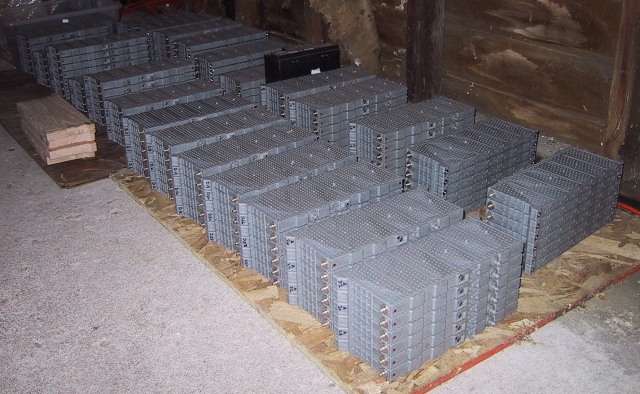
Cobasy's admits outright on their website that their large format batteries are produced for high volumes systems applications only. OEM only. This means that small companies like Tesla Motors, AC Propulsion, UEV, Commuter Cars could not buy these batteries, and niether could your EV hobbyist. GM and Ford could, as could other large automakers, but they refuse to make electric cars. Cobasys, in the links you gave, admits outright that there is no distribution network for these batteries. This is telling. The refusal of large automakers to produce EVs is very telling, and if you only sell to large automakers, the patent is effectively sat on in regards to EVs.

The people who have the patent aren't making them for non OEM uses. Unless you have a large company, which manufacturs their own goods that use this battery that can order in high volumes, you won't be able to get ahold of the 95 AH NiMH directly. You'll have to go to places like EV Bones, who may have scavenged them from crushed vehicles.

It's such a sad state of affairs.

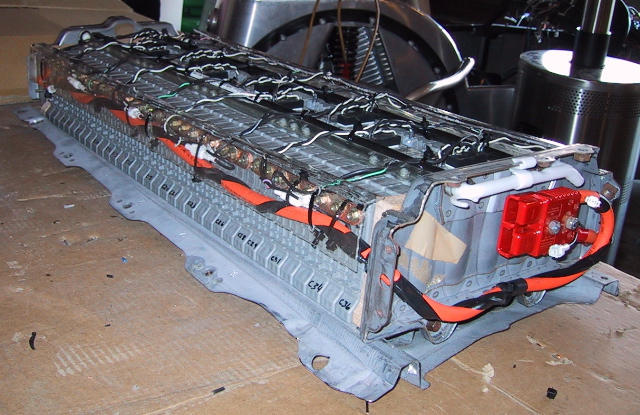
A pack of 28 of them would give my in-progress Triumph GT6 ~200 miles highway range. While they don't pack the power of AGMs, they would still allow 0-60 mph ~7 seconds with a Zilla 1k and a Netgain WarP 9" motor and ~120 peak horsepower from the combination, this acceleration assuming 2,400 pounds vehicle weight. If only there were a way to get ahold of them at a reasonable price.
Last edited by The_Toecutter on Thu 02 Nov 2006, 22:45:26, edited 1 time in total.
The unnecessary felling of a tree, perhaps the old growth of centuries, seems to me a crime little short of murder. ~Thomas Jefferson
User avatar
The_Toecutter
Intermediate Crude
Intermediate Crude
 
Posts: 2142
Joined: Sat 18 Jun 2005, 03:00:00

Re: Is Ovshinsky delusional?

Postby JRP3 » Thu 02 Nov 2006, 22:45:20

Yeah, pretty damn frustrating.

I wonder if evbones convinced them to sell them replacement batteries for their S-10s?

I also wonder if a bunch of Joe hobbyists got together and placed a group order if they'd sneak a shipment out the backdoor....
User avatar
JRP3
Tar Sands
Tar Sands
 
Posts: 768
Joined: Mon 23 Oct 2006, 03:00:00

Re: Is Ovshinsky delusional?

Postby The_Toecutter » Thu 02 Nov 2006, 22:53:05

$this->bbcode_second_pass_quote('', 'I') wonder if evbones convinced them to sell them replacement batteries for their S-10s?


Too small of a volume and not an OEM. Given the number of S10s scrapped, it is very likely that they got them from destroyed EVs. Perhaps I should call them and find out.

$this->bbcode_second_pass_quote('', 'I') also wonder if a bunch of Joe hobbyists got together and placed a group order if they'd sneak a shipment out the backdoor.


Perhaps if we got 5,000-10,000 individual people at once...

A bulk purchase by a few hundred hobbyists was done with Thundersky Li Ions, which got prices down to ~$400/kWh.

But Chevron is an entirely different animal. Thundersky wants EVs to prosper. Chevron doesn't.

All of these Joe hobbyists would have to guise themselves under some fictional corporation, and assuming one set of batteries per car and one or two cars per hobbyist, you'd need a lot of them.

Anyway, I found the following wikipedia quote interesting:

http://en.wikipedia.org/wiki/Battery_electric_vehicle

"In order to use NiMH batteries without violating Chevron's patents, hybrid automobile manufacturers are required to design vehicles which are at least 50% powered by gasoline; otherwise, they are limited to the use of "D" cell-sized NiMH ("small format") batteries."

Wonder how true it is?
The unnecessary felling of a tree, perhaps the old growth of centuries, seems to me a crime little short of murder. ~Thomas Jefferson
User avatar
The_Toecutter
Intermediate Crude
Intermediate Crude
 
Posts: 2142
Joined: Sat 18 Jun 2005, 03:00:00
Top

Re: Is Ovshinsky delusional?

Postby JRP3 » Thu 02 Nov 2006, 23:18:05

I was thinking along the lines of a large enough order to make it worth while but not large enough to draw attention. They have certainly dealt in smaller quantities before. 20 people each getting 8 batteries is 160 batteries.

Here they are actually bragging about the EV1 and S-10 performance:

$this->bbcode_second_pass_quote('', 'G')M EV1 Case Study

The first mass-produced electric vehicle (GM EV1) was powered by NiMH battery systems for a combined total of over 1,000,000 miles.
As a testimony to our strong heritage, our NiMH battery systems powered the first mass-produced EV electric vehicle – the GM EV1 – in 1996. Our NiMH battery systems have powered approximately 1000 GM EV1s for a combined total of 1,000,000 plus miles. Our NiMH battery systems have enabled the EV1 to have a real world range of 250 km. For another electric vehicle project, the Chevy S10 Pick-up Truck achieved a range of 110 to 130 km with full payload.


http://www.cobasys.com/solutions/featured_solutions.htm
User avatar
JRP3
Tar Sands
Tar Sands
 
Posts: 768
Joined: Mon 23 Oct 2006, 03:00:00
Top

Re: Is Ovshinsky delusional?

Postby oilfreeandhappy » Sat 04 Nov 2006, 09:45:44

I purged my files a few years back, but ECD is a publicly held company, and these records are available. I found this in a 1997 letter to shareholders, in reference to moving the NiMH production from Troy, MI, to a larger facility:
>The move to larger facilities will not only permit us to increase production but also will make the Troy facility available
for its original intended purpose, which is production process development and validation of cost- and weight-saving
advanced designs that will help us meet very aggressive cost targets. We expect Ovonic NiMH batteries to be equivalent in
cost (battery pack plus electricity to recharge) to the life-cycle fuel cost for an internal combustion engine powered vehicle,
while maintaining and improving all of their superior performance characteristics.

You can browse this site for more:
http://www.ovonic.com/ir_let_stock.cfm

There's also a link to Investor Relations. I'm sure they would send you older reports.

$this->bbcode_second_pass_quote('The_Toecutter', '')$this->bbcode_second_pass_quote('', 'I') owned Energy Conversion Devices stock through the 90s and into 2000, and followed all these developments fairly closely. The entire acquistion of Ovonics by Chevron through Texaco was a calculated plan to shelve this technology. I also recall Ovshinsky quotes in Shareholder packets, about the price of EV NiMH batteries going down dramatically, if mass produced.


Could you scan any of these by chance? Someone posted NiMH price versus volume on the EV list in the late 1990s and I came across it in a search about 2 years ago. $150/kWh in volume of 20,000 cars per year. But I only had that post, claiming this came from a slide that former ECD chairman Robert Stemple presented. I'd love to have a concrete source! The EV list would thank you many times over if you could find that.

$this->bbcode_second_pass_quote('', 'T')hanks for the info. I wasn't aware of the problems of small NiMH versus the larger units in EVs. This fills in another void in the puzzle. I often wondered why NiMH became available in the smaller sizes - cell phones, bicycle headlights, etc. It's because they could make a buck on the product with the small units, but hold the large battery price at too high of a level to compete with fossil fuels.


Ever read the EV world blog entry on this subject?

http://www.evworld.com/blogs/index.cfm?page=blogentry&blogid=104&authorid=51&archive=0

How about Remy Chevalier's article?

http://www.electrifyingtimes.com/hurryupandwait.html


I can also back up the info I earlier typed with sources, if you're interested. Below is the source to the original PDF file claiming $225/kWh in mass production and 1,750 cycles to 100% discharge for large AH NiMH. It is no longer active, however:

http://www.team-fate.net/technicalrepor ... Report.pdf

Google yields this cached link, containnig the same info:

Design and Development of the UC Davis FutureTruck

Check page 11:

"Analysis of existing battery life cycle data and consultation with industry experts indicates that mature NiMH technology should withstand approxamately 1,750 full discharges with an annual life exceeding seven to ten years."

Also of note:

"A cost of $225/kWh for large volume production (> 20,000 units) is favored by many analysts."

1,750 cycles to 100% discharge is a very long life!

A 200 mile range midsize car would in theory have a pack that lasts 350,000 miles before range is only 80% of the original rating. The electric motor and control system would last even longer.

Here is one of the earlier studies detailing the use of large AH NiMH in SCE's RAV4 EV fleet:

http://www.evchargernews.com/miscfiles/sce-rav4ev-100k.pdf

"Test data provide strong evidence that all five vehicles will exceed the 100,000-mile mark and SCE's positive experience points to a very strong likelihood of a 130,000 to 150,000-mile battery and drivetrain operational life."

This was in 2000. As of 2006, the most senior vehicles in the fleet are still chugging along at 150k miles.

The RAV4 EV had a 26 kWh pack. Hand made, it was like $30,000. If it were produced in high volume, at $225/kWh, it would be $5,850. At 150,000 miles life, this is a $.039/mile battery cost!

A larger pack will yield a disproportionately longer battery life, lowering cost.

Lets do a hypothetical cost comparision, between a gasoline powered RAV4 of 1999 model year, and an electric one assuming mass production of batteries. We'll use $2.10/gallon as the gasoline cost, $.10/kWh for electricity cost.


The gasoline version of the RAV4 gets 26 mpg combined and costs roughly $.04/mile to maintain. At $2.10/gallon, this is $.1208/mile fuel + maintenance.

The electric version of the RAV4 gets .4 kWh/mile from the electric outlet, costs $.01/mile in maintenance, and $.039/mile for battery. At $.10/kWh, this is $.089 electricity + battery + maintenance.


Over 150,000 miles, the electric version would save the operator $4,770 at today's gas and electricity prices. At $3.00/gallon, this savings jumps to $9,958. In $7.00/gallon Europe, assuming $.20/kWh electricity for Europe, this savings jumps to $25,835! That's a lot of coin in any of those cases.

The RAV4 EV would achieve cost parity with its gasoline counterpart at $1.27/gallon. Gas is never going to be this cheap again and hasn't been this cheap since 911. Any higher than $1.27/gallon, the electric car is cheaper to operate than its gasoline powered counterpart. Gas is currently a cheap $2.10/gallon, and will rise rapidly post election season or a few months after.

It becomes quite clear why the auto industry, oil industry, and governments of the world don't want us using EVs over gas cars and why they have stifled this alternative. There goes their huge profit margins and revenues.

The prospect of a dieoff from an oil shortage, resource wars, and internal strife does not bother them. They want their money first and foremost, and to hell with everyone else or the consequences of their actions.
Earth_Wind_and_Solar
User avatar
oilfreeandhappy
Lignite
Lignite
 
Posts: 318
Joined: Sun 29 Jan 2006, 04:00:00
Location: Colorado Springs, CO
Top

Re: Is Ovshinsky delusional?

Postby gg3 » Sun 05 Nov 2006, 06:27:12

Toecutter, check your PM inbox.
User avatar
gg3
Expert
Expert
 
Posts: 3271
Joined: Mon 24 May 2004, 03:00:00
Location: California, USA

Next

Return to Energy Technology

Who is online

Users browsing this forum: No registered users and 0 guests