$this->bbcode_second_pass_quote('', 'E')ven though Ovshinsky’s technologies would marginalize fossil fuels, the need for them wouldn’t be eliminated. “We’re not saying that oil is going to be irrelevant. It certainly has its place,” he says. “We’re not anti-anything. We want to solve problems with realistic solutions.”
So far, Ovshinsky has support from some unexpected places. For example, Texaco paid $67.3 million in May 2000 for a 20 percent stake in ECD Ovonics. (Texaco later merged with Chevron.) That investment allowed Texaco to work with ECD Ovonics on commercializing technologies such as its solid hydrogen storage and regenerative fuel cell. “They said: ‘Stan, we don’t want to change you. We want you to change us,’” Ovshinsky says.
Texaco’s conversion reflects Ovshinsky’s ability to sell renewable energy, even to those who’ve made their fortunes in oil. “He’s a visionary and a missionary,” says Frank Jamerson, a retired General Motors executive who’s known Ovshinsky for 30 years, and worked with him on electric vehicles in the 1990s. “He’s been inventing products that do exactly what I was hoping to do: eliminate fossil fuels, both with batteries and photovoltaics.”



PeakOil is You
Re: Is Ovshinsky delusional?
 by The_Toecutter » Fri 27 Oct 2006, 19:57:06
Delusional? Nah. The oilies having Ovshinski pussy-whipped is a more likely explanation for his words.
I'm sure you're aware of Chevron having control of the Ovonic NiMH battery, and sitting on it...
This is the battery that would allow 150 mile range EVs with no special attention to efficiency(200-300 miles or more with attention to efficiency), cost $220/kWh in mass production, has no capacity loss in cold weather, and could potentially outlast a car's chassis two times over. Shelf life of Nickel based batteries is usually in decades, and while typical NiMH do not last that long, Ovonics have so far proven their longevity.
The oil company doesn't want us driving EVs. This antiquated 1990s technology made them viable then. Ovshinski came up with it.
A few famous quotes of his, in italics:
"They tried to stop us from going to California. They threatened us! I said to them, ‘Look, the Communist Party no longer runs the world. A party line cannot be imposed upon people who don’t believe in it. The consortium is set up to make sure the American public has an electric car. It was not set up to fight the mandate. We are a battery company, and we’re not going to lie to the public.'" ~The Car That Could: The Inside Story of GM’s Revolutionary Electric Vehicle, by Michael Shnayerson, page 203.
The story behind the above quote is that basically Ovshinsky wanted to reveal at a conference the state of EV battery technology, and GM and the USABC threatened him. This battery had allowed a Solectria Force(a converted Geo Metro sedan) 180-200 miles range at 60 mph highway speeds in 1996. Theoretical life was at least 100,000 miles(later fleet studies by Southern California Edison shown no degridation, peak power loss, or capacity loss after 150,000 miles. Entire packs have yet to fail in their RAV4 EV fleet. Some think max life may be around 250,000 miles or so, but none of their EVs have been driven that long yet.)
Also interesting, about the USABC, Dan Sperling, PhD at the Institute of Transportation Studies at the University of California, noted that the automakers had repeatedly attempted to use the USABC to suppress information on and development of battery technology. He talked about Valence being forced by contract with GM not to reveal any battery technology advances.
"The people who are saying that battery technology isn’t ready are absolutely wrong. It’s part of the party line. It’s self-perpetuating. It’s very sad. You tell a lie big enough and long enough, and people start to believe it. The fact of the matter is volume. That’s the only reason batteries are the cost that they are."
When Ovshinsky made that quote, the NiMH did 50 Wh/kg specific capacity, 300 W/kg peak power, and > 800 cycle life to 100% discharge. For a 500 kg pack in a 170 Wh/mile car, this was viable for a 150 mile range EV with a pack life of 120,000+ miles and 200 peak battery horsepower. Voila, we have the NiMH EV1, more or less. Cost parity with gas cars at most, $1.30/gallon if everything was done ni similar volume, but since all the cars are crushed, we won't ever know. Te RAV4 EVs are a good basis to compare. Further, in mass production at the time, cost would have been $150/kWh in volume for 20,000 cars per year, but this was the 1990s. Today, cost would be closer to $220/kWh.
The newest generation of NiMH did 60 Wh/kg, 400 W/kg peak power, and UC Davis claims 1,750 cycles to 100% discharge.
Now we have Li Ion. It has much more power and far more range per unit weight, but so too is its cost higher and its longevity leaves more to be desired. To get Li Ion to be affordable for EVs, you will need a much greater production scale than Ovonic NiMH, making the barrier to entry that much more difficult to surpass(unless you are a big automaker with lots of money, but in that case, you probably don't want people driving EVs anyway). Li Ion is 400-500 cycles to 100% discharge, degrades 2-4% per year if properly managed, 500 W/kg of peak power, 150-180 Wh/kg specific capacity, and if produced in automotive volume, $250-300/kWh. If electronically managed properly, a Li Ion pack could feasibly last about 7 years or 100,000 miles, whichever comes first, before it only delivered 80% of its original range. In order for a mass produced Li Ion battery EV to compete with a gas car, gas needs to be at least $2.50/gallon.
Given the longevity of Ovonic NiMH, cost parity for that would be under $1/gallon gas, but studies that assumed 100,000 mile life and $150/kWh in mass production placed cost parity at $1.30/gallon. In reality, as the RAV4s are showing, these last well over 150,000 miles. While the RAV4s don't use Ovonics and instead Panasonics, the basic principle remains the same. Large size NiMH are far more robust than small size.
I'm sure you're aware of Chevron having control of the Ovonic NiMH battery, and sitting on it...
This is the battery that would allow 150 mile range EVs with no special attention to efficiency(200-300 miles or more with attention to efficiency), cost $220/kWh in mass production, has no capacity loss in cold weather, and could potentially outlast a car's chassis two times over. Shelf life of Nickel based batteries is usually in decades, and while typical NiMH do not last that long, Ovonics have so far proven their longevity.
The oil company doesn't want us driving EVs. This antiquated 1990s technology made them viable then. Ovshinski came up with it.
A few famous quotes of his, in italics:
"They tried to stop us from going to California. They threatened us! I said to them, ‘Look, the Communist Party no longer runs the world. A party line cannot be imposed upon people who don’t believe in it. The consortium is set up to make sure the American public has an electric car. It was not set up to fight the mandate. We are a battery company, and we’re not going to lie to the public.'" ~The Car That Could: The Inside Story of GM’s Revolutionary Electric Vehicle, by Michael Shnayerson, page 203.
The story behind the above quote is that basically Ovshinsky wanted to reveal at a conference the state of EV battery technology, and GM and the USABC threatened him. This battery had allowed a Solectria Force(a converted Geo Metro sedan) 180-200 miles range at 60 mph highway speeds in 1996. Theoretical life was at least 100,000 miles(later fleet studies by Southern California Edison shown no degridation, peak power loss, or capacity loss after 150,000 miles. Entire packs have yet to fail in their RAV4 EV fleet. Some think max life may be around 250,000 miles or so, but none of their EVs have been driven that long yet.)
Also interesting, about the USABC, Dan Sperling, PhD at the Institute of Transportation Studies at the University of California, noted that the automakers had repeatedly attempted to use the USABC to suppress information on and development of battery technology. He talked about Valence being forced by contract with GM not to reveal any battery technology advances.
"The people who are saying that battery technology isn’t ready are absolutely wrong. It’s part of the party line. It’s self-perpetuating. It’s very sad. You tell a lie big enough and long enough, and people start to believe it. The fact of the matter is volume. That’s the only reason batteries are the cost that they are."
When Ovshinsky made that quote, the NiMH did 50 Wh/kg specific capacity, 300 W/kg peak power, and > 800 cycle life to 100% discharge. For a 500 kg pack in a 170 Wh/mile car, this was viable for a 150 mile range EV with a pack life of 120,000+ miles and 200 peak battery horsepower. Voila, we have the NiMH EV1, more or less. Cost parity with gas cars at most, $1.30/gallon if everything was done ni similar volume, but since all the cars are crushed, we won't ever know. Te RAV4 EVs are a good basis to compare. Further, in mass production at the time, cost would have been $150/kWh in volume for 20,000 cars per year, but this was the 1990s. Today, cost would be closer to $220/kWh.
The newest generation of NiMH did 60 Wh/kg, 400 W/kg peak power, and UC Davis claims 1,750 cycles to 100% discharge.
Now we have Li Ion. It has much more power and far more range per unit weight, but so too is its cost higher and its longevity leaves more to be desired. To get Li Ion to be affordable for EVs, you will need a much greater production scale than Ovonic NiMH, making the barrier to entry that much more difficult to surpass(unless you are a big automaker with lots of money, but in that case, you probably don't want people driving EVs anyway). Li Ion is 400-500 cycles to 100% discharge, degrades 2-4% per year if properly managed, 500 W/kg of peak power, 150-180 Wh/kg specific capacity, and if produced in automotive volume, $250-300/kWh. If electronically managed properly, a Li Ion pack could feasibly last about 7 years or 100,000 miles, whichever comes first, before it only delivered 80% of its original range. In order for a mass produced Li Ion battery EV to compete with a gas car, gas needs to be at least $2.50/gallon.
Given the longevity of Ovonic NiMH, cost parity for that would be under $1/gallon gas, but studies that assumed 100,000 mile life and $150/kWh in mass production placed cost parity at $1.30/gallon. In reality, as the RAV4s are showing, these last well over 150,000 miles. While the RAV4s don't use Ovonics and instead Panasonics, the basic principle remains the same. Large size NiMH are far more robust than small size.
The unnecessary felling of a tree, perhaps the old growth of centuries, seems to me a crime little short of murder. ~Thomas Jefferson
-

The_Toecutter - Intermediate Crude

- Posts: 2142
- Joined: Sat 18 Jun 2005, 03:00:00
Re: Is Ovshinsky delusional?
by Mesuge » Sat 28 Oct 2006, 05:21:14
Toe> Exactly, I've seen in some EV1 related video with the electric car program manager at Edison speaking about their RAV4 fleet and how happy they are about the longevity of the NiMh packs etc..
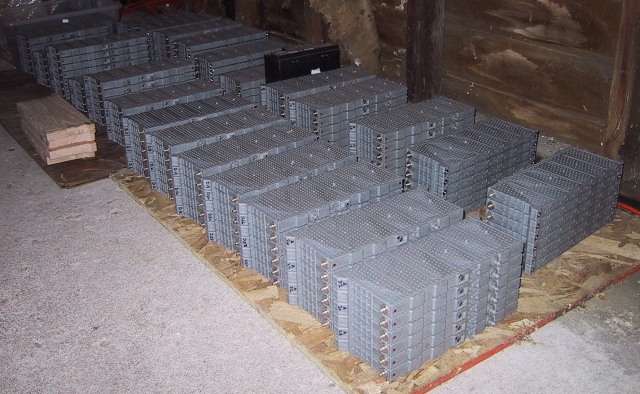
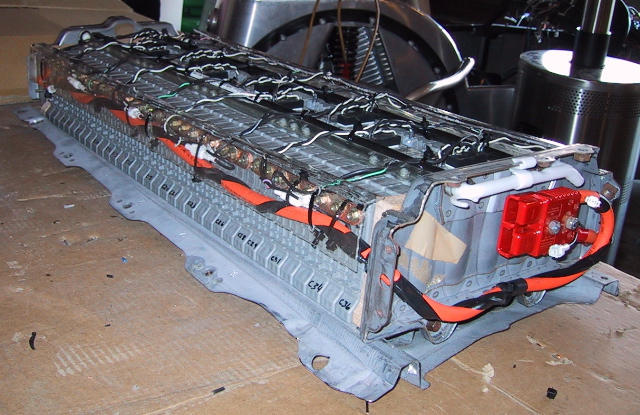
I'm wondering isn't there some way around the ban on high capacity NiMh batteries and so to speak possible to outfox the oily shills? Wouldn't be possible to get at least near the price/Wh performance by making hybridized paralel and serial batt. strings from smaller NiMhcells?
For instance, there have been some diy conversions and experiments using the smaller cells from scrapyard hybrids exactly in this fashion..

http://www.hackaday.com/2006/10/19/electric-7-ev/
EV NiMh Lotus 7 home page:
http://www.electric7.com/
About the NiMh pack, from this:
link to image
to this:
link to image
[url=http://www.electric7.com/IMG_2431.jpglink to image[/url]
details here:
http://www.electric7.com/construction.html
And don't forget to download the videos from the front page,
especially the second one - the onboard video with the humming
Siemens motor inverter combo inside, sounds like symphony..
I'm wondering isn't there some way around the ban on high capacity NiMh batteries and so to speak possible to outfox the oily shills? Wouldn't be possible to get at least near the price/Wh performance by making hybridized paralel and serial batt. strings from smaller NiMhcells?
For instance, there have been some diy conversions and experiments using the smaller cells from scrapyard hybrids exactly in this fashion..
http://www.hackaday.com/2006/10/19/electric-7-ev/
EV NiMh Lotus 7 home page:
http://www.electric7.com/
About the NiMh pack, from this:
link to image
to this:
link to image
[url=http://www.electric7.com/IMG_2431.jpglink to image[/url]
details here:
http://www.electric7.com/construction.html
And don't forget to download the videos from the front page,
especially the second one - the onboard video with the humming
Siemens motor inverter combo inside, sounds like symphony..
DOOMerotron: at all-time high [8.3] out of 10..
-

Mesuge - Heavy Crude

- Posts: 1500
- Joined: Tue 01 Nov 2005, 04:00:00
- Location: Euro high horse bastard on the run
Re: Is Ovshinsky delusional?
by JRP3 » Sat 28 Oct 2006, 09:42:36
$this->bbcode_second_pass_quote('The_Toecutter', '
')
I'm sure you're aware of Chevron having control of the Ovonic NiMH battery, and sitting on it...
')
I'm sure you're aware of Chevron having control of the Ovonic NiMH battery, and sitting on it...
Yes I've been peeling back the layers on this whole tragedy, (much thanks to you and your information), I just couldn't believe his comments. I guess they forced him to drink the coolaid.
It's really quite frustrating.
I'd start building my own EV tomorrow if these Ovonics were readily available, or some equivalent technology.
Maybe the new foam-lead acid battery will come into existence.
http://www.greencarcongress.com/2006/01 ... ergy_.html
-

JRP3 - Tar Sands

- Posts: 768
- Joined: Mon 23 Oct 2006, 03:00:00
Re: Is Ovshinsky delusional?
by JRP3 » Sat 28 Oct 2006, 09:58:06
$this->bbcode_second_pass_quote('Mesuge', '
')
I'm wondering isn't there some way around the ban on high capacity NiMh batteries and so to speak possible to outfox the oily shills? Wouldn't be possible to get at least near the price/Wh performance by making hybridized paralel and serial batt. strings from smaller NiMhcells?
')
I'm wondering isn't there some way around the ban on high capacity NiMh batteries and so to speak possible to outfox the oily shills? Wouldn't be possible to get at least near the price/Wh performance by making hybridized paralel and serial batt. strings from smaller NiMhcells?
My guess is that expense goes up quite a bit having to piece together all those smaller batteries.
Those packs do look interesting though.
-
JRP3 - Tar Sands
- Posts: 768
- Joined: Mon 23 Oct 2006, 03:00:00
Re: Is Ovshinsky delusional?
by The_Toecutter » Sat 28 Oct 2006, 15:18:51
$this->bbcode_second_pass_quote('', 'W')ouldn't be possible to get at least near the price/Wh performance by making hybridized paralel and serial batt. strings from smaller NiMhcells?
Not really. On small size NiMH, even the Chinese have difficulty getting below $400/kWh. Then you have the problem of battery regulation and cooling, which greatly adds to the cost and complexity for these packs. The smaller NiMH don't have the longevity of the larger size NiMH, and this is precisely why Toyota and Honda keep theirs below 90% state of charge at all times but above ~40% state of charge. They cannot deep discharge these like one would be able to do with the large size modules. NiMH batteries have to be specifically designed for EV use if they are going to be placed in an EV, otherwise they will have problems such as charge retention and overheating. HEV batteries don't have the same requireemnts as pure EV batteries, and thus they have been designed differently. Ovonic and Panasonic both designed proper batteries for EVs.
Cooling a bunch of small NiMH batteries itself is an expensive nightmare.
$this->bbcode_second_pass_quote('', 'F')or instance, there have been some diy conversions and experiments using the smaller cells from scrapyard hybrids exactly in this fashion.
That Lotus 7 replica is pretty famous on the EV list. But there's plenty of debate on whether or not the pack will last. I recall the vehicle only having 12 miles range due to each individual pack's built in management system preventing the state of charge from reaching certain levels, but I can't recall where I read that, so I may be wrong about that range number.
$this->bbcode_second_pass_quote('', 'M')y guess is that expense goes up quite a bit having to piece together all those smaller batteries.
Those packs do look interesting though.
So much so that Li Ion becomes far cheaper.
The unnecessary felling of a tree, perhaps the old growth of centuries, seems to me a crime little short of murder. ~Thomas Jefferson