Man invents 'world's most fuel-efficient car'
May 12 2006 at 07:44PM
London - A British inventor on Friday unveiled a car he claims is the world's most fuel efficient - capable of doing 12 875km per 4,5 litres (about 2 861km per litre).
Andy Green, 45, spent just £2 000 (R23 360) over two years creating the three-wheeled contraption in his spare time.
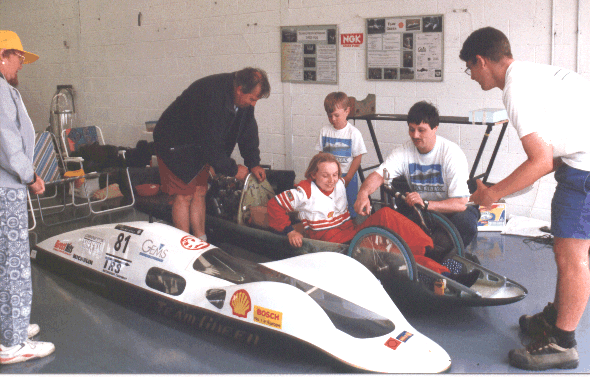
The car, named "TeamGreen", is 3,1m long and a mere 0,6m wide, weighing just 30kg.
"It's a labour of love," said Green, a technician in the mechanical engineering department of Bath University, south-west England.
'It's a labour of love'
"I think the car is important because it is a reminder to us all that the way to achieve fuel-savings is to drive lighter cars - it's the weight of this car that is the main reason for its fuel-efficiency," he said.
Green's car is powered by a single cylinder four-stroke engine with a capacity of just 35cc.
It will be the only British entry in a global competition in France later this month to decide the world's most fuel-economic car.
The winner of the Shell Eco-Marathon championships will be the car that runs the longest on an average speed of 30km/h.
Two women, chosen for their slight frames, have been selected to drive the Briton's invention for the three-day event.
Green is already a seasoned inventor of environmentally friendly cars, of which "TeamGreen" is his fourth.
He holds the British record for fuel-efficiency, having achieved 6 603 miles to the gallon in one of his previous cars. - Sapa-AFP



PeakOil is You
British Inventor Unveils 8000 MPG Car
8000 mpg car
 by MyOtherID » Fri 12 May 2006, 23:12:27
-

MyOtherID - Lignite

- Posts: 343
- Joined: Thu 02 Mar 2006, 04:00:00
- Location: Vegas, America's cloaca
Re: 8000 mpg car
by MyOtherID » Fri 12 May 2006, 23:15:18
This makes me think that with the right tech, we can move peak oil out a long way. And these cars should be cheap! A lot of Murkans are going to have to go on crash diets ...
[web]http://news.scotsman.com/scitech.cfm?id=714682006[/web]
[web]http://news.scotsman.com/scitech.cfm?id=714682006[/web]
-
MyOtherID - Lignite
- Posts: 343
- Joined: Thu 02 Mar 2006, 04:00:00
- Location: Vegas, America's cloaca
Re: 8000 mpg car
by lutherquick » Fri 12 May 2006, 23:25:49
Now if the US Army could use this car while invading IraN, or Venezuela, you know? for democracy... then GM could mass produce these things... call it maybe the "Hommer"... or "Homvee"
That's the only way Americans would buy it... If marketing showed bodies, piles of Iranian children, driven over by this "Team Green" Hommer...
And the first one could be the H4...
That's the only way Americans would buy it... If marketing showed bodies, piles of Iranian children, driven over by this "Team Green" Hommer...
And the first one could be the H4...
-

lutherquick - Tar Sands

- Posts: 529
- Joined: Fri 04 Feb 2005, 04:00:00
- Location: NJ
Re: 8000 mpg car
by Dukat_Reloaded » Fri 12 May 2006, 23:38:06
1 litre for 8,000km, that is amazing. Basicly if we begin using those cars, oil is going to drop to 0.
-

Dukat_Reloaded - Tar Sands
- Posts: 953
- Joined: Sun 31 Jul 2005, 03:00:00
British Inventor Unveils 8000 MPG Car
by BillKTurner » Sat 13 May 2006, 00:19:46
http://www.allheadlinenews.com/articles/7003538016
British Inventor Unveils 8000 MPG Car
May 12, 2006 2:18 p.m. EST
Julie Farby - All Headline News Staff Writer
London, England (AHN)—A British inventor unveils the world's most fuel-efficient vehicle, a three-wheel “TeamGreen” car capable of doing 8,000 miles to the gallon.
The 45-year-old inventor, Andy Green, from the University of Bath, built his budget eco-motor for just £2,000, and will be the sole British contender for the title of the world's most fuel-economic car in a global competition being held later this month.
It has taken Mr. Green more than two years to design and build the car, which will be the fourth eco-vehicle he has built. He holds the British record for fuel-efficiency, with 6,603 miles to the gallon in a previous car.
According to the report, the new vehicle is powered by a single cylinder four-stroke engine with a capacity of just 35cc and runs with a special management system incorporating fuel injection.
A spokesman for Bath University says, "Andy Green is keeping the spirit of the lone British inventor who takes on the world very much alive."
{merged}
British Inventor Unveils 8000 MPG Car
May 12, 2006 2:18 p.m. EST
Julie Farby - All Headline News Staff Writer
London, England (AHN)—A British inventor unveils the world's most fuel-efficient vehicle, a three-wheel “TeamGreen” car capable of doing 8,000 miles to the gallon.
The 45-year-old inventor, Andy Green, from the University of Bath, built his budget eco-motor for just £2,000, and will be the sole British contender for the title of the world's most fuel-economic car in a global competition being held later this month.
It has taken Mr. Green more than two years to design and build the car, which will be the fourth eco-vehicle he has built. He holds the British record for fuel-efficiency, with 6,603 miles to the gallon in a previous car.
According to the report, the new vehicle is powered by a single cylinder four-stroke engine with a capacity of just 35cc and runs with a special management system incorporating fuel injection.
A spokesman for Bath University says, "Andy Green is keeping the spirit of the lone British inventor who takes on the world very much alive."
{merged}
-

BillKTurner - Wood
- Posts: 3
- Joined: Fri 28 Apr 2006, 03:00:00
Re: British Inventor Unveils 8000 MPG Car
by NeoPeasant » Sat 13 May 2006, 00:34:15
No one posted a pic. Doesn't matter, these cars are all recumbent tricycle looking thingies with pencil thin solid tires. They run the test on glass smooth indoor bicycle tracks. They fire the motor for one or two power strokes, coast as long as possible, then repeat.
It's a stunt that has no meaning for real world vehicles.
It's a stunt that has no meaning for real world vehicles.
The battle to preserve our lifestyle has already been lost. The battle to preserve our lives is just beginning.
- NeoPeasant
- Heavy Crude

- Posts: 1003
- Joined: Tue 12 Oct 2004, 03:00:00
Re: British Inventor Unveils 8000 MPG Car
by MyOtherID » Sat 13 May 2006, 01:00:49
[web]http://staff.bath.ac.uk/ensajg/tg/[/web]
-
MyOtherID - Lignite
- Posts: 343
- Joined: Thu 02 Mar 2006, 04:00:00
- Location: Vegas, America's cloaca
Re: British Inventor Unveils 8000 MPG Car
by MyOtherID » Sat 13 May 2006, 01:08:56
$this->bbcode_second_pass_quote('NeoPeasant', 'N')o one posted a pic. Doesn't matter, these cars are all recumbent tricycle looking thingies with pencil thin solid tires. They run the test on glass smooth indoor bicycle tracks. They fire the motor for one or two power strokes, coast as long as possible, then repeat.
It's a stunt that has no meaning for real world vehicles.
It's a stunt that has no meaning for real world vehicles.
Not quite, Kuntsler.
$this->bbcode_second_pass_quote('TeamGreen', 'T')he rules specify that each team should construct a vehicle capable of covering a 5 or 10 mile course at a minimum average speed of 15 miles per hour.
The vehicle is allowed to accelerate using the engine and then to coast with the engine switched off - provided that the vehicle maintains the 15 mph average or greater.
$this->bbcode_second_pass_quote('', 'I')t's a stunt that has no meaning for real world vehicles.
What is a "real world vehicle"? For me it is one that gets me from A to B. With vehicles like this, the road danger would be minimal and we could all have our own cars, even children.
-
MyOtherID - Lignite
- Posts: 343
- Joined: Thu 02 Mar 2006, 04:00:00
- Location: Vegas, America's cloaca
Re: British Inventor Unveils 8000 MPG Car
by pea-jay » Sat 13 May 2006, 01:30:45
Holy F***ing moly. That car has hummer road kill written all over it. I dont think the driver knew what he hit if he hit one of those things. Like other people have said, there is little to no practical application for this technology. Personal vehicles are the size they are because we are the size we are. Either we figure out how to make appropriate sized vehicles that can be powered without petroleum or we will simply do with out. Unless there is another british inventor out there that has figured how to shrink humans to one sixth their original height, this is not the future of automobiles.
Now on the other hand, I'd love to see the reaction on fans faces if a whole bunch of thes vehicles were substituted in as "racecars" at a NASCAR racing event. The only deafening noise to be heard would be the boos and jeers as these vehicles ambled and coasted by on their one glorious cylinder's worth of automotive achievement. That would be priceless.
Now on the other hand, I'd love to see the reaction on fans faces if a whole bunch of thes vehicles were substituted in as "racecars" at a NASCAR racing event. The only deafening noise to be heard would be the boos and jeers as these vehicles ambled and coasted by on their one glorious cylinder's worth of automotive achievement. That would be priceless.
UNplanning the future...
http://unplanning.blogspot.com
http://unplanning.blogspot.com
-

pea-jay - Heavy Crude
- Posts: 1547
- Joined: Sat 17 Jul 2004, 03:00:00
- Location: NorCal
Re: British Inventor Unveils 8000 MPG Car
by MyOtherID » Sat 13 May 2006, 01:53:29
How to deal with this rubbish?
$this->bbcode_second_pass_quote('pea-jay', 'H')oly F***ing moly. That car has hummer road kill written all over it. I dont think the driver knew what he hit if he hit one of those things.
$this->bbcode_second_pass_quote('pea-jay', 'H')oly F***ing moly. That car has hummer road kill written all over it. I dont think the driver knew what he hit if he hit one of those things.
Hummers are like Dodo birds. When you see a Hummer, stop and regard it with awe, for your grandchildren will never see one rolling, only standing mutely in a museum.
$this->bbcode_second_pass_quote('pea-brain', 'L')ike other people have said, there is little to no practical application for this technology. Personal vehicles are the size they are because we are the size we are. Either we figure out how to make appropriate sized vehicles that can be powered without petroleum or we will simply do with out.
Codswallop! I know plenty of people who just want to get their bums from one point to another, without having to pedal. You remind me of the idiotic right-wing talk show hosts in America who froth at the mouth when anyone suggests SUVs are unnecessary.
Your response is actually sickening, showing an appalling lack of imagination, a typically American resistance to change (how about using the metric system, you f-wits?), and the familiar quasi-religious commitment to doomerism.
-
MyOtherID - Lignite
- Posts: 343
- Joined: Thu 02 Mar 2006, 04:00:00
- Location: Vegas, America's cloaca



 200% reduction means we would actually make an extra 100%. A little critical thinking is required here I believe. From my reading it's 70 - 80% of all fossil fuels is used for transport. So a reduction of 80% would mean total and complete conversion to alternatives. Not likely (within the next 15 years) me thinks.