Donate Bitcoin

Donate Paypal


PeakOil is You

PeakOil is You

THE Petrodollar Thread (merged)

Discussions about the economic and financial ramifications of PEAK OIL

Re: Petrodollars - is this how it works?

Postby Doly » Wed 26 Apr 2006, 03:57:45

About salaries in the US: the claim that average salaries haven't risen in the last 20 years applies to unskilled workers. See http://bernie.house.gov/economy/today.asp

The problem seems to be that the wage gap between rich and poor people in the US is increasing. So, Mr Bill, you may not be entirely correct in the claim that Americans are getting wealthier as a whole. But, clearly, the rich doesn't mean only the super-rich in these statistics. Middle-class families have been doing better.
User avatar
Doly
Expert
Expert
 
Posts: 4370
Joined: Fri 03 Dec 2004, 04:00:00

Re: Petrodollars - is this how it works?

Postby MrBill » Wed 26 Apr 2006, 04:04:20

$this->bbcode_second_pass_quote('Doly', 'A')bout salaries in the US: the claim that average salaries haven't risen in the last 20 years applies to unskilled workers. See http://bernie.house.gov/economy/today.asp

The problem seems to be that the wage gap between rich and poor people in the US is increasing. So, Mr Bill, you may not be entirely correct in the claim that Americans are getting wealthier as a whole. But, clearly, the rich doesn't mean only the super-rich in these statistics. Middle-class families have been doing better.


Yes, the donut effect, and it is serious because stable countries have a large, prosperous middle class, to give the lower classes (I do not mean than condescendingly) something realistic to aspire to, and provide a buffer between the rich and the poor that is good for the wealthy as well.


I will not even start to defend the greed of the super rich or the growing wage gap between highly paid CEOs and hourly earners. That is too much even for me. I can only hope that unadulterated greed must generate its own set of rewards?Greed is Good
The organized state is a wonderful invention whereby everyone can live at someone else's expense.
User avatar
MrBill
Expert
Expert
 
Posts: 5630
Joined: Thu 15 Sep 2005, 03:00:00
Location: Eurasia

Re: Petrodollars - is this how it works?

Postby grabby » Wed 26 Apr 2006, 07:32:45

It is our job to elect people who will punish the rich this next election.
that oughta teach us!
(course I'll loose my job)
User avatar
grabby
Heavy Crude
Heavy Crude
 
Posts: 1291
Joined: Tue 08 Nov 2005, 04:00:00

Re: Petrodollars - is this how it works?

Postby SoothSayer » Thu 04 May 2006, 11:38:29

As the poster of the original questions, I can only say that aftre 14 replies I am still confused.

I have heard that the USA gains special leverage through all oil being sold in US dollars ... so I was looking for a Kinder-Garten explanation for morons.

Sadly I am now even more confused. I am sure that M1, M2, M3 stats etc are all vital to the world economy ... but I still don't know what the very simple "trick" behind petrodollars is.

Oh well, I'll have to order that book from Amazon ...
User avatar
SoothSayer
Heavy Crude
Heavy Crude
 
Posts: 1167
Joined: Thu 02 Mar 2006, 04:00:00
Location: England

Re: Petrodollars - is this how it works?

Postby Petrodollar » Thu 04 May 2006, 13:36:29

SoothSayer,
Still confused by all the verbiage? No problem, I'll list 4 macroeconomic effects of petrodollar recycling (but fully explaining these issues will require more time than I have at the moment, so I'll edit this post as time permits);

I. Currency Risk/Currency Exposure (esp. when OPEC prices oil in a currency band of $22-28 - which obviously has given way in part due to Peak Oil and in part due the dollar devaluation relative to the euro and other major currencies in the wake of the 2001 tax cuts and subsequent Iraq War). What do I mean by currency risk?

Well, let's examine recent history. Americans are mostly ignorant of the dramatic effects of currency risks and the reasons for higher gasoline (or petrol) prices in Europe. Very high fuel prices in the autumn of 2000 occurred when the relatively new euro was at its historic low against the dollar (one euro was worth about 82 cents, a tremendous fall from the euro at 1.17 when it was lauched in Jan 1999).

The French, Germans, Spanish, Greeks, and related eurozone nations not only experienced an increase in fuel prices due to a dip in oil production, but they also felt the brutal effects of currency risk caused by the euro’s relatively low valuation.

The situation in Western Europe during September 2000 was in many ways reminiscent of the fuel crisis in the US of 1973–1974 and 1979-1980. Indeed, the European economy nearly ground to a halt, and there were strong civil protests over the high gasoline/petrol prices. The crisis lasted only a few days but nearly led to violence. In France, fishermen blockaded ports on the English Channel because their fuel costs had doubled, even though their fuel was already tax free. Schools were closed, hospitals were put on red alert, and supermarkets started rationing bread.

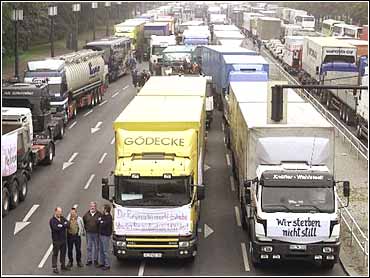
Transportation came to a near standstill in much of Western Europe. CBS News reported how events unfolded in Germany and elsewhere within the eurozone,

$this->bbcode_second_pass_quote('', 'T')housands of truckers from across Germany clogged the streets around the capital’s center Tuesday demanding relief from higher gas prices. And they got some when the government offered low-interest loans to some trucking companies. …The protest is the biggest so far in Germany, on the heels of demonstrations that halted traffic in France, Britain and Spain before easing in recent days. Elsewhere Tuesday, minor blockages continued in Spain, where markets ran out of fish, and Greek motorists fearing for shortages due to trucker strikes lined up for gas.


Protests also erupted in France where thousands of farmers drove their tractors into Paris as a sign of their displeasure at the rapid increase in fuel prices. This resulted in the deployment of French riot police. News reports of the economic fallout also included disruptions in the UK, Spain, and Greece.

Here are some pictures/articles of what oil currency risk looked like in the eurozone circa Sept 2000...
ImageImage

“German Truckers Fume over Fuel Prices,” CBS News, September 26, 2000, http://www.cbsnews.com/stories/2000/09/ ... 3748.shtml.

“Fuel protests continue across Europe,” BBS News, September 13, 2000, http://news.bbc.co.uk/1/hi/world/europe/921456.stm

"Pumps Run Dry Amid Fuel Protests," CNN News, September 4, 2000, http://edition.cnn.com/2000/WORLD/europ ... index.html

The price of gas in the US only went up about 15 cts. However, at the time, the euro was beginning its widespread use, but its value had fallen sharply in 2000 relative to the US dollar, and the EU’s currency risk for their imported oil was dramatic - an almost doubling of their gasoline prices.

Here's one more simple hypothetical example. Let's say Japan wants to import 1 million barrels of oil per month this year. Lets assume the price on the NYMEX or IPE is $70 per/bl. So, Japan will spend $70,000,000 (or $70 million) per month for imported oil. If the Japanese yen depreciates 10% relative to the dollar over a given month, then the real cost of importing oil into Japan goes up by a commensurate 10%. (The real or realized imported oil bill now becomes $77,000,000 per month - an increase of $7 million - and this is due simply to the fact that the dollar is the monopoly "unit of account" or price, for international oil trade).

Assuming they still want and/or need to import 1 million/bls per month, Japan has 2 or perhaps 3 non-violent choices in order to achieve this goal. One, they can buy up 10% more (petro)dollars (i.e. typically US treasuries) by printing 10% more yen - but that is inflationary for the yen and would create even more depreciation pressures against the yen. Option #2 is sell the US more goods and services that total up to $7 million in order to acquire those currency reserves in dollars (i.e. lots of Honda automobiles, Sony TVs, etc.).

The Japanese could also try a combination of options #1 and #2, but the point of this simplistic scenario is to illustrate how currency risk/exposure regarding international oil trades in a monopoly petrocurrency effects the petrodollar's demand/liquidity value - and how a "strong dollar" can become painful for country with a "weak currency" regarding imported oil. Obviously, the dollar, as the world's reserve currency, is of supposed to be a "strong currency."

Since the G.W. Bush administration came to power with its irresponsible/ideological $1.7 trillion dollar tax cuts, the dollar has lost a lot of value relative to other major currencies. As in the past, the dollar is again being challenged in the oil pricing arena, but everytime this happens it appears that Saudi Arabia has squashed such proposals with OPEC - apparently with US insistence. Here's a 2003 UK Observer article that addresses this pattern:

$this->bbcode_second_pass_quote('', ''')At various points in time since the early 1970s, oil producers have discussed this, especially in periods when the dollar has been weak. Opinions have tended to be wide-ranging, depending on the strategic and trade alliances certain members have with particular trade blocs,' said Yarjani.

That was an elliptical reference to the overwhelming influence of Saudi Arabia, whose government is the staunchest ally of the US within Opec.

'The Saudis are holding the line on oil prices in Opec and should they, for example, go along with the rest of the Opec people in demanding that oil be priced in euros, that would deal a very heavy blow to the American economy,' Youssef Ibrahim, of the influential US Council on Foreign Relations, told CNN.

Last year the former US Ambassador to Saudi Arabia told a committee of the US Congress: 'One of the major things the Saudis have historically done, in part out of friendship with the United States, is to insist that oil continues to be priced in dollars. Therefore, the US Treasury can print money and buy oil, which is an advantage no other country has. With the emergence of other currencies and with strains in the relationship, I wonder whether there will not again be, as there have been in the past, people in Saudi Arabia who raise the question of why they should be so kind to the United States.


Indeed, returning to the Japanese hypothetical, there is theoretical 3rd option: The Japanese could also lobby OPEC again for what Kuwait was considering back in 1978 - oil pricing in three currencies: dollar, yen and German mark. {note: In 1973 OPEC floated a proposal that involved a basket of 12 currencies - which would have been difficult to implement - but not impossible}[/i] Of course these discussions within OPEC prompted the US Secretary of the Treasury (Blumenthal) to fly over to Saudi Arabia and personally intervene by getting Saudi Arabia to squash this proposal within OPEC - the quid pro quo was Saudi getting I beleive a 325% increase in voting power within the IMF....(Spiro's book actually discusses the declassified "talking points" of this meeting b/t the US and Saudi Arabia).

I suppose the fourth option (the violent policy choice) would be to invade an oil-rich country and simply take their oil, but the Japanese tried that in WWII and it did not turn out too well for them by 1945. (A couple of weeks after Pearl Harbor in Dec. 1941, the Japanese invaded and captured the giant oil fields of the Dutch East-Indies - present day Indonesia).

Of course the US has long been immune to currency risk (when OPEC sold oil in a price band of $22 to $28 ), and the result to the average Joe is cheap gas prices, which we now consider an inalienable right. This segues into the 2 major effect of monopoly petrodollar recycling...

II. Taxation policies on petrol/gasoline sales with and without currency risk (US vs. the rest of the G7 or G10). Most folks don't make this connection, but their are a couple of reasons why gasoline is taxed much higher in Europe and Japan, and it has nothing to do with taxation "ideology," something to do with building mass transit with oil tax revenue, and a lot to do with the macroeconomics surrounding a vital imported product whose unit of account (price) is in dollars only - oil.

Indeed, the lack of currency risk is one of the reasons why taxes on gasoline are much lower in the United States than in most other countries. The average world price for a gallon of gasoline in 2004 was about $5, or nearly 60% higher than typical US prices. Higher gasoline taxes in the EU and elsewhere provides a cushion for that nation’s currency risks for its imported oil and energy purchases.

Without this, a country could experience wild swings in daily prices at the gas pump due to fluctuations in its domestic currency’s valuation relative to the dollar on the volatile international currency market. If oil became priced in a basket of currencies, the US government would ultimately have to do what other industrialized nations have done, increase taxes on gasoline in order to mitigate wild fluctuation in price/currency risk that would lead to societal discord. This important economic/taxation effect is often overlooked by stateside commentators when discussing the US benefits stemming from the monopoly petrodollar pricing system for global oil trade.

Turning again to recent history: How did Europe resolve the fuel crisis of September 2000? Simple, their respective parliaments temporarily lowered the taxation levels of petrol sales in order to stabilize the oil price back to near the previous level. The eurozone governments reduced some of its own revenue stream in order to prevent the outbreak of more societal discord/rioting. (pic. of French farmers and their tractors that had invaded Paris and the subsequent deployment riot police circa Sept 15, 2000)

Image

Politicians usually like to stay in power as long as possible...but at that point the situation morphed into a phase that I call petrodollar warfare...

After this crisis, European governments appear to have sought strategies to mitigate future economic crises and potential rioting that stems from oil currency risk. Right about this time a guy named Saddam Hussein opened up a euro-denominated bank account with the French bank BNP Paribas. He announced shortly thereafter that all oil exports from his country were to paid in euros, not dollars. Here's an excellent UK-based article that discusses the "quasi-state secret" about Saddam's switch to the euro - which over the past 5 years has only been mentioned once the mainstream US media (April 2003):

When will we buy oil in euros? (Feb 23, 2003)
http://observer.guardian.co.uk/business ... 67,00.html

$this->bbcode_second_pass_quote('', 'L')ast year Russia entered into negotiations with Germany over the establishment of an exchange to sell oil futures denominated in euros. Russia, which on some measures is the world's Number 1 oil producer at the moment, is awash with petrodollars, but trades mainly with Europe. Russia's foreign exchange holdings recently reached an all-time high of $50bn.

At the moment, European consumers are benefiting from the link between oil and the dollar. The euro's surge has, in effect, paid for much of the increase in the price of oil. This, however, is just the flipside of the very high prices in France and Germany in Autumn 2000, which were a combination of a very weak euro and high oil price. US consumers have no such additional worries, as there is no currency risk.

So there is a huge list of potential winners from a move to price oil in euros, but movement remains slow.


Saddam had no control over the destination of his oil sales under the UN administered Oil-for-Food program (most of the oil was bought by the US), but the UN did allow him to change to a euro-based payment system. {note: The US bought about 64% of Iraq's oil exports from 2001 to Feb 2003, but Exxon et al had to make those trades in euros - not dollars}. In the meantime, in June 2001, the EU Parliament adopted a formal policy that asked OPEC and non-OPEC to begin preparations for oil transaction in euros.

$this->bbcode_second_pass_quote('', '')The European Parliament … calls on the EU, in dialogue with the OPEC and non-OPEC countries, to prepare the way for payment for oil in euros.”

— European Parliament resolution on the Communication from the Commission on the European Union’s oil supply, June 14, 2001


Why? Again, its currency risk. Here's what OPEC observed 4 years ago:

$this->bbcode_second_pass_quote('', '')...From the EU’s point of view, it is clear that Europe would prefer to see payments for oil shift from the dollar to the euro, which effectively removed the currency risk...

...In the long-term, perhaps one question that comes to mind is could a dual system operate simultaneously? Could one pricing system apply to the Western Hemisphere in dollars and for the rest of the world in euros .... Should the euro challenge the dollar in strength, which essentially could include it in the denomination of the oil bill, it could be that a system may emerge which benefits more countries in the long-term."

— Javad Yarjani, Head of OPEC’s Petroleum Market Analysis Department, in a speech to Spanish officials, April 2002


The governments of both highly developed countries and less developed countries don’t like currency risk for their vital oil imports, and those pesky Europeans thought that the euro would make a nice alternative oil transaction currency. Of course the US/UK military-industrial-petroleum-banking nexus did not approve of Saddam awarding most of Iraq's oil and gas field exploration over the French, Russians and Chinese firms via PSA contracts from 1997 to 2000, and the petroeuro switch was the final straw that required "regime change" and a pliant/pro-US gov't in Iraq.

So, these powerful interests likely asked their spokespersons (G.W. Bush/Cheney & Tony Blair) back around Christmas 2000 to do something about this euro encroachment into the crucial oil transaction market via the Iraq dictator...and at Bush's very first National Security meeting in Jan. 2001 topic #1 was how to get Saddam...

Indeed, there are indications that the Iraq War was a forceful way to deliver a message to OPEC and other oil producers: do not attempt to shift from the petrodollar to a petroeuro system. William Engdahl’s conversation with a forthright London-based banker after Baghdad became under US control is quite enlightening:

$this->bbcode_second_pass_quote('', 'I')nformed banking circles in the City of London and elsewhere in Europe privately confirm the significance of that little-noted Iraq move from petrodollar to petroeuro. ‘The Iraq move was a declaration of war against the dollar,’ one senior London banker told me recently. ‘As soon as it was clear that Britain and the US had taken Iraq, a great sigh of relief was heard in London City banks. They said privately, “now we don’t have to worry about that damn euro threat.”


III. International Demand/Liquidity Value of a monopoly petrocurrency and associated effects on issuer nation to expand both domestic credit and export inflation to the world.

Here's how Dr. Spiro summarized the effects of petrodollar recycling following the 1974 agreement with Saudi Arabia to price and conduct oil transactions in the dollar, which was formally adopted by the rest of OPEC in 1975:

$this->bbcode_second_pass_quote('', 'S')o long as OPEC oil was priced in US dollars, and so long as OPEC invested the dollars in US government instruments, the US government enjoyed a double loan. The first part of the loan was for oil. The government could print dollars to pay for oil, and the American economy did not have to produce goods and services in exchange for the oil until OPEC used the dollars for goods and services. Obviously, the strategy could not work if dollars were not a means of exchange for oil.

The second part of the loan was from all other economies that had to pay dollars for oil but could not print [US petro] currency. Those economies had to trade their goods and services for dollars in order to pay OPEC. Again, so long as OPEC held the dollars rather than spending them, the US received a loan. It was therefore important to keep OPEC oil priced in dollars at the same time that the government officials continued to recruit Arab funds.


This arrangement has been working for 3 decades, and now the US gov't/Fed Reserve has become overly dependent on this subsidy while it allowed the real US economy (manufacturing) to unfortunately become rather hollowed-out. Do not underestimate the international demand/liquidity value for dollars due to its petrocurrency status. This macroeonomic effect is illustrated by the huge increase in the price of oil from 2002 to 2005 — and a commensurate increase in dollar holdings by foreign banks — despite the Federal Reserve’s abnormally low interest rates during most of this time period. In 2006, international investment analyst Jephraim P. Gundzik noted this important macroeconomic phenomenon in the Asia Times,

$this->bbcode_second_pass_quote('', 'A')s of mid-2005, foreign investors, including foreign central banks, held an estimated $6.6 trillion worth of US bonds and equities, up from less than $4 trillion in mid-2002. About 60% of this money is parked in long-term US Treasury, agency and corporate bonds. The rapid and sustained increase of international oil prices is the main factor behind the growth in foreign holdings of US securities and the external supply of dollars used to purchase these securities.

What does this demand allow the US to do? Well, petrodollars are currently funding almost half of the massive US current account deficit. The 2005 current account deficit was $805 billion, or about $2.2 billion per day. What is the effect of petrodollar flows? About $1 billion per day, 365 days per year. This issue was acknowledged recently in Business Week...

$this->bbcode_second_pass_quote('', '[')Unlike the 1970s oil boom] "Arab states are now major buyers of goods from Japan, China, and the rest of Asia, where they sell the bulk of their oil. So these petrodollars get recycled as Japanese yen or Chinese yuan - which the Japanese and Chinese governments convert into U.S. Treasuries. Indirectly, then, oil money is bankrolling U.S. deficit spending. Paul Donovan, a global economist for UBS Investment Bank in London, estimates that petrodollars, mostly channeled through Asia and Europe, are funding up to 45% of the U.S. current account deficit."

Stanley Reed, "The New Middle East Oil Boom, "Business Week, March 13, 2006, page 36.

IV. World Reserve Currency Designation (complicated subject but just to paraphrase a friend of mine at the US Treasury:

"The dollar could lose it petrocurrency status and still remain the world reserve currency (due to IMF loans in the dollar), but it would not be a currency of much value." - Anonymous

...and that is not as far fetched as it sounds...

http://archives.tcm.ie/businesspost/200 ... ry2097.asp

$this->bbcode_second_pass_quote('', '')Dollar may lose its reserve status

Sunday, February 06, 2005 - By Matthew Lynn


(exerpt)
....Asian nations may or may not end their dollar pegs. But politics as much as economics will play the main role in those decisions.

That leaves commodity prices. If the dollar's unique status is indeed coming to an end, that is where we will see it first.

"It is crucial to the dollar's dominant role as a reserve currency that dollar pricing of oil should continue

— Stephen Lewis, economist at London-based Monument Securities, 2005

...and here's some more food for thought...

$this->bbcode_second_pass_quote('', 'I')t is too early to conclude that the dollar is finished, yet the challenge is real and growing. The world may well be set for a period during which the dollar and the euro compete for reserve status - hardly a promising situation for global stability.

The dollar is being shunned for obvious reasons. The trade deficit grew to a record $609 billion last year, and George W Bush's administration expects the budget shortfall to reach a record $427 billion in the year ending in September.

The New York Board of Trade's Dollar Index, which measures the dollar against a basket of six currencies, has dropped 18 per cent since the end of 2001.

...a little more info re commodity pricing...

$this->bbcode_second_pass_quote('', 'C')ommodity pricing also matters to the currency markets. The fact that commodities are priced in dollars is one of the key sources of that currency's strength. Everyone buying big-ticket items such as oil, metals or aircraft must buy dollars for their purchases. That is a major source of demand for the currency.

Who will be the first to break ranks? Russian oil must be one candidate - most of it is sold in Europe anyway. Airbus aircraft must be another - the bulk of its costs are in euros, and it has the luxury of now being the dominant producer in its industry....

Decline or rout?

True enough. You need to hold a very strong market position to impose a new currency on your industry.

Much depends on the future path of the dollar. It has been weak for about three years now. So far, producers have responded with higher prices.

Two more years of dollar weakness and they may well decide to take more radical action.


It will only take one commodity producer to break ranks for the move to be widely imitated. At that point, the dollar's decline could well turn into a rout. Commodity pricing is now the weakest line of dollar defence..

Final thoughts

The only book that really explains the secretive and extraordinary lengths the US Treasury went through in 1973-1974 and again in 1978 to keep oil transactions priced and conducted in dollars only as opposed to a basket of currencies was written over a 15 year period by economist Dr. David Spiro (from 1984 to 1999). This book predates the euro's launch, and thus does not address the ongoing petroeuro conflict, which is of course a topic discussed in my book, along with Peak Oil, warfare, geopolitics, etc.

David Spiro's fascinating book is filled with many interviews of the original participants who made all this happen back in the 1970s, along with numerous declassified Treasury and CIA documents that he retreived via the FOIA process. Anyhow, here's Spiro's final 2 paragraphs from his somewhat obscure but important book:

$this->bbcode_second_pass_quote('', 'I')n this book, I argue that US cooperation after hegemony seems unlikely in the extreme. Petrodollar recycling was unusual in that it was a severe shock to international economic stability. Yet insofar as the oil shocks were a symptom of US hegemonic decline, similar shocks can be expected in the future. International institutions do not have the capability to handle such threats to stability, and US unilateralism will prevent the strengthening of multilateral cooperative regimes.

Although the relative decline of US hegemony has led to an increase in observable power outcomes, the result ultimately will be worldwide economic instability. When it is in a period of relative decline, it is in the short-term interest of the United States to pursue unilateral exploitation of its dominant position. This interest is increasingly at variance with the international goals of confidence, stability, and cooperation.

— David E. Spiro, The Hidden Hand of American Hegemony: Petrodollar Recycling and the International Markets, Cornell University Press, 1999

Dr. Spiro’s prediction about US cooperation being extremely unlikely “after hegemony” is quite prophetic. Following the publication of his book, the euro currency was launched, and the neoconservatives came to power with a stated goal of enforcing US global supremacy — using “preventive” warfare if necessary.

The question that remains is obvious: Will monetary reform occur in a graduated, negotiated treaty, or will it be forced upon us in a preciptious manner ushering in a worldwide financial crisis stemming from the current global economic imbalances?

Perhaps a more enlightened future US administration will undertake multilateral negotiations with the EU, Russia and OPEC regarding a dual oil-currency system along with global monetary reform. A controlled, phased-in approach within OPEC to incrementally accommodate euro-based oil trades over a decade-long process, could allow the US to undertake the structural changes needed to accommodate a gradual reduction in purchases of US Treasuries and related debt obligations.

The end goal would include the dollar and euro with 1-to-1 parity to reduce destabilizing petrocurrency arbitrage, thus facilitating a balanced dual currency oil-transaction system. This hypothetical scenario would certainly be difficult to implement in a controlled manner, but theoretically it could serve to minimize dislocations within the US economy — assuming responsible energy, tax and fiscal policies were simultaneously enacted by a rational government. We need a reality-based government here in the US to achieve this lofty goal, along with the adoption of a crash action program stemming from Peak Oil.

The current Executive branch, along with its highly corrupt and ideological accomplices in Congress, are completely incapable of proposing such negotiations, never mind engaging in realisitc energy policies, and this group of neo-imperialists may in fact run the "unsinkable" US Titanic into an iceberg somewhere in Mesopotamia or Persia before a multi-lateralist and realistic government can come into power and quickly provide a much needed course correction. Only time will tell.

I may add details when I have more time...but I hope that helped ;-)
Last edited by Petrodollar on Thu 04 May 2006, 16:48:01, edited 24 times in total.
User avatar
Petrodollar
Coal
Coal
 
Posts: 406
Joined: Tue 19 Jul 2005, 03:00:00
Location: Maryland
Top

Re: Petrodollars - is this how it works?

Postby Petrodollar » Thu 04 May 2006, 13:53:10

...one more speech worth reading about this issue:

http://www.house.gov/paul/congrec/congr ... 021506.htm

$this->bbcode_second_pass_quote('', 'H')ON. RON PAUL OF TEXAS
Before the U.S. House of Representatives

February 15, 2006

The End of Dollar Hegemony


BTW, this includes a link to a video of this speech:
http://www.lewrockwell.com/paul/paul303.html
User avatar
Petrodollar
Coal
Coal
 
Posts: 406
Joined: Tue 19 Jul 2005, 03:00:00
Location: Maryland
Top

Re: Petrodollars - is this how it works?

Postby Euric » Thu 04 May 2006, 23:08:33

$this->bbcode_second_pass_quote('Petrodollar', '
')
Of course the US has long been immune to currency risk (when OPEC sold oil in a price band of $22 to $28 ), and the result to the average Joe is cheap gas prices, which we now consider an inalienable right. This segues into the 2 major effect of monopoly petrodollar recycling...

II. Taxation policies on petrol/gasoline sales with and without currency risk (US vs. the rest of the G7 or G10). Most folks don't make this connection, but their are a couple of reasons why gasoline is taxed much higher in Europe and Japan, and it has nothing to do with taxation "ideology," something to do with building mass transit with oil tax revenue, and a lot to do with the macroeconomics surrounding a vital imported product whose unit of account (price) is in dollars only - oil.

Indeed, the lack of currency risk is one of the reasons why taxes on gasoline are much lower in the United States than in most other countries. The average world price for a gallon of gasoline in 2004 was about $5, or nearly 60% higher than typical US prices. Higher gasoline taxes in the EU and elsewhere provides a cushion for that nation’s currency risks for its imported oil and energy purchases.

Without this, a country could experience wild swings in daily prices at the gas pump due to fluctuations in its domestic currency’s valuation relative to the dollar on the volatile international currency market. If oil became priced in a basket of currencies, the US government would ultimately have to do what other industrialized nations have done, increase taxes on gasoline in order to mitigate wild fluctuation in price/currency risk that would lead to societal discord. This important economic/taxation effect is often overlooked by stateside commentators when discussing the US benefits stemming from the monopoly petrodollar pricing system for global oil trade.


I think US immunity to currency risk is quickly coming to an end. The US thinking is that those central banks or others holding petro-dollars won't want to part with them because of the costs of conversion and thus feel there is no other choice but to invest them in US securities and bonds.

Selling off earned dollars is exactly what is happening now. The costs of currency conversion are now seen as tolerable compared to the loss of a investments when the dollar economy does collapse.

Because the world economies are losing faith in the dollar and the dollar is still the petro currency, the traders in oil are pushing the cost of oil up to compensate for dollar weakness or pushing the euro up to compensate the euro economies for the higher cost of fuel. Either way, the US is experiencing unaffordable fuel price increases. Fuel costs to people using appreciating currencies are not rising as fast as in the US.

Whereas other economies have learned to deal with high fuel costs, the Americans have not. Even now there are some American law makers who are thinking of lowering or repealing the gasoline tax to offer some relief. A move that will prove almost at once to have the opposite effects then what is intended. Those services that rely on those taxes will have to go without and thus the services provided will either be cut or reduced.

It is obvious why the EU and others want an alternate currency for the sale of oil, and that is so they can reduce their tax burden and raise the US tax burden as a means to equalize. It is far from fair that the US should have cheap fuel when no one else does.

No one should feel sorry for the US. Americans have wasted a limited resource for too long and the time is ripe for them to pay the price for their wastefulness.

I don't think the world price for gasoline was ever near $5.

Here is a country by country average of gasoline prices for 2000 in US$/L.

http://www.nationmaster.com/red/graph-T ... pri&int=-1

for the past few years in pdf format.

http://www.internationalfuelprices.com/


http://www.international-fuel-prices.co ... es2005.pdf

Nowhere did I see a 5 $/L cost for anyone.
User avatar
Euric
Tar Sands
Tar Sands
 
Posts: 622
Joined: Sat 04 Dec 2004, 04:00:00
Top

Re: Petrodollars - is this how it works?

Postby MrBill » Fri 05 May 2006, 03:38:03

$this->bbcode_second_pass_quote('', 'I') don't think the world price for gasoline was ever near $5.

Here is a country by country average of gasoline prices for 2000 in US$/L.

http://www.nationmaster.com/red/graph-T ... pri&int=-1

for the past few years in pdf format.

http://www.internationalfuelprices.com/


http://www.international-fuel-prices.co ... es2005.pdf

Nowhere did I see a 5 $/L cost for anyone.


$5-6 dollar equivalent in euros or local currency (up to $6.40 in the UK) PER GALLON versus $2.5-3 per gallon in the USA.

I have to disagree with Mr. Clark about high taxes on petrol in Europe. I think it is because European governments are addicted to the tax revenue to plug their bloated budget deficits. In Germany, as alternate fuels like diesel, and then bio-diesel, have become more popular the government has raised the taxes on autos with diesel engines, and now this year the taxes on bio-diesel. This has the perverse effect of forcing mortorists to burn more gasoline than driving more fuel-efficient diesel autos, and also discourages changeover to bio-diesel.

But you cannot dismiss taxes as a social policy tool in Europe either. The SPD-Green coalition pushed through 'Eco-taxes' on petroleum specifically to make fuel more expensive and encourage less consumption. The CDP/CSU cannot repeal those taxes now because they need the tax revenue, as they are already above their deficit ceiling.

Also, when you distill a barrel of crude oil you get both gasoline and diesel from different ends of the barrel, so you cannot promote ONLY diesel autos as this leaves too much gasoline leftover. This is also why Europe exports gasoline to the USA.

And as we see the dollar declining in value against the euro, Sterling and yen ($1.2685, $1.8500 and 113.50) even as the price of crude (and other commodities like metals) continue to rise suggests that Europeans, Chinese and Japanese buyers of these commodities are paying less in real terms than American consumers, as the full-price increase in nominal dollar terms is not being passed on completely as these currencies appreciate against the greenback.

And as for example both Germany (the heart of European manufacturing & exports) and Japan use less energy input per unit of economic output that is a further competitive boost. So therefore, commodities priced in dollars, combined with a flexible, free floating foreign exchange market for euros, Sterling and yen pass along the effects to importers of America's fiscal laxity AND rewards them for promoting better fuel efficiency. While US policy makers are caught flat-footed and have to resort to knee-jerk reactions like proposing excess profit taxes on oil producers or raising fuel efficiency by several measy percent over the next decade, which is going to do precious little to help make adjustments in the short-term to higher energy prices now.

This will become more marked as we move towards $1.3000 and 110 with or without higher nominal prices for crude (unfortunately, I do not see manufacturers or exporters in the UK benefiting from a higher pound even as it gets pushed higher from a weaker dollar, but at least it makes imports cheaper and helps contain inflation).

And as for street protests and road blockages in France, well they are a regular occurance year in and year out, and are not just limited to energy issues, but also globalization, the working week, youth job contracts, privatization and any other adhoc reason to hold a good rally to get the government's attention. It is a form of political participation in France as the political elite are quite cut-off from everyday voters. But in any case, point taken, certainly the fuel riots in the UK were in response to higher prices there, even though they were not members of the eurozone, so it was not just euro weakness, but other factors as well.

As for the euro-dollar being held at par. Simply unworkable without completely reforming & overhauling both the American and European economies to bring their growth & stability indicators in-line with one another. And as there is no political appetite to make those type of changes on either side of the Atlantic quite an unrealistic suggestion. We may as well propose that the UN be given the powers to stop wars and end poverty. Great in principle, but as we have seen unworkable on the ground.

$this->bbcode_second_pass_quote('', 'N')EW YORK (MPTrader) -- In his first testimony before Congress Thursday, new Federal Reserve Chairman Ben Bernanke seemed to suggest a pause in future rate hikes following the upcoming meeting of the Federal Open Market Committee. How did the markets react to the "good" news? They proceeded to go up across the board -- suggesting that the Fed ought to do anything but stop hiking rates!
[url=http://www.marketwatch.com/News/Story/Story.aspx?guid={0F210185-BB4A-4A55-A6D2-621F78307284}&siteid=mktw&dist=nbi]Don't underestimate inflation or the commodity bull[/url]
The organized state is a wonderful invention whereby everyone can live at someone else's expense.
User avatar
MrBill
Expert
Expert
 
Posts: 5630
Joined: Thu 15 Sep 2005, 03:00:00
Location: Eurasia
Top

Re: Petrodollars - is this how it works?

Postby MrBill » Fri 05 May 2006, 04:44:09

Not that the EU is immune from at least contemplating punitive taxes on some in the name of fairness to others. Am surprised to see countries like Slovenia lining up on that side of the debate when the CEE entrants to the EU have mainly benefited from tax friendly policies and subsequent higher growth?
$this->bbcode_second_pass_quote('', 'B')RUSSELS, May 5 (Reuters) - Big oil company profits caused a stir as EU finance ministers met in Brussels on Friday after one minister said the public seemed upset about the "big winners" of the crude price surge that has sparked inflation fears.
Several ministers, however, dismissed any idea of a windfall tax on profits of the kind announced in recent days by companies such as Exxon Mobil, Shell, Total or BP -- ranging very roughly from $500 to $1,000 per second for the first quarter of 2006.

"There seems to be a sort of irritation in public opinion," Jean-Claude Juncker, prime minister and finance minister of Luxembourg, told a late-night news conference on Thursday after chairing a working dinner with ministers from the euro zone.
The ministers' primary concern is whether the oil price rise sparks inflation, after warnings by the European Central Bank that it would not hesitate to raise interest rates further to keep such a threat at bay.
"On taxation of oil company profits, as I said we are at the beginning of a process. I can simply say we started this discussion. I can say no more than that," Juncker said.
The comments, while vague, conveyed the idea that taxing the juicy gains had crossed politicians' minds, although Juncker said on Friday there had been no proposal on a windfall tax.
"We are not really there. We were asking oil companies if they would invest in substantial refining," he said.
Slovenian Finance Minister Andrej Bajuk was enthusiastic, saying: "Absolutely, yes. It would be marvellous to have a more active tax policy ... there is a lot of income. It would be wise to take a serious look."
But others were outrightly dismissive.
"We already tax oil profits," Dutch Finance Minister Gerritt Zalm told reporters. "Why would you give higher tax for companies when they make higher profits, and what would you do if it makes lower profits?"
Austrian Finance Minister Karl-Heinz Grasser said a windfall oil profit tax was "not realistic".
"I think it's not really a proposal that has a big chance of being implemented," he said. "If it is possible to have such a tax on a worldwide basis, but I really state on a worldwide basis, then I think we could discuss it."
Exxon, the world's biggest oil company, racked up profits of roughly $1,000 a second in the first quarter, while Shell earned about $785 per second, BP more than $660 and Total roughly $550 a second.

WATER OFF A DUCK'S BACK
Ministers from the 12-nation euro zone were joined for the second day of a regular Brussels gathering on economic policy by their counterparts from the other countries in the 25-country European Union.
On Thursday, euro zone ministers sounded a decidedly more upbeat note than usual on the region's economic outlook, saying recovery was on track after a lull late last year, and in spite of high oil prices and rising interest rates.
The ministers were joined for dinner on Thursday by ECB chief Jean-Claude Trichet, hours after saying in Frankfurt that he would have to raise official credit costs to avert inflation if growth in the region continued at the current pace.
The ECB left rates unchanged at 2.5 percent but Trichet's comments hardened market expectations of a rise in June.
Last year finished with a whimper as economic growth in the last three months slowed to a quarterly 0.3 percent, half of what it was in the third quarter.
Growth in Germany and Italy ground to a halt but now seem to be picking up and monthly surveys have shown business activity at five-year highs.
"The recovery is so strong that it probably won't matter much," Zalm, not prone to making dramatic statements, said of oil prices that recently topped $75 a barrel.
The International Monetary Fund last month forecast global economic growth of 4.9 percent this year, well above the average annual growth rate of the past 30 years, and raised its euro zone forecast to 2.0 from 1.8 percent.
Those forecasts and new ones the European Commission issues on Monday come despite the latest record in oil prices and a rise in world interest rates after years of dirt-cheap credit.
"So far the impact has not been significant. We've seen a big rise in oil prices and at the same time an improvement in the rate of growth," European Economic and Monetary Affairs Commissioner Joaquin Almunia said.
Almunia has until recently forecast 1.9 percent growth this year after a dip to 1.3 percent in 2005 from 2.0 in 2004.
Hard figures on gross domestic product for the first three months of this year are due on May 11.
The organized state is a wonderful invention whereby everyone can live at someone else's expense.
User avatar
MrBill
Expert
Expert
 
Posts: 5630
Joined: Thu 15 Sep 2005, 03:00:00
Location: Eurasia
Top

Re: Petrodollars - is this how it works?

Postby OilsNotWell » Fri 05 May 2006, 05:20:38

Thank you for all of your posts Petrodollar, you are a great asset to this board!
User avatar
OilsNotWell
Heavy Crude
Heavy Crude
 
Posts: 1202
Joined: Wed 11 Aug 2004, 03:00:00

Re: Petrodollars - is this how it works?

Postby MrBill » Fri 05 May 2006, 05:28:05

Anyone selling you simple easy to understand solutions to complex problems is doing you a disservice in helping you to understand their root causes and implications. This article on the dollar's woes is just one example of a dynamic system with many feedback loops to keep it more or less stable, but it is constantly in change.
$this->bbcode_second_pass_quote('', ' ')
11:49 05May2006 RTRS-ANALYSIS-Declining dollar opens new realm for investors

By Jeremy Gaunt, European Investment Correspondent
LONDON, May 5 (Reuters) - Glance at investment bank Citigroup's latest calculations for returns on euro zone government bonds and you will get a quick lesson in what shifting currency rates can do to an investment portfolio.
A sell-off in debt in the euro zone has produced a string of losses for investors whose wealth is in euros. In local currency terms, this has translated into a minus 2.84 percent return in the first four months of the year.
U.S. investors flush with dollars, however, saw their euro zone purchases rise in value. The euro zone debt returns were a positive 3.76 percent, reflecting the dollar's roughly 7 percent depreciation against the euro since the beginning of the year.

With the dollar weaker and widely expected to slip further against major currencies -- resuming a three-year decline that was interrupted in 2005 -- the question before investors is what this will mean to assets outside the currency realm.
At one level, the Citigroup calculations would seem to supply an answer. Investment tends to flow towards appreciating currencies and away from weakening ones, all else being equal.
"You would certainly want to avoid dollar assets if you thought your home currency was going to appreciate," said Andrew Clare, consultant financial economist with Britain's Legal & General Investment Management.
And a weaker dollar should help U.S. investors' portfolios if they are diversified into non-U.S. dollar assets.
It would imply rising demand for assets in the euro zone, Japan, Britain and the like and less fervour -- and hence lower prices -- for U.S. Treasuries and Wall Street.

MACRO MOVES
All this, however, assumes investment flows driven by unhedged currency trends alone. In reality, the impact of a weaker dollar will be far more complex.
At least some U.S. equities, for example, would be expected to benefit from a weaker dollar. L&G's Clare suggests one trade would be to favour U.S. exporters over European and Japanese counterparts.
Many investments will also be hedged, negating the currency impact
.
But the main impact of the dollar's return to its downward path -- if that is what is happening -- would be macroeconomic, impacting on inflation and interest rate expectations.
Christel Rendu de Lint, senior fixed income manager with Switzerland's Pictet Asset Management, reckons a stronger euro would cool the European Central Bank's desire to raise rates.
A strong euro would dampen inflationary pressures by making foreign goods cheaper while higher interest rates would risk driving the currency even higher
.
"The stronger the appreciation, the less rate hikes you will get," she said, pointing to short-term euro-zone debt as a likely beneficiary.
The U.S. Federal Reserve, by contrast, might be tempted to keep tightening rates if it thought a weaker dollar was threatening to increase inflation.
That would recreate the very interest rate differential that led to the dollar's strength against major currencies throughout most of last year
.
Adding to the mix, dollar-denominated energy would become cheaper in non-dollar countries, a boost for non-U.S. equities.
"With the weaker dollar, the cost of energy for the larger part of the world economy tends to decline and hence profits tend to improve
," said Giorgio Radaelli, chief strategist at Switzerland-based wealth manager BSI.

LIMITED FALL?
Such mixed results from a weaker dollar may go some way towards explaining why there has only been minimal impact on U.S. financial markets so far despite the 6 percent dollar fall against a basket of major currencies <=USD>.
The broad S&P 500 stock index <.SPX> has underperformed globally but is still up more than 5 percent in the year to date. U.S. Treasury yields, meanwhile, are up, but so are yields in the euro zone, Japan and Britain.
Another explanation may be that while investors expect the dollar to decline as U.S. rate rises come to an end and the country's large current account deficit comes into play, they are not expecting a meltdown.
One poll of 10 leading investors conducted by Reuters last week suggested they expect the dollar at $1.28 to the euro <EUR=> at year-end while another Reuters survey of more than 50 currency strategists came up with the same number in 12 months.
That would be a rise of less than 2 percent for the euro from current levels and would be quite some way from the $1.35 level seen at the end of 2004.

Or in other words for every action there is an equal and opposite reaction. But I still favor non-US dollar assets at this juncture in time and have at least 2/3 of my porfolio in non-dollar assets like euro, Sterling and C$, while favoring those US companies that are globally positioned/hedged like GE & Citibank. Or being invested in energy, which would appreciate in nominal terms from a weaker US dollar (but that is an unfair comparison with other assets as I can also play the energy from the short side which is not as easy for individuals in stocks or bonds).
The organized state is a wonderful invention whereby everyone can live at someone else's expense.
User avatar
MrBill
Expert
Expert
 
Posts: 5630
Joined: Thu 15 Sep 2005, 03:00:00
Location: Eurasia
Top

Re: Petrodollars - is this how it works?

Postby gigacannon » Fri 05 May 2006, 05:54:42

I like to think about it in terms of shifting debt around. Arabs sell say $100 of oil to Germany. Germany, thus, owes $100 of stuff to Arabia. But if Germany sells France $100 of stuff, Germany is essentially 'passing the buck' to France. France in turn sells its crap to other people. The transaction might have been made in dollars, but those dollars have no root, necessarily, in American commodity.

The real value of the oil sold originally is weighed against the useful work and material products generated by its sale. But until the Arabs decide to use that money, essentially what people are doing is shifting that $100 of debt around and diluting it through all the world's economies.

There are two reasons I suspect oil is traded in dollars. First, it allows people to more easily analyse the value of that oil. If you have trades going on in ten or so different currencies, you have to do more research and arithmatic to mentally calculate its value. Secondly, by forcing everyone to trade in dollars, it prevents scams. For example, if it were acceptable to trade in the currency of, say, Liberia, someone could just buy the oil then overthrow the Liberian government again and massively devalue the worth of the currency, making the debt larger.

Although the USA has, I think, used its political muscle to ensure that all oil is traded in dollars, I also think that within the oil industry itself, there is a general consensus that trading with the dollar is a good idea.
User avatar
gigacannon
Peat
Peat
 
Posts: 73
Joined: Tue 02 May 2006, 03:00:00
Location: UK (Unless I'm at sea)

Re: Petrodollars - is this how it works?

Postby SoothSayer » Fri 05 May 2006, 11:18:56

>> Oh well, I'll have to order that book from Amazon ...

Done! You can now retire on the proceeds petrodollar

(Actually, is there any money in writing books petrodollar?)
User avatar
SoothSayer
Heavy Crude
Heavy Crude
 
Posts: 1167
Joined: Thu 02 Mar 2006, 04:00:00
Location: England

How will the PetroDollar and American Hemegony play out??

Postby inquiry » Sat 30 Dec 2006, 12:20:45

Hi,

I'd like to know from informed users of this forum how you people think the PetroDollar and American Hemegony will soon / or eventually play out.

On one hand, as long as America can militarily control of the OPEC nations and force them to export oil in petrodollars, the dollar will always likely remain stable, 'con'-fident, and the global default currency no matter how high of a deficit the US runs up, because of peak oil, the value and price of oil will always necessarily go up exponentially. Thus, as long as OPEC is exporting in Dollars, the EURO will never have as much power and will never be as much a threat to the dollar as must would like to believe.

On the other hand, China, Japan, India, all these counties really have to do is STOP BUYING, or START BUYING LESS of USA Debt and the US is screwed over night literally. They don't even have to sell a single dollar, since its obvious that the US needs these foriegn nations to purchase more and more of its debt each and every day just to 'survive'.

But I do realize that it is not in China's or Japan's best interest to stop trading with the US or stop buying the US debt...

However there soon will and must come to a point when the Global Pyramid Ponzi Scheme of Capitalistic Infinite Growth Machine must come to a halt and topple over as we reach negative EROEI and slide down olduvia gorge.

So given all these, my question is how long do you guys think America can effectively remain dictator of the chained world and kept these clandestine illegal taxation of every other nation in this world through its petrodollar fiat currency manipulation and 'inflation' to get something for nothing?

Thanks in advance
User avatar
inquiry
Wood
Wood
 
Posts: 23
Joined: Sat 30 Dec 2006, 04:00:00

Re: How will the PetroDollar and American Hemegony play out?

Postby dukey » Sat 30 Dec 2006, 12:34:09

the situtation is weird, and frankly i dont fully understand it, even though i have studied economics to a reasonable level.

From what i understand china has been manipulating the price of the dollar to keep it expensive compared to the chinese currency. Makes chinese exports more competetive, but is that really needed now ? China now holds 1 trillion US dollars, it is quite rediculous really. If the dollar starts to lose its value china wont want to keep those dollars, yet at the same time dumping them could cause havoc. I don't know how this will play out.

American debt is also spiralling out of control, at both person and government level.
User avatar
dukey
Intermediate Crude
Intermediate Crude
 
Posts: 2248
Joined: Sun 20 Feb 2005, 04:00:00

Re: How will the PetroDollar and American Hemegony play out?

Postby inquiry » Sat 30 Dec 2006, 12:42:58

Another thing I forget to mention was that as long as America can force OPEC and other important oil exporting nations to sell in petrodollars, the US effectively gets all the oil it wants for free. There is no point in physically 'stealing' the oil when you can do it in a much more secretive, efficient, and low profile way. America doesn't need to 'steal' a drop of Iraq's oil as long as its exporting in USD, it all belongs to America anyway... Even if the Iraqis later decide not to sell it to America, since its exporting in dollar currency, any nation that buys oil from OPEC is effectively buying it from the US!

Am I correct in assuming this? Since OPEC is exporting oil in dollars, all Uncle Sam really has to do to get that oil is have the Fed's print money out like crazy and drop it down from helicopters right?

But we all know is this madness, so my question is how long will it last?

It would be ridiculous to assume the Chinese leaders don't know about this that we are talking about... So if it turns out that what Chinese is doing is actually NOT good for it in the long run (ie destroying your nations raw resources and environment for a trillion potentially WORTHLESS USD) why would the Chinese government we allowing such a thing?

The more I think about this the less it makes sense to me...
User avatar
inquiry
Wood
Wood
 
Posts: 23
Joined: Sat 30 Dec 2006, 04:00:00

Re: How will the PetroDollar and American Hemegony play out?

Postby Zac » Sat 30 Dec 2006, 13:51:09

I think part of the reason China continues to play along is that it is a very unstable "nation," with a long history of breaking up into competing fiefdoms. This means they absolutely need to keep their populace fed, clothed, housed, and most of all employed, or civil strife will ensue. If the dollar tanks, there goes China's export market and all those factory jobs. Instant civil war.
User avatar
Zac
Wood
Wood
 
Posts: 11
Joined: Sat 16 Dec 2006, 04:00:00

Re: How will the PetroDollar and American Hemegony play out?

Postby AirlinePilot » Sat 30 Dec 2006, 14:00:29

Whats Hemegony? :)
User avatar
AirlinePilot
Moderator
Moderator
 
Posts: 4378
Joined: Tue 05 Apr 2005, 03:00:00
Location: South of Atlanta

Re: How will the PetroDollar and American Hemegony play out?

Postby Bas » Sat 30 Dec 2006, 14:22:22

$this->bbcode_second_pass_quote('AirlinePilot', 'W')hats Hemegony? :)


:lol:
Bas
 
Top

Re: How will the PetroDollar and American Hemegony play out?

Postby Bas » Sat 30 Dec 2006, 14:32:14

$this->bbcode_second_pass_quote('Zac', 'I') think part of the reason China continues to play along is that it is a very unstable "nation," with a long history of breaking up into competing fiefdoms. This means they absolutely need to keep their populace fed, clothed, housed, and most of all employed, or civil strife will ensue. If the dollar tanks, there goes China's export market and all those factory jobs. Instant civil war.


while the chinese economy is for 50 percent dependent on exports, this will only diminish from now on as the internal growth of the market has now taken over as the most important factor in chinese growth and this factor will only increase in importance through time and with it the dollar will lose in importance for the chinese economy.
Bas
 
Top

PreviousNext

Return to Economics & Finance

Who is online

Users browsing this forum: No registered users and 0 guests

cron