About salaries in the US: the claim that average salaries haven't risen in the last 20 years applies to unskilled workers. See http://bernie.house.gov/economy/today.asp
The problem seems to be that the wage gap between rich and poor people in the US is increasing. So, Mr Bill, you may not be entirely correct in the claim that Americans are getting wealthier as a whole. But, clearly, the rich doesn't mean only the super-rich in these statistics. Middle-class families have been doing better.



PeakOil is You
THE Petrodollar Thread (merged)
Re: Petrodollars - is this how it works?
 by Doly » Wed 26 Apr 2006, 03:57:45
-

Doly - Expert

- Posts: 4370
- Joined: Fri 03 Dec 2004, 04:00:00
Re: Petrodollars - is this how it works?
by MrBill » Wed 26 Apr 2006, 04:04:20
$this->bbcode_second_pass_quote('Doly', 'A')bout salaries in the US: the claim that average salaries haven't risen in the last 20 years applies to unskilled workers. See http://bernie.house.gov/economy/today.asp
The problem seems to be that the wage gap between rich and poor people in the US is increasing. So, Mr Bill, you may not be entirely correct in the claim that Americans are getting wealthier as a whole. But, clearly, the rich doesn't mean only the super-rich in these statistics. Middle-class families have been doing better.
The problem seems to be that the wage gap between rich and poor people in the US is increasing. So, Mr Bill, you may not be entirely correct in the claim that Americans are getting wealthier as a whole. But, clearly, the rich doesn't mean only the super-rich in these statistics. Middle-class families have been doing better.
Yes, the donut effect, and it is serious because stable countries have a large, prosperous middle class, to give the lower classes (I do not mean than condescendingly) something realistic to aspire to, and provide a buffer between the rich and the poor that is good for the wealthy as well.
I will not even start to defend the greed of the super rich or the growing wage gap between highly paid CEOs and hourly earners. That is too much even for me. I can only hope that unadulterated greed must generate its own set of rewards?Greed is Good
The organized state is a wonderful invention whereby everyone can live at someone else's expense.
-

MrBill - Expert
- Posts: 5630
- Joined: Thu 15 Sep 2005, 03:00:00
- Location: Eurasia
Re: Petrodollars - is this how it works?
by grabby » Wed 26 Apr 2006, 07:32:45
It is our job to elect people who will punish the rich this next election.
that oughta teach us!
(course I'll loose my job)
that oughta teach us!
(course I'll loose my job)
-

grabby - Heavy Crude

- Posts: 1291
- Joined: Tue 08 Nov 2005, 04:00:00
Re: Petrodollars - is this how it works?
by SoothSayer » Thu 04 May 2006, 11:38:29
As the poster of the original questions, I can only say that aftre 14 replies I am still confused.
I have heard that the USA gains special leverage through all oil being sold in US dollars ... so I was looking for a Kinder-Garten explanation for morons.
Sadly I am now even more confused. I am sure that M1, M2, M3 stats etc are all vital to the world economy ... but I still don't know what the very simple "trick" behind petrodollars is.
Oh well, I'll have to order that book from Amazon ...
I have heard that the USA gains special leverage through all oil being sold in US dollars ... so I was looking for a Kinder-Garten explanation for morons.
Sadly I am now even more confused. I am sure that M1, M2, M3 stats etc are all vital to the world economy ... but I still don't know what the very simple "trick" behind petrodollars is.
Oh well, I'll have to order that book from Amazon ...
-
SoothSayer - Heavy Crude
- Posts: 1167
- Joined: Thu 02 Mar 2006, 04:00:00
- Location: England
Re: Petrodollars - is this how it works?
by Petrodollar » Thu 04 May 2006, 13:36:29
SoothSayer,
Still confused by all the verbiage? No problem, I'll list 4 macroeconomic effects of petrodollar recycling (but fully explaining these issues will require more time than I have at the moment, so I'll edit this post as time permits);
I. Currency Risk/Currency Exposure (esp. when OPEC prices oil in a currency band of $22-28 - which obviously has given way in part due to Peak Oil and in part due the dollar devaluation relative to the euro and other major currencies in the wake of the 2001 tax cuts and subsequent Iraq War). What do I mean by currency risk?
Well, let's examine recent history. Americans are mostly ignorant of the dramatic effects of currency risks and the reasons for higher gasoline (or petrol) prices in Europe. Very high fuel prices in the autumn of 2000 occurred when the relatively new euro was at its historic low against the dollar (one euro was worth about 82 cents, a tremendous fall from the euro at 1.17 when it was lauched in Jan 1999).
The French, Germans, Spanish, Greeks, and related eurozone nations not only experienced an increase in fuel prices due to a dip in oil production, but they also felt the brutal effects of currency risk caused by the euro’s relatively low valuation.
The situation in Western Europe during September 2000 was in many ways reminiscent of the fuel crisis in the US of 1973–1974 and 1979-1980. Indeed, the European economy nearly ground to a halt, and there were strong civil protests over the high gasoline/petrol prices. The crisis lasted only a few days but nearly led to violence. In France, fishermen blockaded ports on the English Channel because their fuel costs had doubled, even though their fuel was already tax free. Schools were closed, hospitals were put on red alert, and supermarkets started rationing bread.
Transportation came to a near standstill in much of Western Europe. CBS News reported how events unfolded in Germany and elsewhere within the eurozone,
$this->bbcode_second_pass_quote('', 'T')housands of truckers from across Germany clogged the streets around the capital’s center Tuesday demanding relief from higher gas prices. And they got some when the government offered low-interest loans to some trucking companies. …The protest is the biggest so far in Germany, on the heels of demonstrations that halted traffic in France, Britain and Spain before easing in recent days. Elsewhere Tuesday, minor blockages continued in Spain, where markets ran out of fish, and Greek motorists fearing for shortages due to trucker strikes lined up for gas.
Still confused by all the verbiage? No problem, I'll list 4 macroeconomic effects of petrodollar recycling (but fully explaining these issues will require more time than I have at the moment, so I'll edit this post as time permits);
I. Currency Risk/Currency Exposure (esp. when OPEC prices oil in a currency band of $22-28 - which obviously has given way in part due to Peak Oil and in part due the dollar devaluation relative to the euro and other major currencies in the wake of the 2001 tax cuts and subsequent Iraq War). What do I mean by currency risk?
Well, let's examine recent history. Americans are mostly ignorant of the dramatic effects of currency risks and the reasons for higher gasoline (or petrol) prices in Europe. Very high fuel prices in the autumn of 2000 occurred when the relatively new euro was at its historic low against the dollar (one euro was worth about 82 cents, a tremendous fall from the euro at 1.17 when it was lauched in Jan 1999).
The French, Germans, Spanish, Greeks, and related eurozone nations not only experienced an increase in fuel prices due to a dip in oil production, but they also felt the brutal effects of currency risk caused by the euro’s relatively low valuation.
The situation in Western Europe during September 2000 was in many ways reminiscent of the fuel crisis in the US of 1973–1974 and 1979-1980. Indeed, the European economy nearly ground to a halt, and there were strong civil protests over the high gasoline/petrol prices. The crisis lasted only a few days but nearly led to violence. In France, fishermen blockaded ports on the English Channel because their fuel costs had doubled, even though their fuel was already tax free. Schools were closed, hospitals were put on red alert, and supermarkets started rationing bread.
Transportation came to a near standstill in much of Western Europe. CBS News reported how events unfolded in Germany and elsewhere within the eurozone,
$this->bbcode_second_pass_quote('', 'T')housands of truckers from across Germany clogged the streets around the capital’s center Tuesday demanding relief from higher gas prices. And they got some when the government offered low-interest loans to some trucking companies. …The protest is the biggest so far in Germany, on the heels of demonstrations that halted traffic in France, Britain and Spain before easing in recent days. Elsewhere Tuesday, minor blockages continued in Spain, where markets ran out of fish, and Greek motorists fearing for shortages due to trucker strikes lined up for gas.
Protests also erupted in France where thousands of farmers drove their tractors into Paris as a sign of their displeasure at the rapid increase in fuel prices. This resulted in the deployment of French riot police. News reports of the economic fallout also included disruptions in the UK, Spain, and Greece.
Here are some pictures/articles of what oil currency risk looked like in the eurozone circa Sept 2000...
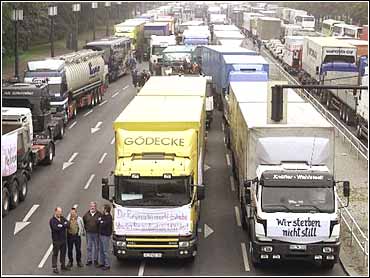

“German Truckers Fume over Fuel Prices,” CBS News, September 26, 2000, http://www.cbsnews.com/stories/2000/09/ ... 3748.shtml.
“Fuel protests continue across Europe,” BBS News, September 13, 2000, http://news.bbc.co.uk/1/hi/world/europe/921456.stm
"Pumps Run Dry Amid Fuel Protests," CNN News, September 4, 2000, http://edition.cnn.com/2000/WORLD/europ ... index.html
The price of gas in the US only went up about 15 cts. However, at the time, the euro was beginning its widespread use, but its value had fallen sharply in 2000 relative to the US dollar, and the EU’s currency risk for their imported oil was dramatic - an almost doubling of their gasoline prices.
Here's one more simple hypothetical example. Let's say Japan wants to import 1 million barrels of oil per month this year. Lets assume the price on the NYMEX or IPE is $70 per/bl. So, Japan will spend $70,000,000 (or $70 million) per month for imported oil. If the Japanese yen depreciates 10% relative to the dollar over a given month, then the real cost of importing oil into Japan goes up by a commensurate 10%. (The real or realized imported oil bill now becomes $77,000,000 per month - an increase of $7 million - and this is due simply to the fact that the dollar is the monopoly "unit of account" or price, for international oil trade).
Assuming they still want and/or need to import 1 million/bls per month, Japan has 2 or perhaps 3 non-violent choices in order to achieve this goal. One, they can buy up 10% more (petro)dollars (i.e. typically US treasuries) by printing 10% more yen - but that is inflationary for the yen and would create even more depreciation pressures against the yen. Option #2 is sell the US more goods and services that total up to $7 million in order to acquire those currency reserves in dollars (i.e. lots of Honda automobiles, Sony TVs, etc.).
The Japanese could also try a combination of options #1 and #2, but the point of this simplistic scenario is to illustrate how currency risk/exposure regarding international oil trades in a monopoly petrocurrency effects the petrodollar's demand/liquidity value - and how a "strong dollar" can become painful for country with a "weak currency" regarding imported oil. Obviously, the dollar, as the world's reserve currency, is of supposed to be a "strong currency."
Since the G.W. Bush administration came to power with its irresponsible/ideological $1.7 trillion dollar tax cuts, the dollar has lost a lot of value relative to other major currencies. As in the past, the dollar is again being challenged in the oil pricing arena, but everytime this happens it appears that Saudi Arabia has squashed such proposals with OPEC - apparently with US insistence. Here's a 2003 UK Observer article that addresses this pattern:
$this->bbcode_second_pass_quote('', ''')At various points in time since the early 1970s, oil producers have discussed this, especially in periods when the dollar has been weak. Opinions have tended to be wide-ranging, depending on the strategic and trade alliances certain members have with particular trade blocs,' said Yarjani.
That was an elliptical reference to the overwhelming influence of Saudi Arabia, whose government is the staunchest ally of the US within Opec.
'The Saudis are holding the line on oil prices in Opec and should they, for example, go along with the rest of the Opec people in demanding that oil be priced in euros, that would deal a very heavy blow to the American economy,' Youssef Ibrahim, of the influential US Council on Foreign Relations, told CNN.
Last year the former US Ambassador to Saudi Arabia told a committee of the US Congress: 'One of the major things the Saudis have historically done, in part out of friendship with the United States, is to insist that oil continues to be priced in dollars. Therefore, the US Treasury can print money and buy oil, which is an advantage no other country has. With the emergence of other currencies and with strains in the relationship, I wonder whether there will not again be, as there have been in the past, people in Saudi Arabia who raise the question of why they should be so kind to the United States.
Indeed, returning to the Japanese hypothetical, there is theoretical 3rd option: The Japanese could also lobby OPEC again for what Kuwait was considering back in 1978 - oil pricing in three currencies: dollar, yen and German mark. {note: In 1973 OPEC floated a proposal that involved a basket of 12 currencies - which would have been difficult to implement - but not impossible}[/i] Of course these discussions within OPEC prompted the US Secretary of the Treasury (Blumenthal) to fly over to Saudi Arabia and personally intervene by getting Saudi Arabia to squash this proposal within OPEC - the quid pro quo was Saudi getting I beleive a 325% increase in voting power within the IMF....(Spiro's book actually discusses the declassified "talking points" of this meeting b/t the US and Saudi Arabia).
I suppose the fourth option (the violent policy choice) would be to invade an oil-rich country and simply take their oil, but the Japanese tried that in WWII and it did not turn out too well for them by 1945. (A couple of weeks after Pearl Harbor in Dec. 1941, the Japanese invaded and captured the giant oil fields of the Dutch East-Indies - present day Indonesia).
Of course the US has long been immune to currency risk (when OPEC sold oil in a price band of $22 to $28 ), and the result to the average Joe is cheap gas prices, which we now consider an inalienable right. This segues into the 2 major effect of monopoly petrodollar recycling...
II. Taxation policies on petrol/gasoline sales with and without currency risk (US vs. the rest of the G7 or G10). Most folks don't make this connection, but their are a couple of reasons why gasoline is taxed much higher in Europe and Japan, and it has nothing to do with taxation "ideology," something to do with building mass transit with oil tax revenue, and a lot to do with the macroeconomics surrounding a vital imported product whose unit of account (price) is in dollars only - oil.
Indeed, the lack of currency risk is one of the reasons why taxes on gasoline are much lower in the United States than in most other countries. The average world price for a gallon of gasoline in 2004 was about $5, or nearly 60% higher than typical US prices. Higher gasoline taxes in the EU and elsewhere provides a cushion for that nation’s currency risks for its imported oil and energy purchases.
Without this, a country could experience wild swings in daily prices at the gas pump due to fluctuations in its domestic currency’s valuation relative to the dollar on the volatile international currency market. If oil became priced in a basket of currencies, the US government would ultimately have to do what other industrialized nations have done, increase taxes on gasoline in order to mitigate wild fluctuation in price/currency risk that would lead to societal discord. This important economic/taxation effect is often overlooked by stateside commentators when discussing the US benefits stemming from the monopoly petrodollar pricing system for global oil trade.
Turning again to recent history: How did Europe resolve the fuel crisis of September 2000? Simple, their respective parliaments temporarily lowered the taxation levels of petrol sales in order to stabilize the oil price back to near the previous level. The eurozone governments reduced some of its own revenue stream in order to prevent the outbreak of more societal discord/rioting. (pic. of French farmers and their tractors that had invaded Paris and the subsequent deployment riot police circa Sept 15, 2000)

Politicians usually like to stay in power as long as possible...but at that point the situation morphed into a phase that I call petrodollar warfare...
After this crisis, European governments appear to have sought strategies to mitigate future economic crises and potential rioting that stems from oil currency risk. Right about this time a guy named Saddam Hussein opened up a euro-denominated bank account with the French bank BNP Paribas. He announced shortly thereafter that all oil exports from his country were to paid in euros, not dollars. Here's an excellent UK-based article that discusses the "quasi-state secret" about Saddam's switch to the euro - which over the past 5 years has only been mentioned once the mainstream US media (April 2003):
When will we buy oil in euros? (Feb 23, 2003)
http://observer.guardian.co.uk/business ... 67,00.html
$this->bbcode_second_pass_quote('', 'L')ast year Russia entered into negotiations with Germany over the establishment of an exchange to sell oil futures denominated in euros. Russia, which on some measures is the world's Number 1 oil producer at the moment, is awash with petrodollars, but trades mainly with Europe. Russia's foreign exchange holdings recently reached an all-time high of $50bn.
At the moment, European consumers are benefiting from the link between oil and the dollar. The euro's surge has, in effect, paid for much of the increase in the price of oil. This, however, is just the flipside of the very high prices in France and Germany in Autumn 2000, which were a combination of a very weak euro and high oil price. US consumers have no such additional worries, as there is no currency risk.
So there is a huge list of potential winners from a move to price oil in euros, but movement remains slow.
Saddam had no control over the destination of his oil sales under the UN administered Oil-for-Food program (most of the oil was bought by the US), but the UN did allow him to change to a euro-based payment system. {note: The US bought about 64% of Iraq's oil exports from 2001 to Feb 2003, but Exxon et al had to make those trades in euros - not dollars}. In the meantime, in June 2001, the EU Parliament adopted a formal policy that asked OPEC and non-OPEC to begin preparations for oil transaction in euros.
$this->bbcode_second_pass_quote('', 'â')€œThe European Parliament … calls on the EU, in dialogue with the OPEC and non-OPEC countries, to prepare the way for payment for oil in euros.”
— European Parliament resolution on the Communication from the Commission on the European Union’s oil supply, June 14, 2001
Why? Again, its currency risk. Here's what OPEC observed 4 years ago:
$this->bbcode_second_pass_quote('', 'â')€œ...From the EU’s point of view, it is clear that Europe would prefer to see payments for oil shift from the dollar to the euro, which effectively removed the currency risk...
...In the long-term, perhaps one question that comes to mind is could a dual system operate simultaneously? Could one pricing system apply to the Western Hemisphere in dollars and for the rest of the world in euros .... Should the euro challenge the dollar in strength, which essentially could include it in the denomination of the oil bill, it could be that a system may emerge which benefits more countries in the long-term."
— Javad Yarjani, Head of OPEC’s Petroleum Market Analysis Department, in a speech to Spanish officials, April 2002
The governments of both highly developed countries and less developed countries don’t like currency risk for their vital oil imports, and those pesky Europeans thought that the euro would make a nice alternative oil transaction currency. Of course the US/UK military-industrial-petroleum-banking nexus did not approve of Saddam awarding most of Iraq's oil and gas field exploration over the French, Russians and Chinese firms via PSA contracts from 1997 to 2000, and the petroeuro switch was the final straw that required "regime change" and a pliant/pro-US gov't in Iraq.
So, these powerful interests likely asked their spokespersons (G.W. Bush/Cheney & Tony Blair) back around Christmas 2000 to do something about this euro encroachment into the crucial oil transaction market via the Iraq dictator...and at Bush's very first National Security meeting in Jan. 2001 topic #1 was how to get Saddam...
Indeed, there are indications that the Iraq War was a forceful way to deliver a message to OPEC and other oil producers: do not attempt to shift from the petrodollar to a petroeuro system. William Engdahl’s conversation with a forthright London-based banker after Baghdad became under US control is quite enlightening:
$this->bbcode_second_pass_quote('', 'I')nformed banking circles in the City of London and elsewhere in Europe privately confirm the significance of that little-noted Iraq move from petrodollar to petroeuro. ‘The Iraq move was a declaration of war against the dollar,’ one senior London banker told me recently. ‘As soon as it was clear that Britain and the US had taken Iraq, a great sigh of relief was heard in London City banks. They said privately, “now we don’t have to worry about that damn euro threat.”
III. International Demand/Liquidity Value of a monopoly petrocurrency and associated effects on issuer nation to expand both domestic credit and export inflation to the world.
Here's how Dr. Spiro summarized the effects of petrodollar recycling following the 1974 agreement with Saudi Arabia to price and conduct oil transactions in the dollar, which was formally adopted by the rest of OPEC in 1975:
$this->bbcode_second_pass_quote('', 'S')o long as OPEC oil was priced in US dollars, and so long as OPEC invested the dollars in US government instruments, the US government enjoyed a double loan. The first part of the loan was for oil. The government could print dollars to pay for oil, and the American economy did not have to produce goods and services in exchange for the oil until OPEC used the dollars for goods and services. Obviously, the strategy could not work if dollars were not a means of exchange for oil.
The second part of the loan was from all other economies that had to pay dollars for oil but could not print [US petro] currency. Those economies had to trade their goods and services for dollars in order to pay OPEC. Again, so long as OPEC held the dollars rather than spending them, the US received a loan. It was therefore important to keep OPEC oil priced in dollars at the same time that the government officials continued to recruit Arab funds.