Donate Bitcoin

Donate Paypal


PeakOil is You

PeakOil is You

Convergence of the sum of many oil field productions

Discuss research and forecasts regarding hydrocarbon depletion.

Convergence of the sum of many oil field productions

Unread postby khebab » Thu 12 Jan 2006, 02:01:33

Motivation:

There is a lot of debate about why a sum of individual oil field productions should produce a symmetric curve. Intuitively, we feel that there is some degree of connection with the Central Limit Theorem:
$this->bbcode_second_pass_quote('', 'a')ny sum of many independent identically distributed random variables will tend to be distributed according to a particular "attractor distribution". The most important and famous result is called simply The Central Limit Theorem which states that if the sum of the variables has a finite variance, then it will be approximately normally distributed

However, individual oil field productions are not random variables and are rather deterministic therefore the Central Limit Theorem cannot be invoked directly. The objectives are the following:
    1- look at the conditions required to converge toward a particular "attractor distribution"
    2- test the validity of the logisitic and gaussian distributions

Methodology:

I made the following assumptions:
    - production profiles of individual fields follow a triangular distribution function
    - the URR, the left side slope (angle beta) , the right side slope (angle gamma) and the time of production start are random variables
three relevant properties for an oil field are the surface of the triangle (URR) and the slopes on the left and right side of the peak (beta and gamma angles) which represents the production growth an decline rates respectively.
[align=center]Image
[/align]
I use basic properties of triangles to derive a, b and c from beta, gamma and the URR: The law of sines and cosines:
[align=center]Image
Image[/align]
By manipulating this two equations we get:
$this->bbcode_second_pass_code('', 'K1= sin(beta)/sin(gamma)
K2= 2*URR/sin(beta)
A=1-K1^2
B= 2*K1*K2*cos(gamma)
C= -K2^2
Delta= B^2 - 4.0*A*C
c= sqrt((-B+sqrt(Delta))/(2*A))
a= K2 / c
b= c * K1')
Consequently, the oil field production profile is the following:
$this->bbcode_second_pass_code('', 'f(x|alpha,beta,t,URR)= (x-t)/(a*c*cos(beta)), if x >= t and x <= t + c*cos(beta)
f(x|alpha,beta,t,URR)= (t + a - x)/(a*(a-c*cos(beta))), if x > t + c*cos(beta) and x <= t + a')

For now, I assume uniform distributions for the different random variables:
    - alpha and beta are distributed within an angle domain such as the resulting slopes are between 2% and 15%,
    - the URR is uniformly distributed between 5 and 20,
    - the starting year t between 1 and 21
Results:
Erratum: for the subplot at the bottom left corner of each figure, the y axis label should be "Prod. / Cum. Prod." instead of "Prod."
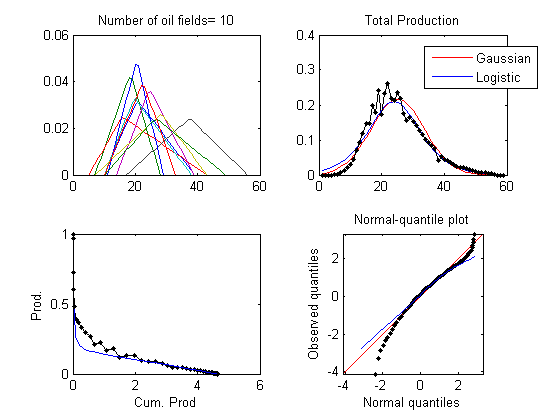
[align=center]Image
Result with 10 oil fields
[/align]
[align=center]Image
Result with 100 oil fields
[/align]
[align=center]Image
Result with 1,000 oil fields[/align]
[align=center]Image
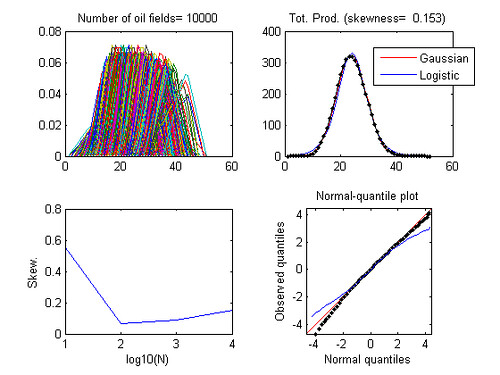
Result with 10,000 oil fields[/align]

Discussion:
    1- the total production seems not to converge completely toward a gaussian or a logistic distribution in particular on the tails. However, these two models seem valid
    2- the resulting curve is slightly asymmetric (skewness= 0.43) and a gamma function is maybe more appropriate
    3- this is a simple model and there are many improvements possible in particular on the probability distribution function of the different variables


Edit (01/12/2006): corrections of a few english mistakes! sorry about that, english is not my first language (especially late at night).
Last edited by khebab on Tue 05 Aug 2008, 14:32:05, edited 3 times in total.
______________________________________
http://GraphOilogy.blogspot.com
khebab
Tar Sands
Tar Sands
 
Posts: 899
Joined: Mon 27 Sep 2004, 03:00:00
Location: Canada

Re: Convergence of the sum of many oil field productions

Unread postby EnergySpin » Thu 12 Jan 2006, 08:58:24

I think that a physically more plausible model for the production of each well, is that it follows a bi-exponential model
f(t) = A1 Exp[-k1 t]+A2 Exp[-k2 t] i.e. a two comparmental model.
This arises as a solution of the following system:

V1--->V2--->f(t)

Where URR = V1(0), V2(0) = 0, and the following differential laws are assumed:
V1'[t]=-k1 V1[t],
V2'[t]=-k2 V2[t]+K1 V1[t]
and f[t]=k2 V2[t].
Solving the system of differential equations leads to:
V1[t] =V1(0) Exp[-k1 t]
V2[t] = (k1*V1(0)) * (Exp[-k1 t] - Exp[-k2 t])/(k2-k1)

and f[t] = (k2*k1*V1(0)) * (Exp[-k1 t] - Exp[-k2 t])/(k2-k1)
The rationale for this model is simple:
The reservoir has a large volume of oil (V1 or URR) which is not directly accessible. Instead one drains a smaller potential compartment (V2) which is fed by V1.
Is it possible to run the simulation assuming this model?
"Nuclear power has long been to the Left what embryonic-stem-cell research is to the Right--irredeemably wrong and a signifier of moral weakness."Esquire Magazine,12/05
The genetic code is commaless and so are my posts.
User avatar
EnergySpin
Intermediate Crude
Intermediate Crude
 
Posts: 2248
Joined: Sat 25 Jun 2005, 03:00:00

Re: Convergence of the sum of many oil field productions

Unread postby khebab » Thu 12 Jan 2006, 09:03:31

EnergySpin, thanks for the good comment!
$this->bbcode_second_pass_quote('EnergySpin', 'I')s it possible to run the simulation assuming this model?

Yes, I can. I will also post the code in R language later. I chose a triangular distribution because it's the simplest unimodal distribution that you can think of and is a good approximation of the envelope of a real oil field production curve. The objective here is that we are trying to find and equivalent of the Central Limit Theorem for the summation of arbitrary curves.
______________________________________
http://GraphOilogy.blogspot.com
khebab
Tar Sands
Tar Sands
 
Posts: 899
Joined: Mon 27 Sep 2004, 03:00:00
Location: Canada

Re: Convergence of the sum of many oil field productions

Unread postby WebHubbleTelescope » Thu 12 Jan 2006, 09:09:59

$this->bbcode_second_pass_quote('khebab', '
')2- the resulting curve is slightly assymetric (skewness= 0.43) and a gamma function is maybe more appropriate


The gamma function occurs when I use the oil shock model and set all 4 rates to the same value and give it a delta function stimulus or another exponential function as input. In the former you get a 4th order gamma and the latter a 5th order gamma. I know this because it is a great way to check the numerical integration accuracy for my model:

http://mobjectivist.blogspot.com/2005/1 ... ution.html

Khebab, what you have discovered is the sampling version of doing convolution. I thought you did radar stuff, DSP and that. You should really be doing a convolution. If you wanted, you could put it in the frequency domain and perform FFTs and just multiply the results and then do an inverse FFT.

With that, I believe you are on the right track.

Try convolving a 4th order gamma and a segment of a quadratic. It is indistigushable from a gaussian on the up-slope.

Give up the ghost on the logistic and gaussian, the match is only empirical and the truth lies in modelling the stochastic process, with real initial conditions and solving the differential equations. And a lot of this amounts to doing convolutions.
User avatar
WebHubbleTelescope
Tar Sands
Tar Sands
 
Posts: 950
Joined: Thu 08 Jul 2004, 03:00:00

Re: Convergence of the sum of many oil field productions

Unread postby EnergySpin » Thu 12 Jan 2006, 09:19:05

$this->bbcode_second_pass_quote('WebHubbleTelescope', '
')The gamma function occurs when I use the oil shock model and set all 4 rates to the same value and give it a delta function stimulus or another exponential function as input. In the former you get a 4th order gamma and the latter a 5th order gamma. I know this because it is a great way to check the numerical integration accuracy for my model:

http://mobjectivist.blogspot.com/2005/1 ... ution.html

Khebab, what you have discovered is the sampling version of doing convolution. I thought you did radar stuff, DSP and that. You should really be doing a convolution. If you wanted, you could put it in the frequency domain and perform FFTs and just multiply the results and then do an inverse FFT.

With all due respect, a garden variety FFT analysis is not going to do much with this messy time series.
Why not apply Bayesian spectrum analysis directly (which will allow us to incorporate prior information)?
There is also a couple of rather interesting pieces of work in exponential signal analysis in (biological) time series analysis which might of some relevance to this. One of it involved regularized algorithms for the numerical inversion of Laplace Transforms, and the other one involved MCMC methods.
I could provide references if anyone is interested ... just PM me.
"Nuclear power has long been to the Left what embryonic-stem-cell research is to the Right--irredeemably wrong and a signifier of moral weakness."Esquire Magazine,12/05
The genetic code is commaless and so are my posts.
User avatar
EnergySpin
Intermediate Crude
Intermediate Crude
 
Posts: 2248
Joined: Sat 25 Jun 2005, 03:00:00

Re: Convergence of the sum of many oil field productions

Unread postby EnergySpin » Thu 12 Jan 2006, 09:26:00

$this->bbcode_second_pass_quote('khebab', 'E')nergySpin, thanks for the good comment!
$this->bbcode_second_pass_quote('EnergySpin', 'I')s it possible to run the simulation assuming this model?

Yes, I can. I will also post the code in R language later. I chose a triangular distribution because it's the simplest unimodal distribution that you can think of and is a good approximation of the envelope of a real oil field production curve. The objective here is that we are trying to find and equivalent of the Central Limit Theorem for the summation of arbitrary curves.

Maybe I'm wrong, but I thought that such a limiting form does not exist as far as the exponential decays are concerned.
But for at least certain distributiions with support on the real positive hemi-axis one can derive closed form expressions for the sum and the product of many such variables. Of course the resultant expressions tend to involve generalized hypergeometric (Lauricella) or Meiger functions, which are not that easy work to with.
"Nuclear power has long been to the Left what embryonic-stem-cell research is to the Right--irredeemably wrong and a signifier of moral weakness."Esquire Magazine,12/05
The genetic code is commaless and so are my posts.
User avatar
EnergySpin
Intermediate Crude
Intermediate Crude
 
Posts: 2248
Joined: Sat 25 Jun 2005, 03:00:00
Top

Re: Convergence of the sum of many oil field productions

Unread postby khebab » Thu 12 Jan 2006, 10:04:12

$this->bbcode_second_pass_quote('WebHubbleTelescope', 'K')hebab, what you have discovered is the sampling version of doing convolution. I thought you did radar stuff, DSP and that. You should really be doing a convolution. If you wanted, you could put it in the frequency domain and perform FFTs and just multiply the results and then do an inverse FFT.

You'right, but I thought that presenting the problem in the time domain was more accessible for a larger audience :roll:. Working in the frequency domain is mainly a computational improvement.

$this->bbcode_second_pass_quote('WebHubbleTelescope', 'G')ive up the ghost on the logistic and gaussian, the match is only empirical and the truth lies in modelling the stochastic process, with real initial conditions and solving the differential equations. And a lot of this amounts to doing convolutions.
Again, you'right, but as a Physic guy, I try to keep in touch with tangible quantities that are directly observables (i.e. the production curve). The gaussian model is the easiest, most common function and is a central pdf in statistical analysis. no more than that. I also believe that a good model should use stochastic PDE as you are suggesting. As you know very well :roll:, there is a lot of resistance in the community in evolving from the gaussian/logistic model mainly for historical reason. If you want to convince people you have to go gradually with simple intuitive experiments that they can recreate themself if possible.
______________________________________
http://GraphOilogy.blogspot.com
khebab
Tar Sands
Tar Sands
 
Posts: 899
Joined: Mon 27 Sep 2004, 03:00:00
Location: Canada
Top

Re: Convergence of the sum of many oil field productions

Unread postby nero » Thu 12 Jan 2006, 13:54:15

$this->bbcode_second_pass_quote('', '-') alpha and beta are distributed between in an angle domain such as the resulting slopes are between 2% and 15%,
- the URR is uniformly distributed between 5 and 20,
- the starting year t between 1 and 21


The starting year should not be uniformly distributed. The discovery is dependent on the exploratory effort which is dependent on the demand(price). The demand is not a constant but develops over time and is dependent in part on the previous supply and previous discovery. That I believe is at the heart of why the central limit theorem is not applicable. The discoveries are not independent random events.
Biofuels: The "What else we got to burn?" answer to peak oil.
User avatar
nero
Heavy Crude
Heavy Crude
 
Posts: 1433
Joined: Sat 22 May 2004, 03:00:00
Location: Ottawa, Ontario
Top

Re: Convergence of the sum of many oil field productions

Unread postby khebab » Thu 12 Jan 2006, 22:17:57

$this->bbcode_second_pass_quote('EnergySpin', 'O')f course the resultant expressions tend to involve generalized hypergeometric (Lauricella) or Meiger functions, which are not that easy work to with.

You got it! that's why I started that thread. However, as pointed out by WHT displacing the problem in the Fourier domain should make thinks a lot more easier.
______________________________________
http://GraphOilogy.blogspot.com
khebab
Tar Sands
Tar Sands
 
Posts: 899
Joined: Mon 27 Sep 2004, 03:00:00
Location: Canada
Top

Re: Convergence of the sum of many oil field productions

Unread postby WebHubbleTelescope » Thu 12 Jan 2006, 22:20:00

$this->bbcode_second_pass_quote('EnergySpin', '
')With all due respect, a garden variety FFT analysis is not going to do much with this messy time series.
Why not apply Bayesian spectrum analysis directly (which will allow us to incorporate prior information)?


Convolution of two functions in the time domain = multiplication of two functions in the frequency domain.

So if you want to do a convolution, its a nice trick to do the FFT, multiply and then the inverse FFT.

Does that answer your question?
User avatar
WebHubbleTelescope
Tar Sands
Tar Sands
 
Posts: 950
Joined: Thu 08 Jul 2004, 03:00:00
Top

Re: Convergence of the sum of many oil field productions

Unread postby khebab » Thu 12 Jan 2006, 22:25:07

$this->bbcode_second_pass_quote('nero', 'T')he starting year should not be uniformly distributed. The discovery is dependent on the exploratory effort which is dependent on the demand(price). The demand is not a constant but develops over time and is dependent in part on the previous supply and previous discovery. That I believe is at the heart of why the central limit theorem is not applicable. The discoveries are not independent random events.

Agreed but the goal here is not to find a realistic model about oil production. I'm trying to understand the basic mechanisms that makes some production curves symmetric (US, Norway,...) and others very asymmetric. The reasons why we can get symmetric curve are not obvious in part because of the things you are mentioning.
______________________________________
http://GraphOilogy.blogspot.com
khebab
Tar Sands
Tar Sands
 
Posts: 899
Joined: Mon 27 Sep 2004, 03:00:00
Location: Canada
Top

Re: Convergence of the sum of many oil field productions

Unread postby turmoil » Thu 12 Jan 2006, 22:37:57

$this->bbcode_second_pass_quote('khebab', 'A')greed but the goal here is not to find a realistic model about oil production. I'm trying to understand the basic mechanisms that makes some production curves symmetric (US, Norway,...) and others very asymmetric. The reasons why we can get symmetric curve are not obvious in part because of the things you are mentioning.

khebab, have you considered the differences between deep water and regular wells, how quickly each was exploited, the secondary and/or tertiary techniques that were used in them, etc? thanks.
"If you are a real seeker after truth, it's necessary that at least once in your life you doubt all things as far as possible"-Rene Descartes

"When you have excluded the impossible, whatever remains however improbable must be the truth"-Sherlock Holmes
User avatar
turmoil
Heavy Crude
Heavy Crude
 
Posts: 1088
Joined: Fri 13 Aug 2004, 03:00:00
Location: Richmond, VA, Pale Blue Dot
Top

Re: Convergence of the sum of many oil field productions

Unread postby khebab » Thu 12 Jan 2006, 23:37:20

$this->bbcode_second_pass_quote('turmoil', 'k')hebab, have you considered the differences between deep water and regular wells, how quickly each was exploited, the secondary and/or tertiary techniques that were used in them, etc? thanks.

not yet, maybe one day! :) my guess is that the application of EOR will affect the growth rate (angle beta) and the decline rate (angle gamma) probably by producing a longer growth period and then a steep fall (c>>b).
______________________________________
http://GraphOilogy.blogspot.com
khebab
Tar Sands
Tar Sands
 
Posts: 899
Joined: Mon 27 Sep 2004, 03:00:00
Location: Canada
Top

Re: Convergence of the sum of many oil field productions

Unread postby WebHubbleTelescope » Fri 13 Jan 2006, 01:04:49

$this->bbcode_second_pass_quote('khebab', '')$this->bbcode_second_pass_quote('nero', 'T')he starting year should not be uniformly distributed. The discovery is dependent on the exploratory effort which is dependent on the demand(price). The demand is not a constant but develops over time and is dependent in part on the previous supply and previous discovery. That I believe is at the heart of why the central limit theorem is not applicable. The discoveries are not independent random events.

Agreed but the goal here is not to find a realistic model about oil production. I'm trying to understand the basic mechanisms that makes some production curves symmetric (US, Norway,...) and others very asymmetric. The reasons why we can get symmetric curve are not obvious in part because of the things you are mentioning.


I have been able to come up with a similarity between Norway and UK even though the shapes of the curves are very different. It appears that both regions spiked up their extraction rate circa 1992, to make up for declining supplies.

Norway
Image
Image

UK
Image
Image

http://mobjectivist.blogspot.com/2006/0 ... etion.html
User avatar
WebHubbleTelescope
Tar Sands
Tar Sands
 
Posts: 950
Joined: Thu 08 Jul 2004, 03:00:00
Top

Re: Convergence of the sum of many oil field productions

Unread postby WebHubbleTelescope » Fri 13 Jan 2006, 01:38:01

$this->bbcode_second_pass_quote('nero', '')$this->bbcode_second_pass_quote('', '-') alpha and beta are distributed between in an angle domain such as the resulting slopes are between 2% and 15%,
- the URR is uniformly distributed between 5 and 20,
- the starting year t between 1 and 21


The starting year should not be uniformly distributed. The discovery is dependent on the exploratory effort which is dependent on the demand(price). The demand is not a constant but develops over time and is dependent in part on the previous supply and previous discovery. That I believe is at the heart of why the central limit theorem is not applicable. The discoveries are not independent random events.


I would largely agree with this statement. However, I think the size of the discoveries are largely uncorrelated from year to year.

If I could, I would rephrase it this way: The sampling rate for establishing discoveries is not an independent random event. Much like a boom and bust cycle, this is likely super-linear and perhaps quadratic over time until the sampling starts firing blanks. The sampling distribution for a quasi-infinite pool is much closer to being a set of independent random events. You should be able to see this if you look at an unsorted creaming curve for the entire world since the 1800's. I haven't seen one yet, but it should be linear, with random-walk excursions above and below the line, if the size of discoveries are uncorrelated. It will bend over with a negative inflection if the big ones get discovered earlier than the rest. You will see this negative inflection with finite regions such as the middle east, but this is misleading because the reason the region got subsequently explored heavily was because of the initial big hit.

Bottom-line is that we see many artifacts because of a finite sample space. I think you have to open up the sample space to see the real random effects.
User avatar
WebHubbleTelescope
Tar Sands
Tar Sands
 
Posts: 950
Joined: Thu 08 Jul 2004, 03:00:00
Top

Re: Convergence of the sum of many oil field productions

Unread postby khebab » Thu 26 Jan 2006, 13:23:07

I explored a little bit the model by gradually increasing the level of randomness in the different variables.

Case 1: trivial case

All fields are identicals in shape (Isoscele triangles) and surface (slope= 5% and URR= 15), only the starting year is a gaussian N(11, 4.33). This ideal case stricly verifies the conditions of the Central Limit Theorem (see Illustration of the central limit theorem). ).

[align=center]
Image
[/align]
The resulting curve is fairly gaussian with maybe heavier tails. Also, the skewness value is decreasing with the number of points in the simulation (see figure in the lower left corner).

Case 2: shape fixed, URR gaussian

The URR is distributed according to a gaussian N(15, 2.89)

[align=center]
Image
Image
Parameters distributions: from left to right and top to bottom: field upslope distribution (in %), URR distribution (log-log representation), field starting year and peak year distribution.
[/align]

Case 3: Isoscele triangles with a gaussian slope, URR gaussian

same as case 2 but we randomly choose the triangle slopes N(8.5, 2.31) (in %). The right tail is getting heavier and the skewness has increased.

[align=center]
ImageImage
[/align]

Case 4: random triangles with gaussian slopes, URR gaussian

Not much difference with case 3 but the skewness value has decreased.
[align=center]
Image[/align]

Case 5: random triangles with gaussian slopes, URR gaussian but big field produced first

Because big fields have a higher discovery cross-section and are economically more valuable, there is a good chance that they will be produced first and conversly the small fields will be produced last. Same as case 4 but we rank fields according to their size and the biggest are produced first. It has a good influence on the result where the production is much more gaussian especially in the tails.

[align=center]Image[/align]

Case 6: random triangles with gaussian slopes, URR lognormal but big field produced first

The distribution of the URR values is clearly not normal and is probably more like a lognormal distribution where big fields have a very low probably of occurence. The lognormal model is the same that have been used in a previous thread (A Statistical Model for the Simulation of Oil Production). Curiously, the impact of this modification is not very strong and the curve is just slightly more skewed.

[align=center]
ImageImage
[/align]

Some conclusions

1- the production profile is well modeled by a gaussian when most of the underlying parameters are also gaussian distributed.
2- the logistic model do not seem to be a particularly better model especially for the tails
3- the distribution of the URR values do not seem to have a big impact on the resulting curve
4- when fields are produced by order of size, the production curve is getting more gaussian.
______________________________________
http://GraphOilogy.blogspot.com
khebab
Tar Sands
Tar Sands
 
Posts: 899
Joined: Mon 27 Sep 2004, 03:00:00
Location: Canada

Re: Convergence of the sum of many oil field productions

Unread postby pup55 » Thu 26 Jan 2006, 19:05:59

All I can think of is that there is no compelling reason to believe that the shape of the distribution would be a lot different if n=15000 or n=20,000.

In other words, you have selected a sufficiently large number for N that within this order of magnitude, the shape of the sum of the curves will start to take on the shape of the individual curves (in this case, gaussian) pretty much no matter what.

I am thinking about the argument of new discoveries and /or reserves growth, and how the discovery of X number of new fields, including a number of super-giants, might influence the shape of the right hand side of the curve.

It looks as though even if X, the new fields, were large in number compared to the known existing fields (which for you is 10,000), the sumnation curve will be more or less the same shape unless the time distribution or the size distribution of the new discoveries is grossly different from the distribution of the currently known discoveries.

What I am saying is that it is possible to have new discoveries to avoid the problem of the right hand side of the curve. These discoveries would have to be sufficiently large and occur in a sufficiently different time sequence to substantially alter the curve shape. Per your post the other day, you might be able to estimate the probability of such an event happening. Example: The discovery of 10 more Ghawar-sized fields, at or about the present time, making the curve a lot broader and flatter than it is in the above examples. (example 6 might be the closest to this).

You would then be able to make a determination kind of like we were talking about the other day, such as that there is y probability that future discoveries would be sufficient to get us out of these problems.

Once you know what y is, no problem to have the conversation with Michael Lynch, who will tell you that we should go on living like we are because "we will probably discover sufficient oil to avoid any problems related to the peak", etc. etc.
User avatar
pup55
Light Sweet Crude
Light Sweet Crude
 
Posts: 5249
Joined: Wed 26 May 2004, 03:00:00

Re: Convergence of the sum of many oil field productions

Unread postby JohnDenver » Thu 26 Jan 2006, 21:12:57

khebab,
I know this is slightly off-topic from the issue you're considering, but I'll say it anyway. When I saw Stuart's recent Gaussian, which matches world production so beautifully over different orders of magnitude, the thing which intrigued me most was that it was made of linear segments whose slopes seem to be determined by economic/political factors, as Stuart pointed out.

This makes me think that the shape of the rising side of the Gaussian is determined by demand, not discovery/resources/geology. As a thought experiment, consider a parallel world where there is no constraint on the resource. In this world, there is a fortuitous discovery of a monstrous pool of oil which is (say) 500Gb in size, and is located on the surface like a lake. What would be the production curve in those circumstances? I think it's clear that production in this world will still be constrained -- not by the ability to mobilize supply, but rather by cartel activity which acts to prevent too much oil from flooding the market, thereby crashing prices and bankrupting all the players who invested in infrastructure prior to discovery of the lake.

Clearly, this effect has been a chronic, dominant feature of oil production on the rising side of the curve. The main goal of Rockefeller's strategy was to cartelize, and thereby constrain supply and stabilize prices. The same can be said for OPEC. So my theory is that the slope of the left side of the Gaussian is determined by cartel activity, which in turn is determined by demand/price. The lake will not be produced, even if it is discovered, because there is no way for the market to consume it. Producing it full-blast would be an act of suicide for the producer. It reminds me of something Mike Lynch said in his thread (I'm paraphrasing): predicting supply essentially boils down to predicting demand. I believe that is 100% true on the upside of the curve.

If I'm correct, it makes your question a lot more difficult to answer. Why should the rising and falling sides of the Gaussian be symmetric if the rising side is determined by economics while the falling side is determined by geology?
JohnDenver
Intermediate Crude
Intermediate Crude
 
Posts: 2145
Joined: Sun 29 Aug 2004, 03:00:00

Re: Convergence of the sum of many oil field productions

Unread postby khebab » Thu 26 Jan 2006, 22:32:39

$this->bbcode_second_pass_quote('pup55', 'I')n other words, you have selected a sufficiently large number for N that within this order of magnitude, the shape of the sum of the curves will start to take on the shape of the individual curves (in this case, gaussian) pretty much no matter what.

That's bascially correct, but it was not necessarely obvious to answer that question prior to this experiment because the Central Limit Thereom states that the random variables have to be independent and identically distributed (i.i.d.) which is not the case for a sum of production profiles. Note that the deterministic shape of the individual production profiles is not a gaussian but a triangle. Only the parameters of the triangles are gaussian distributed.
$this->bbcode_second_pass_quote('pup55', 'W')hat I am saying is that it is possible to have new discoveries to avoid the problem of the right hand side of the curve. These discoveries would have to be sufficiently large and occur in a sufficiently different time sequence to substantially alter the curve shape. Per your post the other day, you might be able to estimate the probability of such an event happening. Example: The discovery of 10 more Ghawar-sized fields, at or about the present time, making the curve a lot broader and flatter than it is in the above examples. (example 6 might be the closest to this).

That's a good question. In case 6, super-giant fields were exploited first then smaller fields. Production from very small fields are contributiong to more than 50% of the total production. I could design an experiment where some giant fields are discovered regularly (uniform distribution) and see if it helps. The distribution of the timing of oil fields coming online has a great influence on the resulting curve. If you assume a uniform distribution for the timing (starting year), the resulting curve has a broad peak forming a production plateau.
______________________________________
http://GraphOilogy.blogspot.com
khebab
Tar Sands
Tar Sands
 
Posts: 899
Joined: Mon 27 Sep 2004, 03:00:00
Location: Canada
Top

Re: Convergence of the sum of many oil field productions

Unread postby khebab » Thu 26 Jan 2006, 22:55:02

$this->bbcode_second_pass_quote('JohnDenver', ' ')Clearly, this effect has been a chronic, dominant feature of oil production on the rising side of the curve. The main goal of Rockefeller's strategy was to cartelize, and thereby constrain supply and stabilize prices. The same can be said for OPEC. So my theory is that the slope of the left side of the Gaussian is determined by cartel activity, which in turn is determined by demand/price. The lake will not be produced, even if it is discovered, because there is no way for the market to consume it. Producing it full-blast would be an act of suicide for the producer. It reminds me of something Mike Lynch said in his thread (I'm paraphrasing): predicting supply essentially boils down to predicting demand. I believe that is 100% true on the upside of the curve.

Agreed. The left side is demand driven and subject to political/economical shocks.
$this->bbcode_second_pass_quote('JohnDenver', ' ')If I'm correct, it makes your question a lot more difficult to answer. Why should the rising and falling sides of the Gaussian be symmetric if the rising side is determined by economics while the falling side is determined by geology?

The right side should be supply driven but economics will have also an influence and should make the curve asymmetric as prices will make small or remote oil fields as well as unconventional sources economically viable.
______________________________________
http://GraphOilogy.blogspot.com
khebab
Tar Sands
Tar Sands
 
Posts: 899
Joined: Mon 27 Sep 2004, 03:00:00
Location: Canada
Top

Next

Return to Peak oil studies, reports & models

Who is online

Users browsing this forum: No registered users and 0 guests

cron