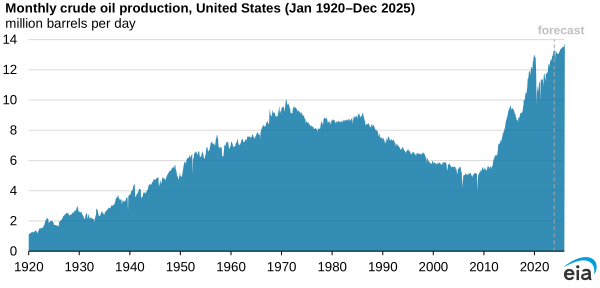
$this->bbcode_second_pass_quote('theluckycountry', 'P')eak oil is PeakOil Production. Not Demand, Not PeakPlastic, Not peak Coal to oil, and certainly not Peak Shale well oil.


PeakOil is You
Peak oil debate
Re: Peak oil debate
 by AdamB » Sun 29 Sep 2024, 13:15:11
Again..for the revisionists that don't know any more about oil than they do tight tracks, or what holding a high school diploma with their name on it feels like.
Peak oil is the theorized point in time when the maximum rate of global oil production will occur, after which oil production will begin an irreversible decline.
This was the same definition employed by the likes of Colin Campbell in 1989 when he first declared global peak circa 1990.
After you go back and get your high school diploma, maybe you'll understand English better?
$this->bbcode_second_pass_quote('Theluckycountry', '
')Fracked oil, like oil made from coal, is manufactured oil.
Wrong. Ever fracked well I've ever PERSONALLY produced oil from, came from, you know, ROCKS. Where it resided after it was created through the normal thermogenic process that oil from Ghawar came from. Except the oil I produced, from shale wells, after completing them, came from lower permeability rock. No, I won't explain that to a moron who doesn't even know the definition of peak oil.
Look up the big words. Take some ibruprofen when you get a headache from trying to figure out those with more than a single syllable.
$this->bbcode_second_pass_quote('theluckycountry', '
')Chemicals are used to produce it and a lot of energy is wasted in the process.
Again, wrong. How much stupid do you really wish to display today?
$this->bbcode_second_pass_quote('theluckycountry', '
')When the original theses of PeakOil was put forward it was based on conventional oil extracted from conventional wells, not oil manufactured from other hydrocarbons.
No it wasn't. Hubbert didn't do it with US peak oil claims in 1936 or 1956 claim, for the world or the country. Colin Campbell didn't do it for his 1990 global claim. Interestingly, Campbell DID claim global peak oil pre-2005 WHICH INCLUDED THE MYSTERIOUS OIL TYPE OF "UNCONVENTIONAL".
You are operating in the standard revisionist mindset, combined with cut and paste internet knowledge. Learn some history. Pick that up along with basic math when you go back and get the education you skipped, leaving you susceptible to saying ignorant things and looking uninformed.
$this->bbcode_second_pass_quote('theluckycountry', '
')This was important......
This never happened until after folks turned out didn't know dick about oil. The kind coming from ROCKS, regardless of the completion technique. You, being ignorant, apparently only got involved in this topic recently and not knowing what "research" is because they taught it in the 10th grade and you dropped out before that, decided being ignorant was better than knowing stuff. Glad your ditch digging and truck driving or whatever did well for your retirement, because you suck when it comes to "knowing" stuff.
$this->bbcode_second_pass_quote('theluckycountry', '
')2007~8 was Global peak oil...
So was 1979. The 2008 global peak was #4 in the claimed peak oils of the 21st century. #6 global peak oil in 2018 still stands as the most recent.
Any other stupid things you want to say, or references that don't know any more math, physics, geology, engineering or history than you do? If you had finished high school you might be able to think for yourself, and not need wholesale quotes from others like you.

Plant Thu 27 Jul 2023 "Personally I think the IEA is exactly right when they predict peak oil in the 2020s, especially because it matches my own predictions."
Plant Wed 11 Apr 2007 "I think Deffeyes might have nailed it, and we are just past the overall peak in oil production. (Thanksgiving 2005)"
Plant Wed 11 Apr 2007 "I think Deffeyes might have nailed it, and we are just past the overall peak in oil production. (Thanksgiving 2005)"