PeakOil is You
Let's Discuss Peak Oil For A Change
Re: Peak oil is a non-threat
 by Tikib » Sun 22 Sep 2019, 19:52:29
Well okay that's fair. There is peak-oil as in the technical term for the peak in global oil production and 'peak oil' as in the predicted result of technical peak oil resulting in the gradual or possibly fast collapse of civilization.
- Tikib
- Lignite

- Posts: 336
- Joined: Mon 08 Dec 2014, 03:13:28
Re: Peak oil is a non-threat
by Plantagenet » Sun 22 Sep 2019, 19:56:22
$this->bbcode_second_pass_quote('Tikib', 'W')ell okay that's fair. There is peak-oil as in the technical term for the peak in global oil production and 'peak oil' as in the predicted result of technical peak oil resulting in the gradual or possibly fast collapse of civilization.
Not really. Peak oil has one specific meaning, and thats the peak in global oil production.
Knock-on effects from peak oil may be quite serious, or perhaps our future energy needs will be met by renewable energy as you suggested in your first post. But lets not confuse peak oil itself with the various speculative scenarios of things that might occur as a result of peak oil.
Cheers!
-

Plantagenet - Expert

- Posts: 26765
- Joined: Mon 09 Apr 2007, 03:00:00
- Location: Alaska (its much bigger than Texas).
Re: Peak oil is a non-threat
by Tikib » Sun 22 Sep 2019, 20:02:56
I REALLY hate having arguments over semantics but I have here and in 'real-life'(tm) have heard people using the phrase peak-oil to describe energy based collapse. /end
Cheers!
Cheers!
- Tikib
- Lignite
- Posts: 336
- Joined: Mon 08 Dec 2014, 03:13:28
Re: Peak oil is a non-threat
by Plantagenet » Sun 22 Sep 2019, 21:26:37
$this->bbcode_second_pass_quote('Tikib', 'I') have here and in 'real-life'(tm) have heard people using the phrase peak-oil to describe energy based collapse.
I don't use it that way and I don't think most of the people at this site do now either, although in the past there may have been some who did.
This forum works best when people discuss their own views rather then setting up some imaginary straw man or some unknown "people" out there in 'real-life'(tm) who supposedly said something, and then bashing the supposed things the unknown straw man said.
Please go ahead and expound on whatever actually is your personal scenario for the future and perhaps we can discuss that?
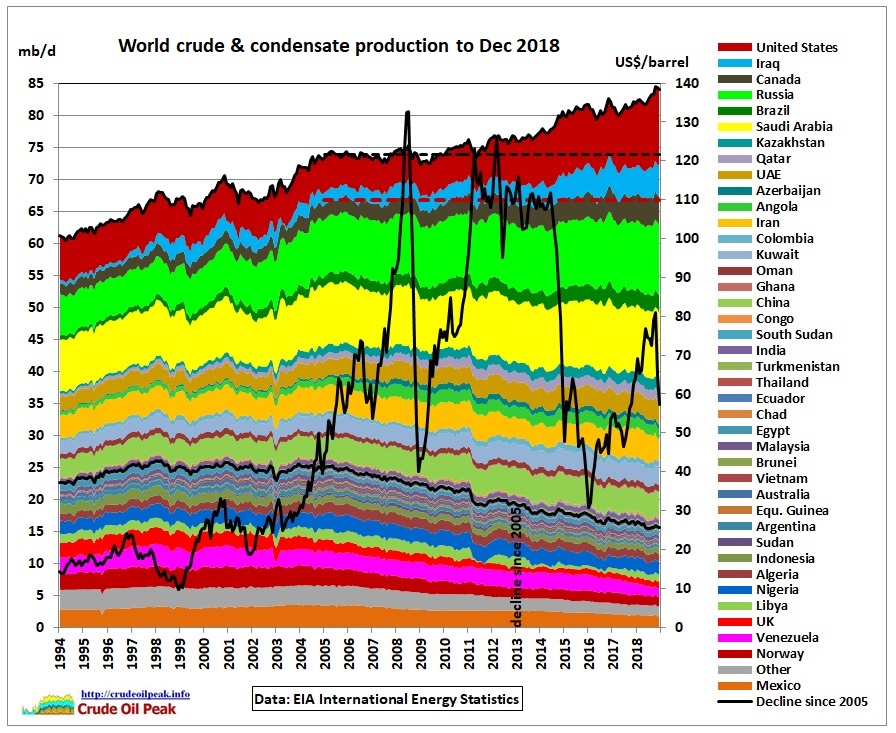
My own view, as I stated above, is that conventional oil has peaked on a global basis, and the growth in world's oil supply since ca. 2010 has mostly come from new production due to US fracking.
Cheers!
Never underestimate the ability of Joe Biden to f#@% things up---Barack Obama
-----------------------------------------------------------
Keep running between the raindrops.
-----------------------------------------------------------
Keep running between the raindrops.
-
Plantagenet - Expert
- Posts: 26765
- Joined: Mon 09 Apr 2007, 03:00:00
- Location: Alaska (its much bigger than Texas).
Re: Peak oil is a non-threat
by Tikib » Sun 22 Sep 2019, 21:49:01
Well yea your right about the conventional oil but that's a well known fact.
US fracking of course can't last forever and will likely begin to shrink sometime in the 2020's at which point total oil production will peak.
But after that we won't see a sharp decline but a small decline followed by a plateau for another 5-10 years as the offshore and super fields take the burden once again.
After say 2030 there could be a sharper drop in production but I think by then electric vehicles and renewables will be capable of taking a significant amount of demand away from oil.
And if there not ready by the time oil production decreases significantly pressurized natural gas can be used to fill in the gap in transportation fuels until we can electrify the whole system.
So I am not that worried about peak oil as a threat to the global economy.
US fracking of course can't last forever and will likely begin to shrink sometime in the 2020's at which point total oil production will peak.
But after that we won't see a sharp decline but a small decline followed by a plateau for another 5-10 years as the offshore and super fields take the burden once again.
After say 2030 there could be a sharper drop in production but I think by then electric vehicles and renewables will be capable of taking a significant amount of demand away from oil.
And if there not ready by the time oil production decreases significantly pressurized natural gas can be used to fill in the gap in transportation fuels until we can electrify the whole system.
So I am not that worried about peak oil as a threat to the global economy.
- Tikib
- Lignite
- Posts: 336
- Joined: Mon 08 Dec 2014, 03:13:28
Re: Peak oil is a non-threat
by ralfy » Sun 22 Sep 2019, 22:12:44
Renewables, etc. require fossil fuels for mining, manufacturing, and transport. The same goes for the infrastructure needed to distribute energy, consumer goods that will use them, etc.
Oil is part of various resources, including minerals, needed for BAU. To ensure BAU, we will need at least one more earth.
Oil is part of various resources, including minerals, needed for BAU. To ensure BAU, we will need at least one more earth.
-

ralfy - Light Sweet Crude

- Posts: 5651
- Joined: Sat 28 Mar 2009, 11:36:38
- Location: The Wasteland
Re: Peak oil is a non-threat
by Tikib » Sun 22 Sep 2019, 22:25:15
Why do you need oil for those things?
Theres no reason you can't electrify the mining operation etc.
Business isn't going to be as usual but it never has been. The economy has been changing and adapting since the dawn of time.
Your right that endless growth can't go on forever, but I don't see a dramatic crash in the next 100 years unless we ignore climate change or we kill ourselves off.
Why I am so confident about this, because of the progress we have made on solar energy. Solar energy is abundant and will soon be extremely cheap to deploy.
https://singularityhub.com/2019/08/09/t ... n-its-way/
Theres no reason you can't electrify the mining operation etc.
Business isn't going to be as usual but it never has been. The economy has been changing and adapting since the dawn of time.
Your right that endless growth can't go on forever, but I don't see a dramatic crash in the next 100 years unless we ignore climate change or we kill ourselves off.
Why I am so confident about this, because of the progress we have made on solar energy. Solar energy is abundant and will soon be extremely cheap to deploy.
https://singularityhub.com/2019/08/09/t ... n-its-way/
- Tikib
- Lignite
- Posts: 336
- Joined: Mon 08 Dec 2014, 03:13:28
Re: Peak oil is a non-threat
by Plantagenet » Sun 22 Sep 2019, 23:13:25
$this->bbcode_second_pass_quote('Tikib', ' ')I don't see a dramatic crash in the next 100 years unless we ignore climate change....
I think you mean assuming we ignore climate change.
But we can't ignore climate change, and IMHO climate change is likely to cause very severe disruptions in the global economy well before we reach the year 2100.
$this->bbcode_second_pass_quote('Tikib', 'W')hy I am so confident about this, because of the progress we have made on solar energy. Solar energy is abundant and will soon be extremely cheap to deploy.
Possibly. But in the mean time we are pumping more and more CO2, CH4 and SF6 into the atmosphere every year, and the climate is getting hotter and hotter, bringing more heat waves, more forest fires, bigger hurricanes, more floods, and higher sea levels.
Cheers!
Never underestimate the ability of Joe Biden to f#@% things up---Barack Obama
-----------------------------------------------------------
Keep running between the raindrops.
-----------------------------------------------------------
Keep running between the raindrops.
-
Plantagenet - Expert
- Posts: 26765
- Joined: Mon 09 Apr 2007, 03:00:00
- Location: Alaska (its much bigger than Texas).