PeakOil is You
Booming Economic Growth?
Re: Booming Economic Growth?
 by marmico » Wed 22 Aug 2018, 06:24:45
Newfie Screech and doomtard onlooker - the tag team of anecdotal pseudo-scientists. Spare me your tribal affiliation and affinity bullshit.
- marmico
- Heavy Crude

- Posts: 1112
- Joined: Mon 28 Jul 2014, 14:46:35
Re: Booming Economic Growth?
by Newfie » Wed 22 Aug 2018, 08:31:37
Another zero content troll post.
Do I need to make myself more clear?
Do I need to make myself more clear?
-

Newfie - Forum Moderator

- Posts: 18651
- Joined: Thu 15 Nov 2007, 04:00:00
- Location: Between Canada and Carribean
Re: Booming Economic Growth?
by Pops » Wed 22 Aug 2018, 11:32:41
$this->bbcode_second_pass_quote('kublikhan', 'I') think one of the biggest problems is wealth inequality.
$this->bbcode_second_pass_quote('', 'U').S. costs are high due to... inefficient regulation. It suggests that construction, like health care or asset management or education, is an area where Americans have simply ponied up more and more cash over the years while ignoring the fact that they were getting less and less for their money.
$this->bbcode_second_pass_quote('', 'U').S. costs are high due to... inefficient regulation. It suggests that construction, like health care or asset management or education, is an area where Americans have simply ponied up more and more cash over the years while ignoring the fact that they were getting less and less for their money.
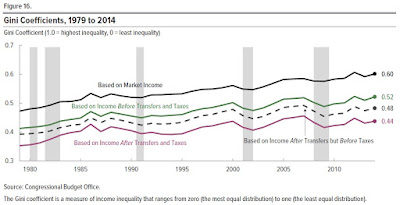
Good link. I kinda think the 2 are connected. Wealth/income inequality where not only is the upper level taking more of the profit but wealth/income dispersion where the the upper and lower incomes are farther and farther apart (CEO pay 300 times worker pay vs a paltry 30 times.
If I'm selling a thing, say plumbing services, which end of the consumer spectrum am I likely to target my prices?
Obviously I'm going to charge as much as the market will bear, it's the American way, so I charge $200 hr. And being a responsible biz owner I make sure that licensing laws are strict to limit the competition, as well as code compliance laws to make sure DIYers need a permit to change the washer on their garden hose. And of course I hold the line on my employees's compensation and evade taxes when possible because I'm smart.
All is well for those customers who are on the same program and make $200/hr themselves, just a straight trade of skills (well, winnings anyway).
But what about the actual plumbers, the employees of our example responsible biz owner who make an average of $20.40/hr. Are they ever going to hire a plumber's equivalent of a "plumber"? Not at 10 times their salary they aren't!
And that's not to mention the clerks, janitors, material handlers (greenie grunts) and assorted minimum wage flunkies hanging around the shop. They will never need a plumber because they will never have a pot to piss in that needs plumbing.
Same goes for any product/service originating domestically that doesn't face global competition; home building, infrastructure, medicine, higher ed... as compared to global commodities like walmart t-shirts 2 for $8, or Betty Crocker flour @ $1lb when the wheat in that bag is worth less than a penny. ($200 per ton/2200)
gini

The legitimate object of government, is to do for a community of people, whatever they need to have done, but can not do, at all, or can not, so well do, for themselves -- in their separate, and individual capacities.
-- Abraham Lincoln, Fragment on Government (July 1, 1854)
-- Abraham Lincoln, Fragment on Government (July 1, 1854)
-

Pops - Elite

- Posts: 19746
- Joined: Sat 03 Apr 2004, 04:00:00
- Location: QuikSac for a 6-Pac
Re: Booming Economic Growth?
by jedrider » Wed 22 Aug 2018, 14:14:27
Brick and Mortar Retail is still feeling the pinch, evidently:
Orchard Supply Hardware stores everywhere are closing for good by the end of the year
https://www.sacbee.com/news/state/article217121080.html
We have a new store nearby in a rapidly growing neighborhood. Still, new homes do not make for good hardware sales.
I've bought several things there, patio furniture being the higher ticket items. They have good fashion taste compared to Home Depot. Sorry to see them go.
Orchard Supply Hardware stores everywhere are closing for good by the end of the year
https://www.sacbee.com/news/state/article217121080.html
We have a new store nearby in a rapidly growing neighborhood. Still, new homes do not make for good hardware sales.
I've bought several things there, patio furniture being the higher ticket items. They have good fashion taste compared to Home Depot. Sorry to see them go.
-

jedrider - Intermediate Crude

- Posts: 3107
- Joined: Thu 28 May 2009, 10:10:44
Re: Booming Economic Growth?
by Outcast_Searcher » Wed 22 Aug 2018, 14:52:55
$this->bbcode_second_pass_quote('jedrider', 'B')rick and Mortar Retail is still feeling the pinch, evidently:
Orchard Supply Hardware stores everywhere are closing for good by the end of the year
https://www.sacbee.com/news/state/article217121080.html
We have a new store nearby in a rapidly growing neighborhood. Still, new homes do not make for good hardware sales.
I've bought several things there, patio furniture being the higher ticket items. They have good fashion taste compared to Home Depot. Sorry to see them go.
Orchard Supply Hardware stores everywhere are closing for good by the end of the year
https://www.sacbee.com/news/state/article217121080.html
We have a new store nearby in a rapidly growing neighborhood. Still, new homes do not make for good hardware sales.
I've bought several things there, patio furniture being the higher ticket items. They have good fashion taste compared to Home Depot. Sorry to see them go.
The overall trend seems rather obvious, and I see no reason for it to abate in most cases.
An exception might be things like fresh food, for people who are picky about the quality of their food a lot.
OTOH, I am a complete idiot at picking out certain food, like ripe (but not rotting) avacados at the grocery store, so I could see a case for a business that for a reasonable premium, consistently and reliably can ship such food with quality, to the customer's needs.
I saw a piece a couple/few days ago claiming Walmart's brick and mortar business will give it a "significant advantage" over competitors like Amazon.
I read it with interest, hoping to find some meaningful insight into WHY this would be so. But all it had was management babblespeak, stupid assumptions, and denial about how the ground is shifting toward internet sales, and why.
https://www.cnbc.com/2018/08/16/ex-walm ... mazon.html
...
The internet still has a long way to go re selling things like clothes, where fit and looks matter. But they can get there. I'd like to see more details and magnified views re things like stitching, pockets, and some kind of 3D rotating zoomable view, like you can get for cars in some cases.
But just the overall customer reviews already give it a huge edge. Once I have those, why do I need to drive to a store, find it, hope the stocking info. is accurate, etc. just to look at the box -- for the vast majority of items?
It's like the idea of in-store returns. WHAT? Why in the F**K do I want to go to Walmart and experience their customer service nightmare, including long lines, to return something, when I could just throw it in a UPS box for convenient return, like I can at Amazon?
The obvious downside is less choices, but as time goes on I don't see why specialty online stores that have great service (including being able to ask salespeople questions) can't become a widespread "thing", like it already is to a large extent for complex electronic gadgets.
(Of course, that COULD have been a thing at places like Best Buy, but when the help is mostly minimum wage bozos looking for a commission, and BAD service and uncompetitive prices and poor inventory/stocking is the norm, little wonder why such B&M businesses are struggling. I have trouble feeling sorry for the effects of PERSISTENTLY BAD MANAGEMENT.)
Given the track record of the perma-doomer blogs, I wouldn't bet a fast crash doomer's money on their predictions.
-

Outcast_Searcher - COB

- Posts: 10142
- Joined: Sat 27 Jun 2009, 21:26:42
- Location: Central KY
Re: Booming Economic Growth?
by kublikhan » Fri 24 Aug 2018, 10:56:21
$this->bbcode_second_pass_quote('noobtube', 'T')o say Venezuela is corrupt implies a complex system, as I understand it. But, how could Venezuela possibly be anywhere near as corrupt as a complex system like the United States? Never understood the argument that banana republics and African dictators were corrupt. How could they be? With what complexity?
You should examine some of Venezuela's currency and price controls for you answer. They make the US look like a model of simplicity in comparison. So much complexity has been added to Venezuela's system there are rife opportunities for corruption.$this->bbcode_second_pass_quote('', 'F')or years, Venezuela has had a hole in its pocket, a very big hole. The government’s complex currency system has led to exorbitant schemes by importers, who wildly inflate the value of goods brought into the country to grab American dollars at rock-bottom exchange rates. Sometimes, they fake the shipments altogether and import nothing at all.
Then they just pocket the dollars that the government provides, or sell some of the money for a gargantuan profit on the soaring black market here for American currency. Tens of billions of dollars needed for vital imports have been drained this way from Venezuela’s treasury, officials say, but the loss is especially painful now.
That has Venezuelans on the left and the right in rare agreement, clamoring for someone to be held accountable for the vanished billions. “It’s scandalous,” said Víctor Álvarez, a leftist economist and government minister under Hugo Chávez, the former president who died in 2013. “It’s like the robbery that our people were subject to in the time of the conquest and the colonies, when the gold and silver were carted off by the ton.”
During the boom years of high oil prices, little was done to stop the billions that disappeared through corruption and fraud. But today, with the country in a deep economic crisis marked by recession, crippling inflation and shortages of goods like milk, condoms and shampoo, the missing billions are particularly conspicuous.
Estimates of the import fraud vary, but a former president of Venezuela’s central bank, Edmée Betancourt, has said that up to $20 billion of the $59 billion that went to product imports in 2012 disappeared through fraudulent transactions.
At the heart of the import ploys are the country’s currency controls, which were begun in 2003 by Mr. Chávez. They are based partly on the populist notion that providing cheap, essentially government-subsidized dollars to importers translates to cheap imported goods for the masses. But economists say the controls create vast incentives for fraud. The system is rife with opportunities for abuse, the main one being wildly inflated invoices.
Such maneuvers mean automatic profits, which only multiply once the money goes through the black market. An importer can buy United States currency from the government for as little as 6.3 bolívares to the dollar, then turn around and get as many as 280 bolívares to the dollar on the black market. Venezuelans call the churning of bolívares and dollars “the bicycle” because the process can go around and around indefinitely, generating exorbitant profits in both currencies along the way.
As the economic crisis has deepened in recent months, the government has cut back sharply on the dollars available to importers, worsening shortages but still not eliminating opportunities for fraud.
Jorge Giordani, a former finance and planning minister, has often railed against the fraud that permeates the system. “It’s a financial system that operates like a sieve,” he said in a recent interview. The scale is mind-boggling, creating distortions in the regional economy.
$this->bbcode_second_pass_quote('', 'U')S authorities are charging a network of Venezuelan elites and international financial actors with laundering over a billion dollars stolen from the state-owned oil company, illustrating once again how corruption has ransacked the South American country, and why it can be considered a mafia state.
The PdVSA officials and business people involved allegedly exploited Venezuela’s foreign currency exchange system to increase the value of company funds obtained from the oil company through bribery and fraud. Because of differences between the actual exchange rate and a government-set rate, connected individuals in Venezuela could steal huge amounts of money from the PdVSA. This is all possible thanks to the inconsistencies and complexities of Venezuela’s currency exchange system.
Moreover, PdVSA is not the only government institution in Venezuela subject to rampant corruption. As InSight Crime revealed in a recent investigation, virtually any potential avenue for graft is being exploited while the government of President Maduro turns a blind eye to secure the loyalty of those around him. Cases include members of the armed forces, members of the first family and possibly even the president, who according to the Miami Herald may have participated in the PdVSA money laundering operation, although he is not mentioned by name in the US investigation report.
The oil barrel is half-full.



 .
.