PeakOil is You
Elon Musk: Killer Robots will eliminate us all in 5-10 Years
Re: Elon Musk: Killer Robots will eliminate us all in 5-10 Y
 by vox_mundi » Thu 21 Jan 2016, 13:45:36
$this->bbcode_second_pass_quote('AgentR11', '.').. What does the world look like when the entire real national production of the United States is accomplished by the action of 1,000 humans and the robotic and computational tools at their command?
North Korea?
This is the same question that could be asked of the agricultural industry, also. Robots will be needed to feed a world of 9 billion. (... Setting aside the fact that other systemic problems will likely terminate the human experiment)
Of course, this is one more step in the distancing of humans from nature and the environment. They will be unaware of how to grow their own food, where it comes from or what goes into it's production (chemicals, pesticides). There is no going back.
What you need to know about the robots that feed humanity
$this->bbcode_second_pass_quote('', 'I')n Iowa, there's a 3,000-acre farm that uses machines to accomplish most tasks, from seeding to fertilizing and chemical application. This land, owned by the Mitchell family, is known as one of the most mechanized farms in the United States, and it's far from being unique. The Mitchells and their equally high-tech neighbors are some of the top corn producers in the US, thanks to their machines. But more and more farmers in the country are also turning to agricultural robots, as laborers start dwindling in number and demands for crops and produce continue to grow. After all, they need all the help they can get to feed millions of people, since it's just not feasible to farm by hand anymore as it was a hundred years ago. Seeing as the US population has grown by 22.5 percent between 1990 (an estimated 250 million) and 2010 (310 million), and the Census Bureau expects it to balloon to more than 420 million in 2050, you can expect to see more robots doing the dirty work on more American farms.
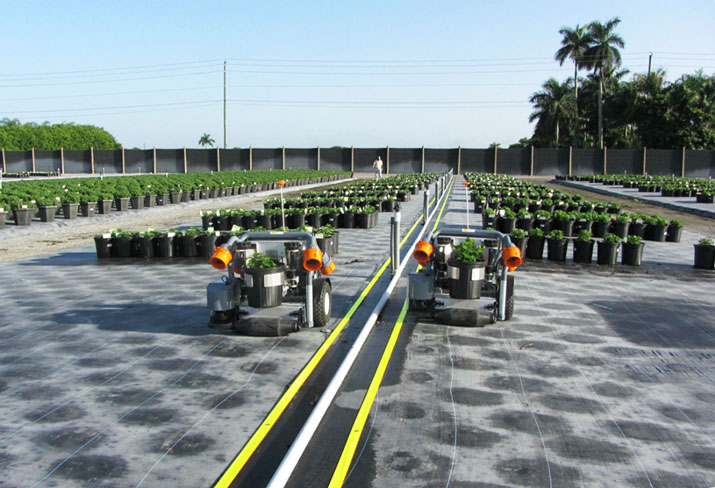
$this->bbcode_second_pass_quote('', 'E')arlier this year, a tree nursery in Florida hired a fleet of robots called HV100 (or "Harvey"), designed by Boston firm Harvest Automation. These Wall-E-like robots autonomously space out saplings as they grow bigger and pack them tightly when it's time to sell them.
Video: https://www.youtube.com/watch?v=p4J8TPOP-OM
A big problem for growers is that spacing is one of the least desirable jobs on the farm. The task involves bending over, picking up one or more containers in each hand (containers weight up to 22 pounds apiece), walking a few steps, and then bending over again to carefully place them in a specific, predefined pattern. Workers do this task daily throughout the growing season under conditions that range from >100°F heat to cold drizzle. The work is seasonal, injuries are common, and pay is low. Labor supply problems are widespread.
The undesirable nature of spacing work results in high turnover; growers find it difficult to predict how many workers will show up on a given day. Shortages lead to triage. When too few workers are available, growers perform only the most urgent jobs and neglect others. Such compromises can affect the yield and quality of the plants and the profitability of the business.
Labor headaches give the nursery and greenhouse industry a strong incentive to adopt robots. In fact, we have encountered virtually no growers who were unwilling to consider using robots.
Robot farmers are the future of agriculture, says government
$this->bbcode_second_pass_quote('', 'A') new vision of robots patrolling the meadows and cornfields of the UK may seem dark and satanic to some, but according to farmers and the government it is the future, and will bring efficiencies and benefits, and an end to some of the most back-breaking jobs around the farm.
An increasing number of "farmbots" are being developed that are capable of finicky and complex tasks that have not been possible with the large-scale agricultural machinery of the past.
For instance, a "lettuce bot" is capable of hoeing away ground weeds from around the base of plants. A "wine bot" trundles through vineyards pruning vines. Other bots are under development to remotely check crops for their growth, moisture and signs of disease.
Are ag-robots ready? 27 companies profiled
$this->bbcode_second_pass_quote('', '[')b]Autonomous machines don't need operators and can operate around the clock. Thus tight operational windows can be achieved for seeding and other time-sensitive activities.
... Modern farmers and ranchers are already high-tech. Digitally-controlled farm implements are regularly in use. There are partially and fully automatic devices for most aspects of agricultural functions from grafting to planting, from harvesting to sorting, packaging and boxing. Farmers use software systems and aerial survey maps and data to guide their field operations. They also use auto-steer systems included in many new tractors (or buy kits that do the same thing) which follow GPS and software guidance. Some farmers are already transitioning some of their operations to full autonomy. Thus forward-thinking farm owners today may be able to skip over slow, incremental improvements and jump directly to robotic and autonomous automation. But are the robots ready?
In a follow-up to my July, 2014 article “Will agricultural robots arrive in time to keep fruit and vegetable costs down?” this article profiles 27 of the many companies (from conglomerates to start-ups) attempting to provide robotic solutions for farming problems and explores what they are doing, when their products will be available, and at what cost.
Moorehead makes the distinction between “autonomous” systems, or “robots,” and “automated” systems that still require a driver onboard. In farming, automated products such as John Deere’s MachineSync and Claas’ AutoFill and Windrow Guidance have been on the market for a few years now.
“There are three classes of people: those who see. Those who see when they are shown. Those who do not see.” ― Leonardo da Vinci
Insensible before the wave so soon released by callous fate. Affected most, they understand the least, and understanding, when it comes, invariably arrives too late.
Insensible before the wave so soon released by callous fate. Affected most, they understand the least, and understanding, when it comes, invariably arrives too late.
-

vox_mundi - Intermediate Crude

- Posts: 3939
- Joined: Wed 27 Sep 2006, 03:00:00