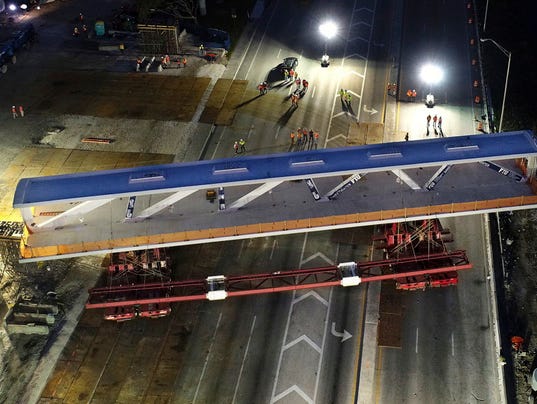
By now you have heard the tragic news about this bridge collapse. As I write this they still don't have a count of how many are trapped dead or alive under the debris.
There is bound to be a lot of finger pointing about just what went wrong but I''ll be willing to guess that somebody will try to pin it on Trump.
At first glance the truss of the bridge looks a little artsy as apposed to pure utilitarian functionality. My statics and structures course was many many moon ago so I can't compute the stresses in the truss members but you can be sure they will all be computed and recomputed in the next few days.
Normally a bridge is designed with a safety factor of at least three meaning it can hold three times the anticipated load without failure. To have this one collapse under it's own weight means a major miscalculation or assembly mistake has occurred.
http://www.miamiherald.com/news/local/c ... 16174.html


PeakOil is You
Florida pedestrian bridge collapse
Florida pedestrian bridge collapse
 by vtsnowedin » Thu 15 Mar 2018, 21:08:56
-

vtsnowedin - Fusion

- Posts: 14897
- Joined: Fri 11 Jul 2008, 03:00:00
Re: Florida pedestrian bridge collapse
by vtsnowedin » Thu 15 Mar 2018, 22:03:38
Looking at the available pictures it looks to me like the top cord or roof failed in two places mid span and the truss members below it punched through the roof. That top cord would be under compression and the instant it failed it was all over.
http://www.miamiherald.com/news/local/c ... LAPSE-6-MI
http://www.miamiherald.com/news/local/c ... LAPSE-6-MI
-
vtsnowedin - Fusion
- Posts: 14897
- Joined: Fri 11 Jul 2008, 03:00:00
Re: Florida pedestrian bridge collapse
by jedrider » Fri 16 Mar 2018, 00:05:07
$this->bbcode_second_pass_quote('', 'A') 174-foot, 950-ton section of the bridge was hoisted into place on Saturday. When finished, the bridge would have been 289 feet long and 109 feet tall.
The bridge was being built under what is called "accelerated bridge construction" methods, which are championed at FIU. The methods basically allow larger pieces to be fabricated away from traffic, rather than assembling lots of smaller pieces above a busy road.
"FIU is about building bridges and student safety. This project accomplishes our mission beautifully," FIU President Mark Rosenberg said after the Saturday installation.
The bridge was being built under what is called "accelerated bridge construction" methods, which are championed at FIU. The methods basically allow larger pieces to be fabricated away from traffic, rather than assembling lots of smaller pieces above a busy road.
"FIU is about building bridges and student safety. This project accomplishes our mission beautifully," FIU President Mark Rosenberg said after the Saturday installation.
Looks to me like the students of FIU got some first hand experience of civil engineering. Someone didn't do their homework.
If you look at the structure, you have to wonder what holds it up? Now we know.
Evidently, their new construction method maybe forgot to calculate stresses at intermediate stages of their 'rapid' construction technique.
I must have a good idea of what will stand and what won't: We had an elevated freeway in Oakland collapse during the 1989 Loma Prieta earthquake and I was always afraid of driving over or under it. Couldn't anyone else see that? Then there is this New York skyscraper that always gave me the creeps, but I knew that it was completely intentional. However, it too was found to be vulnerable to collapse.
http://www.slate.com/blogs/the_eye/2014/04/17/the_citicorp_tower_design_flaw_that_could_have_wiped_out_the_skyscraper.html
-

jedrider - Intermediate Crude

- Posts: 3107
- Joined: Thu 28 May 2009, 10:10:44
Re: Florida pedestrian bridge collapse
by Cog » Fri 16 Mar 2018, 07:39:41
Evidently this is designed to be a cable suspension bridge and the engineering firm was putting tension on some cables. When either the anchor point or crane failed it created a shock load on the bridge. Why anyone thought you should have traffic under it when you are doing something like this is beyond me.
From Marco Rubio twitter:
The cables that suspend the #Miami bridge had loosened & the engineering firm ordered that they be tightened. They were being tightened when it collapsed today.
I think Rubio is wrong here but there are bridges that are post-tensioned and they were doing something involving that process when it failed.
From Marco Rubio twitter:
The cables that suspend the #Miami bridge had loosened & the engineering firm ordered that they be tightened. They were being tightened when it collapsed today.
I think Rubio is wrong here but there are bridges that are post-tensioned and they were doing something involving that process when it failed.
-

Cog - Fusion
- Posts: 13416
- Joined: Sat 17 May 2008, 03:00:00
- Location: Northern Kekistan
Re: Florida pedestrian bridge collapse
by Cog » Fri 16 Mar 2018, 07:59:33
One more thing. The city was adamant that traffic not be blocked during the construction process. Which is why the bulk of the bridge was constructed off site and moved into place. Bad call in retrospect.
-
Cog - Fusion
- Posts: 13416
- Joined: Sat 17 May 2008, 03:00:00
- Location: Northern Kekistan
Re: Florida pedestrian bridge collapse
by vtsnowedin » Fri 16 Mar 2018, 08:32:20
Yes this rapid construction process is all the rage and sometimes I think they throw in unreasonable requirements just so they can use the method and get an award or promotion. There is no glory in just putting in a temporary bridge and doing things the old fashioned way. Perhaps after this disaster they will rethink their enthusiasm for the method?
.
.
-
vtsnowedin - Fusion
- Posts: 14897
- Joined: Fri 11 Jul 2008, 03:00:00
Re: Florida pedestrian bridge collapse
by yellowcanoe » Fri 16 Mar 2018, 08:56:35
$this->bbcode_second_pass_quote('vtsnowedin', 'Y')es this rapid construction process is all the rage and sometimes I think they throw in unreasonable requirements just so they can use the method and get an award or promotion. There is no glory in just putting in a temporary bridge and doing things the old fashioned way. Perhaps after this disaster they will rethink their enthusiasm for the method?
.
.
The old fashioned way involved rerouting traffic around the construction site for an extended period of time. Here in Ottawa a number of bridges on the expressway that runs through the center of the city have been replaced in recent years using a rapid bridge replacement procedure. New bridge sections (one for the east bound lanes and one for the west bound lanes) are built off site. Traffic needs to be rerouted for less than 72 hours on a long weekend in the summer to enable demolition of the old bridge sections and installation of the new bridge sections. This has worked well and is far more preferable to having many months of traffic disruption.
"new housing construction" is spelled h-a-b-i-t-a-t d-e-s-t-r-u-c-t-i-o-n.
- yellowcanoe
- Tar Sands

- Posts: 965
- Joined: Fri 15 Nov 2013, 14:42:27
- Location: Ottawa, Canada
Re: Florida pedestrian bridge collapse
by vtsnowedin » Fri 16 Mar 2018, 10:04:38
$this->bbcode_second_pass_quote('yellowcanoe', '')$this->bbcode_second_pass_quote('vtsnowedin', 'Y')es this rapid construction process is all the rage and sometimes I think they throw in unreasonable requirements just so they can use the method and get an award or promotion. There is no glory in just putting in a temporary bridge and doing things the old fashioned way. Perhaps after this disaster they will rethink their enthusiasm for the method?
.
.
The old fashioned way involved rerouting traffic around the construction site for an extended period of time. Here in Ottawa a number of bridges on the expressway that runs through the center of the city have been replaced in recent years using a rapid bridge replacement procedure. New bridge sections (one for the east bound lanes and one for the west bound lanes) are built off site. Traffic needs to be rerouted for less than 72 hours on a long weekend in the summer to enable demolition of the old bridge sections and installation of the new bridge sections. This has worked well and is far more preferable to having many months of traffic disruption.
One of the last state jobs I worked on was a 20 million dollar upgrade to an exit with 60,000 vehicles a day and five bridges. We built widened lanes and temporary bridge widening s to provide a new lane before any old lane was closed. Much of the work on the commercial street under the interstate was done at night so all traffic was free flowing or at least as much as it would be under normal traffic light control. The costs of the temporary lanes was some two million dollars. There is more then one way to skin a cat.
-
vtsnowedin - Fusion
- Posts: 14897
- Joined: Fri 11 Jul 2008, 03:00:00