
$this->bbcode_second_pass_quote('', '[')img]https://3c1703fe8d.site.internapcdn.net/newman/csz/news/800/2017/unseenplanet.png[/img]
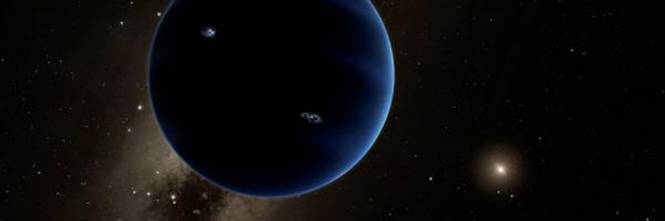
An unknown, unseen "planetary mass object" may lurk in the outer reaches of our solar system, according to new research on the orbits of minor planets to be published in the Astronomical Journal. This object would be different from—and much closer than—the so-called Planet Nine, a planet whose existence yet awaits confirmation.
In the paper, Kat Volk and Renu Malhotra of the University of Arizona's Lunar and Planetary Laboratory, or LPL, present compelling evidence of a yet-to-be- discovered planetary body with a mass somewhere between that of Mars and Earth. The mysterious mass, the authors show, has given away its presence—for now—only by controlling the orbital planes of a population of space rocks known as Kuiper Belt objects, or KBOs, in the icy outskirts of the solar system.
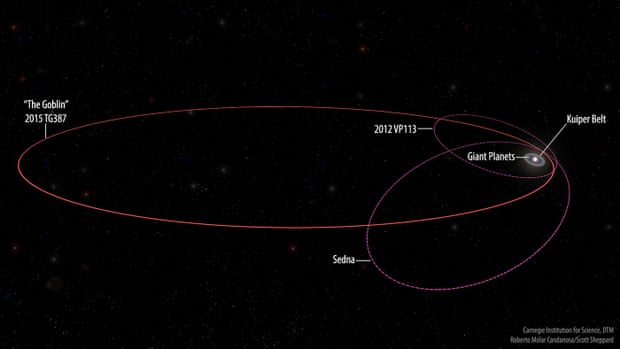
While most KBOs—debris left over from the formation of the solar system—orbit the sun with orbital tilts (inclinations) that average out to what planetary scientists call the invariable plane of the solar system, the most distant of the Kuiper Belt's objects do not. Their average plane, Volk and Malhotra discovered, is tilted away from the invariable plane by about eight degrees. In other words, something unknown is warping the average orbital plane of the outer solar system.
"The most likely explanation for our results is that there is some unseen mass," says Volk, a postdoctoral fellow at LPL and the lead author of the study. "According to our calculations, something as massive as Mars would be needed to cause the warp that we measured."
In other words, the effect is most likely a real signal rather than a statistical fluke. According to the calculations, an object with the mass of Mars orbiting roughly 60 AU from the sun on an orbit tilted by about eight degrees (to the average plane of the known planets) has sufficient gravitational influence to warp the orbital plane of the distant KBOs within about 10 AU to either side.
"The observed distant KBOs are concentrated in a ring about 30 AU wide and would feel the gravity of such a planetary mass object over time," Volk said, "so hypothesizing one planetary mass to cause the observed warp is not unreasonable across that distance."
This rules out the possibility that the postulated object in this case could be the hypothetical Planet Nine, whose existence has been suggested based on other observations. That planet is predicted to be much more massive (about 10 Earth masses) and much farther out at 500 to 700 AU.
"That is too far away to influence these KBOs," Volk said. "It certainly has to be much closer than 100 AU to substantially affect the KBOs in that range."

Because a planet, by definition, has to have cleared its orbit of minor planets such as KBOs, the authors refer to the hypothetical mass as a planetary mass object. The data also do not rule out the possibility that the warp could result from more than one planetary mass object.
The most likely place a planetary mass object could be hiding would be in the galactic plane, an area so densely packed with stars that solar system surveys tend to avoid it.
"The chance that we have not found such an object of the right brightness and distance simply because of the limitations of the surveys is estimated to be to about 30 percent," Volk said.
A possible alternative to an unseen object that could have ruffled the plane of outer Kuiper Belt objects could be a star that buzzed the solar system in recent (by astronomical standards) history, the authors said.
"A passing star would draw all the 'spinning tops' in one direction," Malhotra said. "Once the star is gone, all the KBOs will go back to precessing around their previous plane. That would have required an extremely close passage at about 100 AU, and the warp would be erased within 10 million years, so we don't consider this a likely scenario."
http://www.skyandtelescope.com/astronom ... -planet-x/