Donate Bitcoin

Donate Paypal


PeakOil is You

PeakOil is You

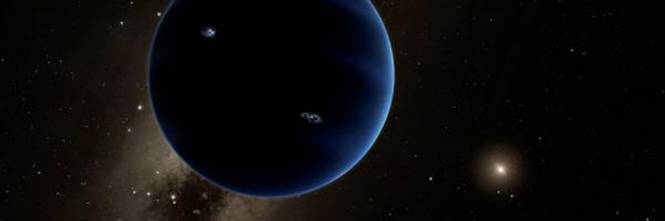
Planet 9 - The Great Perturber

What's on your mind?
General interest discussions, not necessarily related to depletion.

Re: Planet 9 - The Great Perturber

Unread postby vox_mundi » Thu 22 Jun 2017, 12:25:32

New Wrinkles in the Search for “Planet X”: Unseen 'Planetary Mass Object' Signalled by Warped Kuiper Belt

$this->bbcode_second_pass_quote('', '[')img]https://3c1703fe8d.site.internapcdn.net/newman/csz/news/800/2017/unseenplanet.png[/img]

An unknown, unseen "planetary mass object" may lurk in the outer reaches of our solar system, according to new research on the orbits of minor planets to be published in the Astronomical Journal. This object would be different from—and much closer than—the so-called Planet Nine, a planet whose existence yet awaits confirmation.

In the paper, Kat Volk and Renu Malhotra of the University of Arizona's Lunar and Planetary Laboratory, or LPL, present compelling evidence of a yet-to-be- discovered planetary body with a mass somewhere between that of Mars and Earth. The mysterious mass, the authors show, has given away its presence—for now—only by controlling the orbital planes of a population of space rocks known as Kuiper Belt objects, or KBOs, in the icy outskirts of the solar system.

While most KBOs—debris left over from the formation of the solar system—orbit the sun with orbital tilts (inclinations) that average out to what planetary scientists call the invariable plane of the solar system, the most distant of the Kuiper Belt's objects do not. Their average plane, Volk and Malhotra discovered, is tilted away from the invariable plane by about eight degrees. In other words, something unknown is warping the average orbital plane of the outer solar system.

"The most likely explanation for our results is that there is some unseen mass," says Volk, a postdoctoral fellow at LPL and the lead author of the study. "According to our calculations, something as massive as Mars would be needed to cause the warp that we measured."

In other words, the effect is most likely a real signal rather than a statistical fluke. According to the calculations, an object with the mass of Mars orbiting roughly 60 AU from the sun on an orbit tilted by about eight degrees (to the average plane of the known planets) has sufficient gravitational influence to warp the orbital plane of the distant KBOs within about 10 AU to either side.

"The observed distant KBOs are concentrated in a ring about 30 AU wide and would feel the gravity of such a planetary mass object over time," Volk said, "so hypothesizing one planetary mass to cause the observed warp is not unreasonable across that distance."

This rules out the possibility that the postulated object in this case could be the hypothetical Planet Nine, whose existence has been suggested based on other observations. That planet is predicted to be much more massive (about 10 Earth masses) and much farther out at 500 to 700 AU.

"That is too far away to influence these KBOs," Volk said. "It certainly has to be much closer than 100 AU to substantially affect the KBOs in that range."

Image

Because a planet, by definition, has to have cleared its orbit of minor planets such as KBOs, the authors refer to the hypothetical mass as a planetary mass object. The data also do not rule out the possibility that the warp could result from more than one planetary mass object.

The most likely place a planetary mass object could be hiding would be in the galactic plane, an area so densely packed with stars that solar system surveys tend to avoid it.

"The chance that we have not found such an object of the right brightness and distance simply because of the limitations of the surveys is estimated to be to about 30 percent," Volk said.

A possible alternative to an unseen object that could have ruffled the plane of outer Kuiper Belt objects could be a star that buzzed the solar system in recent (by astronomical standards) history, the authors said.

"A passing star would draw all the 'spinning tops' in one direction," Malhotra said. "Once the star is gone, all the KBOs will go back to precessing around their previous plane. That would have required an extremely close passage at about 100 AU, and the warp would be erased within 10 million years, so we don't consider this a likely scenario."
http://www.skyandtelescope.com/astronom ... -planet-x/
“There are three classes of people: those who see. Those who see when they are shown. Those who do not see.” ― Leonardo da Vinci

Insensible before the wave so soon released by callous fate. Affected most, they understand the least, and understanding, when it comes, invariably arrives too late.
User avatar
vox_mundi
Intermediate Crude
Intermediate Crude
 
Posts: 3939
Joined: Wed 27 Sep 2006, 03:00:00

Re: Planet 9 - The Great Perturber

Unread postby vox_mundi » Wed 18 Oct 2017, 11:04:54

Evidence is Growing for Existence of Planet Nine

$this->bbcode_second_pass_quote('', '[')b]Astronomers announced in 2016 that a Planet 9 might exist. Their theory was based on the way some trans-Neptunian objects (TNOs behave.

The new research announced on October 17 works with the orbits of trans-Neptunian objects, too. It’s led by Juliette Becker, a graduate student in the Department of Astronomy at University of Michigan. Becker’s work consists of a large set of computer simulations, which, the researchers say, uncovered two findings about trans-Neptunian objects, also known as TNOs. Their statement explained:
$this->bbcode_second_pass_quote('', '[')i]First, the researchers established a version of Planet 9 that would most likely cause our solar system to look the way it currently does, by preventing the TNOs from being destroyed or thrown out of the solar system.

Second, the simulations predict that there is a process that they call resonance hopping by which a TNO jumps between stable orbits. This process can prevent the TNOs from being ejected from the solar system.

There are now five different lines of observational evidence pointing to the existence of Planet 9. If you were to remove this explanation and imagine Planet 9 does not exist, then you generate more problems than you solve. All of a sudden, you have five different puzzles, and you must come up with five different theories to explain them.

… it is now harder to imagine our solar system without a Planet 9 than with one.


Evaluating the Dynamical Stability of Outer Solar System Objects in the Presence of Planet Nine, https://arxiv.org/abs/1706.06609
“There are three classes of people: those who see. Those who see when they are shown. Those who do not see.” ― Leonardo da Vinci

Insensible before the wave so soon released by callous fate. Affected most, they understand the least, and understanding, when it comes, invariably arrives too late.
User avatar
vox_mundi
Intermediate Crude
Intermediate Crude
 
Posts: 3939
Joined: Wed 27 Sep 2006, 03:00:00

Re: Planet 9 - The Great Perturber

Unread postby vox_mundi » Fri 18 May 2018, 11:34:25

A Newly Discovered Solar System Object Hints at Hidden Planet Nine

$this->bbcode_second_pass_quote('', '[')b]Astronomers found a strange dwarf world that provides even more evidence that a giant planet is lurking at the edge of our solar system.

Image

Astronomers have speculated for a few years that a ninth planet may be orbiting the sun at a great distance, and have spent the past few years searching for it. They first started the hunt back in 2016 after looking at a handful of distant solar system objects and noticing something strange. These objects, all orbiting further away than Pluto, had something similar in common: they orbited the sun at a distinct angle from all of the inner planets.

The observations suggests the gravitational influence of another planet is altering the distant objects' orbits. Now additional findings of a newly discovered planetary object with an odd orbit support the case for an undiscovered Planet Nine. The new object, called 2015 BP519, takes an elliptical journey around the Sun spanning from 35 to 862 times the radius of Earth’s own orbit. 2015 BP519 orbits at a 54 degree angle compared to nearly everything in the inner solar system, and the theory is that Planet Nine is responsible.
$this->bbcode_second_pass_quote('', '[')b]In the new paper, they describe how they ran many simulations of the object within the known solar system, letting the clock run forward and backward 4.5 billion years at a time. Nothing could explain how the object landed in such a tilted orbit. It wasn’t until they added in a ninth planet — a planet with characteristics that perfectly match Batygin and Brown’s predictions — that the wacky orbit finally made sense. “The second you put Planet Nine in the simulations, not only can you form objects like this object, but you absolutely do,” said Juliette Becker, a graduate student at Michigan and the lead author on the new paper. A strong and sustained interaction with Planet Nine appears to be the only way to pump up the object’s inclination, pushing it away from the plane of the solar system.There is no other reasonable way to populate the Kuiper belt with such highly inclined bodies,” Batygin said. “I think the case for the existence of Planet Nine is now genuinely excellent.”


https://arxiv.org/pdf/1805.05355.pdf

Image
https://twitter.com/dAArkEnergy/status/ ... 8017514497


Could Recent Supernovae Be Responsible For Mass Extinctions?

$this->bbcode_second_pass_quote('', '.').. Looking at the fossil record during the Pliocene–Pleistocene boundary (2.5 million years ago), we see a dramatic change in the fossil record and in land cover globally. Thomas tells Astrobiology Magazinethat "there were changes, especially in Africa, which went from being more forested to more grassland." During this time the geologic record shows an elevated global concentration of iron-60 (60Fe), which is a radioactive isotope produced during a supernova.

Brian C. Thomas. Photobiological Effects at Earth's Surface Following a 50 Parsec Supernova, Astrobiology (2017).
“There are three classes of people: those who see. Those who see when they are shown. Those who do not see.” ― Leonardo da Vinci

Insensible before the wave so soon released by callous fate. Affected most, they understand the least, and understanding, when it comes, invariably arrives too late.
User avatar
vox_mundi
Intermediate Crude
Intermediate Crude
 
Posts: 3939
Joined: Wed 27 Sep 2006, 03:00:00
Top

Re: Planet 9 - The Great Perturber

Unread postby vox_mundi » Tue 02 Oct 2018, 12:07:12

Search for Planet X Gets a Boost with the Discovery of a Super Distant Object

$this->bbcode_second_pass_quote('', '[')img]https://3c1703fe8d.site.internapcdn.net/newman/csz/news/800/2018/2-newextremely.jpg[/img]

Massively elongated orbit suggests object is influenced by theoretical giant Planet Nine in Oort Cloud region

An extremely distant dwarf planet, named The Goblin, has been discovered in observations that are redefining the outer reaches of the solar system.

Astronomers made the discovery while hunting for a hypothetical massive planet, known as Planet Nine, that is suspected to be in orbit far beyond Pluto in a mysterious region known as the Oort Cloud. Planet Nine has not yet been seen directly, but The Goblin appears to be under the gravitational influence of a giant unseen object, adding to astronomers’ certainty that it is out there.
$this->bbcode_second_pass_quote('', '[')b]... “Each time we find another one of these smaller objects, it will lead us to constrain where the bigger planet could be”

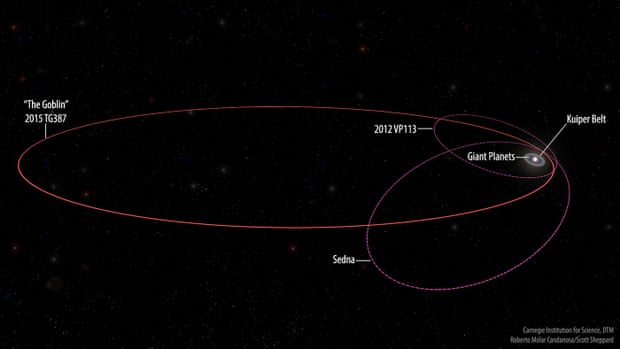
The newly discovered icy world, estimated to be just 300km across, is in an extremely elongated orbit. At its closest, it gets about two and a half times as far from the sun as Pluto. Then it heads off to the outermost fringes of the solar system, to almost 60 times further out than Pluto, taking an astounding 40,000 years to loop once around the sun. For 99% of its orbit, it would be too faint to see.

The tiny rock — eloquently named TG387 and nicknamed “The Goblin” — was spotted by astronomers at the Carnegie Institution of Science using a giant Japanese observatory in Hawaii called Subaru.

Image

Intriguingly the orbits of the three objects discovered so far appear to be clustered together, suggesting that they are being shepherded by a giant, unknown object. This has pointed astronomers to the existence of a ninth, super-Earth sized planet.

Right now, there are 14 far-out space rocks that all share similar orbit patterns, suggesting that this planet is out there. Their paths are all super elongated, and they all cluster together in the same area when they approach the Sun. Plus, their orbits are all tilted alike, and they point in the same general direction, as if something big has pushed them into similar places. These objects are the strongest lines of evidence astronomers have for Planet X, and finding a new one that matches this pattern reinforces that idea that this planet is more than just a theory.
“There are three classes of people: those who see. Those who see when they are shown. Those who do not see.” ― Leonardo da Vinci

Insensible before the wave so soon released by callous fate. Affected most, they understand the least, and understanding, when it comes, invariably arrives too late.
User avatar
vox_mundi
Intermediate Crude
Intermediate Crude
 
Posts: 3939
Joined: Wed 27 Sep 2006, 03:00:00
Top

Re: Planet 9 - The Great Perturber

Unread postby onlooker » Tue 02 Oct 2018, 12:22:43

UFOs THE BEST EVIDENCE 2: The Government CoverUp - FEATURE FILM

https://www.youtube.com/watch?v=vYLLoHzMbkM&t=76s
"We are mortal beings doomed to die
User avatar
onlooker
Fission
Fission
 
Posts: 10957
Joined: Sun 10 Nov 2013, 13:49:04
Location: NY, USA

Re: Planet 9 - The Great Perturber

Unread postby vox_mundi » Tue 02 Oct 2018, 13:40:17

The Truth is Out There onlooker ...

$this->bbcode_second_pass_quote('', '[')img]https://vignette.wikia.nocookie.net/x-files/images/0/0c/Cigarette_Smoking_Man_%281992%29.jpg/revision/latest/scale-to-width-down/180?cb=20051209141358[/img] Image

They're just keepin' it to themselves.
$this->bbcode_second_pass_quote('', '[')img]https://3.bp.blogspot.com/-XyweNCjH_ps/Vvi0Jgb1f6I/AAAAAAAAAxM/OO-4MrmzhkMbRlBQvJ2ehiCBqHgWoZjow/s600/Exoplanets%2Bwithin%2B20%2Bpc-2016-dimmer-names.gif[/img]
73 exoplanetary host stars sorted by distance from our Sun. Spectral types are indicated by the color key at lower right. The inner circle has a radius of 5 parsecs, and each successive ring represents an increment of 5 parsecs.

Image
Number of ExoPlanets - Range: 10 Parsecs
http://backalleyastronomy.blogspot.com/ ... rsecs.html
“There are three classes of people: those who see. Those who see when they are shown. Those who do not see.” ― Leonardo da Vinci

Insensible before the wave so soon released by callous fate. Affected most, they understand the least, and understanding, when it comes, invariably arrives too late.
User avatar
vox_mundi
Intermediate Crude
Intermediate Crude
 
Posts: 3939
Joined: Wed 27 Sep 2006, 03:00:00
Top

Previous

Return to Open Topic Discussion

Who is online

Users browsing this forum: No registered users and 0 guests

cron