
PeakOil is You
Running the US Power Grid on 100% Renewables
Re: Running the US Power Grid on 100% Renewables
 by Cog » Sun 25 Jun 2017, 09:30:31
Renewables will grow in use when the economic conditions justify them.
-

Cog - Fusion

- Posts: 13416
- Joined: Sat 17 May 2008, 03:00:00
- Location: Northern Kekistan
Re: Running the US Power Grid on 100% Renewables
by KaiserJeep » Sun 25 Jun 2017, 09:56:46
Gentlefolk, don't go all simplistic about this. The dieoff as you are calling it, will be just as unevenly distribuited as was the FF-powered population surge that endangered the world. The most vulnerable people are those who only exist because of all that FF-powered food production.
So ask yourselves what will the average US citizen do as fuel costs climb and the 3rd world starves? The process of the end of oil will gradually worsen over a period of years, it's not like throwing a switch or running off a cliff. Nor are we as vulnerable as they, we in the USA only spend about 6% of our income on food. Lots of income elasticity there to accomodate and compensate for newly expensive food, delivered by newly expensive transport, and cooked on newly expensive kitchen fuels.
Granted, US citizens will scream to high heaven as the world changes and they by necessity must beome obsessed with food. Our lifestyles will change dramatically over a span of years. Government checks will not feed those who have retired or live on welfare. There will be hardships on display on the nightly news, and the Internet will positively be ablaze.
I believe it will be the Apocalypse for the two groups of criminals we call Democrats and Republicans. It happened on their watch, and if anybody looks too comfortable, they obviously knew about the coming emergency, they should be the first to be lynched. The 1% are also legitimate targets, in a country where even the lower class has easy access to guns.
The times they will be changing, and the country will change with it. I have been deliberately a little vague, because such catastrophies as this are unprecedented, as will be our response. Such hardships as are to come may cause nobility to break out all around us, and a sharing of food, and caring for the disadvataged.
Except that is not what ape tribes do when faced with a food shortage. Apes attack their neighboring tribes and take their food and consume it, and then consume their neighbors themselves if things continue to worsen. It is only when things reach their most desperate that apes consume their own tribal members.
BTW, them city dwelling people are not in MY tribe.
I am desperately hoping that when it is apparent to all that the FF's will run out, we will still have the where-with-all to do the power down and to transition to renewables. I agree with the assessment about that above which says such things are not happening until the situation is desperate and obvious to all. I plan to own land that will let me grow food, and a house that does not depend upon FF's to operate. If not many of my neighbors have what I have, then they can superinsulate what they do have. Within the shell of every average 2400-sq. ft. home can be built a 500-sq. ft. home, by building a partition three feet thick and filling it with straw or shredded paper. You can similarly abandon one floor and live in a basement or the first floor of a 2-story home, adding insulation above. Note that Europe already has 10s of thousands of superinsulated Passive Homes, and that Norway has already got 98% carbon-free power. (The way they measure that is questionable.)
Affluent 1st World citizens have options, is the point I am making. Options not available to 3rd World people living in shacks and already malnourished. We will survive, adapt, and eventually prosper in a smaller sense, and they will die.
One final thought for you: In case you missed it, the process of the end of the world began decades ago.
So ask yourselves what will the average US citizen do as fuel costs climb and the 3rd world starves? The process of the end of oil will gradually worsen over a period of years, it's not like throwing a switch or running off a cliff. Nor are we as vulnerable as they, we in the USA only spend about 6% of our income on food. Lots of income elasticity there to accomodate and compensate for newly expensive food, delivered by newly expensive transport, and cooked on newly expensive kitchen fuels.
Granted, US citizens will scream to high heaven as the world changes and they by necessity must beome obsessed with food. Our lifestyles will change dramatically over a span of years. Government checks will not feed those who have retired or live on welfare. There will be hardships on display on the nightly news, and the Internet will positively be ablaze.
I believe it will be the Apocalypse for the two groups of criminals we call Democrats and Republicans. It happened on their watch, and if anybody looks too comfortable, they obviously knew about the coming emergency, they should be the first to be lynched. The 1% are also legitimate targets, in a country where even the lower class has easy access to guns.
The times they will be changing, and the country will change with it. I have been deliberately a little vague, because such catastrophies as this are unprecedented, as will be our response. Such hardships as are to come may cause nobility to break out all around us, and a sharing of food, and caring for the disadvataged.
Except that is not what ape tribes do when faced with a food shortage. Apes attack their neighboring tribes and take their food and consume it, and then consume their neighbors themselves if things continue to worsen. It is only when things reach their most desperate that apes consume their own tribal members.
BTW, them city dwelling people are not in MY tribe.
I am desperately hoping that when it is apparent to all that the FF's will run out, we will still have the where-with-all to do the power down and to transition to renewables. I agree with the assessment about that above which says such things are not happening until the situation is desperate and obvious to all. I plan to own land that will let me grow food, and a house that does not depend upon FF's to operate. If not many of my neighbors have what I have, then they can superinsulate what they do have. Within the shell of every average 2400-sq. ft. home can be built a 500-sq. ft. home, by building a partition three feet thick and filling it with straw or shredded paper. You can similarly abandon one floor and live in a basement or the first floor of a 2-story home, adding insulation above. Note that Europe already has 10s of thousands of superinsulated Passive Homes, and that Norway has already got 98% carbon-free power. (The way they measure that is questionable.)
Affluent 1st World citizens have options, is the point I am making. Options not available to 3rd World people living in shacks and already malnourished. We will survive, adapt, and eventually prosper in a smaller sense, and they will die.
One final thought for you: In case you missed it, the process of the end of the world began decades ago.
Last edited by KaiserJeep on Sun 25 Jun 2017, 10:20:30, edited 3 times in total.
KaiserJeep 2.0, Neural Subnode 0010 0000 0001 0110 - 1001 0011 0011, Tertiary Adjunct to Unimatrix 0000 0000 0001
Resistance is Futile, YOU will be Assimilated.
Warning: Messages timestamped before April 1, 2016, 06:00 PST were posted by the unmodified human KaiserJeep 1.0
Resistance is Futile, YOU will be Assimilated.
Warning: Messages timestamped before April 1, 2016, 06:00 PST were posted by the unmodified human KaiserJeep 1.0
- KaiserJeep
- Light Sweet Crude

- Posts: 6094
- Joined: Tue 06 Aug 2013, 17:16:32
- Location: Wisconsin's Dreamland
Re: Running the US Power Grid on 100% Renewables
by asg70 » Sun 25 Jun 2017, 11:00:28
$this->bbcode_second_pass_quote('baha', '
')I've made some predictions here that may come back to bite me So I'll stick my neck out and predict in 50 years there will be a whole industry devoted to removing CO2 from the air, turning it to limestone, and using it to fill old strip mines.
')I've made some predictions here that may come back to bite me
So I'll stick my neck out and predict in 50 years there will be a whole industry devoted to removing CO2 from the air, turning it to limestone, and using it to fill old strip mines.That would be an optimistic scenario, like if fusion power (or even thorium nukes) comes of age. We won't have enough surplus energy to do it purely on the backs of renewables.
More likely agriculture will fail due to AGW and the world will be busy filing themselves into smaller and smaller lifeboats and beating back starving refugees (aka zombies).
(Of course, every time I issue my doom scenario it's ignored by those who claim I'm a corny because my narrative is a little further downfield and doesn't emphasize oil depletion.)
BOLD PREDICTIONS
-Billions are on the verge of starvation as the lockdown continues. (yoshua, 5/20/20)
HALL OF SHAME:
-Short welched on a bet and should be shunned.
-Frequent-flyers should not cry crocodile-tears over climate-change.
- asg70
- Permanently Banned
- Posts: 4289
- Joined: Sun 05 Feb 2017, 14:17:28
Re: Running the US Power Grid on 100% Renewables
by asg70 » Sun 25 Jun 2017, 13:35:18
$this->bbcode_second_pass_quote('pstarr', '
')The US will never change voluntarily.
')The US will never change voluntarily.
I'm seeing tons of solar panels on roofs these days, many on "wasteful" McMansions.
Change is happening, just not the sort you'd prefer.
$this->bbcode_second_pass_quote('pstarr', '
')We will sink into feudal state nothing like the movies.
Unfortunately the earliest your dystopia can come to pass is still some time in the future so you will have to content yourself with cockily restating your predictions again and again while BAU rolls ever onward.
BOLD PREDICTIONS
-Billions are on the verge of starvation as the lockdown continues. (yoshua, 5/20/20)
HALL OF SHAME:
-Short welched on a bet and should be shunned.
-Frequent-flyers should not cry crocodile-tears over climate-change.
- asg70
- Permanently Banned
- Posts: 4289
- Joined: Sun 05 Feb 2017, 14:17:28
Re: Running the US Power Grid on 100% Renewables
by Newfie » Sun 25 Jun 2017, 14:00:42
Until they come about.
-

Newfie - Forum Moderator
- Posts: 18651
- Joined: Thu 15 Nov 2007, 04:00:00
- Location: Between Canada and Carribean
Re: Running the US Power Grid on 100% Renewables
by Cog » Sun 25 Jun 2017, 14:53:59
Type 2 diabetics will survive this as their need for insulin meds will go away as soon as the pounds melt away. As a matter of fact, a lot of people won't need the meds they are currently prescribed due to their obesity.
If you are a Type 1 diabetic or on various anti-immune drugs from a transplant then yeah you are going to die.
If you are a Type 1 diabetic or on various anti-immune drugs from a transplant then yeah you are going to die.
-
Cog - Fusion
- Posts: 13416
- Joined: Sat 17 May 2008, 03:00:00
- Location: Northern Kekistan
Re: Running the US Power Grid on 100% Renewables
by Plantagenet » Sun 25 Jun 2017, 20:26:59
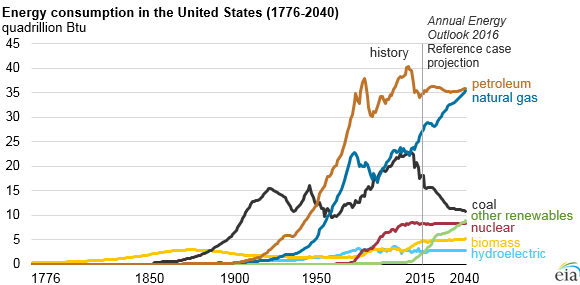
Unfortunately the US Power Grid isn't actually switching to renewables---its switching from coal to Natural Gas.
Cheers!
Never underestimate the ability of Joe Biden to f#@% things up---Barack Obama
-----------------------------------------------------------
Keep running between the raindrops.
-----------------------------------------------------------
Keep running between the raindrops.
-

Plantagenet - Expert

- Posts: 26765
- Joined: Mon 09 Apr 2007, 03:00:00
- Location: Alaska (its much bigger than Texas).
Re: Running the US Power Grid on 100% Renewables
by Plantagenet » Sun 25 Jun 2017, 21:11:11
$this->bbcode_second_pass_quote('baha', '
')Plantagenet - Thank you too. I always love your pretty pictures You aren't paying attention. I didn't say anything about the grid switching to renewables...I said burn the damn thing down 
')Plantagenet - Thank you too. I always love your pretty pictures
You aren't paying attention. I didn't say anything about the grid switching to renewables...I said burn the damn thing down You're welcome haha.
Please note that the title of this thread is "Running the US Power Grid on 100% Renewables"
Please also note that if you follow through on your wish to burn the grid down you will be committing multiple felonies.
Cheers!
Never underestimate the ability of Joe Biden to f#@% things up---Barack Obama
-----------------------------------------------------------
Keep running between the raindrops.
-----------------------------------------------------------
Keep running between the raindrops.
-
Plantagenet - Expert
- Posts: 26765
- Joined: Mon 09 Apr 2007, 03:00:00
- Location: Alaska (its much bigger than Texas).