
Donate Bitcoin

Donate Paypal


PeakOil is You

PeakOil is You

Has Kepler Discovered an Alien Megastructure?

What's on your mind?
General interest discussions, not necessarily related to depletion.

Re: Has Kepler Discovered an Alien Megastructure?

Postby Newfie » Mon 18 Jan 2016, 17:05:06

Thanks
User avatar
Newfie
Forum Moderator
Forum Moderator
 
Posts: 18651
Joined: Thu 15 Nov 2007, 04:00:00
Location: Between Canada and Carribean

Re: Has Kepler Discovered an Alien Megastructure?

Postby vox_mundi » Thu 21 Jan 2016, 12:36:47

The aliens are silent because they're dead

$this->bbcode_second_pass_quote('', 'I')n research aiming to understand how life might develop, the scientists realised new life would commonly die out due to runaway heating or cooling on their fledgling planets.

"The universe is probably filled with habitable planets, so many scientists think it should be teeming with aliens," said Dr Aditya Chopra from the ANU Research School of Earth Sciences and lead author on the paper, which is published in Astrobiology. (The Case for a Gaian Bottleneck: The Biology of Habitability

"Early life is fragile, so we believe it rarely evolves quickly enough to survive."

"Most early planetary environments are unstable. To produce a habitable planet, life forms need to regulate greenhouse gases such as water and carbon dioxide to keep surface temperatures stable."

A plausible solution to Fermi's paradox, say the researchers, is near universal early extinction, which they have named the Gaian Bottleneck.

"One intriguing prediction of the Gaian Bottleneck model is that the vast majority of fossils in the universe will be from extinct microbial life, not from multicellular species such as dinosaurs or humanoids that take billions of years to evolve," said Associate Professor Lineweaver.
“There are three classes of people: those who see. Those who see when they are shown. Those who do not see.” ― Leonardo da Vinci

Insensible before the wave so soon released by callous fate. Affected most, they understand the least, and understanding, when it comes, invariably arrives too late.
User avatar
vox_mundi
Intermediate Crude
Intermediate Crude
 
Posts: 3939
Joined: Wed 27 Sep 2006, 03:00:00

Re: Has Kepler Discovered an Alien Megastructure?

Postby Rod_Cloutier » Thu 21 Jan 2016, 23:43:20

SETI, the search for Extraterrestrial intelligence is taking this matter seriously, and are looking for radio or laser transmissions:

$this->bbcode_second_pass_quote('', 'T')o investigate this idea, we have been using the Allen Telescope Array to search for non-natural radio signals from the direction of KIC 8462852. This effort is looking for both narrow-band signals (similar to traditional SETI experiments) as well as somewhat broader transmissions that might be produced, for example, by powerful spacecraft.

But what if ET isn’t signaling at radio frequencies? Our ATA observations are being augmented by a search for brief but powerful laser pulses. These observations are being conducted by the Boquete Optical SETI Observatory in Panama, part of a nascent global network of optical SETI observatories.


http://www.seti.org/seti-institute/myst ... ic-8462852

You can participate with SETI at home at this link yourselves:

http://setiathome.ssl.berkeley.edu/

(I have been participating in this way myself since 2004)
Rod_Cloutier
Heavy Crude
Heavy Crude
 
Posts: 1448
Joined: Fri 20 Aug 2004, 03:00:00
Location: Winnipeg, Canada

Re: Has Kepler Discovered an Alien Megastructure?

Postby vox_mundi » Mon 08 Aug 2016, 16:45:43


The So-Called Alien Megastructure Just Got Even More Mysterious


$this->bbcode_second_pass_quote('', '[')img]http://pop.h-cdn.co/assets/16/31/980x490/landscape-1470507596-starz.png[/img]

Last fall, a little-known star called KIC 8462852 became our planetary obsession when astronomers said that its erratic flickering could be the result of an alien megastructure. Further observation of Tabby’s Star yielded no signs of aliens, but the sudden dips in luminosity continue to defy explanation. Now, things just got a bit weirder.

In an unpublished paper posted today to arXiv, Caltech astronomer Ben Montet and Joshua Simon of the Carnegie Institute describe the results of a new photometric analysis of Tabby’s Star, which was first flagged in the Kepler Space Telescope’s database by citizen science astronomers.

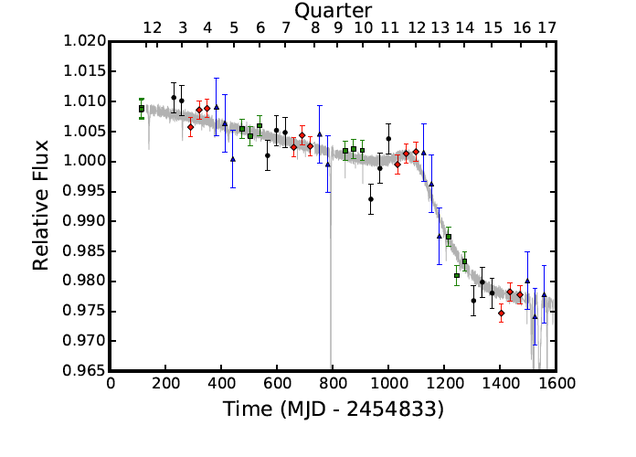
By carefully examining all the full-frame images collected during Kepler’s observational campaign, Montet and Simon discovered something astonishing: Not only did the star’s light output occasionally dip by up to 20 percent, its total stellar flux diminished continuously over the course of four years.

For the first 1000 days of Kepler’s campaign, Tabby’s Star decreased in luminosity by approximately 0.34 percent per year. For the next 200 days, the star dimmed more rapidly, its total stellar flux dropping by 2 percent before leveling off. Overall, Tabby’s Star faded roughly 3 percent during the four years that Kepler stared at it—an absolutely enormous, inexplicable amount. The astronomers looked at 500 other stars in the vicinity, and saw nothing else like it.

“The part that really surprised me was just how rapid and non-linear it was,” Montet told Gizmodo. “We spent a long time trying to convince ourselves this wasn’t real. We just weren’t able to.”
Image
“There are three classes of people: those who see. Those who see when they are shown. Those who do not see.” ― Leonardo da Vinci

Insensible before the wave so soon released by callous fate. Affected most, they understand the least, and understanding, when it comes, invariably arrives too late.
User avatar
vox_mundi
Intermediate Crude
Intermediate Crude
 
Posts: 3939
Joined: Wed 27 Sep 2006, 03:00:00

Re: Has Kepler Discovered an Alien Megastructure?

Postby Plantagenet » Mon 08 Aug 2016, 17:23:10

The aliens and their robots building the Alien Megastructure around the star finish one part of the structure, and then they start another part. They get the framework done, and they star installing walls and solar energy collectors.

Of course the effects on the star's apparent intensity are nonlinear. The construction of the megastructure is itself a non-linear process.

Image
User avatar
Plantagenet
Expert
Expert
 
Posts: 26765
Joined: Mon 09 Apr 2007, 03:00:00
Location: Alaska (its much bigger than Texas).

Re: Has Kepler Discovered an Alien Megastructure?

Postby Newfie » Mon 08 Aug 2016, 17:29:27

I think you would faint if you were correct.

Except of course it makes perfect sense.
User avatar
Newfie
Forum Moderator
Forum Moderator
 
Posts: 18651
Joined: Thu 15 Nov 2007, 04:00:00
Location: Between Canada and Carribean

Re: Has Kepler Discovered an Alien Megastructure?

Postby vox_mundi » Mon 08 Aug 2016, 19:58:11

How to Build a RingWorld

$this->bbcode_second_pass_quote('', '[')img]http://pop.h-cdn.co/assets/cm/15/05/640x400/54cb4a7167d5b_-_ringworld-03-0914-de.jpg[/img]

Sci-fi author Larry Niven conjured up such a megastructure for his award-winning 1970 book Ringworld. Niven imagined a ring with a radius of 93 million miles—the sun-Earth distance—with the sun placed at the center. The ring' would reach 600 million miles across and a million miles tall. The vast landscape could comfortably support perhaps trillions of humans (or another similarly ambitious, technologically advanced race).

Image

"The thing is roomy enough: three million times the area of the Earth. It will be some time before anyone complains about the crowding," Niven wrote in a 1974 essay entitled "Bigger Than Worlds."

Niven figured a Ringworld would have a thickness of a few thousand feet, and require raw materials with a mass equal to that of Jupiter. Mountain "walls" a thousand miles high would line each rim, preventing the atmosphere from leaking into space. The inner surface could be sculpted like Earth's surface—full of great (though shallow) oceans, soaring mountains, and prodigious farmland—or whatever its builders desired.


It's Yuuge!!!
“There are three classes of people: those who see. Those who see when they are shown. Those who do not see.” ― Leonardo da Vinci

Insensible before the wave so soon released by callous fate. Affected most, they understand the least, and understanding, when it comes, invariably arrives too late.
User avatar
vox_mundi
Intermediate Crude
Intermediate Crude
 
Posts: 3939
Joined: Wed 27 Sep 2006, 03:00:00
Re: Has Kepler Discovered an Alien Megastructure?

Postby vox_mundi » Fri 12 Aug 2016, 18:46:55

This would be easier ...

Scientists find new Earth-like planet

$this->bbcode_second_pass_quote('', ' ') Scientists are preparing to unveil a new planet in our galactic neighbourhood which is "believed to be Earth-like" and orbits its star at a distance that could favour life, German weekly Der Spiegel reported Friday.

The exoplanet orbits a well-investigated star called Proxima Centauri, part of the Alpha Centauri star system, the magazine said, quoting anonymous sources.

"The still nameless planet is believed to be Earth-like and orbits at a distance to Proxima Centauri that could allow it to have liquid water on its surface—an important requirement for the emergence of life," said the magazine.

"Never before have scientists discovered a second Earth that is so close by," it said, adding that the European Southern Observatory (ESO) will announce the finding at the end of August.

The exoplanet orbiting Proxima Centauri, if confirmed, is just 4.24 light-years away.

This is a mere stepping stone in relation to the scale of the Universe but still too far away for humans to reach in present-generation chemical rockets.

According to NASA's Godard Space Center's website, it lies 39,900,000,000,000 kilometres away, or 271,000 times the distance of Earth to the Sun.


Effects of Proxima Centauri on Planet Formation in Alpha Centauri

$this->bbcode_second_pass_quote('', '[')img]http://images.spaceref.com/news/2016/ooprx.jpg[/img]

Proxima Centauri is an M dwarf approximately 15,000 AU from the Alpha Centauri binary, comoving and likely in a loosely bound orbit.

Dynamic simulations show this configuration can form from a more tightly bound triple system. As our nearest neighbors, these stars command great interest as potential planet hosts, and the dynamics of the stars govern the formation of any planets within the system. Here we present a scenario for the evolution of Alpha Centauri A and B and Proxima Centauri as a triple system. Based on N-body simulations, we determine this pathway to formation is plausible, and we quantify the implications for planet formation in the Alpha Centauri binary.

We expect this formation scenario may have truncated the circumstellar disk slightly more than a system that formed in the current configuration, but that it most likely does not prevent terrestrial planet formation. We simulate planet formation in this system and find that in most scenarios, two or more terrestrial planets can be expected around either Alpha Centauri A or B, orbiting in a region out to approximately 2 AU. Additionally, terrestrial planet formation and stability in Proxima Centauri's habitable zone is also plausible.
“There are three classes of people: those who see. Those who see when they are shown. Those who do not see.” ― Leonardo da Vinci

Insensible before the wave so soon released by callous fate. Affected most, they understand the least, and understanding, when it comes, invariably arrives too late.
User avatar
vox_mundi
Intermediate Crude
Intermediate Crude
 
Posts: 3939
Joined: Wed 27 Sep 2006, 03:00:00
Top

Re: Has Kepler Discovered an Alien Megastructure?

Postby vox_mundi » Mon 29 Aug 2016, 13:24:23

Not a Drill: SETI Is Investigating a Possible Extraterrestrial Signal From Deep Space

$this->bbcode_second_pass_quote('', '[')img]http://www.centauri-dreams.org/wp-content/uploads/2016/08/ratan_2.jpeg[/img]
Strong signal from the direction of HD 164595. “Raw” record of the signal together with expected shape of the signal for point-like source in the position of HD 164595. Credit: Bursov et al.

An international team of scientists from the Search For Extraterrestrial Intelligence (SETI) are investigating mysterious signal spikes emitting from a 6.3 billion year-old star in the constellation Hercules–95 light years away from Earth. The implications are extraordinary and point to the possibility of a civilization far more advanced than our own.

The unusual signal was originally detected on May 15, 2015 by the Russian Academy of Science-operated RATAN-600 radio telescope in Zelenchukskaya, Russia but was kept secret from the international community. Interstellar space reporter Paul Gilster broke the story after the researchers quietly circulated a paper announcing the detection of “a strong signal in the direction of HD164595.”

The mysterious star’s designation is HD164595 and it’s considered to be sun-like in nature with a nearly identical metallic composition to our own star. So far, a single Neptune-like (but warmer) planet has been discovered in its orbit–HD 164595 b. But as Gilster explained, “there could, of course, be other planets still undetected in this system.”

Experts say it is far too early to know what the signal means or where, precisely,it came from.

“The signal is provocative enough that the RATAN-600 researchers are calling for permanent monitoring of this target,” said Gilster. And that’s exactly what is transpiring. As of last night, the SETI institute is diverting its Allen Telescope Array in northern California to investigate while their counterparts at METI International (Messaging Extraterrestrial Intelligence) will utilize Panama’s Boquete Optical Observatory.

“In addition, we need to be alert to the possibility than if we do really find a signal from an advanced civilization, they are also transmitting at other frequencies than the one where we first detected them. That’s why it’s so important to prepare for follow-up SETI observations at both radio and optical frequencies, to be launched as soon as we detect a credible candidate signal at any frequency.”

Image
http://www.geekwire.com/2016/signal-set ... -hd164595/

$this->bbcode_second_pass_quote('', '[')img]http://pop.h-cdn.co/assets/15/27/1435603521-contact-machine.gif[/img]
“There are three classes of people: those who see. Those who see when they are shown. Those who do not see.” ― Leonardo da Vinci

Insensible before the wave so soon released by callous fate. Affected most, they understand the least, and understanding, when it comes, invariably arrives too late.
User avatar
vox_mundi
Intermediate Crude
Intermediate Crude
 
Posts: 3939
Joined: Wed 27 Sep 2006, 03:00:00
Top

Re: Has Kepler Discovered an Alien Megastructure?

Postby Newfie » Mon 29 Aug 2016, 13:55:37

Wow....thanks.

If they are a they and they turn out to be more advanced it proves advancement is possible. A small ray of hope!
User avatar
Newfie
Forum Moderator
Forum Moderator
 
Posts: 18651
Joined: Thu 15 Nov 2007, 04:00:00
Location: Between Canada and Carribean

Re: Has Kepler Discovered an Alien Megastructure?

Postby onlooker » Mon 29 Aug 2016, 14:28:39

Just a wild idea but what if life is getting assistance from advanced ETs(singular or plural ). This would certainly increase the odds of life including intelligent one to survive and prosper
"We are mortal beings doomed to die
User avatar
onlooker
Fission
Fission
 
Posts: 10957
Joined: Sun 10 Nov 2013, 13:49:04
Location: NY, USA

Re: Has Kepler Discovered an Alien Megastructure?

Postby Newfie » Mon 29 Aug 2016, 15:01:25

And who would the first, most advanced, life form be? God?
User avatar
Newfie
Forum Moderator
Forum Moderator
 
Posts: 18651
Joined: Thu 15 Nov 2007, 04:00:00
Location: Between Canada and Carribean

Re: Has Kepler Discovered an Alien Megastructure?

Postby Tanada » Mon 29 Aug 2016, 15:42:11

$this->bbcode_second_pass_quote('Newfie', 'A')nd who would the first, most advanced, life form be? God?


Any sufficiently advanced technology appears to be magic to the less advanced viewer. Does the average teen understand anything about the iPhone they are glued too, or is it just a wonder box from the gods at Apple?
$this->bbcode_second_pass_quote('Alfred Tennyson', 'W')e are not now that strength which in old days
Moved earth and heaven, that which we are, we are;
One equal temper of heroic hearts,
Made weak by time and fate, but strong in will
To strive, to seek, to find, and not to yield.
Tanada
Site Admin
Site Admin
 
Posts: 17094
Joined: Thu 28 Apr 2005, 03:00:00
Location: South West shore Lake Erie, OH, USA
Top

Re: Has Kepler Discovered an Alien Megastructure?

Postby onlooker » Mon 29 Aug 2016, 15:57:31

Remember you only need just one ET to have sufficiently progressed and then deemed it a worthy calling to do what I said
"We are mortal beings doomed to die
User avatar
onlooker
Fission
Fission
 
Posts: 10957
Joined: Sun 10 Nov 2013, 13:49:04
Location: NY, USA

Re: Has Kepler Discovered an Alien Megastructure?

Postby vox_mundi » Tue 30 Aug 2016, 16:36:03

Possible signal at 11 GHz frequency from sun-like star; Odds not favorable

$this->bbcode_second_pass_quote('', '.').. Could it be a transmission from a technically proficient society? At this point, we can only consider what is known so far. This is a technical story, of course.

First, is the detected signal really coming from the direction of HD 164595? The RATAN-600 is of an unusual design (a ring on the ground of diameter 577 meters), and has an unusual "beam shape" (the patch of sky to which it is sensitive). At the wavelength of the reported signal, 2.7 cm – which is equivalent to a frequency of 11 GHz – the beam is about 20 arcsec by 2 arcmin. In other words, it's a patch that's highly elongated in the north-south direction.

The patch from which the signal seems to be coming agrees in the east-west direction (the narrow part of the beam) with HD 165695's sky coordinates, so that's the basis of the assumption by the discoverers that this is likely to be coming from that star system. But of course, that's not necessarily the case.

Second is the question of the characteristics of the signal itself. The observations were made with a receiver having a bandwidth of 1 GHz. That's a billion times wider than the bandwidths traditionally used for SETI, and is 200 times wider than a television signal. The strength of the signal was 0.75 Janskys, or in common parlance, "weak." But was it weak only because of the distance of HD 164595? Perhaps it was weak because of "dilution" of the signal by the very wide bandwidth of the Russian receiver? Just as a pot pie, incorporating lots of ingredients, can make guessing the individual foodstuffs more difficult, a wide-bandwidth receiver can dilute the strength of relatively strong narrow-band signals.

The chance that this is truly a signal from extraterrestrials is not terribly promising, and the discoverers themselves apparently doubt that they've found ET. Nonetheless, one should check out all reasonable possibilities, given the importance of the subject.

Consequently, the Allen Telescope Array (ATA) was swung in the direction of HD 164595 beginning on the evening of August 28. According to our scientists Jon Richards and Gerry Harp, it has so far not found any signal anywhere in the very large patch of sky covered by the ATA.

However, we have not yet covered the full range of frequencies in which the signal could be located, if it's of far narrower bandwidth than the Russian 1 GHz receiver. We intend to completely cover this big swath of the radio dial in the next day or two. A detection, of course, would immediately spur the SETI and radio astronomy communities to do more follow-up observations.


Mysterious signal unlikely to be aliens after SETI draws a blank

$this->bbcode_second_pass_quote('', '[')b]In an informal Report posted online this morning, Steve Croft at the Berkeley SETI Research Center reported how the Breakthrough Listen Initiative — a project that uses radio telescopes across the world to look for signs of intelligent life beyond Earth — searched for the signal in archived data. Unfortunately, no counterparts were spotted in the Naval Radio Astronomy Observatory Catalog — a null result, which is unexpected if the signal is real.

This suggests that the Russian team was “either extremely lucky to detect this source in their observations, or that the transient is due to local interference or other calibration issues”, write Croft and his colleagues.

Just in case, the team aimed the Green Bank Telescope in West Virginia toward the star on Sunday night. They didn’t detect any ongoing emission from the direction of the star, but they are careful to point out that this doesn’t mean there’s no extraterrestrial civilisation there.

Seth Shostak of the SETI Institute and his colleagues also observed the star on Sunday and Monday nights with the Allen Telescope Array in northern California. The first night turned up empty and Shostak hasn’t yet received the results from the second night.

And Douglas Vakoch, the president of METI International — a group that isn’t just looking for signs of intelligent extraterrestrial life, but would like to send messages to them as well — has made plans to swing the Optical SETI Observatory in Panama toward the star. Unfortunately, a series of thunderstorms has hit the area and are forecast to continue for several days.


Don't give up hope, Newfie & onlooker, et.al.

Image

The Truth Is Out There (I Know, I've Seen It)
“There are three classes of people: those who see. Those who see when they are shown. Those who do not see.” ― Leonardo da Vinci

Insensible before the wave so soon released by callous fate. Affected most, they understand the least, and understanding, when it comes, invariably arrives too late.
User avatar
vox_mundi
Intermediate Crude
Intermediate Crude
 
Posts: 3939
Joined: Wed 27 Sep 2006, 03:00:00
Top

Re: Has Kepler Discovered an Alien Megastructure?

Postby vox_mundi » Thu 20 Oct 2016, 11:19:31

Either Stars Are Strange, or There Are 234 Aliens Trying To Contact Us

$this->bbcode_second_pass_quote('', '[')img]http://cdn.phys.org/newman/csz/news/800/2016/2-eitherstarsa.png[/img]

... What we're talking about here is a new study from E.F. Borra and E. Trottier, two astronomers at Laval University in Canada. Their study, titled "Discovery of peculiar periodic spectral modulations in a small fraction of solar type stars" was just published at arXiv.org. ArXiv.org is a pre-print website, so the paper itself hasn't been peer reviewed yet. But it is generating interest.

The two astronomers used data from the Sloan Digital Sky Survey, and analyzed the spectra of 2.5 million stars. Of all those stars, they found 234 stars that are producing a puzzling signal. That's only a tiny percentage. And, they say, these signals "have exactly the shape of an ETI signal" that was predicted in a previous study by Borra.

The 234 stars in Borra and Trottier's study aren't random. They're "overwhelmingly in the F2 to K1 spectral range" according to the abstract. That's significant because this is a small range centred around the spectrum of our own Sun. And our own Sun is the only one we know of that has an intelligent species living near it. If ours does, maybe others do too?

The detected signals are pulses of light separated by a constant time interval. These types of signals were predicted by Borra in his 2012 paper, and they are what he and Trottier set out to find in the Sloan data. It may be a bit of a red flag when scientist's find the very thing they predicted they would find. But Trottier and Borra are circumspect about their own results.


Breakthrough Listen ​at UC Berkeley to conduct follow up observations of reported anomalous spectral features in solar type stars
“There are three classes of people: those who see. Those who see when they are shown. Those who do not see.” ― Leonardo da Vinci

Insensible before the wave so soon released by callous fate. Affected most, they understand the least, and understanding, when it comes, invariably arrives too late.
User avatar
vox_mundi
Intermediate Crude
Intermediate Crude
 
Posts: 3939
Joined: Wed 27 Sep 2006, 03:00:00
Top

Re: Has Kepler Discovered an Alien Megastructure?

Postby onlooker » Thu 20 Oct 2016, 11:31:13

So does this mean "The spectrum of the Sun's solar radiation is close to that of a black body with a temperature of about 5,800 K. "Or "The range of electromagnetic energy emitted by the sun is known as the solar spectrum, and lies mainly in three regions: ultraviolet, visible, and infrared. The solar spectrum extends from about 0.29 µm (or 290 nm) in the longer wavelengths of the ultraviolet region, to over 3.2 µm (3,200 nm) in the far infrared. " Or perhaps that those stars are very similar to the Sun
"We are mortal beings doomed to die
User avatar
onlooker
Fission
Fission
 
Posts: 10957
Joined: Sun 10 Nov 2013, 13:49:04
Location: NY, USA

Re: Has Kepler Discovered an Alien Megastructure?

Postby vox_mundi » Thu 20 Oct 2016, 12:19:09

$this->bbcode_second_pass_quote('onlooker', 'S')o does this mean "The spectrum of the Sun's solar radiation is close to that of a black body with a temperature of about 5,800 K. "Or "The range of electromagnetic energy emitted by the sun is known as the solar spectrum, and lies mainly in three regions: ultraviolet, visible, and infrared. The solar spectrum extends from about 0.29 µm (or 290 nm) in the longer wavelengths of the ultraviolet region, to over 3.2 µm (3,200 nm) in the far infrared. " Or perhaps that those stars are very similar to the Sun


When they're speaking about "overwhelmingly in the F2 to K1 spectral range" they're talking about steller spectral types. https://en.wikipedia.org/wiki/Stellar_c ... tral_types in the main sequence stars.

F2 to K1 encompasses sun-like stars like our own sun which is a G type star. Not too hot; not too cold; not too big; not too small; and easy on the UV, x-rays, gamma rays, radiation belts, and magnetic storms. Just right for habitable planets. The spectrum of various elements in the stellar atmosphere may indicate the building material of their planetary neighborhood.

$this->bbcode_second_pass_quote('', '[')b]F-type stars have strengthening H and K lines of Ca II. Neutral metals (Fe I, Cr I) beginning to gain on ionized metal lines by late F. Their spectra are characterized by the weaker hydrogen lines and ionized metals. Their color is white. About 1 in 33 (3.03%) of the main-sequence stars in the solar neighborhood are F-type stars.

G-type stars, including the Sun[11] have prominent H and K lines of Ca II, which are most pronounced at G2. They have even weaker hydrogen lines than F, but along with the ionized metals, they have neutral metals. There is a prominent spike in the G band of CH molecules. Class G main-sequence stars make up about 7.5%, nearly one in thirteen, of the main-sequence stars in the solar neighborhood.

K-type stars are orangish stars that are slightly cooler than the Sun. They make up about 12%, nearly one in eight, of the main-sequence stars in the solar neighborhood.[nb 5][9] There are also giant K-type stars, which range from hypergiants like RW Cephei, to giants and supergiants, such as Arcturus, whereas orange dwarfs, like Alpha Centauri B, are main-sequence stars.

They have extremely weak hydrogen lines, if they are present at all, and mostly neutral metals (Mn I, Fe I, Si I). By late K, molecular bands of titanium oxide become present. There is a suggestion that K Spectrum stars may potentially increase the chances of life developing on orbiting planets that are within the habitable zone https://en.wikipedia.org/wiki/Habitabil ... ar_systems
“There are three classes of people: those who see. Those who see when they are shown. Those who do not see.” ― Leonardo da Vinci

Insensible before the wave so soon released by callous fate. Affected most, they understand the least, and understanding, when it comes, invariably arrives too late.
User avatar
vox_mundi
Intermediate Crude
Intermediate Crude
 
Posts: 3939
Joined: Wed 27 Sep 2006, 03:00:00
Top

Re: Has Kepler Discovered an Alien Megastructure?

Postby vox_mundi » Sat 20 May 2017, 13:06:32

Bizarre Star Dims Again, and Astronomers Scramble to Catch It in the Act

$this->bbcode_second_pass_quote('', '[')img]https://i.kinja-img.com/gawker-media/image/upload/s--PkzRNxFF--/c_scale,fl_progressive,q_80,w_800/xvhna1tgx4hcefmmiab5.jpg[/img]
One theory for the odd behavior exhibited by Tabby star is that two proto-planets smashed into each other (pictured above), producing a massive debris field. A new theory suggests a collision likely occurred—but between a large planet and the star itself.

The star often called the most mysterious in the galaxy has begun darkening again. Scientists are now rushing to watch the event with as many telescopes as they can muster to attempt to understand what is causing its bewildering fluctuations of light.

The star, called KIC 8462852 and nicknamed “Tabby's Star” after Yale University astronomer Tabetha “Tabby” Boyajian, first made news in 2015 when researchers discovered something odd about its light, whose strange brightenings and dimmings have even caused some to speculate it might host alien megastructures around it.

These dimming events are far too substantial to be caused by planets crossing the face of the star, so scientists looked for other explanations. Some have even suggested that it might host signs of intelligent alien life—specifically, a Dyson sphere, a hypothetical megastructure built around a star to capture as much of its energy as possible to power an advanced civilization. It was soon decided that the only way to solve the mystery would be to observe the star in the act of dimming across the electromagnetic spectrum.

... Now scientists have discovered Tabby's Star is dimming again, and are racing to get as many telescopes as they can to watch it in as many wavelengths of light as possible, Wright said. “All week there's been some indication that something might be up,” he said. “Sure enough, at about 4 A.M. this morning [Pacific time], I got a phone call from Tabby [Boyajian] saying that Fairborn Observatory in Arizona had confirmed the star as 3 percent dimmer than it normally is. That's enough to say that it’s absolutely no statistical fluke, and we’ve now confirmed it with multiple observatories.”

Among the telescopes Wright said researchers now hope to use to catch this dimming event in the act:
$this->bbcode_second_pass_quote('', '[')i]—The Green Bank Telescope in West Virginia, the world's largest fully steerable radio telescope
—The Automated Planet Finder at Lick Observatory near San Jose, Calif., a robotic optical telescope
—Both telescopes at the Keck Observatory in Hawaii, which operate in optical and near-infrared wavelengths
—The MMT Observatory in Arizona, an optical telescope
—NASA's Swift Gamma-Ray Burst Mission, which operates in gamma ray, x-ray, ultraviolet and optical wavelengths
‑Las Cumbres Observatory, a worldwide network of robotic optical telescopes
—Fairborn Observatory in Arizona, which operates in optical wavelengths
—The Large Binocular Telescope in Arizona, which operates in optical and near-infrared wavelengths
—The Hobby–Eberly Telescope in Texas, an optical telescope

“Our plan is to observe the star in as many wavelengths as we can,” Wright said. “This could be the weekend that we take the data that solves the puzzle.” Even more telescopes may also join in. “It's been a crazy 18 hours, and it’s going to be a really exciting weekend,” he said.

It remains unknown how long this dimming might last. “Most dips in the Kepler data take two to seven days,” Wright said. “So if this is a deep dip, it might be going on for a week. If it’s a shallow dip, it could be gone soon. Hopefully it’s a deep dip.” The data from Kepler does suggest such dimming events happen in clusters.
“This could just be the beginning,” Wright added.

$this->bbcode_second_pass_quote('', '[')b]... researchers hypothesize that a planet recently plunged into KIC 8462852. The gravitational energy produced by the collision would have boosted the star’s normal nuclear energy production, causing it to brighten rapidly and then slowly decay over time. If this idea is correct, then we happen to be observing Tabby’s star as it returns to its normal level of luminosity.

This theory may also help to explain the star’s sudden dips in light. Following the collision, portions of the planet (and possibly bits of its moon or moons) entered into eccentric orbits. Every time this debris field moves in front of the star (from our vantage point), it appears to flicker.

“Towards the end of this slow process...any moons around the planet would have been detached by the tidal field of Tabby’s star.” Given that gas giants like Jupiter and Saturn host dozens of fairly large icy moons, that’s a lot of potential material to be added to the orbiting debris cloud.

As for the size of the planet, the researchers say that depends on when the impact occurred. “If the planet was Jupiter-sized, then the disruption would have taken place about 1,000 years ago in order to explain the rate of dimming observed today,” Metzger told Gizmodo “On the other hand, if the object was the size of the Moon, then the brightening and dimming would have taken place about a decade ago.” Metzger says a collision with a moon-like object probably wouldn’t produce the observed century-long dimming, but it could explain the dimming seen during four years of Kepler observations.

Image
“There are three classes of people: those who see. Those who see when they are shown. Those who do not see.” ― Leonardo da Vinci

Insensible before the wave so soon released by callous fate. Affected most, they understand the least, and understanding, when it comes, invariably arrives too late.
User avatar
vox_mundi
Intermediate Crude
Intermediate Crude
 
Posts: 3939
Joined: Wed 27 Sep 2006, 03:00:00
Top

Re: Has Kepler Discovered an Alien Megastructure?

Postby GoghGoner » Sun 21 May 2017, 20:22:00

I would love for this to be an alien mega-structure but something tells me there is going to be a more boring conclusion to this mystery.
GoghGoner
Heavy Crude
Heavy Crude
 
Posts: 1827
Joined: Thu 10 Apr 2008, 03:00:00
Location: Stilłwater subdivision

PreviousNext

Return to Open Topic Discussion

Who is online

Users browsing this forum: No registered users and 0 guests

cron