
PeakOil is You
Has Kepler Discovered an Alien Megastructure?
-

Newfie - Forum Moderator

- Posts: 18651
- Joined: Thu 15 Nov 2007, 04:00:00
- Location: Between Canada and Carribean
Re: Has Kepler Discovered an Alien Megastructure?
 by vox_mundi » Thu 21 Jan 2016, 12:36:47
The aliens are silent because they're dead
$this->bbcode_second_pass_quote('', 'I')n research aiming to understand how life might develop, the scientists realised new life would commonly die out due to runaway heating or cooling on their fledgling planets.
"The universe is probably filled with habitable planets, so many scientists think it should be teeming with aliens," said Dr Aditya Chopra from the ANU Research School of Earth Sciences and lead author on the paper, which is published in Astrobiology. (The Case for a Gaian Bottleneck: The Biology of Habitability
"Early life is fragile, so we believe it rarely evolves quickly enough to survive."
"Most early planetary environments are unstable. To produce a habitable planet, life forms need to regulate greenhouse gases such as water and carbon dioxide to keep surface temperatures stable."
A plausible solution to Fermi's paradox, say the researchers, is near universal early extinction, which they have named the Gaian Bottleneck.
"One intriguing prediction of the Gaian Bottleneck model is that the vast majority of fossils in the universe will be from extinct microbial life, not from multicellular species such as dinosaurs or humanoids that take billions of years to evolve," said Associate Professor Lineweaver.
$this->bbcode_second_pass_quote('', 'I')n research aiming to understand how life might develop, the scientists realised new life would commonly die out due to runaway heating or cooling on their fledgling planets.
"The universe is probably filled with habitable planets, so many scientists think it should be teeming with aliens," said Dr Aditya Chopra from the ANU Research School of Earth Sciences and lead author on the paper, which is published in Astrobiology. (The Case for a Gaian Bottleneck: The Biology of Habitability
"Early life is fragile, so we believe it rarely evolves quickly enough to survive."
"Most early planetary environments are unstable. To produce a habitable planet, life forms need to regulate greenhouse gases such as water and carbon dioxide to keep surface temperatures stable."
A plausible solution to Fermi's paradox, say the researchers, is near universal early extinction, which they have named the Gaian Bottleneck.
"One intriguing prediction of the Gaian Bottleneck model is that the vast majority of fossils in the universe will be from extinct microbial life, not from multicellular species such as dinosaurs or humanoids that take billions of years to evolve," said Associate Professor Lineweaver.
“There are three classes of people: those who see. Those who see when they are shown. Those who do not see.” ― Leonardo da Vinci
Insensible before the wave so soon released by callous fate. Affected most, they understand the least, and understanding, when it comes, invariably arrives too late.
Insensible before the wave so soon released by callous fate. Affected most, they understand the least, and understanding, when it comes, invariably arrives too late.
-

vox_mundi - Intermediate Crude

- Posts: 3939
- Joined: Wed 27 Sep 2006, 03:00:00
Re: Has Kepler Discovered an Alien Megastructure?
by Rod_Cloutier » Thu 21 Jan 2016, 23:43:20
SETI, the search for Extraterrestrial intelligence is taking this matter seriously, and are looking for radio or laser transmissions:
$this->bbcode_second_pass_quote('', 'T')o investigate this idea, we have been using the Allen Telescope Array to search for non-natural radio signals from the direction of KIC 8462852. This effort is looking for both narrow-band signals (similar to traditional SETI experiments) as well as somewhat broader transmissions that might be produced, for example, by powerful spacecraft.
But what if ET isn’t signaling at radio frequencies? Our ATA observations are being augmented by a search for brief but powerful laser pulses. These observations are being conducted by the Boquete Optical SETI Observatory in Panama, part of a nascent global network of optical SETI observatories.
$this->bbcode_second_pass_quote('', 'T')o investigate this idea, we have been using the Allen Telescope Array to search for non-natural radio signals from the direction of KIC 8462852. This effort is looking for both narrow-band signals (similar to traditional SETI experiments) as well as somewhat broader transmissions that might be produced, for example, by powerful spacecraft.
But what if ET isn’t signaling at radio frequencies? Our ATA observations are being augmented by a search for brief but powerful laser pulses. These observations are being conducted by the Boquete Optical SETI Observatory in Panama, part of a nascent global network of optical SETI observatories.
http://www.seti.org/seti-institute/myst ... ic-8462852
You can participate with SETI at home at this link yourselves:
http://setiathome.ssl.berkeley.edu/
(I have been participating in this way myself since 2004)
- Rod_Cloutier
- Heavy Crude

- Posts: 1448
- Joined: Fri 20 Aug 2004, 03:00:00
- Location: Winnipeg, Canada
Re: Has Kepler Discovered an Alien Megastructure?
by vox_mundi » Mon 08 Aug 2016, 16:45:43
The So-Called Alien Megastructure Just Got Even More Mysterious
$this->bbcode_second_pass_quote('', '[')img]http://pop.h-cdn.co/assets/16/31/980x490/landscape-1470507596-starz.png[/img]
Last fall, a little-known star called KIC 8462852 became our planetary obsession when astronomers said that its erratic flickering could be the result of an alien megastructure. Further observation of Tabby’s Star yielded no signs of aliens, but the sudden dips in luminosity continue to defy explanation. Now, things just got a bit weirder.
In an unpublished paper posted today to arXiv, Caltech astronomer Ben Montet and Joshua Simon of the Carnegie Institute describe the results of a new photometric analysis of Tabby’s Star, which was first flagged in the Kepler Space Telescope’s database by citizen science astronomers.
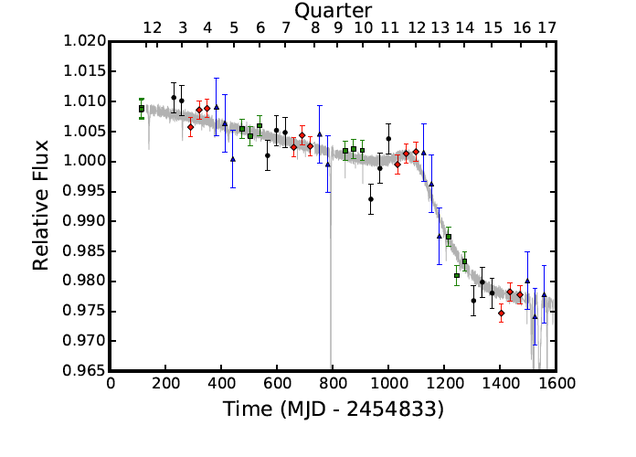
By carefully examining all the full-frame images collected during Kepler’s observational campaign, Montet and Simon discovered something astonishing: Not only did the star’s light output occasionally dip by up to 20 percent, its total stellar flux diminished continuously over the course of four years.
For the first 1000 days of Kepler’s campaign, Tabby’s Star decreased in luminosity by approximately 0.34 percent per year. For the next 200 days, the star dimmed more rapidly, its total stellar flux dropping by 2 percent before leveling off. Overall, Tabby’s Star faded roughly 3 percent during the four years that Kepler stared at it—an absolutely enormous, inexplicable amount. The astronomers looked at 500 other stars in the vicinity, and saw nothing else like it.
“The part that really surprised me was just how rapid and non-linear it was,” Montet told Gizmodo. “We spent a long time trying to convince ourselves this wasn’t real. We just weren’t able to.”
“There are three classes of people: those who see. Those who see when they are shown. Those who do not see.” ― Leonardo da Vinci
Insensible before the wave so soon released by callous fate. Affected most, they understand the least, and understanding, when it comes, invariably arrives too late.
Insensible before the wave so soon released by callous fate. Affected most, they understand the least, and understanding, when it comes, invariably arrives too late.
-
vox_mundi - Intermediate Crude
- Posts: 3939
- Joined: Wed 27 Sep 2006, 03:00:00
Re: Has Kepler Discovered an Alien Megastructure?
by Plantagenet » Mon 08 Aug 2016, 17:23:10
The aliens and their robots building the Alien Megastructure around the star finish one part of the structure, and then they start another part. They get the framework done, and they star installing walls and solar energy collectors.
Of course the effects on the star's apparent intensity are nonlinear. The construction of the megastructure is itself a non-linear process.

Of course the effects on the star's apparent intensity are nonlinear. The construction of the megastructure is itself a non-linear process.
-

Plantagenet - Expert

- Posts: 26765
- Joined: Mon 09 Apr 2007, 03:00:00
- Location: Alaska (its much bigger than Texas).
Re: Has Kepler Discovered an Alien Megastructure?
by Newfie » Mon 08 Aug 2016, 17:29:27
I think you would faint if you were correct.
Except of course it makes perfect sense.
Except of course it makes perfect sense.
-
Newfie - Forum Moderator
- Posts: 18651
- Joined: Thu 15 Nov 2007, 04:00:00
- Location: Between Canada and Carribean
Re: Has Kepler Discovered an Alien Megastructure?
by vox_mundi » Mon 08 Aug 2016, 19:58:11
How to Build a RingWorld
$this->bbcode_second_pass_quote('', '[')img]http://pop.h-cdn.co/assets/cm/15/05/640x400/54cb4a7167d5b_-_ringworld-03-0914-de.jpg[/img]
Sci-fi author Larry Niven conjured up such a megastructure for his award-winning 1970 book Ringworld. Niven imagined a ring with a radius of 93 million miles—the sun-Earth distance—with the sun placed at the center. The ring' would reach 600 million miles across and a million miles tall. The vast landscape could comfortably support perhaps trillions of humans (or another similarly ambitious, technologically advanced race).

"The thing is roomy enough: three million times the area of the Earth. It will be some time before anyone complains about the crowding," Niven wrote in a 1974 essay entitled "Bigger Than Worlds."
Niven figured a Ringworld would have a thickness of a few thousand feet, and require raw materials with a mass equal to that of Jupiter. Mountain "walls" a thousand miles high would line each rim, preventing the atmosphere from leaking into space. The inner surface could be sculpted like Earth's surface—full of great (though shallow) oceans, soaring mountains, and prodigious farmland—or whatever its builders desired.
$this->bbcode_second_pass_quote('', '[')img]http://pop.h-cdn.co/assets/cm/15/05/640x400/54cb4a7167d5b_-_ringworld-03-0914-de.jpg[/img]
Sci-fi author Larry Niven conjured up such a megastructure for his award-winning 1970 book Ringworld. Niven imagined a ring with a radius of 93 million miles—the sun-Earth distance—with the sun placed at the center. The ring' would reach 600 million miles across and a million miles tall. The vast landscape could comfortably support perhaps trillions of humans (or another similarly ambitious, technologically advanced race).
"The thing is roomy enough: three million times the area of the Earth. It will be some time before anyone complains about the crowding," Niven wrote in a 1974 essay entitled "Bigger Than Worlds."
Niven figured a Ringworld would have a thickness of a few thousand feet, and require raw materials with a mass equal to that of Jupiter. Mountain "walls" a thousand miles high would line each rim, preventing the atmosphere from leaking into space. The inner surface could be sculpted like Earth's surface—full of great (though shallow) oceans, soaring mountains, and prodigious farmland—or whatever its builders desired.
It's Yuuge!!!
“There are three classes of people: those who see. Those who see when they are shown. Those who do not see.” ― Leonardo da Vinci
Insensible before the wave so soon released by callous fate. Affected most, they understand the least, and understanding, when it comes, invariably arrives too late.
Insensible before the wave so soon released by callous fate. Affected most, they understand the least, and understanding, when it comes, invariably arrives too late.
-
vox_mundi - Intermediate Crude
- Posts: 3939
- Joined: Wed 27 Sep 2006, 03:00:00