Donate Bitcoin

Donate Paypal


PeakOil is You

PeakOil is You

Has the Great Contraction Begun?

Discussions about the economic and financial ramifications of PEAK OIL

Re: Has the Great Contraction Begun?

Unread postby Shaved Monkey » Tue 19 Jan 2016, 20:48:14

This is what I woke up to over my bowl of gruel (poached eggs on sourdough toast)
Australian CEOs gloomy about 2016 as world drowns in $200 trillion in debt
$this->bbcode_second_pass_quote('', 'T')he world is burdened by $200 trillion in debt that won't get paid back and will ultimately destroy emerging market economies and global growth, according to ASX chief executive Elmer Funke Kupper.

Mr Funke Kupper's comments come as a new survey shows Australian CEOs are less optimistic about growth in the world economy, as well as their own company's ability to make money in the coming year



$this->bbcode_second_pass_quote('', '&')quot;I think the world is burdened with about 200 trillion dollars' worth of debt which is an amount of money that simply is not going to be paid back."

This was happening in an environment where there were "record levels of quantitative easing and record low interest rates".

"But one day that's going to unwind, and when it's going to unwind, I think we'll see some forces at work that could really damage some parts of the world, particularly emerging markets economies."

http://www.theage.com.au/business/200-t ... m9119.html

The suits can see it, but they cant think its forever,just a temporary blimp.
Im amazed its being reported in the daily paper its going to scare the horses.
Ready to turn Zombies into WWOOFers
User avatar
Shaved Monkey
Intermediate Crude
Intermediate Crude
 
Posts: 2578
Joined: Wed 30 Mar 2011, 01:43:28

Re: Has the Great Contraction Begun?

Unread postby MonteQuest » Tue 19 Jan 2016, 21:39:32

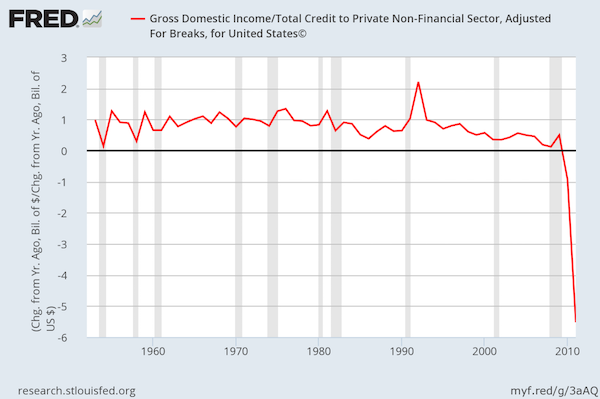
$this->bbcode_second_pass_quote('MonteQuest', 'I') think the real contraction started in the early 70's with we went off the gold standard and the first oil shocks occurred. Since that time, GDP has only grown due to increased debt. Now, more debt doesn't grow GDP, it hinders it.


This is the wealth “illusion” I mentioned. We have been addicted to borrowing money, spending it, and passing it off as growth. This chart shows marginal debt, or, in other words, the productivity/growth gained from each additional dollar of debt. This graph shows private non-financial debt only.
Image

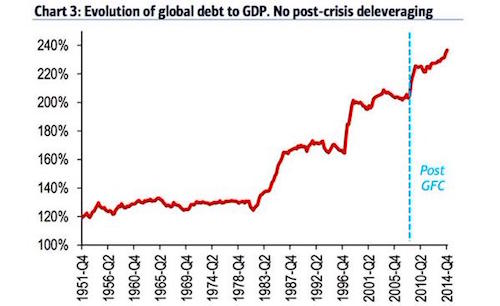
The "illusion" has been with us for a while. It's now at 313% of GDP.
Image

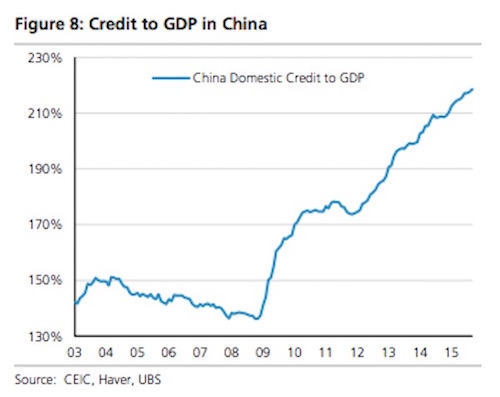
China came to the game a little later.
Image

Save the banks and the rich at the cost of the poor. Right, Pops?

BTW, this is what is known as a Ponzi scheme.
Last edited by MonteQuest on Tue 19 Jan 2016, 22:02:52, edited 1 time in total.
A Saudi saying, "My father rode a camel. I drive a car. My son flies a jet-plane. His son will ride a camel."
User avatar
MonteQuest
Expert
Expert
 
Posts: 16593
Joined: Mon 06 Sep 2004, 03:00:00
Location: Westboro, MO

Re: Has the Great Contraction Begun?

Unread postby MonteQuest » Tue 19 Jan 2016, 21:50:04

It is utterly impossible, as this country has demonstrated again and again, for the rich to save as much as they have been trying to save, and save anything that is worth saving. They can save idle factories and useless railroad coaches; they can save empty office buildings and closed banks; they can save paper evidences of foreign loans; but as a class they cannot save anything that is worth saving, above and beyond the amount that is made profitable by the increase of consumer buying.

It is for the interests of the well to do – to protect them from the results of their own folly – that we should take from them a sufficient amount of their surplus to enable consumers to consume and business to operate at a profit. This is not “soaking the rich”; it is saving the rich. Incidentally, it is the only way to assure them the serenity and security which they do not have at the present moment
.-- Marriner Eccles, chairman of the Federal Reserve under FDR.

This is why the growing income in equality is such a threat and why the rich abhor any "socialist" measures to rein it in.
A Saudi saying, "My father rode a camel. I drive a car. My son flies a jet-plane. His son will ride a camel."
User avatar
MonteQuest
Expert
Expert
 
Posts: 16593
Joined: Mon 06 Sep 2004, 03:00:00
Location: Westboro, MO

Re: Has the Great Contraction Begun?

Unread postby Pops » Wed 20 Jan 2016, 10:18:43

$this->bbcode_second_pass_quote('MonteQuest', 'I')'ve already explained this several times.

No, you just keep saying 'banks don't lend out reserves'

Of course they don't 'lend out' reserves Monte — they are reserves.

Reserves are not lent — they are leveraged — 10 to 1

Required reserves already have deposits attached, the $2.5T excess reserves are sitting there waiting for a loan to be made as soon as interest rises above the Fed's new interest rate.

Basically an inflation time bomb waiting to go off.

From the Minneapolis Fed
$this->bbcode_second_pass_quote('', 'B')anks in the United States have the potential to increase liquidity suddenly and significantly—from $12 trillion to $36 trillion in currency and easily accessed deposits—and could thereby cause sudden inflation. This is possible because the nation’s fractional banking system allows banks to convert excess reserves held at the Federal Reserve into bank loans at about a 10-to-1 ratio. ..

Banks in the United States currently hold $2.4 trillion in excess reserves: deposits by banks at the Federal Reserve over and above what they are legally required to hold to back their checkable deposits (and a small amount of other types of bank accounts). Before the 2008 financial crisis, this amount was essentially zero. To put this number in perspective, the monetary base of the United States (the sum of all currency outside the Federal Reserve System plus both required and excess reserve deposits by banks at the Fed) is $4 trillion. So, 60 percent of the entire monetary base is now in the form of excess reserves compared to roughly 0 percent precrisis....

Bank actions alone could cause a large increase in liquidity (when banks hold substantial excess reserves) because of the nation’s fractional reserve banking system. Since each dollar of bank deposit requires approximately only 10 cents of required reserves at the Fed, then each dollar of excess reserves can be converted by banks into 10 dollars of deposits. That is, for every dollar in excess reserves, a bank can lend 10 dollars to businesses or households and still meet its required reserve ratio. And since a bank’s loan simply increases the dollar amount in the borrower’s account at that bank, these new loans are part of the economy’s total stock of liquidity. Thus, if every dollar of excess reserves were converted into new loans at a ratio of 10 to one, the $2.4 trillion in excess reserves would become $24 trillion in new loans, and M2 liquidity would rise from $12 trillion to $36 trillion, a tripling of M2.

Lots more ...


The public justification may have been to "increase liquidity" and "help homeowners" by that went out the window as soon as congress signed off. What happened in reality was lining the shareholders pockets, making too-big-to-fail even bigger, of course no homeowners helped (LOL), and leaving a huge potential bubble of loans poised to inflate in a sort of reverse bank run.

Oh, and fueling mergers that make too-big-to-fail even bigger.

Here is a great article by Matt Taibbi from 2013
$this->bbcode_second_pass_quote('', 'P')ut another way, banks are getting paid about as much every year for not lending money as 1 million Americans received for mortgage modifications and other housing aid in the whole of the past four years...

Moreover, instead of using the bailout money as promised – to jump-start the economy – Wall Street used the funds to make the economy more dangerous. From the start, taxpayer money was used to subsidize a string of finance mergers, from the Chase-Bear Stearns deal to the Wells Fargo­Wachovia merger to Bank of America's acquisition of Merrill Lynch. Aided by bailout funds, being Too Big to Fail was suddenly Too Good to Pass Up.
The legitimate object of government, is to do for a community of people, whatever they need to have done, but can not do, at all, or can not, so well do, for themselves -- in their separate, and individual capacities.
-- Abraham Lincoln, Fragment on Government (July 1, 1854)
User avatar
Pops
Elite
Elite
 
Posts: 19746
Joined: Sat 03 Apr 2004, 04:00:00
Location: QuikSac for a 6-Pac
Top

Re: Has the Great Contraction Begun?

Unread postby MonteQuest » Wed 20 Jan 2016, 11:01:41

$this->bbcode_second_pass_quote('Pops', 'N')o, you just keep saying 'banks don't lend out reserves'

Of course they don't 'lend out' reserves Monte — they are reserves.

Reserves are not lent — they are leveraged — 10 to 1


Maybe I should have said that the excess reserves via QE does not influence the banks ability to lend. And yes, fractional reserve banking creates new money "based on" a fraction of those reserves 10%.

The FED increases the base money to be lent by the banks by buying new Treasury bonds. In QE, they bought exisiting bad debt bonds and securities. Money that was already part of the monetary base. It was a liquidity swap. They did not increase the amount of money available to be lent.

I take it you didn't read this:

Banks Don't Lend Out Reserves

The volume of excess reserves in the system is what it is, and banks cannot reduce it by lending. They could reduce excess reserves by converting them to physical cash, but that would simply exchange one safe asset (reserves) for another (cash). It would make no difference whatsoever to their ability to lend. Only the Fed can reduce the amount of base money (cash + reserves) in circulation.
Last edited by MonteQuest on Wed 20 Jan 2016, 11:14:04, edited 1 time in total.
A Saudi saying, "My father rode a camel. I drive a car. My son flies a jet-plane. His son will ride a camel."
User avatar
MonteQuest
Expert
Expert
 
Posts: 16593
Joined: Mon 06 Sep 2004, 03:00:00
Location: Westboro, MO
Top

Re: Has the Great Contraction Begun?

Unread postby Pops » Wed 20 Jan 2016, 11:13:20

$this->bbcode_second_pass_quote('', 'T')he volume of excess reserves in the system is what it is, and banks cannot reduce it by lending.

The volume of reserves can't be reduced but excess reserves can be converted to required reserves by making loans.
The legitimate object of government, is to do for a community of people, whatever they need to have done, but can not do, at all, or can not, so well do, for themselves -- in their separate, and individual capacities.
-- Abraham Lincoln, Fragment on Government (July 1, 1854)
User avatar
Pops
Elite
Elite
 
Posts: 19746
Joined: Sat 03 Apr 2004, 04:00:00
Location: QuikSac for a 6-Pac
Top

Re: Has the Great Contraction Begun?

Unread postby Pops » Wed 20 Jan 2016, 11:16:05

Here is the NY fed (since you didn't believe Minneapolis Fed)
$this->bbcode_second_pass_quote('', 'S')ome observers have expressed concern that the large quantity of reserves will lead to an
increase in the inflation rate unless the Federal Reserve acts to remove them quickly once the
economy begins to recover. Meltzer (2009), for example, worries that “the enormous increase in
bank reserves — caused by the Fed’s purchases of bonds and mortgages — will surely bring on
severe inflation if allowed to remain.” Feldstein (2009) expresses similar concern that “when the
economy begins to recover, these reserves can be converted into new loans and faster money
growth” that will eventually prove inflationary. Under a traditional operational framework,
where the central bank influences interest rates and the level of economic activity by changing
the quantity of reserves, this concern would be well justified. Now that the Federal Reserve is
paying interest on reserves, however, matters are different.


They argue that the Fed can control this lending by increasing the rate they pay - not that the increased excess can't be loaned.
The legitimate object of government, is to do for a community of people, whatever they need to have done, but can not do, at all, or can not, so well do, for themselves -- in their separate, and individual capacities.
-- Abraham Lincoln, Fragment on Government (July 1, 1854)
User avatar
Pops
Elite
Elite
 
Posts: 19746
Joined: Sat 03 Apr 2004, 04:00:00
Location: QuikSac for a 6-Pac
Top

Re: Has the Great Contraction Begun?

Unread postby MonteQuest » Wed 20 Jan 2016, 11:36:20

$this->bbcode_second_pass_quote('Pops', ' ')Put another way, banks are getting paid about as much every year for not lending money as 1 million Americans received for mortgage modifications and other housing aid in the whole of the past four years...

Moreover, instead of using the bailout money as promised – to jump-start the economy – Wall Street used the funds to make the economy more dangerous. From the start, taxpayer money was used to subsidize a string of finance mergers, from the Chase-Bear Stearns deal to the Wells Fargo­Wachovia merger to Bank of America's acquisition of Merrill Lynch. Aided by bailout funds, being Too Big to Fail was suddenly Too Good to Pass Up.


Here, Matt Taibbi is referring to TARP, not QE. TARP was a taxpayer funding bailout. QE was not.
A Saudi saying, "My father rode a camel. I drive a car. My son flies a jet-plane. His son will ride a camel."
User avatar
MonteQuest
Expert
Expert
 
Posts: 16593
Joined: Mon 06 Sep 2004, 03:00:00
Location: Westboro, MO
Top

Re: Has the Great Contraction Begun?

Unread postby MonteQuest » Wed 20 Jan 2016, 11:59:03

$this->bbcode_second_pass_quote('Pops', ' ')They argue that the Fed can control this lending by increasing the rate they pay - not that the increased excess can't be loaned.


Like I said, maybe I should have said that the excess reserves via QE does not influence the banks ability to lend. Or that a bank does not lend out its reserves except to other banks. Holding excess reserves via QE does not increase a banks ability to lend. It increases the liquidity of the monetary base within the banking system.

It is important to keep in mind that the excess reserves in our example were not created with the goal of lowering interest rates or increasing bank lending significantly relative to pre-crisis levels. Rather, these reserves were created as a byproduct of lending policies designed to mitigate the effects of a disruption in financial markets. In fact, the central bank paid interest on reserves to prevent the increase in reserves from driving market interest rates below the level it deemed appropriate given macroeconomic conditions. In such a situation, the absence of a money-multiplier effect should be neither surprising nor troubling.--NY FED.

And this from where your NY FED quote left off:

"Now that the Federal Reserve is paying interest on reserves, however, matters are different."

When the economy begins to recover, firms will have more profitable opportunities to invest,
increasing their demands for bank loans. Consequently, banks will be presented with more
lending opportunities that are profitable at the current level of interest rates. As banks lend more,
new deposits will be created and the general level of economic activity will increase. Left
unchecked, this growth in lending and economic activity may generate inflationary pressures.
Under a traditional operating framework, where no interest is paid on reserves, the central bank
must remove nearly all of the excess reserves from the banking system in order to arrest this
process. Only by removing these excess reserves can the central bank limit banks’ willingness to
lend to firms and households and cause short-term interest rates to rise.

Paying interest on reserves breaks this link between the quantity of reserves and banks’
willingness to lend. By raising the interest rate paid on reserves, the central bank can increase
market interest rates and slow the growth of bank lending and economic activity without
changing the quantity of reserves. In other words, paying interest on reserves allows the central
bank to follow a path for short-term interest rates that is independent of the level of reserves. By
choosing this path appropriately, the central bank can guard against inflationary pressures even if
financial conditions lead it to maintain a high level of excess reserves.


$this->bbcode_second_pass_quote('Pops', 'T')hen paid them interest on the money so they wouldn't do the favor for Main Street.


So, the banks aren't being paid by taxpayers not to lend. It's monetary policy to control interest rates given macroeconomic conditions. The fact is that the Fed has told us many times why they pay interest on reserves. There is no reason at all to be skeptical of the explanation. Prior to the decision to pay interest on reserves, the interbank rate (Fed Funds rate)had shown more volatility than Fed policy makers were comfortable with. By paying interest on reserve balances, the Fed hoped to establish a floor to the Fed Funds rate, because – in principle – no bank will lend to other banks at a rate lower than the rate they can earn by holding the reserves in their Fed account.
A Saudi saying, "My father rode a camel. I drive a car. My son flies a jet-plane. His son will ride a camel."
User avatar
MonteQuest
Expert
Expert
 
Posts: 16593
Joined: Mon 06 Sep 2004, 03:00:00
Location: Westboro, MO
Top

Re: Has the Great Contraction Begun?

Unread postby MonteQuest » Wed 20 Jan 2016, 12:51:41

This whole money system is a very confusing topic. When you say the banks are being paid to not make fractional loans on the excess reserves and I say no, having excess reserves doesn’t affect loans, there is only one way I can think of that excess reserves can influence loans. Excess reserves could be used to meet the 10% reserve requirements necessary to make a loan if the current reserves a bank held didn’t meet the 10% requirement. One bank could also lend to another these excess reserves. But, banks haven’t been experiencing a reserves requirement shortage, now or since the 2008 crisis. Connect the dots.

Or, I guess you could say holding excess reserves increases the amount of loans they could make, given new loan demand.
A Saudi saying, "My father rode a camel. I drive a car. My son flies a jet-plane. His son will ride a camel."
User avatar
MonteQuest
Expert
Expert
 
Posts: 16593
Joined: Mon 06 Sep 2004, 03:00:00
Location: Westboro, MO

Re: Has the Great Contraction Begun?

Unread postby Pops » Wed 20 Jan 2016, 13:05:33

$this->bbcode_second_pass_quote('MonteQuest', 'T')his whole money system is a very confusing topic. When you say the banks are being paid to not make fractional loans on the excess reserves and I say no, having excess reserves doesn’t affect loans, there is only one way I can think of that excess reserves can influence loans. Excess reserves could be used to meet the 10% reserve requirements necessary to make a loan if the current reserves a bank held didn’t meet the 10% requirement.


There we go. Thanks.

The only thing that keeps the banks from converting all that excess into loans is they are earning more from the taxpayer at 0 risk. The Fed of Wall Street says, it's cool (of course, LOL) The Fed of Flyover not so much, it could happen faster than the Fed could keep up, or maybe they couldn't raise interest payments because the Congress gets excited or (I don't remember them all)


I've always said cash is King and pooh-poohed the idea of hyperinflation because I figured government would try to defend the dollar rather than let it become worthless.

Over the last couple of years reading about the bailout and all the confusing ins and outs, it's become pretty clear to me that while cash may be king for some short period, that big overhang of reserves shows why the Main Street bailout didn't work but even worse possess a real risk.

I'm more of a hard money guy all the time.

.
The legitimate object of government, is to do for a community of people, whatever they need to have done, but can not do, at all, or can not, so well do, for themselves -- in their separate, and individual capacities.
-- Abraham Lincoln, Fragment on Government (July 1, 1854)
User avatar
Pops
Elite
Elite
 
Posts: 19746
Joined: Sat 03 Apr 2004, 04:00:00
Location: QuikSac for a 6-Pac
Top

Re: Has the Great Contraction Begun?

Unread postby MonteQuest » Wed 20 Jan 2016, 13:18:00

$this->bbcode_second_pass_quote('Pops', ' ')The only thing that keeps the banks from converting all that excess into loans is they are earning more from the taxpayer at 0 risk.


No, what keeps the banks from converting all that excess into loans is that their existing reserves are enough to cover the 10% reserve requirements for loans. Had existing reserves been in short supply, then QE would have had an influence on some banks ability to lend, if they hadn't been able to borrow short-term reserves from other banks.

$this->bbcode_second_pass_quote('Pops', 'O')ver the last couple of years reading about the bailout and all the confusing ins and outs, it's become pretty clear to me that while cash may be king for some short period, that big overhang of reserves shows why the Main Street bailout didn't work but even worse possess a real risk.


The bank bailout was TARP (taxpayer funds) QE was not taxpayers funds.

Tarp bought good bank securities with taxpayer dollars. QE swapped bad bank securities with reserves.
Last edited by MonteQuest on Wed 20 Jan 2016, 13:42:06, edited 2 times in total.
A Saudi saying, "My father rode a camel. I drive a car. My son flies a jet-plane. His son will ride a camel."
User avatar
MonteQuest
Expert
Expert
 
Posts: 16593
Joined: Mon 06 Sep 2004, 03:00:00
Location: Westboro, MO
Top

Re: Has the Great Contraction Begun?

Unread postby Pops » Wed 20 Jan 2016, 13:38:08

$this->bbcode_second_pass_quote('MonteQuest', 'N')o, what keeps the banks from converting all that excess into loans is that their existing reserves are enough to cover the 10% reserve requirements for loans.

So banks will never, ever make additional loans converting those excess reserves because... they have all their existing requirements covered?


Whatever, Monte, lol

.
The legitimate object of government, is to do for a community of people, whatever they need to have done, but can not do, at all, or can not, so well do, for themselves -- in their separate, and individual capacities.
-- Abraham Lincoln, Fragment on Government (July 1, 1854)
User avatar
Pops
Elite
Elite
 
Posts: 19746
Joined: Sat 03 Apr 2004, 04:00:00
Location: QuikSac for a 6-Pac
Top

Re: Has the Great Contraction Begun?

Unread postby MonteQuest » Wed 20 Jan 2016, 13:46:44

$this->bbcode_second_pass_quote('Pops', '')$this->bbcode_second_pass_quote('MonteQuest', 'N')o, what keeps the banks from converting all that excess into loans is that their existing reserves are enough to cover the 10% reserve requirements for loans.

So banks will never, ever make additional loans converting those excess reserves because... they have all their existing requirements covered?
Whatever, Monte, lol.


Why would they? If suddenly the demand for loans increased, then they might have to tap those reserves to meet the 10% requirement.

They could have sold the bad debt the FED purchased to gain excess reserves. What the QE swap did was to convert bank assets to reserves. The monetary base remained the same, the liquidity of the assets just changed.

Is it easier now for the bank assets--via excess reserves liquidity-- to be used to back a loan? Yes.
A Saudi saying, "My father rode a camel. I drive a car. My son flies a jet-plane. His son will ride a camel."
User avatar
MonteQuest
Expert
Expert
 
Posts: 16593
Joined: Mon 06 Sep 2004, 03:00:00
Location: Westboro, MO
Top

Re: Has the Great Contraction Begun?

Unread postby MonteQuest » Wed 20 Jan 2016, 14:00:26

$this->bbcode_second_pass_quote('pstarr', 'S')o now that you two guys have worn out the pin-head, can we agree that the Great Contraction has begun? That we have run out of planet and increased breeding capacity?


Sometimes wearing out the pin-head, as you call it, causes epiphanies to occur on both sides.
A Saudi saying, "My father rode a camel. I drive a car. My son flies a jet-plane. His son will ride a camel."
User avatar
MonteQuest
Expert
Expert
 
Posts: 16593
Joined: Mon 06 Sep 2004, 03:00:00
Location: Westboro, MO
Top

Re: Has the Great Contraction Begun?

Unread postby MonteQuest » Wed 20 Jan 2016, 14:30:56

The biggest factor affecting bank loans has been the tightening of standards since the subprime fiasco of 2008.

Image

Yet, even so, bank loans are back up to where they were pre-crash.

Image

So, much for the argument banks aren't lending. Some loans, like auto loans are subprime.

Now, I am open to the argument that the little guy isn't getting the loans he needs.

But it appears, that consumers are using discretionary income to deleverage existing debt, rather than spending, which is why we have had a weaker recovery. All comes back to too much debt.
A Saudi saying, "My father rode a camel. I drive a car. My son flies a jet-plane. His son will ride a camel."
User avatar
MonteQuest
Expert
Expert
 
Posts: 16593
Joined: Mon 06 Sep 2004, 03:00:00
Location: Westboro, MO

Re: Has the Great Contraction Begun?

Unread postby MonteQuest » Wed 20 Jan 2016, 14:49:46

$this->bbcode_second_pass_quote('pstarr', 'S')o you guys came to an agreement. I've been waiting for this for my entire time here. You are obviously the two most brilliant generalist peakers around, with a multi-disciplinary grasp of not only oil geology but also economics, ecology, agricultural and just plain simple brainstorming. I've always looked to your debates as edifying to the extreme. When you come to an agreement after much hashing and teeth-gnashing then I know to expect. Truthiness. So is it hyperinflation, great deflation, excitement or snoozeville?


Well, that's a rather magnanimous critique. :) Thanks!

As to your question: I think every thing will be done, that can be done, to blow the bubble even bigger. The FED is missing their inflation target and prices are declining, so that spells deflation which often goes hand in hand with economic stagnation. Of course, the Fed’s hard-money critics say that the central bank has already increased the money supply so much that it will lose control of inflation as the economy recovers. But, with so many dollars parked overseas, I don't think anyone has a handle on what the money supply actually is.

Having said all that, all I will predict is volatility as the bubble searches for a pin.

But I sure wouldn't be excited that all is well. I'd say, it's an ominous portent.
A Saudi saying, "My father rode a camel. I drive a car. My son flies a jet-plane. His son will ride a camel."
User avatar
MonteQuest
Expert
Expert
 
Posts: 16593
Joined: Mon 06 Sep 2004, 03:00:00
Location: Westboro, MO
Top

PreviousNext

Return to Economics & Finance

Who is online

Users browsing this forum: No registered users and 0 guests

cron