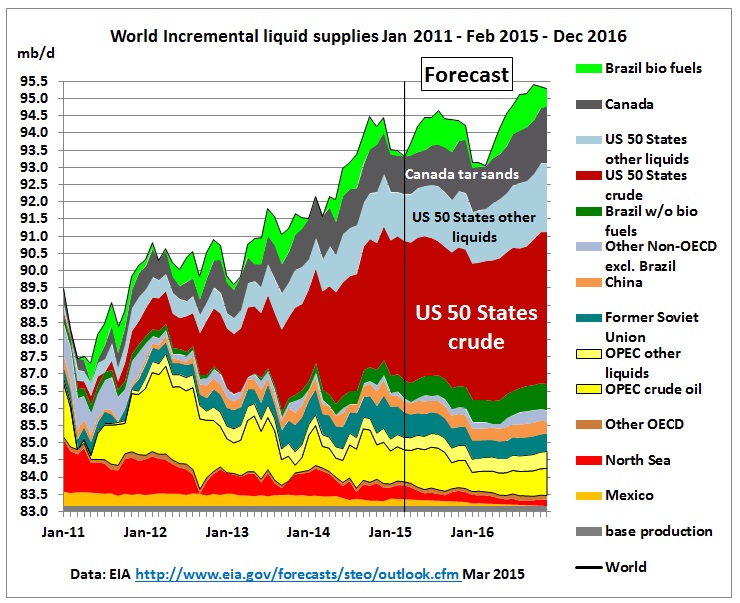
$this->bbcode_second_pass_quote('Tanada', 'O')n the one hand I am tired of waiting but don't know how much longer we will have to wait. It seems like from the last few years of production records effectively 90 percent of gains came from the USA 'Fracking Miracle' and those days are rapidly winding down by about half.


PeakOil is You
Waiting for Peak Oil...Quietly Waiting
Re: Waiting for Peak Oil...Quietly Waiting
 by Outcast_Searcher » Sat 25 Jul 2015, 16:21:18
I pretty much agree. Ironically, part of fracking winding down is from an oversupply (and thus underpricing) of oil, at least in the short term. After all, many of the complaints on this site and in the news are that the economic losses from low oil prices outweigh the economic gains. (Of course, this is the usual short term thinking. If oil prices stay in the, say, $40 to $70 price range for several years, the benefits to consumers will GREATLY outweigh the losses to firms which had to temporarily shut down production). And when oil prices go back to about $100, wala, fracking becomes nicely profitable again.
$this->bbcode_second_pass_quote('', '
')The question plaguing my mind is, now what? The instant doom expectations I had in 2005-2008 didn't exactly unfold as I expected. On the other hand the way things have unfolded from 2008-2015 have not been all roses and lollypops either.
Not lollipops, but FAR from doom. Again, short term thinking. The world was handling $100ish oil just fine overall, given the general economic growth trend from 2011 through 2014 (round figures) as high oil prices didn't even come close to the "crushing" economic effects the doomers predicted.
$this->bbcode_second_pass_quote('', '
')On the gripping hand, how prepared is our government and the other governments of the planet to deal with peak when it finally starts cutting into world supply? The EIA is still casting fantasies about ever more oil being found somewhere each year for the foreseeable future. The IEA is about the same.
Governments are as governments do. Of course they're clueless. They're generally elected by clueless citizenry and re-elected for thinking short term and promising a chicken in every pot. Preparedness takes discipline and sacrifice. What percentage of the populace wants THAT?
Until we ACTUALLY see a meaningful, sustained decline from the bumpy plateau, why shouldn't the big energy agencies NOT predict that lots of new oil will be found? After all, again, we're currently awash in the stuff, thanks in part to the KSA's policy of (long term) self-destructive pumping all they can, regardless of how massive their government deficits become.
Now, should they predict increasing amounts will be found? Well, it depends on your outlook for technology. I don't know. But until the bumpy plateau shows actual, meaningful, sustained drop off -- predicting roughly the same level of oil discoveries seems far more rational to me than the doomer assumption that -- any time now -- oil discoveries will dissipate rapidly, and then we're all in big trouble real soon.
No, I'm not a cornie -- I'm a moderate. But I do try to look at trends relatively dispassionately, without a preconceived bias, since I'm just looking for information. I have no particular axe to grind. (I can afford the amount of hydrocarbons I need at true economy-crushing prices -- benefits of being frugal and living with a small carbon footprint. Thus, I'm not just whistling past the graveyard. And though I'm very concerned about AGW long term, I'll be dead long before the short term consequences of that are massively impactful to every day living).
OTOH, is there ANY point at which the short doomers will be willing to convert to the longer term kind? (I agree that longer term, doom seems the likely destiny of people, given how they behave).
Given the track record of the perma-doomer blogs, I wouldn't bet a fast crash doomer's money on their predictions.
-

Outcast_Searcher - COB

- Posts: 10142
- Joined: Sat 27 Jun 2009, 21:26:42
- Location: Central KY
Re: Waiting for Peak Oil...Quietly Waiting
by ennui2 » Sat 25 Jul 2015, 16:48:42
Here is an oldie but goodie.
$this->bbcode_second_pass_quote('', 'U')p until a week ago I was mainly concerned about peak oil. Now it looks as if peak natural gas is imminent as well (according to the latest data posted at The Oil Drum)
We're so screwed
$this->bbcode_second_pass_quote('', 'U')p until a week ago I was mainly concerned about peak oil. Now it looks as if peak natural gas is imminent as well (according to the latest data posted at The Oil Drum)
We're so screwed
I remember a lot of hand-wringing on TOD about how the NE was already largely powered by NG and hence our electrical grid was screwed.
How wrong they were. And yet some of the people from TOD just setup shop with their own blogs and continued to retool their narratives to fit the current frame. High oil prices spell doom. Low oil prices spell doom. All data always spells doom. Sorry. Not going to look at it in such simplistic terms anymore.
"If the oil price crosses above the Etp maximum oil price curve within the next month, I will leave the forum." --SumYunGai (9/21/2016)
-

ennui2 - Permanently Banned
- Posts: 3920
- Joined: Tue 20 Sep 2011, 10:37:02
- Location: Not on Homeworld