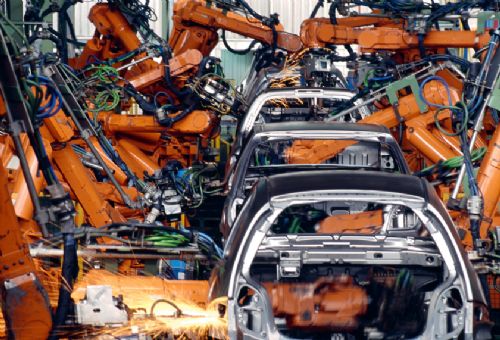
I don't have confidence in automation per se - if confidence means trust that is. I have confidence that capital will chase technology as long as it increases profit by replacing humans. Tech for it's own sake is a consumer motivation not a capitalist one.
Moore's law is about more transistors on a single chip. I think miniaturization is great for the iWatch and whatever consumer products but multitasking across multiple processors doesn't require that does it? The portion of my brain that tells my fingers which keys to tap isn't the part that decides what word to communicate and that part isn't the part that comes up with the reason for the communication.
And really, few jobs require a total human to perform, so replacing humans in total is not required to perform most jobs.



PeakOil is You
The juncture of peak oil and automation
Re: The juncture of peak oil and automation
 by Pops » Tue 02 Sep 2014, 12:20:07
The legitimate object of government, is to do for a community of people, whatever they need to have done, but can not do, at all, or can not, so well do, for themselves -- in their separate, and individual capacities.
-- Abraham Lincoln, Fragment on Government (July 1, 1854)
-- Abraham Lincoln, Fragment on Government (July 1, 1854)
-

Pops - Elite

- Posts: 19746
- Joined: Sat 03 Apr 2004, 04:00:00
- Location: QuikSac for a 6-Pac
Re: The juncture of peak oil and automation
by Pops » Tue 02 Sep 2014, 12:33:19
$this->bbcode_second_pass_quote('radon1', 'T')his requires two things: population surplus outside the boundaries of the financial economy ("China's peasantry"), and resources which are sufficient, in marginal terms, to provide for accommodation of this surplus within these boundaries ("Siberian riches").
Can you expound on this, I don't get what you are saying.
$this->bbcode_second_pass_quote('radon1', 'T')hink of Japan (Korea etc.). Cannot quickly find a graph of the Japanese industrial production/export over the same period unfortunately.
They may have become competitive on their island but containerization made them competitive on anyone's island.
$this->bbcode_second_pass_quote('', '[')i]The Box That Changed Asia and the World
Malcom McLeans efforts during the Vietnam War led to the container revolution.
...
The first Japanese containership, owned by Matson partner N.Y.K. Line, completed its maiden voyage to America in September 1968. Six weeks later, Sea-Land began six sailings a month from Yokohama to the West Coast, its ships laden with televisions and stereos produced by Japanese factories. Other Japanese carriers entered as well. The Japan-West Coast route, which had no commercial container service at all before September 1967, was suddenly crowded with ships needing to be filled. Seven different companies were competing for less than 7,000 tons of eastbound freight each month by the end of 1968, and more were about to join. The lack of business proved to be only temporary. The cargo would soon come, in a flood.
The huge increase in long-distance trade that came in the containers wake was foreseen by no one. When he studied the role of freight in the New York region in the late 1950s, Harvard economist Benjamin Chinitz predicted that containerization would favor metropolitan New Yorks industrial base by letting the regions factories ship to the South more cheaply than plants in New England or the Midwest. Apparel, the regions biggest manufacturing sector, would not be affected by changes in transport costs, because it was not transport-sensitive.
The possibility that falling transport costs could decimate much of the U.S. manufacturing base by making it practical to ship almost everything long distances simply did not occur to Chinitz. He was hardly alone in failing to recognize the extent to which lower shipping costs would stimulate trade. Through the 1960s, study after study projected the growth of containerization by assuming that existing import and export trends would continue, with the cargo gradually being shifted into containers. The possibility that the container would permit a worldwide economic restructuring that would vastly increase the flow of trade was not taken seriously.
A good article about containerization and globalization
The legitimate object of government, is to do for a community of people, whatever they need to have done, but can not do, at all, or can not, so well do, for themselves -- in their separate, and individual capacities.
-- Abraham Lincoln, Fragment on Government (July 1, 1854)
-- Abraham Lincoln, Fragment on Government (July 1, 1854)
-
Pops - Elite
- Posts: 19746
- Joined: Sat 03 Apr 2004, 04:00:00
- Location: QuikSac for a 6-Pac
Re: The juncture of peak oil and automation
by Pops » Tue 02 Sep 2014, 13:24:50
The left/right bit was bull but it doesn't take my whole body or brain to move my typing finger and that is what a robot is, a replacement for my typing finger.
Likewise, "AI" as in a replacement for an entire human mind is not required either. There is no need to replicate everything I do to replace "part" of what I do - automatically kerning and leading a block of text for example or writing a sports or weather article.
Likewise, "AI" as in a replacement for an entire human mind is not required either. There is no need to replicate everything I do to replace "part" of what I do - automatically kerning and leading a block of text for example or writing a sports or weather article.
The legitimate object of government, is to do for a community of people, whatever they need to have done, but can not do, at all, or can not, so well do, for themselves -- in their separate, and individual capacities.
-- Abraham Lincoln, Fragment on Government (July 1, 1854)
-- Abraham Lincoln, Fragment on Government (July 1, 1854)
-
Pops - Elite
- Posts: 19746
- Joined: Sat 03 Apr 2004, 04:00:00
- Location: QuikSac for a 6-Pac
Re: The juncture of peak oil and automation
by radon1 » Tue 02 Sep 2014, 13:47:18
$this->bbcode_second_pass_quote('Pops', '')$this->bbcode_second_pass_quote('radon1', 'T')his requires two things: population surplus outside the boundaries of the financial economy ("China's peasantry"), and resources which are sufficient, in marginal terms, to provide for accommodation of this surplus within these boundaries ("Siberian riches").
Can you expound on this, I don't get what you are saying.
"population surplus outside the boundaries of the financial economy" - people who are not working full-time selling their labor for dollars or any other money/tokens easily convertible into dollars. At this point - mostly subsistence peasants in South East Asia and elsewhere, as well as nomads, North Koreans and alike people. Basically, still the majority of the world's population.
"resources which are sufficient, in marginal terms, to provide for accommodation of this surplus within these boundaries" - resources that are required for the above people to abandon their subsistence peasantry and become full-time workers receiving salaries in dollars (money/tokens easily convertible into dollars), and, generally, consider this change as attractive for themselves.
$this->bbcode_second_pass_quote('', 'T')hey may have become competitive on their island but containerization made them competitive on anyone's island.
Containerization may itself be viewed as act of automation. In any event, both are specific cases of advancement of the division of labor. As such, both require the fulfillment of the two conditions above.