I'd give Gail a grade of "incomplete" on this essay.
It's unfortunate that in an essay entitled "where are we headed" Gail doesn't say a word about the expansion of fracking in tight shale from the US to other countries around the world. It's pretty clear now that fracking in the US has delayed the peak in global oil production. Thanks to US fracking global oil production is still slowly rising. That's a big deal. Peakers completely missed seeing the importance of fracking in the US---now it appears Gail is completely missing the reality that we are going to see significant overseas production from fracking as well.
How can we know "where we are going" if we don't take into account the likelihood that we will soon see fracking in shales in KSA, China, Australia, and the EU? How much oil will come from these new sources? How soon?



PeakOil is You
Gail: Energy Supply, Population, and the Economy
Re: Gail: Where are we headed?
 by Plantagenet » Fri 25 Jul 2014, 11:53:50
-

Plantagenet - Expert

- Posts: 26765
- Joined: Mon 09 Apr 2007, 03:00:00
- Location: Alaska (its much bigger than Texas).
Re: Gail: Where are we headed?
by efarmer » Fri 25 Jul 2014, 12:10:42
When a fellow says it ain't the money but the principle of the thing, it's the money. ~ Artemus Ward
If your outgo exceeds your income, then your upkeep will be your downfall. ~ Bill Earle
I just need enough to tide me over until I need more. ~ Bill Hoest
This forum has had a bunch of posting about preemptive strategies to address resource limits and much hand wringing about how they do not gain inertia and manifest to scale. Speculative price peaks are giving way to permanent high prices and this will drive the real response, ad hoc at first, and then organized to a greater degree about 5 years after ad hoc is steamrolling along enough to drive consensus on really doing something. Reduced consumption is going to win big because it is the simplest method of coping available at the lowest granular level of self direction. I also predict a donkey will race the latest water powered cars and win because it is able to move under it's own power.
If your outgo exceeds your income, then your upkeep will be your downfall. ~ Bill Earle
I just need enough to tide me over until I need more. ~ Bill Hoest
This forum has had a bunch of posting about preemptive strategies to address resource limits and much hand wringing about how they do not gain inertia and manifest to scale. Speculative price peaks are giving way to permanent high prices and this will drive the real response, ad hoc at first, and then organized to a greater degree about 5 years after ad hoc is steamrolling along enough to drive consensus on really doing something. Reduced consumption is going to win big because it is the simplest method of coping available at the lowest granular level of self direction. I also predict a donkey will race the latest water powered cars and win because it is able to move under it's own power.
-

efarmer - Intermediate Crude

- Posts: 2003
- Joined: Fri 17 Mar 2006, 04:00:00
Re: Gail: Where are we headed?
by AgentR11 » Fri 25 Jul 2014, 12:50:44
Pops I think your 2 graphs illustrate the answer to why there's not been so much oscillation. SA can, and will, modulate their output in order to keep the price stable. This will be especially true if they start to frack shales; where the high price is required to keep the thing profitable; they may internally be seeing a situation where without fracking they could hit their maximum output and still not be able to keep prices from a spike and crash, which would provide motivation to bring unconventional stuff into the mix.
Yes we are, as we are,
And so shall we remain,
Until the end.
And so shall we remain,
Until the end.
- AgentR11
- Light Sweet Crude

- Posts: 6589
- Joined: Tue 22 Mar 2011, 09:15:51
- Location: East Texas
Re: Gail: Where are we headed?
by Pops » Fri 25 Jul 2014, 13:40:44
I don't know what the likelihood of fracing the world is - nobody does obviously or the Monterey guess wouldn't have been so far off.
It's disingenuous to say uninvested "peakers" missed the importance of LTO in the US when every major refinery in the US spent billions to reconfigure in order to handle heavier oil as light oil was forecast to fade away. I have seen no evidence that they are switching back even now.
That certain folks with an uncritical eye to any positive PR fluffing now think fracing is the be-all end-all of PO for now and evermore is somewhat naive.
In fact, the thing that is never talked about here (x ROCK & Doc maybe) and that is more widespread and probably a bigger development than fracking or shale is the increase in horizontal drilling - whether fraced shale or not.

http://marketrealist.com/2014/07/horizo ... igs-arent/
$this->bbcode_second_pass_quote('AgentR11', 'P')ops I think your 2 graphs illustrate the answer to why there's not been so much oscillation. SA can, and will, modulate their output in order to keep the price stable.
) Good point, on the downside price anyway, no one seems inclined or able to open the stops to bring the price down.It's disingenuous to say uninvested "peakers" missed the importance of LTO in the US when every major refinery in the US spent billions to reconfigure in order to handle heavier oil as light oil was forecast to fade away. I have seen no evidence that they are switching back even now.
That certain folks with an uncritical eye to any positive PR fluffing now think fracing is the be-all end-all of PO for now and evermore is somewhat naive.
In fact, the thing that is never talked about here (x ROCK & Doc maybe) and that is more widespread and probably a bigger development than fracking or shale is the increase in horizontal drilling - whether fraced shale or not.
http://marketrealist.com/2014/07/horizo ... igs-arent/
$this->bbcode_second_pass_quote('AgentR11', 'P')ops I think your 2 graphs illustrate the answer to why there's not been so much oscillation. SA can, and will, modulate their output in order to keep the price stable.
The legitimate object of government, is to do for a community of people, whatever they need to have done, but can not do, at all, or can not, so well do, for themselves -- in their separate, and individual capacities.
-- Abraham Lincoln, Fragment on Government (July 1, 1854)
-- Abraham Lincoln, Fragment on Government (July 1, 1854)
-

Pops - Elite
- Posts: 19746
- Joined: Sat 03 Apr 2004, 04:00:00
- Location: QuikSac for a 6-Pac
Re: Gail: Where are we headed?
by Plantagenet » Fri 25 Jul 2014, 13:54:39
$this->bbcode_second_pass_quote('pstarr', '')$this->bbcode_second_pass_quote('Plantagenet', 'I')'d give Gail a grade of "incomplete" on this essay.
It's unfortunate that in an essay entitled "where are we headed" Gail doesn't say a word about the expansion of fracking in tight shale from the US to other countries around the world. It's pretty clear now that fracking in the US has delayed the peak in global oil production. Thanks to US fracking global oil production is still slowly rising. That's a big deal. Peakers completely missed seeing the importance of fracking in the US---now it appears Gail is completely missing the reality that we are going to see significant overseas production from fracking as well.
How can we know "where we are going" if we don't take into account the likelihood that we will soon see fracking in shales in KSA, China, Australia, and the EU? How much oil will come from these new sources? How soon?
Actually, you are completely wrong. No other country has the combination of technical support, drilling rigs, mineral-rights/financial access, water, pipeline/train/truck collection systems, and a wealthy consumer base.It's unfortunate that in an essay entitled "where are we headed" Gail doesn't say a word about the expansion of fracking in tight shale from the US to other countries around the world. It's pretty clear now that fracking in the US has delayed the peak in global oil production. Thanks to US fracking global oil production is still slowly rising. That's a big deal. Peakers completely missed seeing the importance of fracking in the US---now it appears Gail is completely missing the reality that we are going to see significant overseas production from fracking as well.
How can we know "where we are going" if we don't take into account the likelihood that we will soon see fracking in shales in KSA, China, Australia, and the EU? How much oil will come from these new sources? How soon?
Your faith in American exceptionalism is noted.
However, every other innovation that the US oil biz has come up with has eventually either been taken overseas by US companies, or has been adopted by foreign oilcos operating in other countries around the world.
I have no doubt we'll eventually see large-scale fracking of oil shales in other countries, just as we have seen in the US.
Your post is an example of a curious blindspot among peakers about fracking. The peakers who made those inaccurate predictions that global oil production would peak in ca. 2005 clearly didn't see fracking coming ---and even though fracking has falsified all the predictions about global oil production peaking in ca. 2005, most peakers want to pretend its not very important. Pstarr thinks fracking can only occur in the US, and Gail doesn't even mention fracking when discussing foreign countries in her essay.
Sorry---technology doesn't work way. If fracking works on a category of rocks in the USA, it will work in similar rocks around the world. KSA has already started testing fracking on a small scale as has China. The EU has some oil shales. South America has some oil shales. The highly productive Eagle Ford trends doesn't stop at the border---it also underlies a bit of NE Mexico. Australia has EXTENSIVE oil shale deposits, and Russia has absolutely gigantic oil shale deposits. Even in the US there are extensive oil shales in Alaska that are just starting to be explored.
Its just a fact that there are extensive oil shales in countries outside the US. I predict many of these will be developed using fracking. I don't understand why peakers can't see large scale fracking of oil shales is going to occur outside the US, and why they don't take this into account when they make predictions about "where are we headed"?

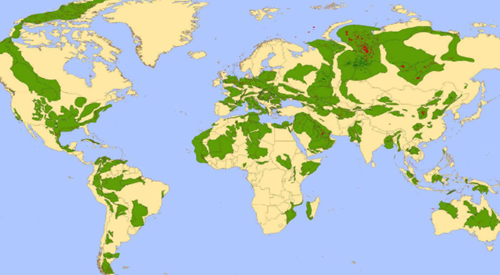
potential global shale resources (not including marine shales)
-
Plantagenet - Expert
- Posts: 26765
- Joined: Mon 09 Apr 2007, 03:00:00
- Location: Alaska (its much bigger than Texas).
Re: Gail: Where are we headed?
by Tanada » Fri 25 Jul 2014, 14:07:52
Fracked shale may be as abundant as shown on that map, but if they are all going to follow the steep decline rates seen so far in the USA how long will it take until this bubble runs out?
In the mean time fracked shale oil is keeping the oil price relatively stable, what happens if tight oil can not replace conventional decline? That's right, peak oil.
In the mean time fracked shale oil is keeping the oil price relatively stable, what happens if tight oil can not replace conventional decline? That's right, peak oil.
$this->bbcode_second_pass_quote('Alfred Tennyson', 'W')e are not now that strength which in old days
Moved earth and heaven, that which we are, we are;
One equal temper of heroic hearts,
Made weak by time and fate, but strong in will
To strive, to seek, to find, and not to yield.
Moved earth and heaven, that which we are, we are;
One equal temper of heroic hearts,
Made weak by time and fate, but strong in will
To strive, to seek, to find, and not to yield.
- Tanada
- Site Admin

- Posts: 17094
- Joined: Thu 28 Apr 2005, 03:00:00
- Location: South West shore Lake Erie, OH, USA


 .
.