Loki, Walmart is expanding its line of organic processed foods hoping higher production means greater efficiency and lower price. The target is lowering prices 25%.
This is on prepared foods so not necessarily impacting fresh but as the resident plastic mulch farmer how do you see removing the premium on the brand "organic" affecting the local/organic market in general?
http://www.forbes.com/sites/clareoconno ... aper-line/



PeakOil is You
How is Agriculture Going to Work?
Re: How is Agriculture Going to Work?
 by Pops » Fri 02 May 2014, 07:16:18
The legitimate object of government, is to do for a community of people, whatever they need to have done, but can not do, at all, or can not, so well do, for themselves -- in their separate, and individual capacities.
-- Abraham Lincoln, Fragment on Government (July 1, 1854)
-- Abraham Lincoln, Fragment on Government (July 1, 1854)
-

Pops - Elite

- Posts: 19746
- Joined: Sat 03 Apr 2004, 04:00:00
- Location: QuikSac for a 6-Pac
Re: How is Agriculture Going to Work?
by KaiserJeep » Fri 02 May 2014, 08:11:02
What may be a more important question than "How is agriculture going to work?" is "How will food deliveries be made?". It occurs to me that I transitioned easily from printed books to E-Books, and now buy online many categories of goods like clothing and shoes and tools and electronics that if asked I would have doubted I would have ever bought online. One of my last hold-outs is food, especially fresh produce and fresh meats, which I still like to select in person. My real problem is that I don't plan a menu, rather I cook what the mood strikes me to cook from whatever food supplies I have on hand.
Although I do plan meals and buy ingredients for meals, I don't typically know in advance what I will be cooking on any given night, or whether me or the wife will be cooking.
When it comes to packaged groceries, I am ready to order those online. If I were to simply take one more step and plan my meals for the week in advance, it would be possible to replace at least one food shopping trip a week with a fresh food delivery. I could use readily available software that translates a menu into a shopping list. The medium sized trucks I see making food deliveries here in Silicon Valley have both refrigerated and ambient temperature storage, and most people seem to be getting one reusable plastic bin of both categories of food delivered to their door. But I bet those trucks, each making dozens of deliveries in a local area, save half the energy devoted to food distribution via shoppers in private vehicles. There is potentially a huge energy win, as well as a reduction in food spoilage, if only I can make the transition to planning a week of meals at once.
Although I do plan meals and buy ingredients for meals, I don't typically know in advance what I will be cooking on any given night, or whether me or the wife will be cooking.
When it comes to packaged groceries, I am ready to order those online. If I were to simply take one more step and plan my meals for the week in advance, it would be possible to replace at least one food shopping trip a week with a fresh food delivery. I could use readily available software that translates a menu into a shopping list. The medium sized trucks I see making food deliveries here in Silicon Valley have both refrigerated and ambient temperature storage, and most people seem to be getting one reusable plastic bin of both categories of food delivered to their door. But I bet those trucks, each making dozens of deliveries in a local area, save half the energy devoted to food distribution via shoppers in private vehicles. There is potentially a huge energy win, as well as a reduction in food spoilage, if only I can make the transition to planning a week of meals at once.
KaiserJeep 2.0, Neural Subnode 0010 0000 0001 0110 - 1001 0011 0011, Tertiary Adjunct to Unimatrix 0000 0000 0001
Resistance is Futile, YOU will be Assimilated.
Warning: Messages timestamped before April 1, 2016, 06:00 PST were posted by the unmodified human KaiserJeep 1.0
Resistance is Futile, YOU will be Assimilated.
Warning: Messages timestamped before April 1, 2016, 06:00 PST were posted by the unmodified human KaiserJeep 1.0
- KaiserJeep
- Light Sweet Crude

- Posts: 6094
- Joined: Tue 06 Aug 2013, 17:16:32
- Location: Wisconsin's Dreamland
Re: How is Agriculture Going to Work?
by vtsnowedin » Fri 02 May 2014, 08:17:21
There is already a company taking online orders and delivering the fresh ingredients for single meals with the instructions for cooking the selected meal. It comes to your door you open it up, fallow the directions and bon appetite!!
-

vtsnowedin - Fusion

- Posts: 14897
- Joined: Fri 11 Jul 2008, 03:00:00
Re: How is Agriculture Going to Work?
by PrestonSturges » Tue 06 May 2014, 10:38:03
These guys in Baltimore are partly tourist attraction these days. These black produce cart vendors were called "Arabs," I forget why, but many Masonic organizations had Middle Eastern themes.
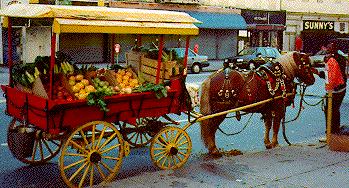
We may well see the return of other professions - recycling was part of every day life back in the day. Someone would collect practically anything. The waste paper basket wasn't even invented until after the Civil War I think because there was no waste.
 There's a NYC rag picker. They were often Jewish. I think Groucho did a rag picker holler in Duck Soup.
We may well see the return of other professions - recycling was part of every day life back in the day. Someone would collect practically anything. The waste paper basket wasn't even invented until after the Civil War I think because there was no waste.
There's a NYC rag picker. They were often Jewish. I think Groucho did a rag picker holler in Duck Soup.-
PrestonSturges - Light Sweet Crude
- Posts: 6052
- Joined: Wed 15 Oct 2008, 03:00:00
Re: How is Agriculture Going to Work?
by Subjectivist » Tue 06 May 2014, 11:34:45
Rags were actually a very valuable resource before we became a throw away society. If they were solid they were reused as towel material for industrial/ mechanic type work where today we use paper towels that get thrown away. If they wete too thin for use as towel material they wete shredded and made into high quality rag paper. It is much better stuff than pulped wood paper, more durable and better at holding ink.
II Chronicles 7:14 if my people, who are called by my name, will humble themselves and pray and seek my face and turn from their wicked ways, then I will hear from heaven, and I will forgive their sin and will heal their land.
- Subjectivist
- Volunteer

- Posts: 4705
- Joined: Sat 28 Aug 2010, 07:38:26
- Location: Northwest Ohio
Re: How is Agriculture Going to Work?
by KaiserJeep » Tue 06 May 2014, 12:40:56
I remember when my next door neighbor was the "milkman" in the 1950's. In the morning we would find whatever we had ordered - milk, cream, cheese, butter, eggs, etc. - in a reusable wooden crate on the porch. There would be a shopping list attached to a clip, you could order extra items and get them the same week - or if you spoke to the milkman during delivery, instantly. We washed and returned the heavy glass milk (quart) and cream (pint) bottles in the wooden crate, along with the smaller wooden box that held the (disposable paper pulp) padding for a dozen eggs.
In a time before "pasturization" and "homogenation" became common processes for processing milk, the system allowed you to get raw unprocessed dairy products less than two days from the cow's udder, after truck/train/bottling/truck. The bottling dates stamped on these products were either the same day or the day before. You had to consume them within a week or they would sour, but our deliveries were every Monday and Thursday.
The great thing about living next door to the milkman in the 1950's in the sweltering humid climate of New Orleans was that he would discard the remaining ice-house ice in his galvanized tub truck bed in the gutter after he completed deliveries. It was refreshing in a time before air conditioning became common, by noon on a typical Summer day, we could no longer walk on the sizzling sidewalks in our bare feet, we would walk in the grass yards, hopping over the smaller concrete walks to the house and garage.
I remember when it became cheaper to freeze ice in a local ice plant than to import it from New England lakes via rail, much was made of the "clean/clear ice suitable for adding directly to drinks". The large ice house compressors were diesel fuel powered.
The low tech ammonia-based refrigerators of the time sometimes leaked toxic - but very smelly - chemical refrigerant into your house. Although people typically got out when this happened, a few old people and pets were killed by it. Gas ranges and clothes dryers also caused fatalities, and sometimes explosions. In that day and time, you were unfortunate or unlucky when you died in such a way, and your relatives did not get rich as a result of your death. (We had a clothesline, never a dryer.)
In the early 1960's, wealthier people began to acquire "room air conditioners", and we called upon the first such neighbor on the block, and marveled at the chilled air in their house. In the early 1960's, round CRT color TVs with vacuum tubes were the high tech marvel of the day.
In the later 1960s and early 1970s we lived in the MidWest. Trash collection was unknown - people composted garbage for the vegetable patch, and burned packaging in a 55g drum "burning barrel". Cans (all steel and tin and lead solder) and glass were sold to recyclers. Aluminum beer cans were an embarassing problem because no aluminum recycling existed, and if they accumulated, you were obviously drinking beer at home. So we drove down country roads, tossing them in ditches.
Many things are different now.
In a time before "pasturization" and "homogenation" became common processes for processing milk, the system allowed you to get raw unprocessed dairy products less than two days from the cow's udder, after truck/train/bottling/truck. The bottling dates stamped on these products were either the same day or the day before. You had to consume them within a week or they would sour, but our deliveries were every Monday and Thursday.
The great thing about living next door to the milkman in the 1950's in the sweltering humid climate of New Orleans was that he would discard the remaining ice-house ice in his galvanized tub truck bed in the gutter after he completed deliveries. It was refreshing in a time before air conditioning became common, by noon on a typical Summer day, we could no longer walk on the sizzling sidewalks in our bare feet, we would walk in the grass yards, hopping over the smaller concrete walks to the house and garage.
I remember when it became cheaper to freeze ice in a local ice plant than to import it from New England lakes via rail, much was made of the "clean/clear ice suitable for adding directly to drinks". The large ice house compressors were diesel fuel powered.
The low tech ammonia-based refrigerators of the time sometimes leaked toxic - but very smelly - chemical refrigerant into your house. Although people typically got out when this happened, a few old people and pets were killed by it. Gas ranges and clothes dryers also caused fatalities, and sometimes explosions. In that day and time, you were unfortunate or unlucky when you died in such a way, and your relatives did not get rich as a result of your death. (We had a clothesline, never a dryer.)
In the early 1960's, wealthier people began to acquire "room air conditioners", and we called upon the first such neighbor on the block, and marveled at the chilled air in their house. In the early 1960's, round CRT color TVs with vacuum tubes were the high tech marvel of the day.
In the later 1960s and early 1970s we lived in the MidWest. Trash collection was unknown - people composted garbage for the vegetable patch, and burned packaging in a 55g drum "burning barrel". Cans (all steel and tin and lead solder) and glass were sold to recyclers. Aluminum beer cans were an embarassing problem because no aluminum recycling existed, and if they accumulated, you were obviously drinking beer at home. So we drove down country roads, tossing them in ditches.
Many things are different now.
KaiserJeep 2.0, Neural Subnode 0010 0000 0001 0110 - 1001 0011 0011, Tertiary Adjunct to Unimatrix 0000 0000 0001
Resistance is Futile, YOU will be Assimilated.
Warning: Messages timestamped before April 1, 2016, 06:00 PST were posted by the unmodified human KaiserJeep 1.0
Resistance is Futile, YOU will be Assimilated.
Warning: Messages timestamped before April 1, 2016, 06:00 PST were posted by the unmodified human KaiserJeep 1.0
- KaiserJeep
- Light Sweet Crude
- Posts: 6094
- Joined: Tue 06 Aug 2013, 17:16:32
- Location: Wisconsin's Dreamland
Re: How is Agriculture Going to Work?
by PrestonSturges » Tue 06 May 2014, 16:45:34
And Canada Dry Ginger Ale came in a heavy green glass bottle, like a champagne bottle, with a painted label. These were recycled at the supermarket.
I've also mentioned the Umbrella Man/Knife Sharpener. The knife sharpener ranged a simple tripod and grindstone up to good sized cart like a foot powered sewing machine. Here's a bicycle version where he peddles to spin the grindstone.
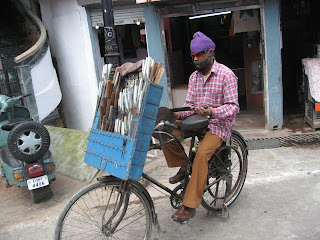
I've also mentioned the Umbrella Man/Knife Sharpener. The knife sharpener ranged a simple tripod and grindstone up to good sized cart like a foot powered sewing machine. Here's a bicycle version where he peddles to spin the grindstone.
-
PrestonSturges - Light Sweet Crude
- Posts: 6052
- Joined: Wed 15 Oct 2008, 03:00:00
Re: How is Agriculture Going to Work?
by Tanada » Wed 07 Dec 2016, 17:10:56
$this->bbcode_second_pass_quote('Alfred Tennyson', 'W')e are not now that strength which in old days
Moved earth and heaven, that which we are, we are;
One equal temper of heroic hearts,
Made weak by time and fate, but strong in will
To strive, to seek, to find, and not to yield.
Moved earth and heaven, that which we are, we are;
One equal temper of heroic hearts,
Made weak by time and fate, but strong in will
To strive, to seek, to find, and not to yield.
- Tanada
- Site Admin

- Posts: 17094
- Joined: Thu 28 Apr 2005, 03:00:00
- Location: South West shore Lake Erie, OH, USA
88 posts
• Page 5 of 5 • 1, 2, 3, 4, 5
Who is online
Users browsing this forum: No registered users and 0 guests