Donate Bitcoin

Donate Paypal


PeakOil is You

PeakOil is You

Global economic future news and discussion

Discussions about the economic and financial ramifications of PEAK OIL

Re: Global economic future news and discussion

Postby Plantagenet » Fri 07 Feb 2014, 19:55:33

$this->bbcode_second_pass_quote('Subjectivist', '
')
Boo hoo the mega rich internationalists won't make quite as many billions because globalism is falling apart.



Yup.

And regular folks are going to become poorer as well. Peak oil is going to really wallop the global economy. We've been in a stagnant economy for five years now, and the future doesn't any better. The latest CBO estimates are the US will still be seeing only 2% GDP growth all the way to 2024..

Image
User avatar
Plantagenet
Expert
Expert
 
Posts: 26765
Joined: Mon 09 Apr 2007, 03:00:00
Location: Alaska (its much bigger than Texas).

Re: Global economic future news and discussion

Postby Graeme » Sat 08 Feb 2014, 18:53:47

A New Multilateralism for the 21st Century: the Richard Dimbleby Lecture

$this->bbcode_second_pass_quote('', 'G')ood evening. It is a great honor to be invited to deliver this year’s Dimbleby Lecture, and I would like to thank the BBC and the Dimbleby family for so kindly inviting me—and especially David Dimbleby for his warm words of introduction.

This evening, I would like to talk about the future. Before looking ahead, however, I would like to look back—for the clues to the future can often be read from the tea leaves of the past.

I invite you to cast your minds back to the early months of 1914, exactly a century ago. Much of the world had enjoyed long years of peace, and giant leaps in scientific and technological innovation had led to path-breaking advances in living standards and communications. There were few barriers to trade, travel, or the movement of capital. The future was full of potential.

Yet, 1914 was the gateway to thirty years of disaster—marked by two world wars and the Great Depression. It was the year when everything started to go wrong.

What happened?

What happened was that the birth of the modern industrial society brought about massive dislocation. The world was rife with tension—rivalry between nations, upsetting the traditional balance of power, and inequality between the haves and have-nots, whether in the form of colonialism or the sunken prospects of the uneducated working classes.

By 1914, these imbalances had toppled over into outright conflict. In the years to follow, nationalist and ideological thinking led to an unprecedented denigration of human dignity. Technology, instead of uplifting the human spirit, was deployed for destruction and terror. Early attempts at international cooperation, such as the League of Nations, fell flat. By the end of the Second World War, large parts of the world lay in ruins.

I now invite you to consider a second turning point—1944. In the summer of that year, the eminent economist, John Maynard Keynes, and a delegation of British officials, embarked on a fateful journey across the Atlantic. The crossing was risky—the world was still at war and enemy ships still prowled the waters. Keynes himself was in poor health.

But he had an appointment with destiny—and he was not going to miss it.


imf
Human history becomes more and more a race between education and catastrophe. H. G. Wells.
Fatih Birol's motto: leave oil before it leaves us.
User avatar
Graeme
Fusion
Fusion
 
Posts: 13258
Joined: Fri 04 Mar 2005, 04:00:00
Location: New Zealand

Re: Global economic future news and discussion

Postby Graeme » Thu 20 Feb 2014, 18:25:44

IMF says reforms could add $2.25tn to global economy by 2018

$this->bbcode_second_pass_quote('', '
')Aggressive reforms could add $2.25tn to the size of the global economy by 2018, the International Monetary Fund has said in a report before G20 finance ministers meet this weekend.

Efforts to rebalance, reform product and labour markets, and boost infrastructure investment could increase global growth by 0.5 percentage points a year and give a significant boost to global living standards, the report says.

The report will be seized upon by Australia, which is chairing the G20, to support its drive for the group of the world’s largest economies to set targets for growth.

The IMF’s analysis shows the potential for boosting growth but calls for a long list of politically difficult reforms. It is not clear whether coordinating reforms at the G20 will make individual countries more likely to carry them out.

For example, the IMF reform scenario assumes that China adopts a fully flexible exchange rate; countries cut service industry regulation and labour protection laws by 20 per cent; while the US, Germany, Brazil, India and Indonesia raise public investment by 0.5 percentage points of total output.

“While most of the gains are attributable to domestic policies, joint action could produce beneficial growth spillovers in the medium to long term,” says the IMF.
“Even more importantly, joint action can also reduce risks of renewed global turmoil both by reducing external imbalances and internal distortions and by strengthening market confidence.”

The IMF calls for a list of reforms to reduce global imbalances, including an improved social safety net in China, measures to boost investment in Germany, and structural reforms to boost competitiveness in France and the UK.


FT
Human history becomes more and more a race between education and catastrophe. H. G. Wells.
Fatih Birol's motto: leave oil before it leaves us.
User avatar
Graeme
Fusion
Fusion
 
Posts: 13258
Joined: Fri 04 Mar 2005, 04:00:00
Location: New Zealand

Re: Global economic future news and discussion

Postby Graeme » Sat 22 Feb 2014, 18:56:42

Rickards: The China bubble is bursting

$this->bbcode_second_pass_quote('', 'A')mid weaker U.S. growth and volatility in capital markets, China stands out as a beacon in the minds of many investors. It is widely assumed that China will continue to grow at about 7% without interruption and will, in time, surpass the United States as the largest economic power in the world.

This China growth story is one that investors take for granted. But investors are in for a rude awakening when they realize how much of the China story is false and how quickly it may come unraveled.

There is evidence that Chinese growth figures are manipulated by bureaucrats to please the political leadership, but that is not the biggest problem with the growth story. Instead, the composition of growth and its non-sustainability are the Achilles Heel. Economic growth is the sum of consumption, investment, government spending and net exports. Major economies work to achieve a sustainable balance among these elements. For example, too much government spending may result in high burdens of debt or taxes, or too many exports may result in trade wars, and so on. A sustainable mix is what is needed for strong long-term growth.

China’s problem is an over-reliance on investment to the exclusion of consumption. Investment makes up 45% of Chinese gross domestic product compared with about 20% in the U.S. Investment can be sustainable if it results in improvements to productive assets such as ports, roads and other critical infrastructure. China’s problem is that much of its investment is wasted on white elephant projects such as empty cities, monumental train stations, and unused airports.

If reported GDP were adjusted for wasted investment, actual growth in China would be seen to be much lower today. If the costs of massive air pollution and other environmental degradation were also deducted, real growth would be even lower.

A frequently proposed solution to this wasted investment problem is for China to rebalance its economy away from investment toward more consumption as in the United States. But there are enormous obstacles to this. The first is that any reduction in investment would depress Chinese growth immediately while the benefits of increased consumption might only be achieved over long periods of time. The other problem is that Chinese citizens are reluctant consumers because of their need to save for retirement or health care due to the lack of a Chinese social safety net.

Also, Chinese workers are demographically dominated by those in their 40s and 50s who have the highest propensity to save, not spend. China has a shortage of younger people, who are more likely to spend, due to the “one child” policy that began in 1980. Thirty years after taking effect, that policy has depleted China of a large portion of its younger generation. China’s rebalancing effort would have been more effective around 2002 when the demographics were most favorable and before investment ran out of control into full-scale waste. That opportunity has now been lost.


darientimes
Human history becomes more and more a race between education and catastrophe. H. G. Wells.
Fatih Birol's motto: leave oil before it leaves us.
User avatar
Graeme
Fusion
Fusion
 
Posts: 13258
Joined: Fri 04 Mar 2005, 04:00:00
Location: New Zealand

Re: Global economic future news and discussion

Postby Tanada » Sun 23 Feb 2014, 07:47:52

$this->bbcode_second_pass_quote('Plantagenet', '')$this->bbcode_second_pass_quote('Subjectivist', '
')
Boo hoo the mega rich internationalists won't make quite as many billions because globalism is falling apart.


Yup.

And regular folks are going to become poorer as well. Peak oil is going to really wallop the global economy. We've been in a stagnant economy for five years now, and the future doesn't any better. The latest CBO estimates are the US will still be seeing only 2% GDP growth all the way to 2024..
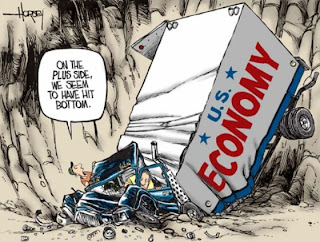

Except for the lucky few who have brains, skills and luck as well we are all going to be a lot poorer after peak oil destroys the world as we knew it. Saying we are going to get poorer is the same as saying the sun is going to rise in the east, it is a given.
$this->bbcode_second_pass_quote('Alfred Tennyson', 'W')e are not now that strength which in old days
Moved earth and heaven, that which we are, we are;
One equal temper of heroic hearts,
Made weak by time and fate, but strong in will
To strive, to seek, to find, and not to yield.
Tanada
Site Admin
Site Admin
 
Posts: 17094
Joined: Thu 28 Apr 2005, 03:00:00
Location: South West shore Lake Erie, OH, USA
Top

Re: Global economic future news and discussion

Postby lasseter » Sun 23 Feb 2014, 15:41:01

Good posts Graeme. I am a firm believer that the past shows the future, that there are cycles, large ones, that cannot be avoided no matter how many promises are made.
Friends, good long lasting friends, these are worth more than gold
User avatar
lasseter
Peat
Peat
 
Posts: 100
Joined: Sat 11 Jan 2014, 03:34:30

Re: Global economic future news and discussion

Postby Graeme » Wed 26 Feb 2014, 18:15:30

Thanks. I'm trying to find articles on global economy by experts. Here is another one by Lagarde. This is her entire speech at Stanford.

LAGARDE: INNOVATION, TECHNOLOGY AND THE 21ST CENTURY GLOBAL ECONOMY – SPEECH

$this->bbcode_second_pass_quote('', 'G')ood afternoon. It is a great honor to come to Stanford University. Stanford, of course, is one of the world’s premier centers of higher learning, and it also has the good fortune of being linked to the world’s leading hub of modern technology and innovation.

So I am delighted to be here, and I would like to especially thank my hosts—John Shoven, director of the Stanford Institute for Economic Policy Research, and Tino Cuellar, director of the Freeman Spogli Institute for International Studies.

As I am just returning from Sydney’s G-20 meeting, I would like to share with you our views on the global economic situation. While unemployment is too high, public and private debt are too high, and global growth is too low relative to potential, we certainly see some economic momentum in the works—global economic growth of 3¾ percent this year, rising to 4 percent next year. This latest pickup of growth is largely due to positive developments among the advanced countries—certainly in the US, but also in Japan and the Euro Area.

Ironically, the emerging markets that kept the global economy afloat during the crisis (together with the developing economies, accounting for three-quarters of global economic growth in recent years) are weakening, with their economic cycles turning and growth slowing. For some of them, a rising tide came with more choppy waves—strong growth opened up vulnerabilities that came into focus as growth began to slow.

At the same time, because the economic situation was improving in the US, the US Federal Reserve started the process of dialing back its unconventional monetary policy. This mix created the conditions for some capital to flow out of a number of emerging markets, thus generating market volatility and currency variations.


eurasiareview
Human history becomes more and more a race between education and catastrophe. H. G. Wells.
Fatih Birol's motto: leave oil before it leaves us.
User avatar
Graeme
Fusion
Fusion
 
Posts: 13258
Joined: Fri 04 Mar 2005, 04:00:00
Location: New Zealand
Top

Re: Global economic future news and discussion

Postby Subjectivist » Fri 28 Feb 2014, 16:35:12

Image

This chart shows the price predictions from 2010. I am already on record as guessing case B will turn out to be correct as the 2014 price, not 2030. Strangely the media still thinks these projections are realistic even though they all give a range of $80 to $95 as the start of 2015 price.
II Chronicles 7:14 if my people, who are called by my name, will humble themselves and pray and seek my face and turn from their wicked ways, then I will hear from heaven, and I will forgive their sin and will heal their land.
Subjectivist
Volunteer
Volunteer
 
Posts: 4705
Joined: Sat 28 Aug 2010, 07:38:26
Location: Northwest Ohio

Re: Global economic future news and discussion

Postby Graeme » Mon 03 Mar 2014, 17:59:47

Global factory growth stumbles as demand falters

$this->bbcode_second_pass_quote('', 'M')anufacturers across Europe and Asia changed down a gear last month as falling demand from abroad hurt Chinese output and European factory growth dipped from January's 2-1/2 year high.

But while the surveys across Asia were more downbeat, data from the euro zone showed output rose in all of the bloc's four biggest economies for the first time in almost three years.

"They are all building up to a picture which says it's going to be okay but nothing particularly stellar. They are not helping the case for a decent pick-up in the first half of the year," said Peter Dixon at Commerzbank.

Markit's final Eurozone Manufacturing Purchasing Managers' Index (PMI) came in at 53.2 last month, up from a flash reading of 53.0 but below January's 54.0 - which was the highest since May 2011. A reading above 50 indicates growth in activity.

The index measuring manufacturing output, which feeds into a composite PMI that is seen as a good gauge of growth, dipped from January's 33-month high.

"(This) reinforces suspicion that it is going to be far from plain sailing for the euro zone in 2014," said Howard Archer at IHS Global Insight.

"While the euro zone may be establishing modest growth, it is still finding it hard to build up momentum."

Gross domestic product across the region expanded 0.3 percent in the final three months of last year, thanks to stronger expansion in France and Germany, and is expected to match that pace each quarter this year.

To meet demand, firms increased headcount for the second month. But worryingly for the European Central Bank, which meets this week to set policy, inflation pressures subsided again.

Average input costs declined for the first time in six months and although factories were able to raise their prices slightly, they barely brought them up from January, possibly stoking fears of deflation in the region.

In one bright spot, British manufacturing grew quicker than expected, adding to signs that the country's economic recovery is broadening out. Job creation in the sector hit a 33-month high.

Similarly U.S. data - due later on Monday - is forecast to show a sliver of improvement in manufacturing, although much focus will be on new order growth, which slumped in January - the most in more than three decades.


reuters
Human history becomes more and more a race between education and catastrophe. H. G. Wells.
Fatih Birol's motto: leave oil before it leaves us.
User avatar
Graeme
Fusion
Fusion
 
Posts: 13258
Joined: Fri 04 Mar 2005, 04:00:00
Location: New Zealand
Top

Re: Global economic future news and discussion

Postby Graeme » Tue 04 Mar 2014, 22:19:52

Lack of investment is stifling the global economy

$this->bbcode_second_pass_quote('', 'S')ome economists, like Larry Summers, call it "secular stagnation". Others refer to it as "Japanisation". But all agree that after too many years of inadequate growth in advanced economies, substantial longer-term risks have emerged, not only for the wellbeing of these countries' citizens but also for the health and stability of the global economy.

Those looking for ways to reduce the risks of inadequate growth agree that, of all possible solutions, increased business investment can make the biggest difference. And many medium-size and large companies, having recovered impressively from the huge shock of the 2008 global financial crisis and subsequent recession, now have the wherewithal to invest in new plants, equipment, and hiring.

Indeed, with profitability at or near record levels, cash holdings by the corporate sector in the United States have piled up quarter after quarter, reaching all-time highs – and earning very little at today's near-zero interest rates. Moreover, because companies have significantly improved their operating efficiency and lengthened the maturities on their debt, they need a lot less precautionary savings than they did in the past.

However one looks at it, the corporate sector in advanced economies in general, and in the US in particular, is as strong as it has been in many years. Non-financial firms have achieved a mix of resilience and agility that contrasts sharply with prevailing conditions for some households and governments around the world that have yet to confront adequately a legacy of over-leverage.

But, rather than deploy their abundant cash in new investments to expand capacity and tap new markets – which they have been very hesitant to do since the global financial crisis erupted – many companies have so far preferred (or have been pressured by activist investors) to give it back to shareholders.

Last year alone, US companies authorised more than $600bn of share buybacks – an impressive amount by any measure, and a record high. Moreover, many companies boosted their quarterly dividend payouts to shareholders. Such activity continued in the first two months of 2014.

But, while shareholders have clearly benefited from companies' unwillingness to invest their ample cash, the bulk of the injected money has been circulating only in the financial sector. Little of it has directly benefited economies that are struggling to boost their growth rates, expand employment, avoid creating a lost generation of workers, and address excessive income inequality.


theguardian
Human history becomes more and more a race between education and catastrophe. H. G. Wells.
Fatih Birol's motto: leave oil before it leaves us.
User avatar
Graeme
Fusion
Fusion
 
Posts: 13258
Joined: Fri 04 Mar 2005, 04:00:00
Location: New Zealand
Top

Re: Global economic future news and discussion

Postby Graeme » Thu 06 Mar 2014, 20:33:46

Russian Dollar Dump Could Crash Financial System-John Williams

$this->bbcode_second_pass_quote('', 'E')conomist John Williams says if Russia sells its U.S. dollar holdings, it could trigger hyperinflation. Could it collapse the financial system? Williams contends, “Yes, it certainly has a potential to do that. Looking outside the United States, there is something over $16 trillion in cash, or near cash. That’s about the same size as our GDP. . . Nobody has wanted to hold the dollar for some time. The dollar, fundamentally, is weak. It couldn’t be weaker. All the major factors are against it. It’s just a matter of what would trigger the massive selling. Nobody wants to hold it. The Russians start selling, and you have China indicating a general alliance here in terms of what’s transpiring. If the rest of the world believes this is what’s going to happen, people who have been wanting to get out of the dollar for some time very easily could front-run the Russians. The scare is on. People will try to get out of it as rapidly as they can.

What would happen if there was massive dollar dumping globally? Williams says, “It would be disastrous for our markets. All those excess dollars coming in, with bonds being sold, interest rates would spike. The stock market would sell off and we’d see inflation. To prevent that and try and keep things stable, the Fed would tend to buy up those Treasuries. It would intervene wherever it could to stabilize the circumstance. It’s going to be very difficult, and it’s going to be very inflationary. Williams goes on to say, “You have to keep in mind, back in 2008, we had one of the greatest financial crises the United States had ever faced. The system was on the brink of collapse at that point in time. What the Fed and the federal government did was spend every penny they could, anything they could create or anything they could guarantee. They did everything they could possibly do to keep the system from crashing. They guaranteed all bank accounts. So, they saved the system, but now what they did has not borne fruit. We have not seen an economic recovery. We have not seen a return of health to the banking system. So, the system is very vulnerable; and if the Russians carry through with their threat, you have, indeed, the risk of it collapsing the system.”


usawatchdog
Human history becomes more and more a race between education and catastrophe. H. G. Wells.
Fatih Birol's motto: leave oil before it leaves us.
User avatar
Graeme
Fusion
Fusion
 
Posts: 13258
Joined: Fri 04 Mar 2005, 04:00:00
Location: New Zealand
Top

Re: Global economic future news and discussion

Postby radon1 » Thu 06 Mar 2014, 21:29:24

$this->bbcode_second_pass_quote('Graeme', '[')b]Russian Dollar Dump Could Crash Financial System-John Williams

$this->bbcode_second_pass_quote('', 'E')conomist John Williams says if Russia sells its U.S. dollar holdings, it could trigger hyperinflation.


Nice links, but it seems that the man talks rubbish on this occasion. In order to dump dollar, you need to take something in exchange, and what would this be? Japanese will gladly stock you up with yen, Europeans - with euro, how those are in any way better than the dollar. Maybe buy roubles or pesos instead?

And in order to drive inflation due to dumping of the dollar, an exchange rate in which lots of international trade is made needs to be derailed. Assuming that most of that trade is with China and yuan is anyway pegged to dollar, there should not be any significant impact on inflation.

If China agrees with Russia that Russia transfers its dollar holdings into yuan holdings and China simultaneously drops the dollar peg - then this could be another story. But would it be wise for Russia to do so? Does not seem so.

Anyway, given that the Russian state financials are managed by liberoids, they will perform any such action in such way that it would be most harmful for Russia and beneficial for the US.

Looks like the man is a gold bug or something.
radon1
Intermediate Crude
Intermediate Crude
 
Posts: 2054
Joined: Thu 27 Jun 2013, 06:09:44
Top

Re: Global economic future news and discussion

Postby dissident » Fri 07 Mar 2014, 01:10:17

The financial chickens are going to start coming home to roost for the USA. Printing money like Pancho Villa and having the world sterilize it is not a long term stable policy. Perhaps if the USA could totally control the world but that is just delusional. The $16 trillion abroad is the sword of Damocles hanging over the US. What Williams is saying is serious and not because of the small Russian holdings being unloaded (BTW, Russia got rid of a huge amount of its dollar holdings since 2008).
dissident
Expert
Expert
 
Posts: 6458
Joined: Sat 08 Apr 2006, 03:00:00

Re: Global economic future news and discussion

Postby radon1 » Fri 07 Mar 2014, 05:57:24

$this->bbcode_second_pass_quote('dissident', 'T')he financial chickens are going to start coming home to roost for the USA. Printing money like Pancho Villa and having the world sterilize it is not a long term stable policy. Perhaps if the USA could totally control the world but that is just delusional. The $16 trillion abroad is the sword of Damocles hanging over the US. What Williams is saying is serious and not because of the small Russian holdings being unloaded (BTW, Russia got rid of a huge amount of its dollar holdings since 2008).


In order to have hyperinflation, either population needs to get lots of money into their hands, or consumer goods supplies need to be disrupted. Unclear how either of these can be achieved by unloading the Russian dollar holdings. Maybe they can, but he does not explain how, he is only making generalizations about "16 trillion".

As long as Russia's main trade items are priced in dollars, any such unloading can be counterproductive. You'd have to pay currency conversion commissions twice every time you commit to an international trade deal. Whereas any short-term effect of the unloading would likely prove to be unsustainable.

Re-pricing everything in another currency, euro or yuan or else, would be a different story. Then the dollar would not be needed at all. Indeed the demand for dollars should fall, leading to sustained reduced demand for treasuries, leading to higher interest rates along the lines of the mechanics that he described. But even then, as long as general commodity trading at exchanges is expressed in dollars, the transactional costs of the non-dollar trading would be higher.

And again, the liberoids will screw up everything. You cannot make what is effectively a branch of the US government screw the US government itself.
radon1
Intermediate Crude
Intermediate Crude
 
Posts: 2054
Joined: Thu 27 Jun 2013, 06:09:44
Top

Re: Global economic future news and discussion

Postby Graeme » Sun 09 Mar 2014, 17:05:34

Global Debt Exceeds $100 Trillion as Governments Binge, BIS Says

$this->bbcode_second_pass_quote('', 'T')he amount of debt globally has soared more than 40 percent to $100 trillion since the first signs of the financial crisis as governments borrowed to pull their economies out of recession and companies took advantage of record low interest rates, according to the Bank for International Settlements.

The $30 trillion increase from $70 trillion between mid-2007 and mid-2013 compares with a $3.86 trillion decline in the value of equities to $53.8 trillion in the same period, according to data compiled by Bloomberg. The jump in debt as measured by the Basel, Switzerland-based BIS in its quarterly review is almost twice the U.S.’s gross domestic product.

Borrowing has soared as central banks suppress benchmark interest rates to spur growth after the U.S. subprime mortgage market collapsed and Lehman Brothers Holdings Inc.’s bankruptcy sent the world into its worst financial crisis since the Great Depression. Yields on all types of bonds, from governments to corporates and mortgages, average about 2 percent, down from more than 4.8 percent in 2007, according to the Bank of America Merrill Lynch Global Broad Market Index.

“Given the significant expansion in government spending in recent years, governments (including central, state and local governments) have been the largest debt issuers,” according to Branimir Gruic, an analyst, and Andreas Schrimpf, an economist at the BIS. The organization is owned by 60 central banks and hosts the Basel Committee on Banking Supervision, a group of regulators and central bankers that sets global capital standards.


bloomberg
Human history becomes more and more a race between education and catastrophe. H. G. Wells.
Fatih Birol's motto: leave oil before it leaves us.
User avatar
Graeme
Fusion
Fusion
 
Posts: 13258
Joined: Fri 04 Mar 2005, 04:00:00
Location: New Zealand
Top

Re: Global economic future news and discussion

Postby Graeme » Mon 10 Mar 2014, 16:51:54

Surpassing China, India will become the world's largest economy by 2050, says a report.

$this->bbcode_second_pass_quote('', 'S')urpassing China, India will become the world's largest economy by 2050, says a report.

"China will overtake the US to become the world's largest economy by 2020, which in turn will be overtaken by India in 2050," according to Wealth Report 2012 by Knight Frank & Citi Private Bank.

As per the report, Indian economy will reach $85.97 trillion size in terms of purchasing power parity by 2050, while the Chinese GDP would be $80.02 trillion during the same period.

The US -- currently the world's largest economy -- is expected to have a GDP of $39.07 trillion by 2050.

Other nations in the top ten list of world's largest economies would be Indonesia (4th), Brazil (5th), Nigeria (6th), Russia (7th), Mexico (8th), Japan (9th) and Egypt (10th).


indiatimes
Human history becomes more and more a race between education and catastrophe. H. G. Wells.
Fatih Birol's motto: leave oil before it leaves us.
User avatar
Graeme
Fusion
Fusion
 
Posts: 13258
Joined: Fri 04 Mar 2005, 04:00:00
Location: New Zealand
Top

Re: Global economic future news and discussion

Postby dolanbaker » Mon 10 Mar 2014, 17:44:35

$this->bbcode_second_pass_quote('Graeme', '[')b]Surpassing China, India will become the world's largest economy by 2050, says a report.

$this->bbcode_second_pass_quote('', 'S')urpassing China, India will become the world's largest economy by 2050, says a report.

"China will overtake the US to become the world's largest economy by 2020, which in turn will be overtaken by India in 2050," according to Wealth Report 2012 by Knight Frank & Citi Private Bank.

As per the report, Indian economy will reach $85.97 trillion size in terms of purchasing power parity by 2050, while the Chinese GDP would be $80.02 trillion during the same period.

The US -- currently the world's largest economy -- is expected to have a GDP of $39.07 trillion by 2050.

Other nations in the top ten list of world's largest economies would be Indonesia (4th), Brazil (5th), Nigeria (6th), Russia (7th), Mexico (8th), Japan (9th) and Egypt (10th).


indiatimes
May well be correct, but for the wrong reasons. It's more likely that India will decline slower than both China and the US, so India will end up the largest economy.

Somewhat bemused by the fact that they have Egypt in the top 10. :?
Religion is regarded by the common people as true, by the wise as false, and by rulers as useful.:Anonymous
Our whole economy is based on planned obsolescence.
Hungrymoggy "I am now predicting that Europe will NUKE ITSELF sometime in the first week of January"
User avatar
dolanbaker
Intermediate Crude
Intermediate Crude
 
Posts: 3855
Joined: Wed 14 Apr 2010, 10:38:47
Location: Éire
Top

Re: Global economic future news and discussion

Postby Tanada » Tue 11 Mar 2014, 08:10:53

It occurs to me that every projection of the future economy assumes endless growth with no real set backs, let alone outright collapse scenario's.

Peak oil has already set back growth by a large percentage, in the western countries at least the economy has been stagnant. As things get tighter and tighter the eastern countries will, sooner or later, also stagnate.

The future is stagnation or decline, not endless growth.
$this->bbcode_second_pass_quote('Alfred Tennyson', 'W')e are not now that strength which in old days
Moved earth and heaven, that which we are, we are;
One equal temper of heroic hearts,
Made weak by time and fate, but strong in will
To strive, to seek, to find, and not to yield.
Tanada
Site Admin
Site Admin
 
Posts: 17094
Joined: Thu 28 Apr 2005, 03:00:00
Location: South West shore Lake Erie, OH, USA
Top

Re: Global economic future news and discussion

Postby Graeme » Tue 11 Mar 2014, 17:06:19

T, I'm fully aware of resource and environmental constraints but some economists do not seem to take these into account (e.g. Knight Frank, see thewealthreport). I posted their analysis because if correct it may be possible to pay back global debt with diligent country by country financial managment.

Strangely enough, I saw this morning yet another long-term analysis by ten leading economists who do envisage a hotter world but they don't say how this will affect the global economy. In fact, some think that this issue though "problematic" is solvable!

Ten Expert Economists' Wild Guesses About the World of 2114

$this->bbcode_second_pass_quote('', 'W')e don’t know what’s going to happen 15 minutes from now, so it seems like an exercise in science fiction to predict what the world will look like in a century. That hasn’t stopped 10 economists who were invited to contribute essays to a new book called In 100 Years: Leading Economists Predict the Future, edited by Ignacio Palacios-Huerta of the London School of Economics. As one of the 10 essayists, Avinash Dixit, noted, “I will not be around to be ridiculed when my predictions go spectacularly wrong.”

Where a book like In 100 Years is most useful is in the one arena for which a century-ahead forecast is valuable, even necessary. That’s climate change. Companies, nations, and reality TV stars will rise and fall over the coming decades, but one thing is certain: Unless greenhouse gas emissions suddenly decline, the world will be considerably hotter in 2114. (Actually 2113, since the essays were completed last year.) In a collection that ranges all over the world, global warming is the one theme that all 10 essayists grapple with.

For the pessimists in the group, climate change is the coup de grâce. For the optimists, it’s the caveat. In the final essay in the book, it’s the sole subject. The 10th author dwells on a solution that’s cheap and easy—maybe, he fears, too cheap and easy. Here, then, is a quick review of who the economists are and what they say about an issue that is likely to preoccupy scientists, policymakers, and the public for the coming century.


businessweek
Human history becomes more and more a race between education and catastrophe. H. G. Wells.
Fatih Birol's motto: leave oil before it leaves us.
User avatar
Graeme
Fusion
Fusion
 
Posts: 13258
Joined: Fri 04 Mar 2005, 04:00:00
Location: New Zealand
Top

Re: Global economic future news and discussion

Postby Graeme » Wed 12 Mar 2014, 18:05:10

Pimco's Outlook for U.S. and Global Economy

$this->bbcode_second_pass_quote('', 'T')he global economy will likely experience steady, broad-based growth in 2014 thanks in no small part to the extraordinary expansion in central bank balance sheets in 2013.

Rising asset prices in combination with fading near-term fiscal uncertainties will drive global aggregate demand growth forward, adding stability to what has thus far been an on-again, off-again global recovery from the financial crisis of 2008.

In the United States, our baseline expectation of 2.5% to 3% real growth marks the likely transition of growth from consumer to corporate and the anticipated broadening of growth from private to public.

Rising consumer optimism, fueled by higher asset prices, steady job growth and gradually easing credit conditions, will likely drive a further fall in household savings rates this year, leading to faster consumption growth.

Corporations, which are sitting on record levels of liquidity, might for the first time this cycle raise the growth rate of capital spending, especially as the market value of enterprises exceeds book value by a substantial amount.

And the public sector, having endured a difficult period of significant spending cuts over the last three years, will no longer be a drag on aggregate demand growth as revenues expand rapidly thanks to higher asset prices and faster consumption and investment growth.

Risks to our U.S. outlook are evenly balanced. On the upside, a rapid easing in household credit standards could turbo-charge the "wealth effect" to drive savings rates lower -- and faster than expected. On the downside, the poor quality of job creation could dent the current growth trajectory of residential investment and home prices by delaying the growth rate of household formations in the year ahead.

In the eurozone, our baseline expectation of 1% to 1.5% real growth calls for a broad-based cyclical improvement in domestic demand amid steady external demand.

We expect the reduction in fiscal drag in the eurozone periphery will reinforce gradually improving credit conditions to drive aggregate demand growth from well below potential to up toward potential in the year ahead. Increasing global confidence in the sustainability and efficacy of the ECB's policy framework is likely to push global excess liquidity into eurozone assets, leading to further improvements in valuations during 2014. Rising asset valuations should drive the positive feedback loop forward, resulting in a steady outlook for consumer and corporate spending in the year ahead.


barrons
Human history becomes more and more a race between education and catastrophe. H. G. Wells.
Fatih Birol's motto: leave oil before it leaves us.
User avatar
Graeme
Fusion
Fusion
 
Posts: 13258
Joined: Fri 04 Mar 2005, 04:00:00
Location: New Zealand
Top

PreviousNext

Return to Economics & Finance

Who is online

Users browsing this forum: No registered users and 0 guests

cron