PeakOil is You
Stabbing the beast
Re: Stabbing the beast
 by Newfie » Mon 20 Jan 2014, 08:55:13
That would work only in warm climates. In temperate climates you need much more land for wood lots, to heat. Or, it's a return to the crafters Black House. Sort of a peat igloo with a common fireplace.
-

Newfie - Forum Moderator

- Posts: 18651
- Joined: Thu 15 Nov 2007, 04:00:00
- Location: Between Canada and Carribean
Re: Stabbing the beast
by KaiserJeep » Mon 20 Jan 2014, 10:58:49
"Stabbing the beast" to some people means advocating that one drops out of a consumer lifestyle, for one more environmentally sound. Based on what I have read in this thread, to other people it means going over the top, environmental activism, and sabotage of the system itself.
I'm pretty certain that environmental activism has never had any net benefit. I remember when activists were torching new SUVs. Then I remember investigations at several Silicon Valley car dealerships where only last year's SUV models got burned. Activism had become a tool for clearing dead inventory.
Likewise I don't know anybody who believes that the "Occupy Wall Street" crowd ever accomplished anything positive. In the end, pretty much all the media coverage was negative.
Tree sitters around here don't even make the news any more. The various law enforcement agencies have developed techniques and equipment to get them out of the trees.
I would advise that you use care when you skirt the edge between criticism of Capitalism and actual activism, which potentially increases human misery. Recent history says that even causing a traffic jam at rush hour is enough to heap popular media scorn on the cause you thought you were promoting.
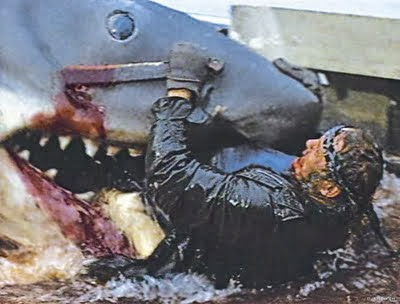
Even the picture associated with "Stabbing the Beast" above does not really mean what you think it does. It depicts a member of the harmful human species that is destroying the Earth, stabbing an endangered species of apex predator shark, from a wooden fishing vessel which is about to create an environmentally damaging slick of engine oil and diesel fuel. (Yes I know it's really a cybernetic shark prop on a wooden prop boat, and that the actor Robert Shaw would go on to star in yet another Peter Benchley novel-turned-movie after that.)
I'm pretty certain that environmental activism has never had any net benefit. I remember when activists were torching new SUVs. Then I remember investigations at several Silicon Valley car dealerships where only last year's SUV models got burned. Activism had become a tool for clearing dead inventory.
Likewise I don't know anybody who believes that the "Occupy Wall Street" crowd ever accomplished anything positive. In the end, pretty much all the media coverage was negative.
Tree sitters around here don't even make the news any more. The various law enforcement agencies have developed techniques and equipment to get them out of the trees.
I would advise that you use care when you skirt the edge between criticism of Capitalism and actual activism, which potentially increases human misery. Recent history says that even causing a traffic jam at rush hour is enough to heap popular media scorn on the cause you thought you were promoting.
Even the picture associated with "Stabbing the Beast" above does not really mean what you think it does. It depicts a member of the harmful human species that is destroying the Earth, stabbing an endangered species of apex predator shark, from a wooden fishing vessel which is about to create an environmentally damaging slick of engine oil and diesel fuel. (Yes I know it's really a cybernetic shark prop on a wooden prop boat, and that the actor Robert Shaw would go on to star in yet another Peter Benchley novel-turned-movie after that.)
KaiserJeep 2.0, Neural Subnode 0010 0000 0001 0110 - 1001 0011 0011, Tertiary Adjunct to Unimatrix 0000 0000 0001
Resistance is Futile, YOU will be Assimilated.
Warning: Messages timestamped before April 1, 2016, 06:00 PST were posted by the unmodified human KaiserJeep 1.0
Resistance is Futile, YOU will be Assimilated.
Warning: Messages timestamped before April 1, 2016, 06:00 PST were posted by the unmodified human KaiserJeep 1.0
- KaiserJeep
- Light Sweet Crude
- Posts: 6094
- Joined: Tue 06 Aug 2013, 17:16:32
- Location: Wisconsin's Dreamland
Re: Stabbing the beast
by dinopello » Mon 20 Jan 2014, 12:39:12
$this->bbcode_second_pass_quote('Newfie', 'T')he irony being that some of the now least privileged may be some of the best situated to survive.
Ironic, maybe. But, long time recognized as the case.
$this->bbcode_second_pass_quote('', '[')b]Blessed are the meek:
for they shall inherit the earth.
-Mathew 5:5
Maybe the ironic thing is it seems most of the most fervent bible thumpers forget that part. Maybe the new pope does though.
-

dinopello - Light Sweet Crude
- Posts: 6088
- Joined: Fri 13 May 2005, 03:00:00
- Location: The Urban Village
Re: Stabbing the beast
by lasseter » Mon 20 Jan 2014, 16:43:04
There is a lot of talk about living off the land, but how many of these backwoods community inhabitants also recieve government pensions or food stamps? How many use a little gas from time to time, or utilize electricity in their homes, either grid or personal solar? Where do their cloths come from, their salt?
I doubt any communities are truly sef sustaining unless they are in the back blocks of India, and even those may barter for salt that is brought in from the coasts on diesel trucks. My brother and I have decided to have as many solar panels in storage as we have up in the air on our retreat homes, but this is only a buffer, not a sustainable solution.
I doubt any communities are truly sef sustaining unless they are in the back blocks of India, and even those may barter for salt that is brought in from the coasts on diesel trucks. My brother and I have decided to have as many solar panels in storage as we have up in the air on our retreat homes, but this is only a buffer, not a sustainable solution.
Friends, good long lasting friends, these are worth more than gold
-

lasseter - Peat

- Posts: 100
- Joined: Sat 11 Jan 2014, 03:34:30
Re: Stabbing the beast
by Pops » Mon 20 Jan 2014, 17:24:15
$this->bbcode_second_pass_quote('lasseter', 'T')here is a lot of talk about living off the land, but how many of these backwoods community inhabitants also recieve government pensions or food stamps? How many use a little gas from time to time, or utilize electricity in their homes, either grid or personal solar? Where do their cloths come from, their salt?
Rhetorically speaking, where does yours?
Most likely from a job and 24/7 self-organized JIT technology, right? Without the job or the tech you get nohtin, at least not if you are the 99
Don't let the perfect be the enemy of the good, there have been very few truly sustainably independent folks for a long time now.
OTOH, there have never been so many, so dependent as now.
The legitimate object of government, is to do for a community of people, whatever they need to have done, but can not do, at all, or can not, so well do, for themselves -- in their separate, and individual capacities.
-- Abraham Lincoln, Fragment on Government (July 1, 1854)
-- Abraham Lincoln, Fragment on Government (July 1, 1854)
-

Pops - Elite

- Posts: 19746
- Joined: Sat 03 Apr 2004, 04:00:00
- Location: QuikSac for a 6-Pac
Re: Stabbing the beast
by dolanbaker » Mon 20 Jan 2014, 17:37:02
Unfortunately (for those who desire to be completely "free") interdependency on others is essential to have any kind of quality of life. There is simply insufficient space to live like a hunter-gatherer and unless you have a large amount of land, insufficient space to supply yourself with all the locally produced food that you would need to sustain yourself & family. Even if you had the land, would you be able to work it without external help.
Religion is regarded by the common people as true, by the wise as false, and by rulers as useful.:Anonymous
Our whole economy is based on planned obsolescence.
Hungrymoggy "I am now predicting that Europe will NUKE ITSELF sometime in the first week of January"
Our whole economy is based on planned obsolescence.
Hungrymoggy "I am now predicting that Europe will NUKE ITSELF sometime in the first week of January"
-

dolanbaker - Intermediate Crude

- Posts: 3855
- Joined: Wed 14 Apr 2010, 10:38:47
- Location: Éire

-
Newfie - Forum Moderator
- Posts: 18651
- Joined: Thu 15 Nov 2007, 04:00:00
- Location: Between Canada and Carribean
Re: Stabbing the beast
by Loki » Tue 21 Jan 2014, 02:02:25
$this->bbcode_second_pass_quote('Pops', '
')
But we didn't come up with that plan because we thought we were going to stick it to the Man. You've heard of Jeavons who said the more you conserve the more someone else will consume? That is my view of FF energy as well as Chinese Chachkas.
')
But we didn't come up with that plan because we thought we were going to stick it to the Man. You've heard of Jeavons who said the more you conserve the more someone else will consume? That is my view of FF energy as well as Chinese Chachkas.
Sorry Pops, but I think the Jeavons' Paradox is one of the more pernicious memes in the peak oil blogosphere. It had limited application in a specific time and place, but it's not a universal law, nor does it apply to a declining resource like oil. There's an extensive body of academic literature on conservation, it generally shows a takeback effect of ~20% or so, certainly not the >100% Jeavons posited.
We can talk about how conservation = efficiency = fragility. But the Jeavons' Paradox just doesn't apply to a resource-constrained world.
That said, I'd like to believe in Holgrem's assertion that the economy is at a delicate tipping point and can be pushed over by a minority reducing their consumption. Doubt it's true, but like Agent Mulder, I want to believe.

Regardless, it can't hurt if folks “drop out” of the mainstream economy, even if only in some parts of their life. Cultural change happens slowly.
A garden will make your rations go further.
-

Loki - Expert
- Posts: 3509
- Joined: Sat 08 Apr 2006, 03:00:00
- Location: Oregon