$this->bbcode_second_pass_quote('KaiserJeep', '
')
Don't worry, however. If you want to stay on an increasingly bad-smelling planet with manure in your toes, nobody will be forcing you to move.
.


PeakOil is You
Luddites vs Technologists
Re: Luddites vs Technologists
 by Ibon » Sat 19 Oct 2013, 04:27:08
The characteristics you are using to describe the planet you are living on is a reflection of your experience while here. I am sorry that this has caused you to search for "greener" pastures elsewhere. Good luck on finding much green out there.
Patiently awaiting the pathogens. Our resiliency resembles an invasive weed. We are the Kudzu Ape
blog: http://blog.mounttotumas.com/
website: http://www.mounttotumas.com
blog: http://blog.mounttotumas.com/
website: http://www.mounttotumas.com
-

Ibon - Expert

- Posts: 9572
- Joined: Fri 03 Dec 2004, 04:00:00
- Location: Volcan, Panama
Re: Luddites vs Technologists
by Ibon » Sat 19 Oct 2013, 04:41:45
$this->bbcode_second_pass_quote('Tanada', 'A')ctually this thread is about the question, is technological advancement at a rapid pace an improvement or a detriment to us?
To address the primary question of this thread we need to go back to a major component missing that would allow us to apply technology toward our sustainable living on this planet.
That component missing has been and will remain still for awhile the incredible resiliency of our planet's biosphere and ecosystems that have allowed us unchallenged to take technological advances down this BAU consumer paradigm Tanada mentioned.
What we are missing are the biosphere feedbacks, the awakening of the Overshoot Predator. Then we will see, as in the depression, a potentially transformative combination of technology applied to creative efficiency. In other words, we need to apply our technology toward external environmental conditions that threaten our survival. Until the biosphere stops giving its abundance unchallenged with no consequences we will continue to squander technology in the BAU consumer paradigm. Passing through that bottle neck can also permanently embed the ethics toward long term sustainability, even after we stabilize our population once these threats bring us down to within carrying capacity once again.
Patiently awaiting......
Patiently awaiting the pathogens. Our resiliency resembles an invasive weed. We are the Kudzu Ape
blog: http://blog.mounttotumas.com/
website: http://www.mounttotumas.com
blog: http://blog.mounttotumas.com/
website: http://www.mounttotumas.com
-
Ibon - Expert
- Posts: 9572
- Joined: Fri 03 Dec 2004, 04:00:00
- Location: Volcan, Panama
Re: Luddites vs Technologists
by KaiserJeep » Sat 19 Oct 2013, 05:59:03
ralfy, I'm still scratching my head. It's not clear to me what you are for or against. I suspect that you are young enough that you enjoy rebellion, even if you are not quite sure what you rebel against.
Ibon, I have personally seen the world human population cross the 3 billion mark (which worried me at age 9) and now it's at 7.3B. I have in fact seen enough damage inflicted to the planet to sadden me. But consumerism is not at fault at all. No group or profession is to blame. The root cause is easily understood and simply represents the advent of modern agricultural methods and medicines on the Third World:
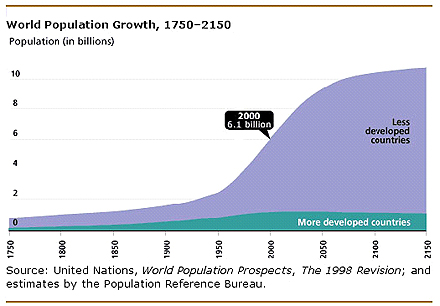
...without changing the cultural paradigm that says that a large family is the best way to survive in that World.
The fate of those that remain on the Earth is simple enough to understand. I do not call the architect of this fate the "overshoot predator" although I congratulate you on a unique and even poetic description.
My preferred terminology is the classic Judeo-Christian: Pestilence, War, Famine, and Death - the Four Horsemen.
It is my opinion that no technology we possess today, or are likely to possess in the near future, is capable of halting or repairing the damage already done, or that soon to be done to the environment. The worlds we live in in space are likely to be very much smaller than that we live on now, and will be easily manageable.
Ibon, I have personally seen the world human population cross the 3 billion mark (which worried me at age 9) and now it's at 7.3B. I have in fact seen enough damage inflicted to the planet to sadden me. But consumerism is not at fault at all. No group or profession is to blame. The root cause is easily understood and simply represents the advent of modern agricultural methods and medicines on the Third World:
...without changing the cultural paradigm that says that a large family is the best way to survive in that World.
The fate of those that remain on the Earth is simple enough to understand. I do not call the architect of this fate the "overshoot predator" although I congratulate you on a unique and even poetic description.
My preferred terminology is the classic Judeo-Christian: Pestilence, War, Famine, and Death - the Four Horsemen.
It is my opinion that no technology we possess today, or are likely to possess in the near future, is capable of halting or repairing the damage already done, or that soon to be done to the environment. The worlds we live in in space are likely to be very much smaller than that we live on now, and will be easily manageable.
KaiserJeep 2.0, Neural Subnode 0010 0000 0001 0110 - 1001 0011 0011, Tertiary Adjunct to Unimatrix 0000 0000 0001
Resistance is Futile, YOU will be Assimilated.
Warning: Messages timestamped before April 1, 2016, 06:00 PST were posted by the unmodified human KaiserJeep 1.0
Resistance is Futile, YOU will be Assimilated.
Warning: Messages timestamped before April 1, 2016, 06:00 PST were posted by the unmodified human KaiserJeep 1.0
- KaiserJeep
- Light Sweet Crude

- Posts: 6094
- Joined: Tue 06 Aug 2013, 17:16:32
- Location: Wisconsin's Dreamland
Re: Luddites vs Technologists
by Tanada » Sat 19 Oct 2013, 08:21:50
$this->bbcode_second_pass_quote('KaiserJeep', '
')It is my opinion that no technology we possess today, or are likely to possess in the near future, is capable of halting or repairing the damage already done, or that soon to be done to the environment. The worlds we live in in space are likely to be very much smaller than that we live on now, and will be easily manageable.
')It is my opinion that no technology we possess today, or are likely to possess in the near future, is capable of halting or repairing the damage already done, or that soon to be done to the environment. The worlds we live in in space are likely to be very much smaller than that we live on now, and will be easily manageable.
IMO and I know it is just my opinion, engineers have a tendency to look at everything in a mechanistic model formula, just like other peoples dependent on mathematics to do their valuable work. The problem I have with that is mathematics is itself a model of the real world, so you are basing a model upon another model instead of looking at the world itself. We see this kind of thinking a lot when a person trained in Macro-economics talks about the economy, they use terms like over heating and growth as if they were talking about a steam powered van neuman machine that can go too fast but can always increase its own working mass. In the real world it doesn't work like that at all, you can't just enter a new program directive and have everything change in short order. The Economy is in most ways like the Environment, growth requires energy inputs and stability is an illusion, but a quasi-stable disequilibrium that constantly self balances through feedback mechanisms is an optimum result.
Take a patch of land east of the Mississippi and strip it down to the soil, then dump three feet of sterilized beach sand on top to eliminate any seed surviving on the soil surface. What will happen? When the spring arrives in the northern area or immediately in the southern area wind blown and bird dropped seeds will arrive on the site, germinate, root and grow. The early colonizers will be what most humans call weeds, they grow in soil absent even dead organic material. These weeds slow wind and water erosion and also serve at least two other purposes, they catch wind blown dust bringing nutrients to the sand, and they also accumulate root and stem structures that add organic carbon to the soil and that serve as both water retention structures and as living space for micro organisms. In two years the area will be covered in grass with a few shrubs popping up. In five years it will be a lot of shrubs with a few young trees popping up. In 30 years it will be a young woodland with many varieties of trees and shrubbery, open meadow areas of grass, and everywhere it will have rich nutrient packed soil.
The best things humans can do for ecosystem restoration is still, get out of the way. But we are itinerant tinkerers, we always assume we can do better so we try and 'help' or 'improve' the process.
The idea that fully artificial environments are easily manageable without external inputs other than energy is hubris. Show me any successful experiment done in a truly sealed environment and I will take it back. Submarines in the US Navy (and presumably others) electrolyze water to get oxygen for the crew to breath and get their supplies from shore. The ISSA gets regular cargo pods and while they use oxygen generators on board they also leak a lot of very expensive mass into space and deliberately deorbit the cargo pods filled with garbage after they unload the fresh supplies. Do you realize that using a solar powered arc furnace they could use most of that 'garbage' as reaction mass to boost their orbit and not have to use expensive fuel hauled up from the surface to simply maintain orbit against the atmospheric drag? We are so far from actually proving any of the life style choices needed for a self sustaining O'Neil colony wheel it isn't remotely funny. Even the proposed modules for ISSA that would have tested a couple useful concepts never got built or delivered, specifically the balloon habitat that was intended to expand out with inflatable sections to give lots of volume and the centrifugal hab where the Astronaut/Cosmonauts would sleep under artificial acceleration simulating gravity to maintain their muscle mass and bone density to test the idea for long duration missions.
As long as space remains a Political project then politics will rule what gets tested, learned or even built. I was a huge supporter of the SSTO/SSTA projects and Pete Conrad was one of my personal hero's though I never met him in person. I also worked online and through letter writing campaigns to try and get CATS passed in California, to no avail. The technology needed to test long duration space living exists, but the political will to use it does not. Until you can change that nothing will get better.
$this->bbcode_second_pass_quote('Alfred Tennyson', 'W')e are not now that strength which in old days
Moved earth and heaven, that which we are, we are;
One equal temper of heroic hearts,
Made weak by time and fate, but strong in will
To strive, to seek, to find, and not to yield.
Moved earth and heaven, that which we are, we are;
One equal temper of heroic hearts,
Made weak by time and fate, but strong in will
To strive, to seek, to find, and not to yield.
- Tanada
- Site Admin

- Posts: 17094
- Joined: Thu 28 Apr 2005, 03:00:00
- Location: South West shore Lake Erie, OH, USA

 $this->bbcode_second_pass_quote('sparky', '.')



 All the other dislocations that happen in a grand game of musical chairs as the Overshoot Predator squeezes down.