Donate Bitcoin

Donate Paypal


PeakOil is You

PeakOil is You

Conservation vs Rationing

General discussions of the systemic, societal and civilisational effects of depletion.

Re: Why is Saudi Arabia not a threat to Fracking?

Unread postby AirlinePilot » Fri 09 Aug 2013, 16:12:53

I understand what you are driving at pwall..but its kind of an apples and oranges comparison. Im strictly talking about US gasoline consumption...a large part of US oil consumption....and how price has driven VMT..efficiency not so much. The correlation points to small amounts of efficiency gains and large amounts of reduction due to price.

Bringing GDP into it is another whole ball of wax specifically since you would have a very hard time addressing the false demand created by monetary policy artificially goosing GDP over the last several years.
User avatar
AirlinePilot
Moderator
Moderator
 
Posts: 4378
Joined: Tue 05 Apr 2005, 03:00:00
Location: South of Atlanta

Re: Why is Saudi Arabia not a threat to Fracking?

Unread postby AirlinePilot » Fri 09 Aug 2013, 16:19:24

$this->bbcode_second_pass_quote('ROCKMAN', ' ')Over a long enough time span the average mpg of US vehicles will increase and we will be more efficient. But for the most part the motivation won’t be to help the health of the planet but to help the health of their wallets. While a few good hearted folks make those cuts for the sake of humanity they are a small minority IMHO.


I would agree 100% with this. There is very little evidence that anything other than BAU is in full force. Recently there HAS been some effort on the part of auto manufacturers to provide higher mileage vehicle choices. Im sure this will continue, but honestly this is only a very recent trend. I doubt it has affected the marketplace in any serious way yet or overall vehicle efficiency.
User avatar
AirlinePilot
Moderator
Moderator
 
Posts: 4378
Joined: Tue 05 Apr 2005, 03:00:00
Location: South of Atlanta

Re: Why is Saudi Arabia not a threat to Fracking?

Unread postby pwallmann » Fri 09 Aug 2013, 16:32:33

We're in complete agreement, the problem is that far too many disagreements (as I sensed above) are simply because we have one group calling an apple what the other group would call an orange and vice versa. It's a conversation that never ends unless both sides are clear on their terms and argue over each other's definition.

We know that we are using less oil/gdp unit produced. We know that the price of oil is at record heights and we are stuck in a stagnating economy. Just seems like these are interesting enough things to consider, rather then trying to decide on how we'd define a word.
pwallmann
Wood
Wood
 
Posts: 36
Joined: Thu 23 May 2013, 11:30:50

Re: Why is Saudi Arabia not a threat to Fracking?

Unread postby John_A » Fri 09 Aug 2013, 16:41:58

$this->bbcode_second_pass_quote('pwallmann', 'I') agree with you AP, but again its just semantics, if I choose to define efficiency in terms of Units of GDP produced for every VMT (which I don't) you could say we're getting more efficient as a society (marginal GDP gains along with a reduction of VMT). It's not wholly unreasonable to frame it in this way.


I wonder why AP just used recent data? Go back to the late 70's and look at American oil consumption per capita and $/GDP. Calculate the same numbers today.

SHAZZZAMMMM BATMAN!! How about a 40% reduction in per capita use and there wasn't even a dieoff or Depression needed to cause it!

Maybe I am bitter, the rationing and shortages and price spikes back in the 70's never did sit well with me, but still the youngsters shouldn't ever forget that once upon a time this was all much worse, there wasn't rationing by price, those bastards at the gas station WOULDN'T GIVE YOU ANY GASOLINE! You would wave money at them and they would just shrug and tell you to buzz off.

Nowadays you can get tanker trucks of the stuff, just tell them when and where and they show up.

Once you've had a REAL energy crisis jump up and bite you in the privates, these more recent wanna-be "crisis" just don't have the pizzazz, sure they are good for us, sure they cause some to pay attention, sure we all need it for our own good, but we need the kinds of crisis we had once upon a time, not this all bark no bite stuff.
45ACP: For when you want to send the very best.
John_A
Heavy Crude
Heavy Crude
 
Posts: 1193
Joined: Sat 25 Jun 2011, 21:16:36

Re: Why is Saudi Arabia not a threat to Fracking?

Unread postby John_A » Fri 09 Aug 2013, 16:47:40

$this->bbcode_second_pass_quote('AirlinePilot', '')$this->bbcode_second_pass_quote('ROCKMAN', ' ')Over a long enough time span the average mpg of US vehicles will increase and we will be more efficient. But for the most part the motivation won’t be to help the health of the planet but to help the health of their wallets. While a few good hearted folks make those cuts for the sake of humanity they are a small minority IMHO.


I would agree 100% with this. There is very little evidence that anything other than BAU is in full force.


I am forced to agree. Peak oil hit with all the force of a butterfly trying to stop a mack truck and left us with cheap natural gas and expensive gasoline. I suppose the good news in all of this is that Americans are changing their vehicle mile driving habits, which means at least this new generation is learning what some of us old farts picked up the last time we went through all of this.
45ACP: For when you want to send the very best.
John_A
Heavy Crude
Heavy Crude
 
Posts: 1193
Joined: Sat 25 Jun 2011, 21:16:36

Re: Why is Saudi Arabia not a threat to Fracking?

Unread postby pwallmann » Fri 09 Aug 2013, 16:57:26

I'd caution how much credit we give to my generation (I'm 27 so I probably fit into this category) I also graduated with a pretty unpractical liberal arts degree from a yuppie upstate new york university... I know plenty of my former classmates that left with 6 figure debt, a useless degree, and are now living at home or living paycheque to paycheque because they can't find work with enough return (why not move to ND or Alberta in my case? I'll never understand it).

Hold off on the praise until they have some $'s in hand. My guess is the wasteful consumption will soon follow. Again, my gut feeling is consistent with AP's story.
pwallmann
Wood
Wood
 
Posts: 36
Joined: Thu 23 May 2013, 11:30:50

Re: Why is Saudi Arabia not a threat to Fracking?

Unread postby ralfy » Fri 09 Aug 2013, 23:35:25

To Pops and John A, you need to understand that in capitalist systems the ultimate goal is not increased output but increased profits from increased output, especially given competition, and that goods and services plus investments involve global transactions.

That means with conservation and efficiency to use less input, the resources that are not used or are saved will be sold by producers to others. The same goes for manufacturers, who experience additional costs for unsold goods.

Even financial institutions are affected because they can only earn more money if they can lend more money. And people will borrow money to either invest them in businesses, which can only give a return on that investment by producing more goods or providing more services that entail resource use, or by spending on goods and services produced. (To Pops, I already explained these points and others in the thread about capitalism.)

The only way for consumption and demand to decrease is to have a world where markets are fully saturated, but that's not the case. Most human beings earn than less $10 a day, and around 60 pct earn only around $2 a day. That means the opportunities to profit more from more sales and investments is high. Most human beings lack and need or want many of the things that only around 15 pct take for granted, and that 15 pct includes all members of this forum: not just needs such as basic and intermediate health care, housing, food, clothing, and utilities including water and electricity, but also passenger vehicles, public transportation, home appliances, electronic gadgets, services such as Internet access, cable television (or even broadcast TV and radio services), education, and more.

The resource levels needed to meet those needs and wants are very high. Take, for example, this list of ecological footprints per capita:

https://en.wikipedia.org/wiki/List_of_c ... _footprint

If most wanted to copy what the U.S., EU members, and Japan are doing, then there will be absolutely no threat to fracking, as we will need the equivalent of more than one earth to meet the needs and wants of the global population.

The middle class sometimes wants to think that "we" will not allow most human beings to avail of these needs and wants because there aren't enough resources, not realizing that its income level and economic growth is based essentially on increased spending from most human beings, and that means more resource consumption to support ever-increasing financial speculation.

The same financial speculation is also the reason why some countries are growing economically even if they use less oil. That's because segments of economic growth involve investments, which means a country might have heavily saturated markets (which means its oil consumption should start dropping), but it may already have as it is a high consumption level (e.g., the U.S. has less than 5 pct of the world's population but has to consume up to a quarter of world oil production) plus more money to invest in other countries (where the money invested is used to support businesses that will produce more goods and services, and thus require more oil consumption).

This explains why as oil consumption is dropping slightly for the U.S., EU, and Japan, it has been rising worldwide:

http://ourfiniteworld.com/2013/04/11/pe ... e-problem/

Likely, the global peak demand can only take place only when many of those needs and wants are met, but that will not happen if it will require a lot more oil per day than what can be provided by all oil and gas resources worldwide. (That is why, as I explained to John and to others in various threads, the issue isn't the amount of reserves but whether or not the production rate can meet increasing demand. The IEA already stated in its Outlook 2010 report that in order to adjust to the next two decades, we will need to cut down global oil consumption increase per year by more than half and to make up for the lack by using renewable energy. The IEA argues that this will require not only significant government intervention but governments worldwide working with each other and conventional oil producers likely maximizing production at all costs, i.e., reaching maximum depletion rate. Several of these points have not been possible the past three to five decades. That is, governments and countries have rarely cooperated on cutting down consumption, especially in a global capitalist system driven by competition and where oil consumption increased significantly because of a growing middle class in BRIC and emerging markets.)

Thus, If it is true that most human beings have many basic needs that have not been met, and if the middle class and the rich rely on them to borrow and spend more to support their own businesses and investments, then Saudi Arabia should not be seen as a threat to fracking, and vice versa.
User avatar
ralfy
Light Sweet Crude
Light Sweet Crude
 
Posts: 5651
Joined: Sat 28 Mar 2009, 11:36:38
Location: The Wasteland

Re: Conservation vs Rationing

Unread postby Pops » Sat 10 Aug 2013, 08:43:35

LOL, PW, it's funny to hear a liberal arts guy say "it's only semantics."

Besides, wasn't semantic arguments the reason Gore invented the internet? To figure out what the meaning of "is" is?

LOL

Anyway. The ramifications of conservation or rationing is the heart of peak oil.

John thinks demand destruction is a good thing and likes to say we went through all this before. But we didn't. The embargoes and higher price floor had the effect of slowing the increase in in gasoline consumption but not much in the way of impacting travel:

Image


But what they really did was put the screws to industrial manufacturing and construction in the US while transportation's share continued to rise:

Here's what happened, transportation consumed an increasing percentage of petroleum while industrial use waned:
Image

We continued to make stuff, but because we'd lost our cheap energy advantage (US peak) the rest of the world could compete with us for the first time.

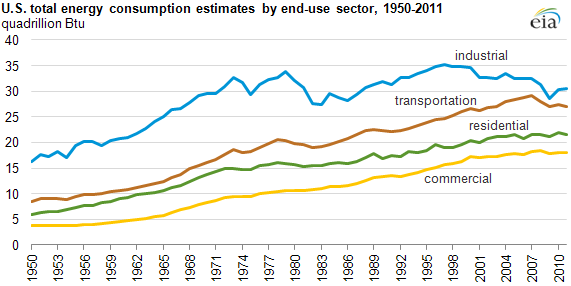
Now stare at this chart of relative use in the US; transportation, residential and commercial energy use dipped slightly during the 70s for about 5 years but it was industrial use that dropped significantly and is now about the same as 1970.

Image

Trans, residential and commercial use have continued to increase apace while industrial uses have fallen. Our industry is more efficient, we replaced assembly line workers with robots, clerks with Quickbooks and switched to plastic chachkas and expensive IT stuff. This is consistent with the proportion of the economy that has moved from heavy industrial manufacturing, construction, mining etc to the back office functions we now specialize in, finance, real estate, insurance, banking, etc. - nail care, dog walking and latte frothing.

Here is a picture of our economy, if it isn't legible, the top blue dotted line is/was manufacturing, the top red dotted line is finance and the solid red rising line is professional and business services.-

Image


We are more "efficient" with a higher BTU-GDP number simply because we don't make "things" that embody energy:

Image


Seems fairly clear that along with becoming more efficient, we changed occupations and sent the inefficient work elsewhere. Not too surprising that the "developing world" sees increasing demand while we push bits and bytes around.

.
The legitimate object of government, is to do for a community of people, whatever they need to have done, but can not do, at all, or can not, so well do, for themselves -- in their separate, and individual capacities.
-- Abraham Lincoln, Fragment on Government (July 1, 1854)
User avatar
Pops
Elite
Elite
 
Posts: 19746
Joined: Sat 03 Apr 2004, 04:00:00
Location: QuikSac for a 6-Pac

Re: Conservation vs Rationing

Unread postby pwallmann » Sat 10 Aug 2013, 13:14:37

pops, I'm not saying that semantics aren't important, I'm saying that it's importance is not being recognized, two parallel arguments discussing efficiency as defined by both sides might be more productive then arguing who's definition is right. That's all I'm saying.

As for being a liberal arts guy, I only went to the school because hockey paid for it, I had wanted to be an architect or civil engineer.... until my first meeting on campus meeting with my advisor when I figured out what "liberal arts" meant and that my school didn't offer either (being from Manitoba I just figured every university covered everything).
pwallmann
Wood
Wood
 
Posts: 36
Joined: Thu 23 May 2013, 11:30:50

Re: Conservation vs Rationing

Unread postby Pops » Sun 11 Aug 2013, 08:56:55

Just giving you a ration, p. You have a leg up on me, as Mr Twain said, I didn't let schooling interfere with my education. lol
The legitimate object of government, is to do for a community of people, whatever they need to have done, but can not do, at all, or can not, so well do, for themselves -- in their separate, and individual capacities.
-- Abraham Lincoln, Fragment on Government (July 1, 1854)
User avatar
Pops
Elite
Elite
 
Posts: 19746
Joined: Sat 03 Apr 2004, 04:00:00
Location: QuikSac for a 6-Pac

Re: Conservation vs Rationing

Unread postby ROCKMAN » Sun 11 Aug 2013, 10:05:22

Pops - great charts. I suspect higher labor costs for the heavy industries played a role in the decline. Energy cost were pretty much the same where ever industrial activity was relocated. Very interesting the constant increase in miles driven. Even adjusted per capita looks like an increasing trend. I suspect one reason is the inability of most to change their driving schedules very much very quickly.
User avatar
ROCKMAN
Expert
Expert
 
Posts: 11397
Joined: Tue 27 May 2008, 03:00:00
Location: TEXAS

Re: Why is Saudi Arabia not a threat to Fracking?

Unread postby AgentR11 » Sun 11 Aug 2013, 13:35:11

$this->bbcode_second_pass_quote('John_A', 'M')aybe I am bitter, the rationing and shortages and price spikes back in the 70's never did sit well with me, but still the youngsters shouldn't ever forget that once upon a time this was all much worse, there wasn't rationing by price, those bastards at the gas station WOULDN'T GIVE YOU ANY GASOLINE! You would wave money at them and they would just shrug and tell you to buzz off.


I always thought that was wrong too. The price should have been allowed to float to where demand was curtailed to meet available supply. The price spike's have never bothered me, they seem the economically rational response to large temporary drops in supply. If you really want to impact consumption, tax at the pump is one sure fire way to do it; best would be to tack on $3/gal tax, and offset the proceeds by reducing income tax rates to zero out the net revenue. Just a tax change, not an increase or decrease.

That would surely do all kinds of good stuff, for the lefties, provides general motivation to move close to work, urban renewal, discourages pointless driving (do you really need a 3000 lb piece of metal to go get a six pack of beer?), and for the righties would provide a cut to rates (always a pure win), and help preserve elite, gated community burbs for the well off, eg reg middle class folks can't manage both the large mortgage and a long commute with $7/gal gas; and poor folks are excluded by gasoline price alone.

That would be economically motivated conservation.
Yes we are, as we are,
And so shall we remain,
Until the end.
AgentR11
Light Sweet Crude
Light Sweet Crude
 
Posts: 6589
Joined: Tue 22 Mar 2011, 09:15:51
Location: East Texas
Top

Re: Conservation vs Rationing

Unread postby Pops » Mon 12 Aug 2013, 09:11:10

$this->bbcode_second_pass_quote('ROCKMAN', 'P')ops - great charts. I suspect higher labor costs for the heavy industries played a role in the decline. Energy cost were pretty much the same where ever industrial activity was relocated. Very interesting the constant increase in miles driven. Even adjusted per capita looks like an increasing trend. I suspect one reason is the inability of most to change their driving schedules very much very quickly.


in 1950 the US extracted more thatn half of the world's oil, by 1970 only one fifth. I gotta believe there is something there beyond greedy workers.

Image


But you're right, workers were making too much, automation and containerization allowing offshoring took care of that.

Image

But I have to assume that all the hype about the Saudi America resurgence of manufacturing had a correlation back then of falling competitiveness?
http://www.economist.com/news/special-r ... osting-its

My bigger point is energy efficiency alone didn't increase our GDP per BTU, changing from heavy industry to light manuf and finance did.

Obviously we have become more efficient, we make stuff now with the bare minimum materials possible, heck, nowadays the 3 pound container of Folgers only requires 1lb 11oz of coffee!
The legitimate object of government, is to do for a community of people, whatever they need to have done, but can not do, at all, or can not, so well do, for themselves -- in their separate, and individual capacities.
-- Abraham Lincoln, Fragment on Government (July 1, 1854)
User avatar
Pops
Elite
Elite
 
Posts: 19746
Joined: Sat 03 Apr 2004, 04:00:00
Location: QuikSac for a 6-Pac
Top

Re: Conservation vs Rationing

Unread postby SeaGypsy » Mon 12 Aug 2013, 11:04:14

$this->bbcode_second_pass_quote('Pops', '
')Trans, residential and commercial use have continued to increase apace while industrial uses have fallen. Our industry is more efficient, we replaced assembly line workers with robots, clerks with Quickbooks and switched to plastic chachkas and expensive IT stuff. This is consistent with the proportion of the economy that has moved from heavy industrial manufacturing, construction, mining etc to the back office functions we now specialize in, finance, real estate, insurance, banking, etc. - nail care, dog walking and latte frothing.

We are more "efficient" with a higher BTU-GDP number simply because we don't make as many "things" that embody energy:

Seems fairly clear that along with becoming more efficient, we changed occupations and sent the inefficient work elsewhere. Not too surprising that the "developing world" sees increasing demand while we push bits and bytes around.


The USA is still a very important and the largest manufacturer yet;

Image

A couple more I dug up:

Image

Image

Image

Then this...Image
SeaGypsy
Master Prognosticator
 
Posts: 9285
Joined: Wed 04 Feb 2009, 04:00:00
Top

Previous

Return to Peak Oil Discussion

Who is online

Users browsing this forum: No registered users and 6 guests