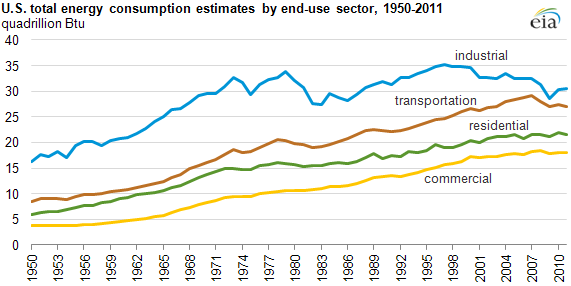
I understand what you are driving at pwall..but its kind of an apples and oranges comparison. Im strictly talking about US gasoline consumption...a large part of US oil consumption....and how price has driven VMT..efficiency not so much. The correlation points to small amounts of efficiency gains and large amounts of reduction due to price.
Bringing GDP into it is another whole ball of wax specifically since you would have a very hard time addressing the false demand created by monetary policy artificially goosing GDP over the last several years.



PeakOil is You
Conservation vs Rationing
Re: Why is Saudi Arabia not a threat to Fracking?
 by AirlinePilot » Fri 09 Aug 2013, 16:12:53
-

AirlinePilot - Moderator

- Posts: 4378
- Joined: Tue 05 Apr 2005, 03:00:00
- Location: South of Atlanta
Re: Why is Saudi Arabia not a threat to Fracking?
by AirlinePilot » Fri 09 Aug 2013, 16:19:24
$this->bbcode_second_pass_quote('ROCKMAN', ' ')Over a long enough time span the average mpg of US vehicles will increase and we will be more efficient. But for the most part the motivation won’t be to help the health of the planet but to help the health of their wallets. While a few good hearted folks make those cuts for the sake of humanity they are a small minority IMHO.
I would agree 100% with this. There is very little evidence that anything other than BAU is in full force. Recently there HAS been some effort on the part of auto manufacturers to provide higher mileage vehicle choices. Im sure this will continue, but honestly this is only a very recent trend. I doubt it has affected the marketplace in any serious way yet or overall vehicle efficiency.
-
AirlinePilot - Moderator
- Posts: 4378
- Joined: Tue 05 Apr 2005, 03:00:00
- Location: South of Atlanta
Re: Why is Saudi Arabia not a threat to Fracking?
by pwallmann » Fri 09 Aug 2013, 16:32:33
We're in complete agreement, the problem is that far too many disagreements (as I sensed above) are simply because we have one group calling an apple what the other group would call an orange and vice versa. It's a conversation that never ends unless both sides are clear on their terms and argue over each other's definition.
We know that we are using less oil/gdp unit produced. We know that the price of oil is at record heights and we are stuck in a stagnating economy. Just seems like these are interesting enough things to consider, rather then trying to decide on how we'd define a word.
We know that we are using less oil/gdp unit produced. We know that the price of oil is at record heights and we are stuck in a stagnating economy. Just seems like these are interesting enough things to consider, rather then trying to decide on how we'd define a word.
- pwallmann
- Wood

- Posts: 36
- Joined: Thu 23 May 2013, 11:30:50
Re: Why is Saudi Arabia not a threat to Fracking?
by John_A » Fri 09 Aug 2013, 16:41:58
$this->bbcode_second_pass_quote('pwallmann', 'I') agree with you AP, but again its just semantics, if I choose to define efficiency in terms of Units of GDP produced for every VMT (which I don't) you could say we're getting more efficient as a society (marginal GDP gains along with a reduction of VMT). It's not wholly unreasonable to frame it in this way.
I wonder why AP just used recent data? Go back to the late 70's and look at American oil consumption per capita and $/GDP. Calculate the same numbers today.
SHAZZZAMMMM BATMAN!! How about a 40% reduction in per capita use and there wasn't even a dieoff or Depression needed to cause it!
Maybe I am bitter, the rationing and shortages and price spikes back in the 70's never did sit well with me, but still the youngsters shouldn't ever forget that once upon a time this was all much worse, there wasn't rationing by price, those bastards at the gas station WOULDN'T GIVE YOU ANY GASOLINE! You would wave money at them and they would just shrug and tell you to buzz off.
Nowadays you can get tanker trucks of the stuff, just tell them when and where and they show up.
Once you've had a REAL energy crisis jump up and bite you in the privates, these more recent wanna-be "crisis" just don't have the pizzazz, sure they are good for us, sure they cause some to pay attention, sure we all need it for our own good, but we need the kinds of crisis we had once upon a time, not this all bark no bite stuff.
45ACP: For when you want to send the very best.
- John_A
- Heavy Crude

- Posts: 1193
- Joined: Sat 25 Jun 2011, 21:16:36
Re: Why is Saudi Arabia not a threat to Fracking?
by John_A » Fri 09 Aug 2013, 16:47:40
$this->bbcode_second_pass_quote('AirlinePilot', '')$this->bbcode_second_pass_quote('ROCKMAN', ' ')Over a long enough time span the average mpg of US vehicles will increase and we will be more efficient. But for the most part the motivation won’t be to help the health of the planet but to help the health of their wallets. While a few good hearted folks make those cuts for the sake of humanity they are a small minority IMHO.
I would agree 100% with this. There is very little evidence that anything other than BAU is in full force.
I am forced to agree. Peak oil hit with all the force of a butterfly trying to stop a mack truck and left us with cheap natural gas and expensive gasoline. I suppose the good news in all of this is that Americans are changing their vehicle mile driving habits, which means at least this new generation is learning what some of us old farts picked up the last time we went through all of this.
45ACP: For when you want to send the very best.
- John_A
- Heavy Crude
- Posts: 1193
- Joined: Sat 25 Jun 2011, 21:16:36