PeakOil is You
THE Mexico Thread Pt. 2 (merged)
Re: Mexico to reopen energy sector to foreign oil companies
 by Subjectivist » Mon 17 Jun 2013, 21:14:50
What companies do you think will be willing to risk working in Mexico in the near future? Between the lack of stability and the threat of the government relapse into nationalisation again a few years in the future why risk it?
II Chronicles 7:14 if my people, who are called by my name, will humble themselves and pray and seek my face and turn from their wicked ways, then I will hear from heaven, and I will forgive their sin and will heal their land.
- Subjectivist
- Volunteer

- Posts: 4705
- Joined: Sat 28 Aug 2010, 07:38:26
- Location: Northwest Ohio
Re: Mexico to reopen energy sector to foreign oil companies
by Plantagenet » Mon 17 Jun 2013, 22:54:22
I can see two kinds of private oil companies that would quickly move into Mexico.
(1) Major offshore oil and gas fields in the GOM are found eastward from Texas into Mexican waters. The same companies that drill in the US GOM waters would probably be happy to drill in Mexican GOM waters.

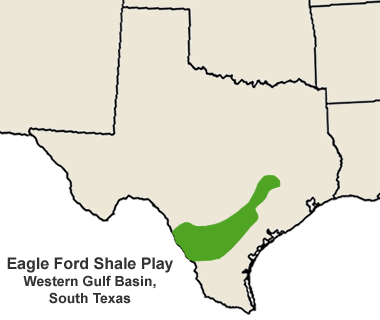
(2) Texas shales like the Eagle Ford extend from Texas into NE Mexico. The same little oil companies that are bidding on land and drilling and fracking shales in Texas would probably be happy to just continue across the border into the same formations on the Mexican side.
(1) Major offshore oil and gas fields in the GOM are found eastward from Texas into Mexican waters. The same companies that drill in the US GOM waters would probably be happy to drill in Mexican GOM waters.
(2) Texas shales like the Eagle Ford extend from Texas into NE Mexico. The same little oil companies that are bidding on land and drilling and fracking shales in Texas would probably be happy to just continue across the border into the same formations on the Mexican side.
-

Plantagenet - Expert

- Posts: 26765
- Joined: Mon 09 Apr 2007, 03:00:00
- Location: Alaska (its much bigger than Texas).
Re: Mexico to reopen energy sector to foreign oil companies
by ROCKMAN » Tue 18 Jun 2013, 08:53:31
“What companies do you think will be willing to risk working in Mexico in the near future?” A valid question but needs to be broken into two categories. First, is the subcontractor industries. That’s a much simpler proposition: they supply the materials and expertise to expand energy production in Mexico for a fee. Not much risk their beyond getting the last invoice paid.
The second area is obviously risky to some degree: direct investment of foreign capital. But if you do as China is doing else where one devises a plan where Mexico benefits significantly from such efforts so they’ll have the incentive to continue to support such projects. China building and operating a refinery in Mexico that not only increases the downstream value of their oil but also allows them to reduce product imports…a win-win for them. At the same time Mexico is suffering greatly from a trade imbalance with China. Of course, they could just stop importing those $billions of products from China that their citizens require. Or they could just export more oil/products to China. Win-win-win.
It’s also good to remember that this isn’t 1938. I know a lot of folks still refuse to believe it but countries can’t make those “nationalization” moves as risk free as they once could. All countries are much more connected to each other on a global financial level than ever before. And if China appears to be content with their arrangements with Venezuela and is willing to expand there I suspect Mexico will look even more attractive. It’s also good to remember that China doesn’t have to lock up the entire new infrastructure inside of Mexico’s border. Remember that $1 billion China will spend in Costa Rica (just down the coast from all that Mexican oil) reactivating that old refinery. A refinery in a country with no oil. It’s not that China might not lose on any of their international JV investments…they will. But just like investing in the stock market: the key is making a positive net return on all of your investments. In that regards I would put my money on China.
Especially compared to the US. Exactly how much oil are we importing from Iraq after all we “invested” there? And compared to all the other investments the US govt made in future energy production from other countries how are we doing? Oh yeah…the US govt hasn’t invested a penny. Which is exactly the point: a US corporation might not be able to justify the risk of investing tens of $billions in Mexico. But a sovereign nation might. IMHO China would have a tad more stroke dealing with Mexican politicians than the CEO of ExxonMobil. The Chinese govt is working hand in hand with their energy industry to secure future supplies around the globe. This will never happen in the US IMHO. At least not until it's too late to make a difference.
The second area is obviously risky to some degree: direct investment of foreign capital. But if you do as China is doing else where one devises a plan where Mexico benefits significantly from such efforts so they’ll have the incentive to continue to support such projects. China building and operating a refinery in Mexico that not only increases the downstream value of their oil but also allows them to reduce product imports…a win-win for them. At the same time Mexico is suffering greatly from a trade imbalance with China. Of course, they could just stop importing those $billions of products from China that their citizens require. Or they could just export more oil/products to China. Win-win-win.
It’s also good to remember that this isn’t 1938. I know a lot of folks still refuse to believe it but countries can’t make those “nationalization” moves as risk free as they once could. All countries are much more connected to each other on a global financial level than ever before. And if China appears to be content with their arrangements with Venezuela and is willing to expand there I suspect Mexico will look even more attractive. It’s also good to remember that China doesn’t have to lock up the entire new infrastructure inside of Mexico’s border. Remember that $1 billion China will spend in Costa Rica (just down the coast from all that Mexican oil) reactivating that old refinery. A refinery in a country with no oil. It’s not that China might not lose on any of their international JV investments…they will. But just like investing in the stock market: the key is making a positive net return on all of your investments. In that regards I would put my money on China.
Especially compared to the US. Exactly how much oil are we importing from Iraq after all we “invested” there? And compared to all the other investments the US govt made in future energy production from other countries how are we doing? Oh yeah…the US govt hasn’t invested a penny. Which is exactly the point: a US corporation might not be able to justify the risk of investing tens of $billions in Mexico. But a sovereign nation might. IMHO China would have a tad more stroke dealing with Mexican politicians than the CEO of ExxonMobil. The Chinese govt is working hand in hand with their energy industry to secure future supplies around the globe. This will never happen in the US IMHO. At least not until it's too late to make a difference.
-

ROCKMAN - Expert
- Posts: 11397
- Joined: Tue 27 May 2008, 03:00:00
- Location: TEXAS
Re: Mexico to reopen energy sector to foreign oil companies
by rockdoc123 » Tue 18 Jun 2013, 11:25:36
The Mexican oil and gas industry is already open to foreign participation. There has been a couple of bid rounds where foreign companies were invited in to service agreements whereby they would be paid through a fee/barrel scheme as well as have all of their capital costs reinbursed. Schlumberger and a couple of others picked up blocks at very low fees.
Because the fees are low and because the current structure of the agreements does not allow for booking of reserves under SEC guidelines there has been little in the way of interest from the independents.
If Nieto changes the agreements to Production Sharing Contracts or Royalty Tax agreements then there is likely to be a flood of activity with companies interested in revisiting the old fields that haven't been subject to modern technology and the Eagle Ford trend continuity. Developing the latter would be challenging I suspect since the trend comes across the border not far from Cuidad Juarez where much of the cartel violence seems to be located. That being said oil companies are working in Iraq, although I suspect the Sinaloa cartel is better armed than Al Qaida!
Because the fees are low and because the current structure of the agreements does not allow for booking of reserves under SEC guidelines there has been little in the way of interest from the independents.
If Nieto changes the agreements to Production Sharing Contracts or Royalty Tax agreements then there is likely to be a flood of activity with companies interested in revisiting the old fields that haven't been subject to modern technology and the Eagle Ford trend continuity. Developing the latter would be challenging I suspect since the trend comes across the border not far from Cuidad Juarez where much of the cartel violence seems to be located. That being said oil companies are working in Iraq, although I suspect the Sinaloa cartel is better armed than Al Qaida!
-
rockdoc123 - Expert
- Posts: 7685
- Joined: Mon 16 May 2005, 03:00:00
Re: Mexico to reopen energy sector to foreign oil companies
by ROCKMAN » Tue 18 Jun 2013, 12:53:55
Good point Doc: “Because the fees are low and because the current structure of the agreements does not allow for booking of reserves under SEC guidelines”. This again is where China has a big advantage by not being strictly ruled by rate of return. It has worked well for them in Iraq…just have to wait to see how well it plays out there. I suspect China would have an easier time dealing with Sinaloa…no big religious component to the negotiations…just $’s. In fact, if China contracts them as “consultants” this could be one of the less troublesome venues they are working in right now. LOL. Human rights certainly won’t be a big issue.
-
ROCKMAN - Expert
- Posts: 11397
- Joined: Tue 27 May 2008, 03:00:00
- Location: TEXAS
Re: Mexico to reopen energy sector to foreign oil companies
by rockdoc123 » Tue 18 Jun 2013, 17:34:12
China, at least CNPC, faces the same issues as other companies that list on the NYSE....they need to demonstrate all the profit measures others do to attract shareholders. Hence they probably can't ignore the reserves booking issue completely. I did read an opinion from one of the Ryder Scott folks that indicated his view that because of the wording in the Iraq contracts reserves could be booked whereas in Mexico under the existing contracts it would be impossible. If memory serves there are 4 or 5 issues you need to check off to make the SEC happy. I will see if I can find that article again. Beyond the reserves booking issue it is the low fees currently being paid that make deals pretty unattractive. As I remember Schlumberger bid $3/bbl .....pretty hard to make money on that unless you are actually spending say $2/bbl in capital costs and charging Pemex $6/bbl (no idea what the numbers are but understand the padding is significant).
As to China being able to work better with the cartels who knows? I did hear an opinion from someone in the security business that Mexico was much harder to deal with than Iraq. In Iraq you could hire the Al Qaida and others to work for you....they liked the money and would trade a job for not blowing up your operation. In Mexico the drug business is so lucrative that you can't possibly offer the cartel people enough money to make working for you more attractive than kidnapping you or shooting you on the street because you happened to be in the way of their drug business. We still vacation in Mexico every year, but there are a lot of places I would not go even on a bet.
As to China being able to work better with the cartels who knows? I did hear an opinion from someone in the security business that Mexico was much harder to deal with than Iraq. In Iraq you could hire the Al Qaida and others to work for you....they liked the money and would trade a job for not blowing up your operation. In Mexico the drug business is so lucrative that you can't possibly offer the cartel people enough money to make working for you more attractive than kidnapping you or shooting you on the street because you happened to be in the way of their drug business. We still vacation in Mexico every year, but there are a lot of places I would not go even on a bet.
-
rockdoc123 - Expert
- Posts: 7685
- Joined: Mon 16 May 2005, 03:00:00
Re: Mexico to reopen energy sector to foreign oil companies
by ROCKMAN » Wed 19 Jun 2013, 13:53:18
A little more detail as to why it’s difficult for Mexico to bring foreign capital, especially from US corporations, into their oil and gas sector. It’s not just about having foreign companies working in Mexico because that has been happening for decades:
“In the eyes of most private oil and gas companies, the Holy Grail of Mexican energy reform would be a change that allows private companies to participate in exploration and development in Mexico in a way that allows them to “book reserves”. This basically means they could then treat reserves in the ground to which they have rights as assets of their companies for accounting purposes. This would greatly expand their ability to obtain both debt and equity financing, given the resulting greater asset base. The fundamental problem with instituting any change in Mexico that would allow such accounting treatment, however, is that Article 27 of the Mexican Constitution grants direct ownership and exclusive rights of exploration and development of hydrocarbons to the Mexican state. Furthermore, the Petroleum Law of 1958 prohibits payments to operators based on a percentage of production, participation or the results of exploration.
These restrictions have required PEMEX to use service contracts where contractors receive a cash fee and, if applicable, bonuses. They have prevented PEMEX from being able to offer concessions, production sharing contracts or similar structures used elsewhere in the world that offer private companies the opportunity to book reserves. Although Mexico has amended its constitution hundreds of times, the prospects for constitutional reform on this issue seem remote as the Mexican state’s constitutional monopoly on ownership of petroleum in the ground has become an important part of Mexican culture and identity. Never say never, but making changes that would allow booking of reserves seems, at least, to be the biggest challenge on the menu of possible reforms.”
IOW ExxonMobil et al might be ready to pump $100 billion into developing Mexico oil reserves but if they can’t claim direct ownership they can’t claim their share in their annual report. Even worse, by not being able to earn a percentage of any production found they can’t balance the basic risk to reward relationship needed to do the typical economic analysis of a project.
And this is where China has a bit of an advantage since they don’t have the same “booking” requirement as corporations. But while they can’t be given a proportional share of production they can trade on aspects like “first call”: China would have the right of first refusal on a volume of Mexican oil exported. And in the case of a finery JV have the first call on any products Mexico wants to export.
“In the eyes of most private oil and gas companies, the Holy Grail of Mexican energy reform would be a change that allows private companies to participate in exploration and development in Mexico in a way that allows them to “book reserves”. This basically means they could then treat reserves in the ground to which they have rights as assets of their companies for accounting purposes. This would greatly expand their ability to obtain both debt and equity financing, given the resulting greater asset base. The fundamental problem with instituting any change in Mexico that would allow such accounting treatment, however, is that Article 27 of the Mexican Constitution grants direct ownership and exclusive rights of exploration and development of hydrocarbons to the Mexican state. Furthermore, the Petroleum Law of 1958 prohibits payments to operators based on a percentage of production, participation or the results of exploration.
These restrictions have required PEMEX to use service contracts where contractors receive a cash fee and, if applicable, bonuses. They have prevented PEMEX from being able to offer concessions, production sharing contracts or similar structures used elsewhere in the world that offer private companies the opportunity to book reserves. Although Mexico has amended its constitution hundreds of times, the prospects for constitutional reform on this issue seem remote as the Mexican state’s constitutional monopoly on ownership of petroleum in the ground has become an important part of Mexican culture and identity. Never say never, but making changes that would allow booking of reserves seems, at least, to be the biggest challenge on the menu of possible reforms.”
IOW ExxonMobil et al might be ready to pump $100 billion into developing Mexico oil reserves but if they can’t claim direct ownership they can’t claim their share in their annual report. Even worse, by not being able to earn a percentage of any production found they can’t balance the basic risk to reward relationship needed to do the typical economic analysis of a project.
And this is where China has a bit of an advantage since they don’t have the same “booking” requirement as corporations. But while they can’t be given a proportional share of production they can trade on aspects like “first call”: China would have the right of first refusal on a volume of Mexican oil exported. And in the case of a finery JV have the first call on any products Mexico wants to export.
-
ROCKMAN - Expert
- Posts: 11397
- Joined: Tue 27 May 2008, 03:00:00
- Location: TEXAS
Re: Mexico to reopen energy sector to foreign oil companies
by Plantagenet » Wed 19 Jun 2013, 14:17:02
$this->bbcode_second_pass_quote('ROCKMAN', ' ')the Holy Grail of Mexican energy reform would be a change that allows private companies to participate in exploration and development in Mexico in a way that allows them to “book reserves”. This basically means they could then treat reserves in the ground to which they have rights as assets of their companies for accounting purposes. This would greatly expand their ability to obtain both debt and equity financing, given the resulting greater asset base. The fundamental problem with instituting any change in Mexico that would allow such accounting treatment, however, is that Article 27 of the Mexican Constitution grants direct ownership and exclusive rights of exploration and development of hydrocarbons to the Mexican state. Furthermore, the Petroleum Law of 1958 prohibits payments to operators based on a percentage of production, participation or the results of exploration.
Yes.
Thats exactly why I started this thread. The new President of Mexico is going to change the Mexican Constitution to remove Article 27 and rewrite the Petroleum laws to allow foreign oil companies into Mexico.
Its happening right now----Mexico is privatizing their oil sector.
I don't think its a coincidence that this is happening right after the Chinese premiere visited Mexico. China has been very aggressive about buying up oil in countries around the world----I wouldn't be surprised if the move to privatize oil in Mexico has been triggered by China----Mexico sure as hell wouldn't be doing it for us gringos.

Mexico is rewriting their constitution to allow Chinese, US and other foreign oil companies to operate in Mexico.
-
Plantagenet - Expert
- Posts: 26765
- Joined: Mon 09 Apr 2007, 03:00:00
- Location: Alaska (its much bigger than Texas).
Re: Mexico to reopen energy sector to foreign oil companies
by ROCKMAN » Wed 19 Jun 2013, 16:22:37
P - Yes...good timing. It will be interesting to see how long the process takes and exactly how the Chinese cut their deals with Mexico. I agree: I'm sure the Chinese had a detailed discussion with the Mexican president on exactly how to structure their deals so it would allow the easiest route to changing the constitution. And given the Chinese are also interested in the refining side they might be figuring a way to satisfy both countries with either little or no change to the constitution. China cut a per bbl fee deal with Iraq. No details, of course, but I suspect the Chinese are getting more out of the deal then pocket change. As mentioned before those "calls" and rights of first refusal can be very valuable especially as the market gets tight yet they don't show up as $'s (or yuans) on a spreadsheet. Same point again: the Chinese companies can function like no other companies can. Deal structures a US pubco could never consider are as easy as dunking an egg roll for the Chinese. And that includes paying off every politician in sight. And they are equally adept at making the natives happy by building roads, hospitals (manned by their own doctors and nurses), schools, etc. Such projects made them very popular in Venezuela.
-
ROCKMAN - Expert
- Posts: 11397
- Joined: Tue 27 May 2008, 03:00:00
- Location: TEXAS
Re: Mexico to reopen energy sector to foreign oil companies
by rockdoc123 » Wed 19 Jun 2013, 17:26:54
$this->bbcode_second_pass_quote('', 'T')hats exactly why I started this thread. The new President of Mexico is going to change the Mexican Constitution to remove Article 27 and rewrite the Petroleum laws to allow foreign oil companies into Mexico.
Its happening right now----Mexico is privatizing their oil sector.
Its happening right now----Mexico is privatizing their oil sector.
Actually what is happening is Nieto is taking a bill forward to Mexican parliament. There is no guaranty he will be able to get the support he needs to change the constitution and he actually hasn't come out and said what exactly that change would entail. I've met with the Pemex folks in past years where they waxed long and lyrical about the rules changing but every proposed bill was blocked. We'll see where this latest initiative goes.
$this->bbcode_second_pass_quote('', ' ')Same point again: the Chinese companies can function like no other companies can.
actually they can't. CNPC is listed on the NYSE and hence governed by the same rules as anyone else with respect to the SEC. Their shares trade, they want higher share price so need to be able to report the production numbers. Sinopec also trades its shares. As I mentioned Ryder Scott thought it was possible to report production from the service agreements in Iraq but not so for the service agreements in Mexico. China as a nation could say that they would bring in additional service companies (as they did in Sudan and Chad and elsewhere) but there really isn't a need for that in the Mexican industry. They have lots of rigs, they have lots of kit and access to logging equipment etc. What they don't have is new technology and understanding how to employ it and the Chinese companies haven't a real clue in that area. Big Blue and Big Red are already in Mexico (Schlumberger and Halliburton) so the tech is there it is really companies with the money and knowledge of how to properly employ that tech they need.
It really comes down as to what changes are actually made. If they have PSC's that is a different story than Royalty tax agreements and it really comes down as to what they want in terms of signature bonuses and production share retained for Pemex. They might even decide to stay with some form of amended service agreement but fees would have to rise or there would be little attention from anyone.
-
rockdoc123 - Expert
- Posts: 7685
- Joined: Mon 16 May 2005, 03:00:00
North America to Drown in Oil as Mexico Ends Monopoly
by Roger Rabbit » Tue 17 Dec 2013, 03:45:57
The flood of North American crude oil is set to become a deluge as Mexico dismantles a 75-year-old barrier to foreign investment in its oil fields.
Plagued by almost a decade of slumping output that has degraded Mexico’s take from a $100-a-barrel oil market, President Enrique Pena Nieto is seeking an end to the state monopoly over one of the biggest crude resources in the Western Hemisphere. The doubling in Mexican oil output that Citigroup Inc. said may result from inviting international explorers to drill would be equivalent to adding another Nigeria to world supply, or about 2.5 million barrels a day.
http://money.msn.com/business-news/article.aspx?feed=BLOOM&date=20131216&id=17195903
Could we see under $2.50 a gal gas again soon, I sure hope so my motorhome cost $250 to fill her up today.

Plagued by almost a decade of slumping output that has degraded Mexico’s take from a $100-a-barrel oil market, President Enrique Pena Nieto is seeking an end to the state monopoly over one of the biggest crude resources in the Western Hemisphere. The doubling in Mexican oil output that Citigroup Inc. said may result from inviting international explorers to drill would be equivalent to adding another Nigeria to world supply, or about 2.5 million barrels a day.
http://money.msn.com/business-news/article.aspx?feed=BLOOM&date=20131216&id=17195903
Could we see under $2.50 a gal gas again soon, I sure hope so my motorhome cost $250 to fill her up today.
- Roger Rabbit
Re: North America to Drown in Oil as Mexico Ends Monopoly
by Arthur75 » Tue 17 Dec 2013, 03:59:37
"North America to Drown in Oil as Mexico Ends Monopoly "
Now that's some serious title !
Now that's some serious title !
-

Arthur75 - Tar Sands

- Posts: 529
- Joined: Sun 29 Mar 2009, 05:10:51
- Location: Paris, France
Re: North America to Drown in Oil as Mexico Ends Monopoly
by Roger Rabbit » Wed 18 Dec 2013, 00:53:37
$this->bbcode_second_pass_quote('Arthur75', '&')quot;North America to Drown in Oil as Mexico Ends Monopoly "
Now that's some serious title !
Now that's some serious title !
Yea with all these new oil discovery's and now Mexico allowing foreign investment in its oil fields looks as if the Peak Oil has not Peaked yet..

- Roger Rabbit