Donate Bitcoin

Donate Paypal


PeakOil is You

PeakOil is You

JD Attacks the Issue of Scale II

General discussions of the systemic, societal and civilisational effects of depletion.

Re: JD Attacks the Issue of Scale II

Unread postby JohnDenver » Wed 09 Jan 2008, 21:48:49

$this->bbcode_second_pass_quote('skyemoor', '')$this->bbcode_second_pass_quote('Tyler_JC', 'T')he idea that growth in manufactoring is based on some kind of % factor is misleading.

Building a new manufactoring plant is neither expensive nor time-consuming.

I mean, look at China for God's sake. They are building massive factories in a matter of months.



Toy factories are one thing; completely retooling an auto assembly line alone can take a year or more. GM was planning on spending over $2 billion for retooling two auto plants in Oshawa that would take 10-12 months each.
$2.5 billion retooling

You have made statements without providing us with any references; Please provide cost and schedule for specific manufacturing plants so that we can understand and consider your claims.


World War II is a good model of the potential for rapid retooling and scale-up:
Image
Note the big dip for WWII. Passenger car production was immediately ramped down to nothing, and the entire infrastructure was retooled to build war machinery. These are the US aircraft production numbers:

1939: 2,141
1940: 6,086
1941: 19,433
1942: 47,836
1943: 85,898
1944: 96,318
1945: 46,001
http://en.wikipedia.org/wiki/WW2_aircraft_production

And that's only one type of war material. With the much smaller industrial base of the early 1940s.
JohnDenver
Intermediate Crude
Intermediate Crude
 
Posts: 2145
Joined: Sun 29 Aug 2004, 03:00:00

Re: JD Attacks the Issue of Scale II

Unread postby Tyler_JC » Thu 10 Jan 2008, 01:06:21

Solar Plant

$this->bbcode_second_pass_quote('', 'E')POD International Inc. (the "Company", "EPOD") (OTC BB: EPOI) (Frankfurt: EDU.F) announces the Company's intent to construct a five (5) megawatt solar panel manufacturing facility in Kelowna, British Columbia.

Further to EPOD's announcement of January 16th regarding the Company's plans to increase its solar panel manufacturing capacity, EPOD announces the Company intends to construct a solar panel manufacturing facility in Kelowna, B.C. An estimated two megawatts of production capacity is anticipated to be available within six months, with the annual capacity of the plant projected to be five megawatts upon completion.
The addition of solar panel manufacturing capacity will allow EPOD to further vertically integrate its solar power operations, and substantially increase the Company's solar panel output. This manufacturing capacity and increased solar panel output will also enable EPOD to maximize its solar power system sales and integration in the Province of Ontario, where the Ontario Power Authority and the Ontario Energy Board recently announced the creation of the Standard Offer Program ( http://www.ontarioelectricityrfp.ca/Doc ... elease.pdf ), a renewable energy feed-in tariff initiative. The Standard Offer Program will pay EPOD and other solar power generators CAD$0.42 per kilowatt-hour (approximately USD$0.37), under what is anticipated to be a 20-year power purchase agreement. Given the Ontario government's increased support of solar energy through the Standard Offer Program, EPOD intends to aggressively pursue solar system sales in the Ontario market effective immediately.


Another Solar Plant

$this->bbcode_second_pass_quote('', '[')b]Evergreen lands $35M German grant to build solar panel factory
Evergreen Solar Inc. secured a $35 million grant from the German government to support construction of a $79 million solar panel factory there.

In February, Evergreen (Nasdaq: ESLR) raised $62 million in a sale of stock, and it finished the quarter with $70 million in cash and securities. The company indicated last month it might have to raise additional cash if it did not land the German grant.

...

Evergreen has been racing to bring additional manufacturing capacity online in Germany, where substantial government subsidies have homeowners scrambling to install solar power systems. Evergreen said the facility should be at full production by the summer of 2006.

...

The plant is expected to employ at least 350 people. As of Dec. 31, Evergreen had 250 employees.


A $79 million factory that will employ 350 people was built in less than a year.

A 2MW solar plant was built in six months.

This stuff can get built fast.
"www.peakoil.com is the Myspace of the Apocalypse."
Tyler_JC
Expert
Expert
 
Posts: 5438
Joined: Sat 25 Sep 2004, 03:00:00
Location: Boston, MA

Re: JD Attacks the Issue of Scale II

Unread postby Oil-Finder » Thu 10 Jan 2008, 04:11:31

$this->bbcode_second_pass_quote('pstarr', '
')When was the last time $85 billion was spent on any one thing in the United States, except war?

Ummm . . .

Petrobras, a company from a Third World nation, intends to spend $50-$100 billion USD to develop its Tupi oil field (source).

If a single company from a developing nation can shell out $50-$100 billion on a single energy project, what makes you think a bunch of companies in the uber-wealthy USA won't be able to come up with a paltry $85 billion?

Another example: Right now, companies are spending $30 billion just to build new hotels in Las Vegas (source).

And still another one: Over the next 6 years, companies and government agencies intend to spend $20 billion on construction projects just in lower Manhattan (source PDF).

I hate to tell you, but these days, $85 billion is not really all that much money.
Last edited by Oil-Finder on Thu 10 Jan 2008, 04:51:52, edited 2 times in total.
User avatar
Oil-Finder
Tar Sands
Tar Sands
 
Posts: 630
Joined: Tue 11 Dec 2007, 04:00:00
Location: Seattle
Top

Re: JD Attacks the Issue of Scale II

Unread postby yesplease » Thu 10 Jan 2008, 04:38:01

$this->bbcode_second_pass_quote('pstarr', 'A') conservative 5% annual decline in those supplies means we would have to build 13 every year from now on at a cost of $81 billion dollars per year with an annual operating for all of $4.3 billion.
Assuming people do not cut use via public transportation/car pooling/less driving/more efficient vehicles/etc... The way the dollar is going it looks like Americans will have to cut back significantly even if the rest of the world doesn't.
$this->bbcode_second_pass_quote('Professor Membrane', ' ')Not now son, I'm making ... TOAST!
User avatar
yesplease
Intermediate Crude
Intermediate Crude
 
Posts: 3765
Joined: Tue 03 Oct 2006, 03:00:00
Top

Re: JD Attacks the Issue of Scale II

Unread postby TonyPrep » Thu 10 Jan 2008, 06:34:36

$this->bbcode_second_pass_quote('JohnDenver', 'I')'d hate to spend a lot of time trying to disprove a known fact, and Tony seems to be too incompetent/lazy to provide any cites or references. Any help would be appreciated. Who proved the statement in bold? I am very curious to know the name of "the man or woman who addressed scale".
You haven't given a fact to disprove; you have provided alternatives to the various uses of fossil fuels but you never show why they can replace fossil fuels in scale, only in function. You appear to have some following on your blog, JD, so you have a large responsibility; to ensure that those who accept your word for all this are not just crossing their fingers that lifestyle changes will be fairly moderate, allowing their dream of unending economic growth to go on, relatively unabated. I sincerely hope that you can provide the proof of scale that they should be given, along with the functionality.

You asked for references. Try chapter 4 of The Party's Over, by Richard Heinberg, chapter 4 of The Long Emergency, by James Kunstler and chapter 4 of The Last Oil Shock, by David Strahan (yes, all chapter 4s), where alternatives are covered, including scale, EROEI and time to scale. It's also covered a little in The End of Oil by Paul Roberts. As a background to the earth's limits (an important aspect of scale) read Limits to Growth and view Albert Bartlett's lecture on the exponential function.

By the way, the bolded question that you continually attribute to me was actually your effort. I agree with the first part, but not the last, though I conceded it for the purposes of this thread.
User avatar
TonyPrep
Intermediate Crude
Intermediate Crude
 
Posts: 2842
Joined: Sun 25 Sep 2005, 03:00:00
Location: Waiuku, New Zealand
Top

Re: JD Attacks the Issue of Scale II

Unread postby TonyPrep » Thu 10 Jan 2008, 06:38:58

$this->bbcode_second_pass_quote('Drake', 'T')he world consumes roughly the energy equivalent of 107 million GWh a year at present rates. Let's say 1/3 of it is based on oil, that makes ~35 million GWh a year. Should that oil part start dropping by 3% this would roughly equate to about 1 million GWh which would have to be "replaced" each year (during the first decade).
It's worse than that, to maintain economic growth, globally, the world needs extra energy each year. So the declines have to be offset and new energy needs to be provided.

To be fair to JD, he admits that lifestyle changes are needed but thinks that prosperity can be maintained and increased, if these changes are made. Further more, I think he believes that all of these transitions will happen without coercion, though free market economics. (I hope I didn't misrepresent you, JD).
User avatar
TonyPrep
Intermediate Crude
Intermediate Crude
 
Posts: 2842
Joined: Sun 25 Sep 2005, 03:00:00
Location: Waiuku, New Zealand
Top

Re: JD Attacks the Issue of Scale II

Unread postby TonyPrep » Thu 10 Jan 2008, 06:45:28

$this->bbcode_second_pass_quote('JohnDenver', 'J')ean Laherrere forecasts:
$this->bbcode_second_pass_quote('', 'L')iquids production will significantly decline after a likely bumpy plateau 2010-2020 and likely chaotic oil prices.
30 years from now, production of easy oil will be 35% less than to day but production of all liquids (including from coal and biomass) only 5% less than to day.
Did he suggest how much of the energy in that reduced liquids would be available for end users (i.e. not used in the process of providing those liquids to the market)? David Pimentel's research suggests that not many biofuels will be energy positive, if any, so adding x to the supply side and 1.01x (for example) to the consumption side doesn't do much for the overall situation.
User avatar
TonyPrep
Intermediate Crude
Intermediate Crude
 
Posts: 2842
Joined: Sun 25 Sep 2005, 03:00:00
Location: Waiuku, New Zealand
Top

Re: JD Attacks the Issue of Scale II

Unread postby TonyPrep » Thu 10 Jan 2008, 06:51:24

$this->bbcode_second_pass_quote('skyemoor', 'T')his leaves coal to shoulder the ramp-up in the next decade.
And I wouldn't place too much reliance on that either. Coal is much more difficult to transport globally and production, both in energy content and quantity may have already peaked in the US (according to the latest EIA figures, which show energy from coal as an undulating plateau for the last decade or more, and volume production down last year).
User avatar
TonyPrep
Intermediate Crude
Intermediate Crude
 
Posts: 2842
Joined: Sun 25 Sep 2005, 03:00:00
Location: Waiuku, New Zealand
Top

Re: JD Attacks the Issue of Scale II

Unread postby Drake » Thu 10 Jan 2008, 08:47:41

$this->bbcode_second_pass_quote('TonyPrep', '')$this->bbcode_second_pass_quote('Drake', 'T')he world consumes roughly the energy equivalent of 107 million GWh a year at present rates. Let's say 1/3 of it is based on oil, that makes ~35 million GWh a year. Should that oil part start dropping by 3% this would roughly equate to about 1 million GWh which would have to be "replaced" each year (during the first decade).
It's worse than that, to maintain economic growth, globally, the world needs extra energy each year. So the declines have to be offset and new energy needs to be provided.

To be fair to JD, he admits that lifestyle changes are needed but thinks that prosperity can be maintained and increased, if these changes are made. Further more, I think he believes that all of these transitions will happen without coercion, though free market economics. (I hope I didn't misrepresent you, JD).


Yeah I left the growth out for simplicity. It would just make the numbers worse but it would still be in the same order of magnitude, initially at least. :)
User avatar
Drake
Wood
Wood
 
Posts: 36
Joined: Fri 04 Jan 2008, 04:00:00
Top

Re: JD Attacks the Issue of Scale II

Unread postby JohnDenver » Thu 10 Jan 2008, 09:11:44

$this->bbcode_second_pass_quote('TonyPrep', '')$this->bbcode_second_pass_quote('JohnDenver', 'I')'d hate to spend a lot of time trying to disprove a known fact, and Tony seems to be too incompetent/lazy to provide any cites or references. Any help would be appreciated. Who proved the statement in bold? I am very curious to know the name of "the man or woman who addressed scale".
You haven't given a fact to disprove; you have provided alternatives to the various uses of fossil fuels but you never show why they can replace fossil fuels in scale, only in function.

Likewise, you have not proven that they *cannot* replace fossil fuels in scale. You seem to think that your position is correct by default, and I'm not going to concede that.

I have offered a large selection of alternatives:

Gas, Coal, Hydro, Nuclear and Renewables

as well as:

Conservation = Walking + Bikes + Mopeds + Scooters + Motorcycles + Electric bicycles + Carpooling + Telecommuting + Riding the bus + Riding the tram/train/subway + Moving nearer to work + Sleeping at/near work + NGVs + Small EVs + Full-size EVs + PHEVs + Hybrids + Light/High-efficiency conventional vehicles + Converting oil-fired generation to coal/nuclear + Improving fleet fuel efficiency + Lowering speed limits + etc.

Your job is to give us a detailed, carefully calculated, irrefutable proof of why it will be impossible for humans to scale up the alternatives (as defined above) to replace liquids in the post-peak period.

Personally, I think it's obvious that the alternatives will scale because:
a) Gas+Coal+Hydro+Nuclear+Renewables is already twice the scale of Liquids, and about 100-200 times bigger than the likely annual decrease in liquid production after peak liquids.
b) Conservation potential, particularly in the US, is staggering. In order for you to demonstrate your claim, you will need to prove that scaling up conservation is *impossible*. But I don't think you can do that. Here's a thought experiment: Tomorrow the government steps in and rations gasoline. Bing! Conservation nationwide, in one day. Lifestyle armageddon? Sure. Does everybody still get where they need to be? Yes. Granted, that's an extreme example, but it vividly shows that it is not *impossible* to scale up conservation in a timely manner, and thus your position (that it is impossible for alternatives to scale) fails on that point alone.

$this->bbcode_second_pass_quote('', 'Y')ou appear to have some following on your blog, JD, so you have a large responsibility; to ensure that those who accept your word for all this are not just crossing their fingers that lifestyle changes will be fairly moderate, allowing their dream of unending economic growth to go on, relatively unabated. I sincerely hope that you can provide the proof of scale that they should be given, along with the functionality.

Gosh, I think I'm getting all teared up after that one. Okey-dokey Tony, I promise! I'm going to go out there and do my durndest to win one for all those doe-eyed kids out there reading my blog!![smilie=icon_salut.gif]

Get real. Why don't you get out of your lazy-boy and start proving your faith-based assertion that the alternatives won't scale.

$this->bbcode_second_pass_quote('', 'Y')ou asked for references. Try chapter 4 of The Party's Over, by Richard Heinberg...

Wow, I'm impressed. You actually went all out and did a whole 20 seconds of research. [smilie=eusa_clap.gif]

Have you ever seen M. King Hubbert's nuclear future (from his 1956 paper, Nuclear Energy and Fossil Fuels)? Here it is:
Image

How did Richard prove that to be impossible? I want details. If you're going to make a point, you have to provide the evidence. I'm not going to do your research for you.

$this->bbcode_second_pass_quote('', 'A')s a background to the earth's limits (an important aspect of scale) read Limits to Growth and view Albert Bartlett's lecture on the exponential function.
Sorry, I don't subscribe to the "finite earth" religion. I believe the destiny of mankind lies in harvesting energy and other resources from space. The earth is just the egg we're hatching out of.

$this->bbcode_second_pass_quote('', 'B')y the way, the bolded question that you continually attribute to me was actually your effort. I agree with the first part, but not the last, though I conceded it for the purposes of this thread.
Okay. Then through the magic of the Internet, let's resurrect your version:
The issue of scale (Tony's version): Humans cannot replace fossil fuels for all of their uses, on scales that business as usual would dictate, on a timescale that mitigates the impact of fossil fuel declines and that doesn't impact our habitat for the worse.
Get crackin'. Let's see the proof Tony.
Peak Oil Debunked
JohnDenver
Intermediate Crude
Intermediate Crude
 
Posts: 2145
Joined: Sun 29 Aug 2004, 03:00:00
Top

Re: JD Attacks the Issue of Scale II

Unread postby Drake » Thu 10 Jan 2008, 09:26:18

$this->bbcode_second_pass_quote('JohnDenver', '')$this->bbcode_second_pass_quote('Drake', 'S')hould that oil part start dropping by 3% this would roughly equate to about 1 million GWh which would have to be "replaced" each year (during the first decade).

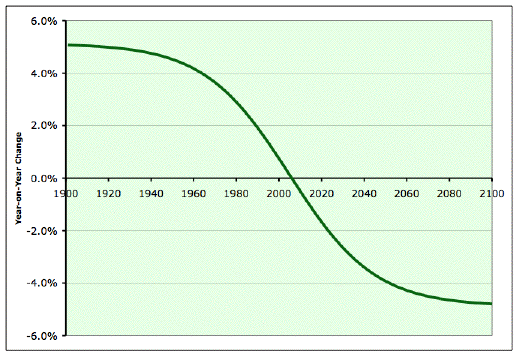
A consistent drop of 3% at post-peak is extremely unlikely. The evidence suggest we'll see a fairly long plateau, followed by slowly increasing decline rates, averaging <2% for the first 20 years, hitting 3% after about 25 years. Colin Campbell is forecasting a post-peak decline rate of 1.8% for 20 years. Jean Laherrere forecasts:
$this->bbcode_second_pass_quote('', 'L')iquids production will significantly decline after a likely bumpy plateau 2010-2020 and likely chaotic oil prices.
30 years from now, production of easy oil will be 35% less than to day but production of all liquids (including from coal and biomass) only 5% less than to day.

According to Hubbert theory, the decline rate for the world, assuming a URR = 2350gb, K = 5%, and peak at 2005, should roughly follow this curve:
Image
If you need the cites, see STRONG ARGUMENT FOR A SLOW DECLINE


Ok, 1% would roughly mean a portion of 8 new GW plants for the US either to be saved or generated each year. That's 4 new Hoover dams each year. It's doable imho with a lot of savings etc., the US has the theoretical potential, but coincidentally you pointed to ww2 in some other post, which is imho exactly what would have to happen. It would have to be ordered in a preplanned fashion to work on that scale over several years, I don't think it'll work on time just through market forces because of the inevitable delays within that system.
Over here in germany we have solid financial incentives for diverse energy saving measures and renewables and I think the development here is a good example how long it takes under normal investment conditions to build up to a certain scale. This includes things like enough new companies and people with the know how to build wind/solar plants or low energy houses etc, people finally getting their asses up and actually altering their houses and all the other things you could think of.
293 Watthours are 1000 BTU, wouldn't it be nice if the US would finally join the metric SI system :-D
User avatar
Drake
Wood
Wood
 
Posts: 36
Joined: Fri 04 Jan 2008, 04:00:00
Top

Re: JD Attacks the Issue of Scale II

Unread postby JohnDenver » Thu 10 Jan 2008, 09:37:06

$this->bbcode_second_pass_quote('TonyPrep', '')$this->bbcode_second_pass_quote('skyemoor', 'T')his leaves coal to shoulder the ramp-up in the next decade.
And I wouldn't place too much reliance on that either. Coal is much more difficult to transport globally

How much more difficult is it to transport globally? What are your figures on that? How much is transported globally now?

$this->bbcode_second_pass_quote('', 'a')nd production, both in energy content and quantity may have already peaked in the US (according to the latest EIA figures, which show energy from coal as an undulating plateau for the last decade or more, and volume production down last year).

That doesn't constitute proof that coal in the US *cannot* grow in terms of energy produced per year. It likely "peaked" due to lack of demand (because coal is foul stuff, and NG is preferred for environmental reasons). You're going to have to go into a lot more detail to show that growth of coal in the US is impossible. As of 2004, the U.S. had about 271 years of measured, proven coal, economically exploitable with current prices and technology.

As I showed in the previous thread, world coal production (in quads) has been growing at very high rates in the last few years:

2001 6.1%
2002 2.0
2003 7.9
2004 8.4
2005 6.9

No "peak" there. It's widely accepted, even among the direst doomers, that peak coal is decades away. "Coal may have peaked" -- LOL. What in the world are you talking about Tony? You're in denial.
Peak Oil Debunked
JohnDenver
Intermediate Crude
Intermediate Crude
 
Posts: 2145
Joined: Sun 29 Aug 2004, 03:00:00
Top

Re: JD Attacks the Issue of Scale II

Unread postby TheDude » Thu 10 Jan 2008, 10:29:39

Image

Jeff Brown and Sam Foucher have published an update to the ELM: A Quantitative Assessment of Future Net Oil Exports by the Top Five Net Oil Exporters. May be of interest to some of you. Others, not so much.

$this->bbcode_second_pass_quote('', 'S')maller oil exporters like Angola can and will increase their net exports, but smaller exporters, just like smaller oil fields, tend to have sharper production peaks and more rapid net export declines than do the larger net exporters. And offsetting many of the gains by some smaller exporters will be sharp declines in net exports from other smaller exporters like Mexico, the #2 source of imported crude oil into the US, which will probably approach zero net oil exports by 2014.


EDIT: Got the bug and gave this its own topic: New work by Westexas and Khebab on the ELM, away from the maddening crowd.
Cogito, ergo non satis bibivi
And let me tell you something: I dig your work.
User avatar
TheDude
Expert
Expert
 
Posts: 4896
Joined: Thu 06 Apr 2006, 03:00:00
Location: 3 miles NW of Champoeg, Republic of Cascadia
Top

Re: JD Attacks the Issue of Scale II

Unread postby JohnDenver » Thu 10 Jan 2008, 11:06:19

$this->bbcode_second_pass_quote('skyemoor', '')$this->bbcode_second_pass_quote('JohnDenver', 'A')ll of the growing alternatives (gas, coal, nuclear, hydro and renewables) produce EV fuel (i.e. electricity), and none of them will peak in the pre-peak-gas period (with the possible exception of hydro).


Let's focus on North America for a moment. Natural Gas has been in overall decline (yearly fluctuations notwithstanding), and all of the production is taken up with space heating, current electrical generation, and industrial processes, with the latter two demands having had some curtailment when supplies have been tight over the last few years. I have no confidence in anyone's claims that N.A. natural gas will increase overall in the coming years; just the opposite, in fact. N.A. does not have sufficient LNG transfer facilities at this time to ramp up import (which would further reduce energy independence) even if there were suppliers that could drastically ramp up their delivery. Note that Qatar has to move their shipments through the Persian Gulf, making any conflict with Iran a point at which those supplies become highly unreliable.

New nuclear plants in the US coming on line anytime soon? I'd like to hear about them and their target dates for being fully operational.

Additional hydro facilities? I'd like to hear about those as well, and their expected capacity.

Renewables: you must mean wind, primarily (if not, provide projects, their completion dates, and expected annual kWH output). Wind certainly is growing at a brisk rate, though is still far down the scale when it comes to percentage of US electricity production, probably still less than 1%, certainly less than 2%.

This leaves coal to shoulder the ramp-up in the next decade. Even if the majority of autos produced in the next 10 years where EV or plug-in hybrid, the use of coal to power them would blacken the skies in N.A., the way it is in many parts of China at present, only worse. Who would want or accept that? The push to shutdown attempts to start up new coal plants has a tremendous head of steam in the US.

Okay. Let's go with your version. Do you expect to see no LNG, no nuclear and no new coal in the U.S.? Do you believe that U.S. energy production will enter a terminal decline, starting now? And industry/government/citizens will passively accept that?

$this->bbcode_second_pass_quote('JohnDenver', 'W')e have to look at the entire picture of the national fleet. 1,000,000 cars were sold in Australia last year. 15,000 scooters represents 1.5% of the vehicles sold, so even if they were to see 50% growth every year for the next five years, scooters would only account for 114,000 vehicles, or still less than 12% of the vehicles sold, far too few to mitigate PO.

I'm really tired of lame "scale" rebuttals of this type.

X can't scale fast enough to solve PO. Therefore X is not a solution.
Y can't scale fast enough to solve PO. Therefore Y is not a solution.
Z can't scale fast enough to solve PO. Therefore Z is not a solution.
Therefore there is no solution to PO.

That's a FALLACY, and it's getting really stale.

You've got to incorporate scooters into the overall equation:
Conservation = Walking + Bikes + Mopeds + Scooters + Motorcycles + Electric bicycles + Carpooling + Telecommuting + Riding the bus + Riding the tram/train/subway + Moving nearer to work + Sleeping at/near work + NGVs + Small EVs + Full-size EVs + PHEVs + Hybrids + Light/High-efficiency conventional vehicles + Converting oil-fired generation to coal/nuclear + Raising fleet efficiency + Lowering speed limits

And show that all of those things together, with their respective rates of scaling, cannot mitigate peak oil. You also have to show that serious effects of peak oil (peak liquids, really) are so imminent that there is no possibility of (say) a 5 year delay. I don't believe you've shown that. If we ride out another 5 years parked in the current oil price climate, the moped/scooter/etc. business is going to be a lot bigger, given its current growth rates.

$this->bbcode_second_pass_quote('skyemoor', 'Y')ou are now proposing a solution that closely resembles a Heinberg Powerdown.

It's true that I am a strong proponent of conservation, but a comparison to Richard Heinberg is a little out there. In the past, I've called my approach "Power Stabilize" -- i.e. hanging in there with conservation until we rearrange our lifestyles and retool for the new growth paradigm based on EVs, nuclear and renewables (supplemented of course with copious amounts of the remaining fossil fuels). I differ with Heinberg on a number of points:

1. I am pro-growth.
2. I don't buy into the "finite earth" cult. I believe we can grow indefinitely by "drilling up" and harvesting space solar energy, using techniques like SPACE MIRRORS and Space-based Solar Power
3. I'm pro coal, pro nuclear, pro breeder, pro nuking the tarsands, pro cooking oil out of old holes with nuclear power, pro oil shale, pro clathrates etc.
4. I'm pro business, pro capitalism, pro democracy, pro technology, pro industry, I believe in a techno-fix, and I think Cuba sucks.
5. I'm not a conspiracy theory nutcase who thinks Dick Cheney ordered 9/11.

$this->bbcode_second_pass_quote('', 'T')hat shows significant movement from your earlier positions;
You obviously have no familiarity at all with my earlier positions. I've been a rabid conservation nut from day one. Ask Monte, or the other old timers. They're the ones who are anti-conservation. They say we can't conserve because a) It'll destroy the economy, and b) It's futile due to Jevon's Law. I say we should conserve because it's fun, and it's the solution. As I said, the essence of the optimistic position is: 1) Conserve, 2) Substitute. The essence of the doomer position is: 1) We can't conserve, 2) Therefore we're fucked.
My original position was actually more extreme. I'm a dyed-in-the-wool car hater, and my original idea was all-out war on cars because they're a virus. It's only recently that I mellowed and jumped on the EV bandwagon. That's one of the few points where my views have changed.

Just curious, but what did you think my earlier position was?
Peak Oil Debunked
JohnDenver
Intermediate Crude
Intermediate Crude
 
Posts: 2145
Joined: Sun 29 Aug 2004, 03:00:00
Top

Re: JD Attacks the Issue of Scale II

Unread postby TheDude » Thu 10 Jan 2008, 11:19:27

$this->bbcode_second_pass_quote('JohnDenver', 'S')omething about scooters


Finally found some data on sales. "Growth rates" are the essential terms to use.

Size of Market for Motor Scooters

$this->bbcode_second_pass_quote('', 'â')€œAccording to Powersports Business, a popular motorcycle industry
trade magazine, motor scooter sales grew at a rate of 18% in 2003.
2004 total U.S. scooter sales are estimated to be well over 100,000
units. “


Order of magnitude, where is thy sting?

Image
Cogito, ergo non satis bibivi
And let me tell you something: I dig your work.
User avatar
TheDude
Expert
Expert
 
Posts: 4896
Joined: Thu 06 Apr 2006, 03:00:00
Location: 3 miles NW of Champoeg, Republic of Cascadia
Top

Re: JD Attacks the Issue of Scale II

Unread postby skyemoor » Thu 10 Jan 2008, 14:28:39

$this->bbcode_second_pass_quote('JohnDenver', '')$this->bbcode_second_pass_quote('skyemoor', '
')Please provide the 1.8% production decline rate prediction by Campbell.


The details are provided here: STRONG ARGUMENT FOR A SLOW DECLINE


Ok, so now we have established a context by looking at All Liquids for this portion of the discussion. There are issues with the All Liquids metric (discussed below), but it would still be best if we continued keeping the context of decline rates focused on specific categories (i.e., CO, C&C, current producing wells, all liquids, future expected production, etc)

$this->bbcode_second_pass_quote('JohnDenver', '')$this->bbcode_second_pass_quote('', 'h')ttp://www.energybulletin.net/29162.html
Dr. Ali Samsam Bakhtiari: says ".. My World Oil Production Capacity model has predicted that over the next 14 years, present global production of 82 million barrels per day will decrease by roughly 32%, down to around 55 million barrels per day by the year 2020."


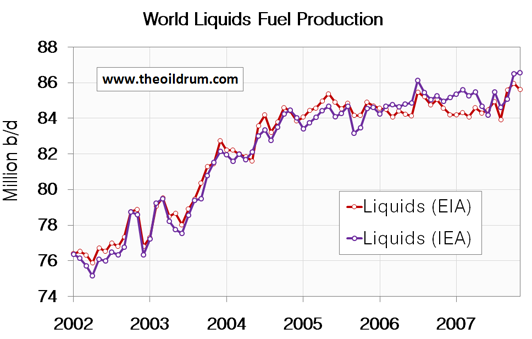
Yes, that's genuine. Bakhtiari was on the pessimistic side of the scale, with a rate of 2.8%. His figure of 82mbd for peak was in error. We are currently at about 86mbd.


Here we must keep track of the category in question; Bakhtiari was referring to CO+NGL; you seem to be referring to All Liquids, hence Bakhtiari was not in error. Note that All Liquids include biofuels that consume near or more than their EROEI, making their inclusion questionable at best, purposefully misleading at worst. All Liquids also includes unconventional fuels (primarily tar sands), which have an EROEI of around 1.5, hence their inclusion suffers similar flaws.

Image

$this->bbcode_second_pass_quote('JohnDenver', '')$this->bbcode_second_pass_quote('', 'h')ttp://newsroom.slb.com/press/inside/print_article.cfm?ArticleID=213&printable=1
Andrew Gould, CEO of Schlumberger, said of the oil decline that "An accurate average decline rate is hard to estimate, but an overall figure of 8% is not an unreasonable assumption".
Gould is speaking of the base decline rate (i.e. the decline of fields in place, prior to bringing new projects on line).

Good, this categorization of decline rates should become the norm here.
http://www.carfree.com
http://ecoplan.org/carshare/cs_index.htm
http://www.velomobile.de/GB/Advantages/advantages.html

Chance favors the prepared mind. -- Louis Pasteur

He that lives upon hope will die fasting. --Benjamin Franklin
User avatar
skyemoor
Heavy Crude
Heavy Crude
 
Posts: 1512
Joined: Sat 16 Oct 2004, 03:00:00
Location: Appalachian Foothills of Virginia
Top

Re: JD Attacks the Issue of Scale II

Unread postby TonyPrep » Thu 10 Jan 2008, 14:41:39

$this->bbcode_second_pass_quote('JohnDenver', 'Y')our job is to give us a detailed, carefully calculated, irrefutable proof of why it will be impossible for humans to scale up the alternatives (as defined above) to replace liquids in the post-peak period.
No, that's not my job. You have usurped the question of replacement of fossil fuels by dissecting the problem down, and starting with the initial period after peak. This does not address the problem, only the initial period, which might be a few years or a couple of decades. My job is not to deal with the problem exactly the way you choose to look at the issue. You've claimed that fossil fuel decline will not require a very different society and economy, and now you choose to focus on showing that society will not collapse in the first few years, which is hardly the point.

In fact, the current EIA figures don't support your assumptions about coal, and others have pointed out that natural gas and hydro are unlikely to provide the extra growth that you hope for, in the initial period.
User avatar
TonyPrep
Intermediate Crude
Intermediate Crude
 
Posts: 2842
Joined: Sun 25 Sep 2005, 03:00:00
Location: Waiuku, New Zealand
Top

Re: JD Attacks the Issue of Scale II

Unread postby TonyPrep » Thu 10 Jan 2008, 14:50:12

$this->bbcode_second_pass_quote('JohnDenver', '')$this->bbcode_second_pass_quote('', 'Y')ou asked for references. Try chapter 4 of The Party's Over, by Richard Heinberg...

Wow, I'm impressed. You actually went all out and did a whole 20 seconds of research. [smilie=eusa_clap.gif]
I see you're descending to ridicule, JD. This does little to enhance your case. You also picked a single reference, when I pointed out several (and forgot Savinar's web site). It most certainly doesn't take 20 seconds to read those things. I actually have a full time job, as well as trying to sort out my family's preparations, but do have time to look at counters to peak oil theory. I always look for the proportion that is wishful thinking (along the lines of Hirsch's report, which ignored yet to be proven technologies), in terms of efficacy, scale, timeliness and likelihood. So far, I've read nothing that doesn't contain a large dollop of that. I wish it were otherwise.
User avatar
TonyPrep
Intermediate Crude
Intermediate Crude
 
Posts: 2842
Joined: Sun 25 Sep 2005, 03:00:00
Location: Waiuku, New Zealand
Top

Re: JD Attacks the Issue of Scale II

Unread postby skyemoor » Thu 10 Jan 2008, 14:52:21

$this->bbcode_second_pass_quote('JohnDenver', '
')World War II is a good model of the potential for rapid retooling and scale-up:


Actually I disagree, for the following reasons;

1. The rest of the developed world was in tatters and the US was the only real manufacturing base, hence the foreign trade surplus was astronomical. Today, it is a deficit of over $600 billion per year.

2. The US was a lender nation then (no foreign debt balance); now, it owes foreign debtors over $9 trillion.

3. Personal savings rates were high then; personal savings rates in the US are now negative!

4. Personal debt is now over $59 trillion!

5. Automobiles are an order of magnitude more complex these days than they were in 1945. Assembly lines, tooling, and vendor interaction complexity are all accordingly an order of magnitude greater as well. Just look under the hood (or behind the dashboard) of a 2007 Ford vs a 1945 Ford.

I've given you direct references on what it takes to simply retool an assembly line these days. You simply showed me what a surge to 3 shifts at a 1940's era auto plant did to plant productivity.
http://www.carfree.com
http://ecoplan.org/carshare/cs_index.htm
http://www.velomobile.de/GB/Advantages/advantages.html

Chance favors the prepared mind. -- Louis Pasteur

He that lives upon hope will die fasting. --Benjamin Franklin
User avatar
skyemoor
Heavy Crude
Heavy Crude
 
Posts: 1512
Joined: Sat 16 Oct 2004, 03:00:00
Location: Appalachian Foothills of Virginia
Top

PreviousNext

Return to Peak Oil Discussion

Who is online

Users browsing this forum: No registered users and 1 guest

cron