




Climate scientists and others have in the past few years issued a steady stream of analyses showing that without immediate remedial actions, a disastrous future is headed our way. But is it a four-decade-old study that will prove prescient?
That study, issued in the 1972 book The Limits to Growth, forecast that industrial output would decline early in the 21st century, followed quickly by a rise in death rates due to reduced provision of services and food that would lead to a dramatic decline in world population. To be specific, per capita industrial output was forecast to decline “precipitously” starting in about 2015.
Well, here we are. Despite years of stagnation following the worst economic crash since the Great Depression, things have not gotten that bad. At least not yet. Although the original authors of The Limits to Growth, led by Donella Meadows, caution against tying their predictions too tightly to a specific year, the actual trends of the past four decades are not far off from the what was predicted by the study’s models. A recent paper examining the original 1972 study goes so far as to say that the study’s predictions are well on course to being borne out.
That research paper, prepared by a University of Melbourne scientist, Graham Turner, is unambiguously titled “Is Global Collapse Imminent?” As you might guess from the title, Dr. Turner is not terribly optimistic.
He is merely the latest researcher to sound alarm bells. Just last month, a revised paper by 19 climate scientists led by James Hansen demonstrates that continued greenhouse-gas emissions will lead to a sea-level rise of several meters in as few as 50 years, increasingly powerful storms and rapid cooling in Europe. Two other recent papers calculate that humanity has already committed itself to a six-meter rise in sea level and a separate group of 18 scientists demonstrated in their study that Earth is crossing multiple points of no return. All the while, governments cling to the idea that “green capitalism” will magically pull humanity out of the frying pan.
Four decades of ‘business as usual’
At least global warming is acknowledged today, even if the world’s governments prescriptions thus far are woefully inadequate. In 1972, the message of The Limits to Growth was far from welcome and widely ridiculed. Adjusting parameters to test various possibilities, the authors ran a dozen scenarios in a global model of the environment and economy, and found that “overshoot and collapse” was inevitable with continued “business as usual”; that is, without significant changes to economic activity. Needless to say, such changes have not occurred.
In the “business as usual” model, the capital needed to extract harder-to-reach resources becomes sufficiently high that other needs for investment are starved at the same time that resources begin to become depleted. Industrial output would begin to decline about 2015, but pollution would continue to increase and fewer inputs would be available for agriculture, resulting in declining food production. Coupled with declines in services such as health and education due to insufficient capital, the death rate begins to rise in 2020 and world population declines at a rate of about half a billion per decade from 2030. According to Dr. Turner:
“The World3 model simulated a stock of non-renewable as well as renewable resources. The function of renewable resources in World3, such as agricultural land and the trees, could erode as a result of economic activity, but they could also recover their function if deliberate action was taken or harmful activity reduced. The rate of recovery relative to rates of degradation affects when thresholds or limits are exceeded as well as the magnitude of any potential collapse.”
The World3 computer model simulated interactions within and between population, industrial capital, pollution, agricultural systems and non-renewable resources, set up to capture positive and negative feedback loops. Dr. Turner writes that changing parameters merely delays collapse. The current boom in fracking natural gas and the extraction of petroleum products from tar sands weren’t anticipated in the 1970s, but the expansion of new technologies to exploit resources pushes back the collapse “one to two decades” but “when it occurs the speed of decline is even greater.”
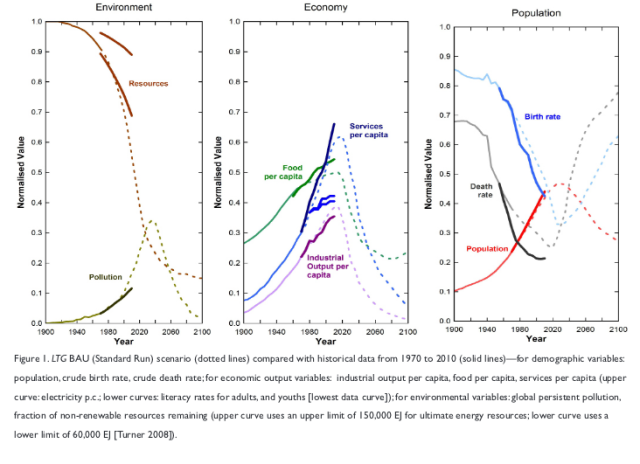 So how much stock should we put in a study more than 40 years old? Dr. Turner asserts that actual environmental, economic and population measurements in the intervening years “aligns strongly” to what the Limits to Growth model expected from its “business as usual” run. He writes:
“[T]he observed industrial output per capita illustrates a slowing rate of growth that is consistent with the [business as usual scenario] reaching a peak. In this scenario, the industrial output per capita begins a substantial reversal and decline at about 2015. Observed food per capita is broadly in keeping with the [Limits to Growth business as usual scenario], with food supply increasing only marginally faster than population. Literacy rates show a saturating growth trend, while electricity generation per capita … grows more rapidly and in better agreement with the [Limits to Growth] model.”
Peak oil and difficult economics
Rising energy costs following global peak oil will make much of the remaining stock uneconomical to exploit. This is a critical forcing point in the collapse scenario. And as more energy is required to extract resources that are more difficult to exploit, the net energy from production continues to fall. John Michael Greer, a writer on peak oil, observes that, just as it takes more energy to produce a steel product than it did a century ago due to the lower quality of iron ore today, more energy is required to produce energy today.
Net energy from oil production has vastly shrunken over the years, Mr. Greer writes:
“[T]the sort of shallow wells that built the US oil industry has a net energy of anything up to 200 to 1: in other words, less than a quart out of each 42-gallon barrel of oil goes to paying off the energy cost of extraction, and the rest is pure profit. … As you slide down the grades of hydrocarbon goo, though, that pleasant equation gets replaced by figures considerably less genial. Your average barrel of oil from a conventional US oilfield today has a net energy around 30 to 1. … The surge of new petroleum that hit the oil market just in time to help drive the current crash of oil prices, though, didn’t come from 30-to-1 conventional oil wells. … What produced the surge this time was a mix of tar sands and hydrofractured shales, which are a very, very long way down the goo curve. …
“The real difficulty with the goo you get from tar sands and hydrofractured shales is that you have to put a lot more energy into getting each [barrel of oil equivalent] of energy out of the ground and into usable condition than you do with conventional crude oil. The exact figures are a matter of dispute, and factoring in every energy input is a fiendishly difficult process, but it’s certainly much less than 30 to 1—and credible estimates put the net energy of tar sands and hydrofractured shales well down into single digits. Now ask yourself this: where is the energy that has to be put into the extraction process coming from? The answer, of course, is that it’s coming out of the same global energy supply to which tar sands and hydrofractured shales are supposedly contributing.”
It is that declining energy availability and greater expense that is the tipping point, Dr. Turner argues:
“Contemporary research into the energy required to extract and supply a unit of energy from oil shows that the inputs have increased by almost an order of magnitude. It does not matter how big the resource stock is if it cannot be extracted fast enough or other scarce inputs needed elsewhere in the economy are consumed in the extraction. Oil and gas optimists note that extracting unconventional fuels is only economic above an oil price somewhere in the vicinity of US$70 per barrel. They readily acknowledge that the age of cheap oil is over, without apparently realising that expensive fuels are a sign of constraints on extraction rates and inputs needed. It is these constraints which lead to the collapse in the [Limits to Growth] modelling of the [business as usual] scenario.”
New oil is dirty oil
The current plunge in oil and gas prices will not be permanent. Speculation on why Saudi Arabia, by far the world’s biggest oil exporter, continues to furiously pump out oil as fast as it can despite the collapse in pricing frequently centers on speculation that the Saudis’ pumping costs are lower than elsewhere and thus can sustain low prices while driving out competitors who must operate in the red at such prices.
If this scenario pans out, a shortage of oil will eventually materialize, driving the price up again. But the difficult economics will not have disappeared; all the easy sources of petroleum have long since been tapped. And the sources for the recent boom — tar sands and fracking — are heavy contributors to global warming, another looming danger. The case for catastrophic climate disruption due to global warming is far better understood today than it was in 1972 — and we are already experiencing its effects.
Dr. Turner, noting with understatement that these gigantic global problems “have been met with considerable resistance from powerful societal forces,” concludes:
“A challenging lesson from the [Limits to Growth] scenarios is that global environmental issues are typically intertwined and should not be treated as isolated problems. Another lesson is the importance of taking pre-emptive action well ahead of problems becoming entrenched. Regrettably, the alignment of data trends with the [Limits to Growth] dynamics indicates that the early stages of collapse could occur within a decade, or might even be underway. This suggests, from a rational risk-based perspective, that we have squandered the past decades, and that preparing for a collapsing global system could be even more important than trying to avoid collapse.”
Sobering indeed. Left unsaid (and, as always, there is no criticism intended in noting a research paper not going outside its parameters) is why so little has been done to head off a looming global catastrophe. Free of constraints, it is not difficult to quantify those “powerful societal forces” as the biggest industrialists and financiers in the world capitalist system. As long as we have an economic system that allows private capital to accumulate without limit on a finite planet, and externalize the costs, in a system that requires endless growth, there is no real prospect of making the drastic changes necessary to head off a very painful future.
Just because a study was conducted decades in the past does not mean we can’t learn from it, even with a measure of skepticism toward peak-oil fast-collapse scenarios. If we reach still further back in time, Rosa Luxemburg’s words haunt us still: Socialism or barbarism.
Hello on Fri, 1st Jul 2016 10:13 am
Can’t wait. The 2005/2008 PO was a dud. so hopefully the club got it right.
oracle on Fri, 1st Jul 2016 10:59 am
Hello Hello, Maybe for you it was a dud. That little financial fiasco that manifested around about 2007 (and continues today) must have escaped your notice. And it did have much to do with oil. Hindsight will be 2020. And here’s hoping that you thoroughly enjoy what’s coming.
PracticalMaina on Fri, 1st Jul 2016 11:04 am
It upped the number of people running small farms 40% in my area, no cheap fuel for commuting, start growing some food!
HARM on Fri, 1st Jul 2016 11:09 am
Oh, so now 2020 is the new revised Doomsday? *Yawn*. I remember Ehrlich predicting global food riots by the 1990s. And then of course MKH himself predicted a global worldwide oil production peak by 2006.
Wake me up when a doomsday/end-of-the-world prediction actually comes true for a change. Until then, BAU (as usual).
Davy on Fri, 1st Jul 2016 11:10 am
Collapse in a global sense is difficult to quantify and define but we are on a schedule of sorts. That reality is hard to deny. It is easier to argue the details but not the trend.
HARM on Fri, 1st Jul 2016 11:15 am
If anything, the U.N.’s population projections of 9.7 billion by 2050, and 11.2 billion by 2100 are far too conservative. We are adding 80 million new hungry mouths every year, or 1.13% a year. Which of course is exponential (non-linear), which means in a decade it will be 100 million more mouths every year, and then 125 million, 150 million, and so on…
HARM on Fri, 1st Jul 2016 11:21 am
We have proven to be far too resilient a species for anything to check our growth. We have far outmatched any terrestrial predators. Neither hunger, nor disease, nor war, nor natural disasters, nor anything short of full scale nuclear war, total destruction of the biosphere, or alien invasion can stop us. That much is obvious to me now.
We will go on growing forever until we can’t. Which is –unfortunately for every other form of complex life on this planet– probably a very long way off. I had previously believed we might face a hard LTG boundary in my lifetime. I now know that was a fantasy. We are and will continue to be an unstoppable cancer on the planet.
energyskeptic on Fri, 1st Jul 2016 11:21 am
Global worldwide oil production did peak in 2005 — conventional oil, which is where 90% of our oil comes from, over half from just 500 giant oil fields, over half of which are declining at a 6% a year rate on average, increasing to9% by 2030, and non-giant fields like deep sea and fracked oil deplete even faster. In a mere 14 years we could be down to half of conventional oil production today, and it’s hard to imagine how unconventional tar sands and fracked oil could make up the difference. Only 1 month of global consumption new oil fields were found last year. Collapse has begun – it’s not an atomic bomb that vaporizes everyone in a micro-second, it is increasing poverty, increasing corrosion of infrastructure, increasing pollution, increasing bankruptcy of companies, manifested in increasing xenophobia and anger against other races, nations, and other outside groups.
Hello on Fri, 1st Jul 2016 11:36 am
Yes HARM. I unfortunately have to agree with you. And I’m equally disappointed.
I was hoping for 2005/2008 to be the cancer cure.
Sissyfuss on Fri, 1st Jul 2016 11:39 am
Marmy, they’re scaring us. Tell us a happy bedtime story. Puleeeese!
HARM on Fri, 1st Jul 2016 11:51 am
@energyskeptic,
And yet global oil+liquids production keep on rising every year, year over year, with no end in sight. Oh… but the data is not telling us what we want to hear, so now we’re changing the goalpost and redefining “oil” to mean only *conventional* oil. Mmmmkay…
Look, I want and end to growth and BAU as much as you do, largely because I too like things like biodiversity, trees, clean water and air. But reality doesn’t cater to what you or I want. It is what it is.
HARM on Fri, 1st Jul 2016 11:54 am
@Hello, thanks, and ditto.
Sadly, the longer growth continues, the harsher the eventual far-off collapse will be, and the fewer species that will be left. For whatever remains of the human race… or whatever yet-to-evolve sentient species that replaces us in some distant future.
PracticalMaina on Fri, 1st Jul 2016 12:00 pm
There using solar to up the production, if the EROEI is so superior why the hell would this make sense. I would think similar solar EOR systems will become more prevalent threw ought the world. The climate be damned, why would we just use the solar directly? Or make liquid hydrogen ect.?
http://social.csptoday.com/markets/oman%E2%80%99s-giant-miraah-project-sets-new-oil-recovery-benchmark
adonis on Fri, 1st Jul 2016 12:05 pm
by 2020 we shall see how many more countries will have gone down like venezuala,greece by then the price of oil will have probably dropped to single digits collapse will be likely affecting people who are unemployed and also broke.
MSN Fanboy on Fri, 1st Jul 2016 12:17 pm
Collectively we are insane, always after the ‘good’ without questioning its costs.
‘good’
‘good’
‘good’
i.e.
Sending money & aid to Famine in Africa
‘good’
‘cost’
A greater famine in Africa at a latter date.
WELL DONE.
All we do is postpone with good & hope for more good.
The truth is this, most of the humans need to die.
So Embrace the ‘bad’
i.e (energyskeptic) “xenophobia and anger against other races, nations, and other outside groups”
‘Cost’ Death (Concentration Camps etc for most humans)
Outcome: Life.
Embrace the ‘bad’ / its the only way to be truly ‘good’.
Thank you Jeebus, for bringing us to the meat grinder, in the name of good.
JuanP on Fri, 1st Jul 2016 12:18 pm
It is interesting to note that the LTG study forecasts that the birth rate will increase drastically in the future. I agree with that. The LTG being more than 40 years old and our refusal as a species to deal with its implications is further proof of the infinity of human stupidity, selfishness, and arrogance. I believe it is decades too late to do anything about it as a species. All we can do now is prepare for the worst as individuals and hope for the best. Time is running out! Are you preparing yourself?
Sys1 on Fri, 1st Jul 2016 12:19 pm
HARM : your pessimism was too much optimistic, just like me. I hoped a fast crash and I witness a slowmotion collapse that could last decades.
Nevertheless, if the global warming get exponential while net energy oil extraction getting fast south, all of that could change VERY fast.
penury on Fri, 1st Jul 2016 12:20 pm
Collapse is occurring around the world. Here in the U.S. collapse is hidden by making up gov statistics, providing EBT cards, other gov benefits, non-action against debt defaults,and forcing people to live in “homeless camps” but as long as Jamie Dimon gets a pay raise everything is “marvelous”.
JuanP on Fri, 1st Jul 2016 12:47 pm
Harm, If I thought it would make any difference I would refute your opinions with facts, but I know from experience that arguing with people like you, Boat, and Hello is completely pointless.
For other readers I want to clarify that population growth went from exponential to linear decades ago and that the comment above on the subject is COMPLETELY WRONG!
Also, the 2008 crisis wreaked havoc here in Miami Beach, where I live, and the bottom 90% of the population here never recovered from the economic losses completely, and many never recovered at all.
Hello on Fri, 1st Jul 2016 1:11 pm
What are you talking about JuanP?
Consumer spending in FL is up compared to 2008. All those Gonzales and Sanchez seem to be pretty happy consuming. No doom in sight.
ghung on Fri, 1st Jul 2016 1:13 pm
Harm said; “And yet global oil+liquids production keep on rising every year, year over year, with no end in sight. Oh… but the data is not telling us what we want to hear, so now we’re changing the goalpost and redefining “oil” to mean only *conventional* oil. Mmmmkay…”
As long as we look only at the number of barrels of oil and so-called “BOE” (barrels of oil equivalent) we’re missing the point. From the article:
“In the “business as usual” model, the capital needed to extract harder-to-reach resources becomes sufficiently high that other needs for investment are starved at the same time that resources begin to become depleted.”
Yeah,, things like deferred infrastructure maintenance investment, increasing costs of essentials like healthcare, massively increasing debt loads, failing states, stagnant wage growth, political impotence,,, all indications that we’re robbing Peter to pay Paul’s resource bills as a result of generally declining resource quality and environmental degradation. Could that be it? It doesn’t matter much if you extract 20% more of a resource if its concentration (quality) has declined by 50%. Indeed, as much as folks like Rock want to discount the relevance of ERoEI, they’ve shown me nothing of substance that makes me think the concept is an invalid one (except to those who’ve done nothing, been nowhere, except in service to big energy).
Things like ERoEI may not affect superficial human behaviors much in the short term, but the physics of resource depletion are utterly indifferent as to how we rationalise consumption and mask depletion with injections of fiat capital. It’ll become clear soon enough that it’s all part-and-parcel of a much larger but finite complex system of consumption that can’t continue as it has for the last couple of centuries.
There is no “we” other than that “we”, collectively have short attention spans and discount our collective future in some very dangerous ways. Meanwhile, calling zombie growth (like more barrels extracted) doesn’t make that real growth. At some point, about all we’ll be left with will be the consequences, which continue to increase even as the real value of our endeavours declines. All things considered, I posit that we reached the point where diminishing returns went negative several decades ago; about the time LtG was first published.
Anonymous on Fri, 1st Jul 2016 1:36 pm
Hello clearly has never heard of debt-driven ‘growth’. Or inflation, or anything to do with economics, clearly. Or even the notion that even in a flat, or declining economy, there can still be ‘growth’ somewhere. Or faked statistics, or transient bubbles etc etc. A more likely explanation he does know about all these things, but prefers to pretend they don’t, or cant exist.
The only real ‘growth’ in floriduh, is likely centered around the illegal drug trade.
Apneaman on Fri, 1st Jul 2016 1:49 pm
HARM, I take most of your points, but I think it is far to early to call the humans resilient. Dominate like no other and especially in a blink of an eye, but, I don’t see homo sapien sapiens as having been put to the test on an evolutionary time scale. We really just got here. 200,000 years in present form and it looks like the cognitive abilities only exploded en-mass about 70,000 years ago. Now if you want to talk about resiliency take a look at the Jelly fish. Been around for over 500 million years and going stronger than ever. 500 million years means they have survived every mass extinction (75% or more) event and most of the smaller extinctions too. After the mother of all extinctions, the Permian, some 90% of ocean life was wiped out, but not jellies – resilient indeed and I bet they will survive this latest, human triggered/caused mass extinction and be thriving many millions of years after we are gone and there is no trace of us left – just a thin geological layer buried beneath the earth. One thing for sure, our personal and cultural resiliency level are going to be tested to the max – some countries are well down the path already. It’s instinctual to fight – to want to live and thrive, but the whole deal is a last man standing proposition.
BTW, it wasn’t energyskeptic who changed the definition of oil; that was certain PTB.
How changing the definition of oil has deceived both policymakers and the public
“But because natural gas plant liquids production has been growing rather rapidly due to recent intensive drilling for natural gas and because those liquids are misleadingly lumped in with oil supplies, people have been mistakenly given the impression that world oil production continues to grow. Not true! What’s growing is a category called “total liquids” which encompasses oil, natural gas plant liquids, biofuels and some other minor fuels. Total liquids are growing only because of large gains in natural gas plant liquids and minor gains in biofuels. And, this is why it is so important to understand what natural gas plant liquids are.
But first, an important question. Why do government and industry officials, oil analysts, and energy reporters equate total liquids and total oil supply? They claim that these other liquids are essentially interchangeable with oil. (I will discuss some of the not-so-savory motives behind this claim later.) In a recent report the U.S. Energy Information Administration put it this way: “The term ‘liquid fuels’ encompasses petroleum and petroleum products and close substitutes, including crude oil, lease condensate, natural gas plant liquids, biofuels, coal-to-liquids, gas-to-liquids, and refinery processing gains.” Let’s see why the “close substitutes” assumption is demonstrably false when it comes to most natural gas plant liquids and decidedly disingenuous when it comes to biofuels.”
http://resourceinsights.blogspot.ca/2012/07/how-changing-definition-of-oil-has.html
The question should be why, after so long, did the PTB move the goal posts?
Hello on Fri, 1st Jul 2016 1:57 pm
I’m sorry anonymous. But you lack understanding.
In order to be able to consume something, it has to be produced first. Who is paying for the production doesn’t really matter, oneself thru work, other people thru providing welfare, other people by providing a loan. The fact is, we have the RESOURCED to produce it.
Lawfish1964 on Fri, 1st Jul 2016 2:02 pm
There’s a reason Kunstler called it the “Long Emergency.” Same reason John Michael Greer states that collapse is a process, not an event. We are in the early stages of collapse. As Energyskeptic says, one result is xenophobia and protection from immigration. That is in full swing here and in Europe.
Dustin Hoffman on Fri, 1st Jul 2016 2:28 pm
Gail Tverberg posted this comment on her blog website Our Finite World and makes a lot of sense
Gail Tverberg says:
June 30, 2016 at 2:47 pm
As long as banks can continue to operate, and people’s bank accounts can buy things, the situation can continue to be fine. I saw an article today saying “71% of Americans think the economy is rigged.” http://money.cnn.com/2016/06/28/news/economy/americans-believe-economy-is-rigged/index.html It is; that is what is keeping the system together. We should be congratulating central bankers on their fine work.”
Boat on Fri, 1st Jul 2016 4:30 pm
Davy on Fri, 1st Jul 2016 11:10 am
“Collapse in a global sense is difficult to quantify and define but we are on a schedule of sorts. That reality is hard to deny. It is easier to argue the details but not the trend.”
We can agree on that. Where we disagree is this trend will unfold over decades, not years.
JuanP on Fri, 1st Jul 2016 4:51 pm
Anonymous, Hello has proven time and again that he has absolutely no idea how the economic system works, and refuses to learn anything. I wouldn’t waste my time explaining anything to him. I believe he simply lacks the capacity to question his beliefs.
Apneaman on Fri, 1st Jul 2016 4:55 pm
There is no way to KNOW how long the ongoing process of collapse will take, but it sure is comforting to read and believe those whose versions suggest that it will be slow and gentle and the worst of it after one is gone. Speculating by using previous collapses is helpful, but not certain and there are a number of very bad things going down that no human, let alone civilization every had to deal with. The word unprecedented cannot be overstated.
Apneaman on Fri, 1st Jul 2016 5:00 pm
Here’s a depressing graph.
10 of California’s 20 largest wildfires burned in last 10 years
https://pbs.twimg.com/media/CmNlZsIUYAAqhLp.jpg
Apneaman on Fri, 1st Jul 2016 5:04 pm
THESE FIRES ARE HUGE, HIDDEN AND HARMFUL. WHAT CAN WE DO?
Smoldering peat gives off massive quantities of carbon dioxide and other pollutants, but the search for solutions is on.
http://ensia.com/features/these-fires-are-huge-hidden-and-harmful-what-can-we-do/
No solution
JuanP on Fri, 1st Jul 2016 5:04 pm
Ap on jellyfish “… and I bet they will survive this latest, human triggered/caused mass extinction and be thriving many millions of years after we are gone… ” I guess you already know this because I know you are constantly reading scientific research, but I will clarify it for others. Jellyfish populations have been exploding everywhere on the planet for years. There are many papers on the subject. They are displacing other water lifeforms and clogging water intakes throughout the world. Here in Miami Beach I can observe this happening from my condo’s windows and balcony. I also see them when I go sailing, rafting, and fishing. There are many times more jellyfish down here than there were 10 or 25 years ago when they were quite rare. They have become an almost constant problem. The lifeguards put their manowar warning purple flags up almost every day now while they were a rare sight when I first came here 25 years ago. I am watching those purple flags on the beach right now.
Apneaman on Fri, 1st Jul 2016 5:09 pm
Now the world is literally burning. Unprecedented.
Climate change turning the world’s bogs into fire hazards, researchers warn
“The world’s bogs hold more carbon than the word’s rainforests, and Canada is home to about 185 billion tonnes of increasingly vulnerable peat deposits, ranging from 40 centimetres to several metres deep, the university said in a press release. Dried peatlands fuelled the 2011 fire in Slave Lake, Alberta, for example, and the recent fire that devastated Fort McMurray also burned through a dried peatland along the only highway in and out of the town, the release noted.
“People don’t think about a fire going down into the soil,” Waddington said. “They think about it going across the landscape.””
http://www.canadianunderwriter.ca/insurance/climate-change-turning-worlds-bogs-fire-hazards-researchers-warn-1004095588/
Apneaman on Fri, 1st Jul 2016 5:12 pm
Southeast Asian fires emitted the most carbon last year since 1997, topped entire EU output
http://www.japantimes.co.jp/news/2016/06/29/asia-pacific/science-health-asia-pacific/southeast-asian-fires-emitted-carbon-last-year-since-1997-topped-entire-eu-output/#.V3bnBtQrKt-
CO2 is your friend!
ghung on Fri, 1st Jul 2016 5:19 pm
CO2 is your friend! It can be used to put out fires,, right?
Boat on Fri, 1st Jul 2016 5:37 pm
ape,
The question should be why, after so long, did the PTB move the goal posts?
Api of 45 to 50 is worth more to refiners than many heavy crudes. Most heavy crudes need to be mixed with light oil to optmize refinery operations.
An api of 34 to 44 is the golden range. If the api is above or below that range you will be docked $.15 per point.
Venezuelan oil (Which there is a lot of) has an api of around 20. 14 points under. The price equilivent of light api 58.
Alberta tar sands has an api around 8. They mix it with light oil to bring the api up to around 33 so it will flow in the pipelines.
Thats why they moved the goalposts. It’s all fuel
Boat on Fri, 1st Jul 2016 5:44 pm
ape,
“There is no way to KNOW how long the ongoing process of collapse will take, but it sure is comforting to read and believe those whose versions suggest that it will be slow and gentle and the worst of it after one is gone”.
Who says or has said any collapse would be gentle. Lol You might rethink that one.
Apneaman on Fri, 1st Jul 2016 5:50 pm
ghung, I don’t know, but they are going to turn it all into rocks and everything will be right as rain again. It’s the latest techno fix being loudly promoted by the climate hope industry (liberals) and non denier fossil fuel lovers too. Put it on the list with the rest of them – Rock On hopey humans.
This Iceland plant just turned carbon dioxide into solid rock — and they did it super fast
https://www.washingtonpost.com/news/energy-environment/wp/2016/06/09/scientists-in-iceland-have-a-solution-to-our-carbon-dioxide-problem-turn-it-into-stone/
Apneaman on Fri, 1st Jul 2016 6:21 pm
Well boaty, those who think it will take many many decades or even centuries (collapse process) and who are wealthy would reason that it will not touch them. How bad did the majority of wealthy suffer during the two world wars and great depression? Also, over on Reddit r/collapse and other collapse aware discussion sites (here) you can often find those who believe that America will avoid the worst of it because it’s America and the reason and only reason Venezuela is going down is because they have a socialist system and did not model themselves after merica. I suspect they are Americans. Humans are hard wired, so to speak, to think that the bad shit will somehow miss them while paradoxically fearing it. I hear many middle aged and older commenters say that the real bad shit will not happen till they are gone – like you – 100% self assured. Like with the climate/environmental stuff “they’re exaggerating” is what you said. For the sake of my family I wish it were true, but the evidence suggests otherwise.
Apneaman on Fri, 1st Jul 2016 6:52 pm
Guacamole Mmmmm….
‘Guacamole-thick’ algae fouls swath of Florida coastline
Highlights
Foul water from Lake Okeechobee taints both coasts, anger residents
Corps, after emergency declaration from governor, agrees to reduce flow
High water in lake remains a concern for aging dike
“Residents and business owners blame the algae on lake water, polluted by fertilizer nutrients and other contaminants. Foul water is also being released to the West Coast down the Caloosahatchee River, with damaging effects of water quality and marine life.”
http://www.miamiherald.com/news/local/environment/article86989367.html
Here’s the whole story.
Angry About Florida’s Ruined Waters, Fishermen Unite Against Big Sugar
“The cause of all this disgusting water was, in a nutshell, plumbing. Lake Okeechobee has been severely polluted with phosphorus and nitrates from a century of farming and development around it. Under normal circumstances, in the rainy season, water is supposed to overflow the lake and move south, through the “River of Grass,” and give life to the Everglades. But vast acres of sugar farms just south of the lake, and the communities of people who operate them, stand in the way.”
“It’s having an unusual political effect: Normally conservative Southwest Florida voters are lining up with tree-hugging environmentalists. Fishermen are organizing against politicians whom they see as concerned about corporations instead of the common good. Both the blue-collar and the rich are pissed off.”
http://www.miaminewtimes.com/news/angry-about-floridas-ruined-waters-fishermen-unite-against-big-sugar-8475700
Apneaman on Fri, 1st Jul 2016 6:59 pm
Another carbon sink losing it’s effectiveness.
Alpine soils storing up to a third less carbon as summers warm
https://www.skepticalscience.com/alpine-soils-storing-up-to-third-less-carbon.html
Truth Has A Liberal Bias on Fri, 1st Jul 2016 7:58 pm
The only commenter on here who is not a complete fucking moron is energyskeptic. The rest of you are a mixture of trolls and morons who both individually and collectively don’t have the slightest fucking clue. I can’t decide who’s more retarded- the doom porn echo chamber losers or the cornucopian ‘no end in sight’ trolls.
onlooker on Fri, 1st Jul 2016 8:04 pm
2020 sounds right for the beginning of the end. Echoing the truth haha.
Truth Has A Liberal Bias on Fri, 1st Jul 2016 8:09 pm
…… Yeah ‘no end in sight’
http://crudeoilpeak.info/world-outside-us-and-canada-doesnt-produce-more-crude-oil-than-in-2005
http://euanmearns.com/a-new-peak-in-conventional-crude-oil-production/
NonyHarmMarm, you’re a fucking retard. Get a grip asshat. Fucking troll. I can’t wait until the hordes of starving migrants kick your teeth in.
JuanP on Fri, 1st Jul 2016 8:12 pm
THALB “The only commenter on here who is not a complete fucking moron is energyskeptic.”
I completely agree with you that you are a complete fucking moron. LOL!
Roger on Fri, 1st Jul 2016 8:53 pm
Ghung,
“Things like ERoEI may not affect superficial human behaviors much in the short term, but the physics of resource depletion are utterly indifferent as to how we rationalise consumption and mask depletion with injections of fiat capital. It’ll become clear soon enough that it’s all part-and-parcel of a much larger but finite complex system of consumption that can’t continue as it has for the last couple of centuries.”
Well said. I agree. That said, consider this..
Let’s say there’s abundant energy at an average EROEI of 5 to last 100 years (likely so IMO). The question then becomes…why not do so? What is the constraint (setting global warming aside for the moment).
Certainly not labor…plenty of folks willing to work.
Capital is what you seem to imply…yes? But, you acknowledge our global fiat system. So, creating “money” from nothing isn’t a problem…and as the shale boom showed, there’s no shortage of willing borrowers or banks.
Hence, IMO, a currency crisis must come first. That is, it will be BAU until the Saudis or Russians refuse the “paper for oil” trade. Which, judging by how the US has alienated them in the last 8 years, is within the next decade. Thoughts?
Roger on Fri, 1st Jul 2016 9:03 pm
Dustin,
“Gail Tverberg says:
June 30, 2016 at 2:47 pm
As long as banks can continue to operate, and people’s bank accounts can buy things, the situation can continue to be fine. I saw an article today saying “71% of Americans think the economy is rigged.””
That’s a bingo!!!
Roger on Fri, 1st Jul 2016 9:17 pm
Boat,
”
Thats why they moved the goalposts. It’s all fuel”
Really? Grab a clue…the gravity differential on crude isn’t anything “new” … It’s been around since the industry began (and these days in despite “posted prices” to the contrary, lube grade heavy oil fetches a premium to light oil…thank you shale drillers).
It’s all fuel — yes, but very different in use. Think of it as if you’re fixing to die of thirst standing on the beach. It’s all water…
They moved the goal posts so as to not panic the sheeple.
Apneaman on Fri, 1st Jul 2016 9:22 pm
Truth, AKA Dunning-Kruger boy, you half faggit loser, your the biggest fucking GOOF on here. Why not expend some energy and try to come with a variety of put downs? While your at it try not writing the same 3 comments over and over. Trust me, there’s plenty of room and it won’t hurt much. You know one thing I watch for is people who ask genuine questions and I ain’t seen you ask one yet. You a fucking know it all. That’s your deal – come on here and make a short statement about something, like you are a world expert on it, then call everyone a fucking retard, then run away. A simple and easy to spot pattern from a simple minded dip shit.
Apneaman on Fri, 1st Jul 2016 9:25 pm
“Think of it as if you’re fixing to die of thirst standing on the beach. It’s all water…”
Instant classic.