
Peak Oil is You

Donate Bitcoins ;-) or Paypal :-)


Page added on March 29, 2016

Why we have a wage inequality problem

Wage inequality is a topic in elections around the world. What can be done to provide more income for those without jobs, and those with low wages?
Wage inequality is really a sign of a deeper problem; basically it reflects an economic system that is not growing rapidly enough to satisfy everyone. In a finite world, it is easy for an economy to grow rapidly at first. In the early days, there are enough resources, such as land, fresh water, and metals, for each person to get a reasonable-sized amount. Each would-be farmer can obtain as much land as he thinks he can work with; fresh water is readily available virtually for free; and goods made with metals, such as cars, are not expensive. There are many jobs available, and wages for most people are fairly similar.
As population grows, and as resources degrade, the situation changes. It is still possible to grow enough food, but it takes large farms, with expensive equipment (but very few actual workers) to produce that food. It is possible to produce enough water, but it takes high-tech equipment and a handful of workers who know how to use the high-tech equipment. Metals suddenly need to be lighter and stronger and have other characteristics for the high tech industry, thus requiring more advanced products. International trade becomes more important to be able to get the correct mix of materials for the advanced products needed to operate the high-tech economy.
With these changes, the economic system that previously provided many jobs for those with limited training (often providing on-the-job training, if necessary) gradually became a system that provides a relatively small number of high-paying jobs, together with many low-paying jobs. In the United States, the change started happening in 1981, and has gotten worse recently.
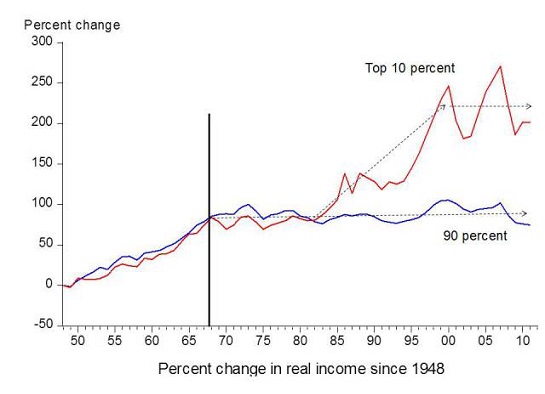
Figure 1. Chart comparing income gains by the top 10% to those of the bottom 90%, by economist Emmanuel Saez. Based on an analysis IRS data; published in Forbes.
What Happens When An Economy Doesn’t Grow Rapidly Enough?
If an economy is growing rapidly enough, it is easy for everyone to get close to an adequate amount. The way I think of the problem is that as economic growth slows, the “overhead” grows disproportionately, taking an ever-larger share of the goods and services the economy produces. The ordinary worker (non-supervisory worker, without advanced degrees) tends to get left out. Figure 2 is my representation of the problem, if the current pattern continues into the future.
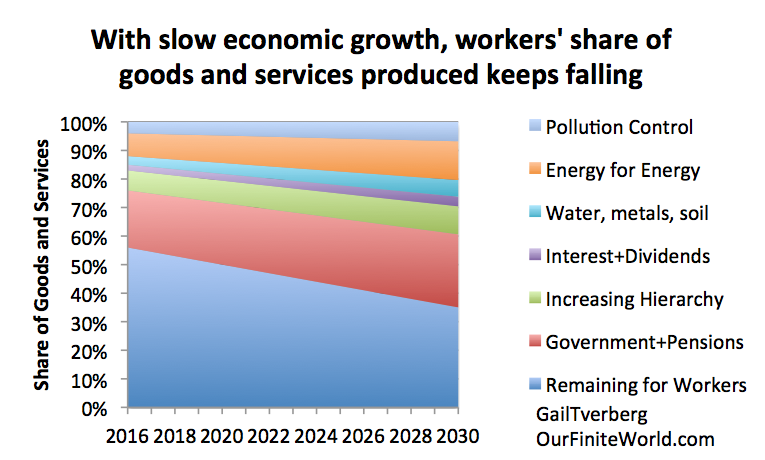
Figure 2. Author’s depiction of changes to workers share of output of economy, if costs keep rising for other portions of the economy. (Chart is only intended to illustrate the problem; it is not based on a study of the relative amounts involved.)
The reason for the workers’ declining share of the total is that we live in a finite world. We are using renewable resources faster than they replenish and continue to use non-renewable resources. The workarounds to fix these problems take an increasing share of the total output of the economy, leaving less for what I have called “ordinary workers.” The problems we encounter include the following:
- Pollution control. Pollution sinks are already full. Continuing to use non-renewable resources (including burning fossil fuels) adds increased pollution. Workarounds have costs, and these take an increasing share of the output of the economy.
- Energy used in energy production. When we started extracting energy products, the cheapest, easiest-to-extract energy products were chosen first. The energy products that are left are higher-cost to extract, and thus require a larger share of the goods the economy produces for extraction.
- Water, metals, and soil workarounds. These suffer from deteriorating quantity and quality, leading to the need for workarounds such as desalination plants, deeper mines, and more irrigated land. All of these take an increasingly large share of the output of the economy.
- Interest and dividends. Capital goods tend to be purchased through debt or sales of stock. Either way, interest payments and dividends must be made, leaving less for workers.
- Increasing hierarchy. Companies need to be larger in size to purchase and manage all of the capital goods needed to work around shortages. High pay for supervisors reduces funds available to pay lower-ranking employees.
- Government funding and pensions. Government programs grow in size in good times, but are hard to cut back in hard times. Pensions, both government and private, are a particular problem because the number of elderly people tends to grow.
It should be no surprise that this type of continuing pattern of eroding wages for ordinary workers leads to great instability. If nothing else, workers become increasingly disillusioned and want to change or overthrow the government.
It might be noted that globalization also plays a role in this shift toward lower wages for ordinary workers. Part of the reason for globalization is simply to work around the problems listed above. For example, if pollution becomes more of a problem, globalization allows pollution to be shifted to countries that do not try to mitigate the problem. Globalization also allows businesses to work around the rising cost of oil production; production can be shifted to countries that instead emphasized coal in their energy mix, with much lower energy used in energy production. With increased globalization, people who are primarily selling the value of their own labor find that wages do not keep up with the rising cost of living.
Studies of Previous Economies that Experienced Declining Wages of Ordinary Workers
Researchers Peter Turchin and Surgey Nefedov analyzed eight civilizations that collapsed in detail, and recorded their findings in the book Secular Cycles. According to them, the typical economic growth pattern of civilizations that collapsed was similar to Figure 3, below. Before the civilizations began to collapse (Crisis Stage), they hit a period of Stagflation. During that period of Stagflation, wages of ordinary workers tended to fall. Eventually these lower wages led to the downfall of the system.
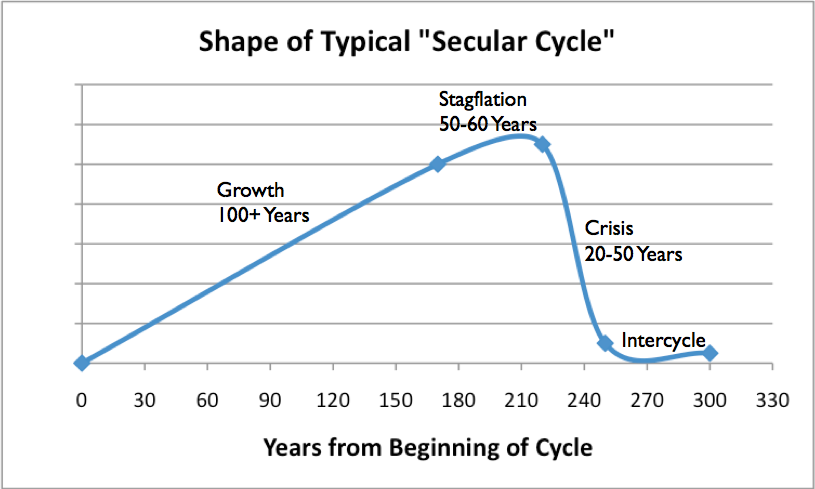
Figure 3. Shape of typical Secular Cycle, based on work of Peter Turchin and Sergey Nefedov in Secular Cycles. Chart by Gail Tverberg.
In many instances, a growth cycle started when a group of individuals discovered a way that they could grow more food for their group. Perhaps they cleared trees from a large plot of land so that they could grow more food, or they found a way to irrigate an area that was dry, again leading to sufficient food for more people. A modern analogy would be discovering how to use fossil fuels to grow more food, thus allowing population to rise.
At first, population grew rapidly, and incomes tended to grow as well, as the size of the group expanded to the carrying capacity of the improved land. Once the economy got close to the carrying capacity of the land, a period of Stagflation took place. There no longer was room for more farmers, unless plots of land were subdivided. Would-be farmers were forced to take lower-paying service jobs, or to become farmers’ helpers. In this changing world, debt levels rose, and food prices spiked.
To try to solve the many issues that arose, there was a need for more elite workers–what we today would call managers and high-level government officials. In some cases, a decision would be made to expand the army, in order to try to invade other countries to obtain more land to solve the problem of inadequate resources for a growing population. All of these changes led to a higher needed tax level and more high-level managers.
What tended to bring the system down was the growing wage inequality and the resulting low wages for ordinary workers. Governments needed ever-higher taxes to pay for their expanding services, but they had difficulty collecting sufficient tax revenue. If they raised taxes to an adequate level, workers found themselves without sufficient money for food. In their weakened state, workers became subject to epidemics. Governments with inadequate tax revenue tended to collapse.
Sometimes, rather than collapse, wars were fought. If the wars were successful, the resource shortage that ultimately led to low wages of workers could be addressed. If not, the end of the group might come through military defeat.
Today’s Fundamental Problem: The World Economy Can No Longer Grow Quickly
Because of our depleted resources and because of the world’s growing population, the only the way the world economy can now grow is in a strange way that assigns more and more output to various parts of “overhead” (Figure 2), leaving less for workers and for unemployed individuals who want to be workers.
Automation looks like it would be a solution since it can produce a large amount of goods, cheaply. It doesn’t really work, however, because it doesn’t provide enough employees who can purchase the output of the manufacturing system, so that demand and supply can stay in balance. In theory, companies that automate their operations could be taxed at a very high rate, so that governments could pay would-be workers, but this doesn’t work either. Companies have a choice regarding which country they operate in. If a tax is added, companies can simply move to a lower-tax rate jurisdiction, where no tax is required for automation.
The world is, in effect, reaching the end of the Stagflation period on Figure 3, and approaching the Crisis period on Figure 3. The catch is that the Crisis period is likely to be shorter and steeper than illustrated on Figure 3, because we live in a much more interconnected world, with more dependence on debt and world trade than in the past. Once the interconnected world economic system starts to fail, we are likely to see a rapid drop in the total amount of goods and services produced, worldwide. This will produce an even worse distribution problem–how does everyone get enough?
The low oil, natural gas, and coal prices we are now seeing may very well be the catalyst that brings the economy to the “Crisis Period” or collapse. Unless there is a rapid increase in prices, companies will cut back on fossil fuel production, as soon as 2016. With less fossil fuel production, the total quantity of goods and services (in other words, GDP) will drop. Most economists do not understand that there is a physics reason for this problem. The quantity of energy consumed needs to keep rising, or world GDP will decline. Technology gains and energy efficiency improvements provide some uplift to GDP growth, but this generally averages less than 1% per year.
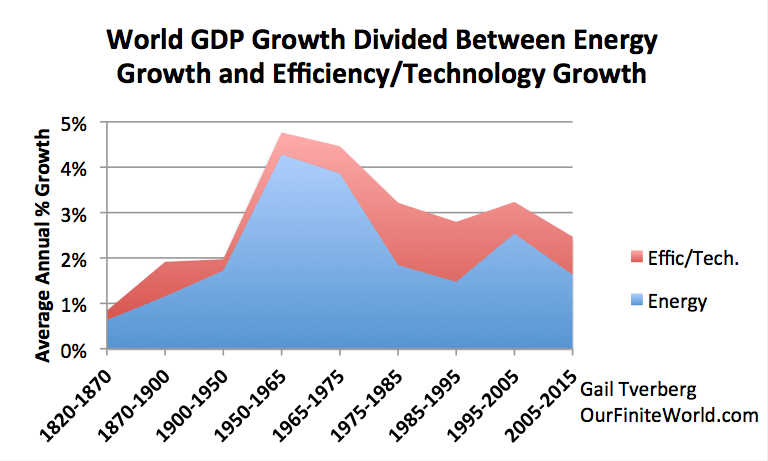
Figure 4. World GDP growth compared to world energy consumption growth for selected time periods since 1820. World real GDP trends for 1975 to present are based on USDA real GDP data in 2010$ for 1975 and subsequent. (Estimated by author for 2015.) GDP estimates for prior to 1975 are based on Maddison project updates as of 2013. Growth in the use of energy products is based on a combination of data from Appendix A data from Vaclav Smil’s Energy Transitions: History, Requirements and Prospects together with BP Statistical Review of World Energy 2015 for 1965 and subsequent.
Are There Political Strategies to Solve Today’s Wage Inequality Problem?
Unfortunately, the answer is probably, “No.” While some strategies look like they might have promise, they risk the possibility of pushing the economy further toward financial collapse, or toward war, or toward a major reduction in international trade. Any of these outcomes could eventually bring down the system. There also doesn’t seem to be much time left.
Our basic problem is that the world economy is growing so slowly that the ordinary workers at the bottom of Figure 2 find themselves with less than an adequate quantity of goods and services. This problem seems to be getting worse rather than better, over time, making the problem a political issue.
These are a few strategies that have been mentioned on political sites for fixing the problem:
- Provide a basic income to all citizens. The intent of this strategy is to try to capture a larger share of the world’s goods and services by printing money (or borrowing money), This money would hopefully allow citizens to purchase a larger share of the goods and services available on the world market. If the pool of goods and services is pretty much fixed in total, more goods and services purchased by one country would mean fewer goods and services purchased by other citizens of other countries. I would expect that this strategy would not really work, because of changing currency relativities: the level of the currency of the country issuing the checks would tend to fall relative to the currencies of other countries. The basic problem is that it is possible to print currency, but not goods and services. There is also a possibility that printing checks for everyone will encourage less work on the part of citizens. If citizens do less work, the country as a whole will produce less. Such a change would leave the country worse off than before.
- Lower interest rates, even negative interest rates. With lower interest rates, the interest portion of the Interest and Dividend sector shown on Figure 2 can theoretically mostly disappear, leaving more money for wages on Figure 2 and thus tending to “fix” the wage problem this way. Low interest rates also tend to reduce dividends, because companies will choose to buy back part of their stock and issue very low interest rate debt instead. If interest rates become negative, the sector can completely disappear. The ultra-low interest rates will have negative ramifications elsewhere. Banks are likely to have a hard time earning an adequate income. Pension funds will find it impossible to pay people the pensions they have been promised, creating a different problem.
- Get jobs back from foreign countries through the use of tariffs. Some jobs might be easier to get back from foreign countries than others. For example, programming, call center operations, and computer tech support are all “service type” jobs that can be done from anywhere, and thus could be transferred back easily. In situations where new factories need to be built, and materials sourced from around the world, the transfer would be more difficult. Businesses will tend to automate operations, rather than hire locally. The countries that we try to get the business from may retaliate by refusing to sell needed devices (for example, computers) and needed raw materials (such as rare earth minerals). Or a collapse may occur in a country we try to get jobs back from, so fewer goods and services are produced worldwide.
- Keep out immigrants. The theory is, “If there aren’t enough jobs to go around, why give them to immigrants?” In a world with sagging GDP, job growth will be slow or may not occur at all. There may be a particular point in keeping out well-educated immigrants, if there aren’t enough jobs for college-educated people who already live in a country. Of course, Europe has been doing the opposite–taking in more immigrants, in the hope that they will provide young workers for countries that are rapidly aging. (Another approach to finding more workers would be to raise the retirement age–but such an approach is not politically popular.)
- Medicare for all. Medicare is the US healthcare plan for those over 65 or having a disability. It pays a substantial share of healthcare costs. The concern I have with “Medicare for all” is that because of the way the economy now functions, the total amount of goods and services that we can choose to purchase, for all kinds of goods and services in total, is almost a fixed sum. (Some people might say we are dealing with a zero-sum game.) If we make a choice to spend more on medical treatment, we are simultaneously making a choice that citizens will be less able to afford other things that might be worthwhile, such as apartments and transportation. The US healthcare system is already the most expensive in the world, as a percentage of GDP. We need to fix the overall system, not simply add more people to a system that is incredibly expensive.
- Free college education for all. As the situation stands today, 45% of recent college graduates are in jobs that do not require a college degree. This suggests that we are already producing far more college graduates than there are jobs for college graduates. If we provide “free college education for all,” this offer needs to be made in the context of entrance exams for a limited number of spaces available (reduced from current enrollment). Otherwise, we sink a huge share of our resources into our education system, to no great benefit for either the students or the overall system. We are back to the zero-sum game problem. If we spend a large share of our resources on college educations that don’t really lead to jobs that pay well, more people of all ages will find themselves unable to afford apartments and cars because of the higher tax levels required to fund the program.
- Renewables to replace fossil fuels. Despite the popularity of the idea, I don’t think that adding renewables provides any significant benefit, given the scenario we are facing. Renewables are made using fossil fuels, and they tend to have pollution problems of their own. They don’t extend the life of the electric grid, if we are facing collapse. At most, they might be helpful for a few people living off grid, if the electrical grid is no longer operating. If the economic system is on the edge of collapse already, fossil fuel use will drop quickly, with or without the use of renewables.
Conclusion
It would be really nice to “roll back” the world economy to a date back before population rose to its current high level, resources became as depleted as they are, and pollution became as big a problem as it is. Unfortunately, we can’t really do this.
We are now faced with the question of whether we can do anything to mitigate what may be a near-term crisis. At this point, it may be too late to make any changes at all, before the downward slide into collapse begins. The current low prices of fossil fuels make the current situation particularly worrisome, because the low prices could lead to lower fossil fuel production, and hence reduce world GDP because of the connection between energy consumption and GDP growth. Low oil prices could also push the world economy downward, due to increasing defaults on energy sector loans and adverse impacts on economies of oil exporters.
In my view, a major reason why fossil fuel prices are now low is because of the low wages of “ordinary workers.” If these wages were higher, workers around the globe could be buying more houses and cars, and indirectly raising demand for fossil fuels. Thus, low fossil fuel prices may be a sign that collapse is near.
One policy that might be helpful at this late date is increased focus on contraception. In fact, an argument could be made for more permissive abortion policies. Our problem is too little resources per capita–keeping the population count in the denominator as low as possible would be helpful.
On a temporary basis, it is also possible that new programs that lead to rising debt–whether or not these programs buy anything worthwhile–may be helpful in keeping the world economy from collapsing. This occurs because the economy is funded by a combination of wages and by growing debt. A shortfall in wages can be hidden by more debt, at least for a short time. Of course, this is not a long-term solution. It simply leads to a larger amount of debt that cannot be repaid when collapse does occur.
69 Comments on "Why we have a wage inequality problem"
GregT on Fri, 1st Apr 2016 2:02 pm
@boat,
“Hard work and taking care of your own is how this American was raised. What can I do for my country, not what can get from it. You man up and help others? It’s good for your mental well being.”
This has absolutely no bearing on what I said above. More non-sense.
onlooker on Fri, 1st Apr 2016 2:15 pm
Your country does not give a shit about you Boat. Man up to the reality that all the mighty institutions of this screwed up world are exploiters and could not care less who they exploit. We in the rich countries just have been less exploited than others. Our time as good compliant consumers is coming to an end and we the middle class of the US especially are now being sacrificed at the altar of oligarchs and their facilitators. I did Man up, I edified myself and stopped in any way possible defending this indefensible system.
GregT on Fri, 1st Apr 2016 2:23 pm
Very few are able to rise up above their indoctrination onlooker. If more were like you, positive change would be a possibility.
onlooker on Fri, 1st Apr 2016 2:28 pm
Yes Greg, unfortunately we have been hiding from limits to growth realities as a species. A small minority have been trying to awaken others. Even here we find the stubborn refusal to wake up. Hope your preparations both mental and physical are proceeding well Greg.
Glamping Southern Ontario on Wed, 5th Apr 2023 8:19 am
Glamping Southern Ontario offers glamping accommodations in the forest of Niagara-on-the-Lake, Ontario. The camp combines rustic glamour, with comfort and convenience.
Disposable Vape on Wed, 5th Apr 2023 8:20 am
Disposable Vape are an ideal solution to replace smoking. The e – cigs contain nicotine cartridges and flavors which can be used over and over again. They’re safe, easy to use and disposable. Just pop a flavor into the mouthpiece and start vaping.
MAHAJABEEN on Wed, 5th Apr 2023 8:21 am
Radio Frequency Shielding is a manufacturer of home, commercial and industrial products. RFSHIELDING systems block out EMFs by absorbing them through the use of fabric or other shielding materials. Products include organic – cotton solid blankets and pillows with breathable padding and eco – friendly, tencel linen covers for cribs, coverlets and shams, place mats and curtains.\https://skyblueconstruction.ca/nuclear-shielding-services/
Magnetic Shielding on Wed, 5th Apr 2023 8:22 am
Apply a strong, durable Magnetic Shielding coating to metal surfaces for added protection against magnets. This unique product offers superior performance over traditional magnetic – shielding coatings by providing full polarization free of unwanted ferrous (metal) surface attraction and magnetism. This process results in little or no observable reduction in the operating performance of any magnetic field source (field strength only) already present on a coated surface.
DHEA for Women on Wed, 5th Apr 2023 8:24 am
DHEA for Women is a proprietary blend of grandmothers’ herbs and nutrients that support healthy levels of DHEA, the body’s most powerful anti – aging hormone. Research shows that as we age, our bodies produce less DHEA, leading to a decline in immune capacity, memory loss and depression. Supplementing with DHEB – 30 will help support healthy levels of DHEA. With the added power of wild – crafted herbs, this customized formula provides potent support for overall wellness while promoting healthy skin, hair, nails, mood and energy.
Decking Contractors on Wed, 5th Apr 2023 8:26 am
It is not just about the boards used to cover a roof. It’s equally, if not more important, to have good honest people who will do the job right and provide value for money. With over 30 years experience in all aspects of decking with PVC and timber Decking Contractors are your local experts. We install 12 mm thick wood decks made from quality hardwood timber that range from 3 – 4 feet tall wicker Rattan Deck furniture available unfinished or stained to match your home for under $1000 plus GST. Our top selling product is outdoor fabric pavers we may be able to supply you with premade here at our business but don’t rule out getting them installed by one of our friendly team members. Look forward to meeting you and giving you a great on site experience.
Corporate Headshots Photography on Wed, 5th Apr 2023 8:26 am
Corporate Headshots Photography – the trusted leader in professional headshots and business profiles for clients across North America. We offer a range of services to support your unique needs, including online ordering and image downloading.
akon on Tue, 14th Nov 2023 1:25 pm
With their exceptional talent and deep understanding of diverse musical genres, an Israeli Music DJ NYC has the ability to create an unforgettable atmosphere that resonates with guests of all ages and backgrounds.
akon on Tue, 14th Nov 2023 1:25 pm
Fence Quotes Ottawa can be obtained from reputable fencing contractors who assess the property, consider specific requirements, and provide a comprehensive breakdown of the costs involved.
akon on Tue, 14th Nov 2023 1:25 pm
In the digital age, accessing the services of a Notary Public Online in USA has become incredibly convenient.
akon on Tue, 14th Nov 2023 1:25 pm
The Security Guard Patrol Service Altamonte Springs is renowned for its vigilant and highly trained personnel, ensuring round-the-clock protection for our clients’ assets.
sara on Wed, 22nd Nov 2023 6:54 am
In this article, we will explore the significance of Architectural Design Service in Anaheim and how they contribute to the city’s unique character and growth.
kolter jorj on Wed, 22nd Nov 2023 6:54 am
Auburn, a picturesque city nestled in the heart of agricultural Alabama, is witnessing a farming revolution with the introduction of DJI Agriculture Spraying Drone in Auburn .
henry coltar on Fri, 5th Apr 2024 4:42 am
Top-notch Doberman Breeders in Kentucky offering exceptional quality and temperament.
henry coltar on Fri, 5th Apr 2024 4:42 am
Whether it’s handling inventory, fulfilling orders, or managing logistics, Temporary Warehouse Workers in Bc contribute significantly to the efficiency of supply chains.