
Peak Oil is You

Donate Bitcoins ;-) or Paypal :-)


Page added on March 29, 2016

Why we have a wage inequality problem

Wage inequality is a topic in elections around the world. What can be done to provide more income for those without jobs, and those with low wages?
Wage inequality is really a sign of a deeper problem; basically it reflects an economic system that is not growing rapidly enough to satisfy everyone. In a finite world, it is easy for an economy to grow rapidly at first. In the early days, there are enough resources, such as land, fresh water, and metals, for each person to get a reasonable-sized amount. Each would-be farmer can obtain as much land as he thinks he can work with; fresh water is readily available virtually for free; and goods made with metals, such as cars, are not expensive. There are many jobs available, and wages for most people are fairly similar.
As population grows, and as resources degrade, the situation changes. It is still possible to grow enough food, but it takes large farms, with expensive equipment (but very few actual workers) to produce that food. It is possible to produce enough water, but it takes high-tech equipment and a handful of workers who know how to use the high-tech equipment. Metals suddenly need to be lighter and stronger and have other characteristics for the high tech industry, thus requiring more advanced products. International trade becomes more important to be able to get the correct mix of materials for the advanced products needed to operate the high-tech economy.
With these changes, the economic system that previously provided many jobs for those with limited training (often providing on-the-job training, if necessary) gradually became a system that provides a relatively small number of high-paying jobs, together with many low-paying jobs. In the United States, the change started happening in 1981, and has gotten worse recently.
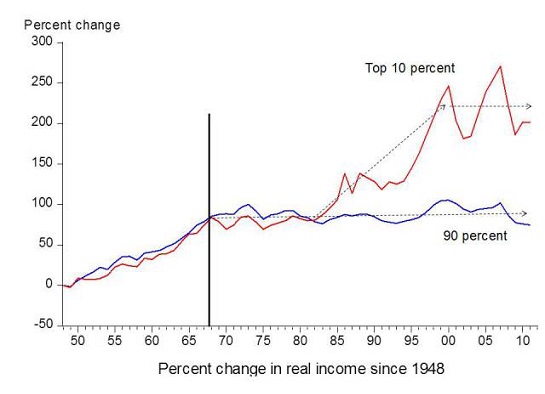
Figure 1. Chart comparing income gains by the top 10% to those of the bottom 90%, by economist Emmanuel Saez. Based on an analysis IRS data; published in Forbes.
What Happens When An Economy Doesn’t Grow Rapidly Enough?
If an economy is growing rapidly enough, it is easy for everyone to get close to an adequate amount. The way I think of the problem is that as economic growth slows, the “overhead” grows disproportionately, taking an ever-larger share of the goods and services the economy produces. The ordinary worker (non-supervisory worker, without advanced degrees) tends to get left out. Figure 2 is my representation of the problem, if the current pattern continues into the future.
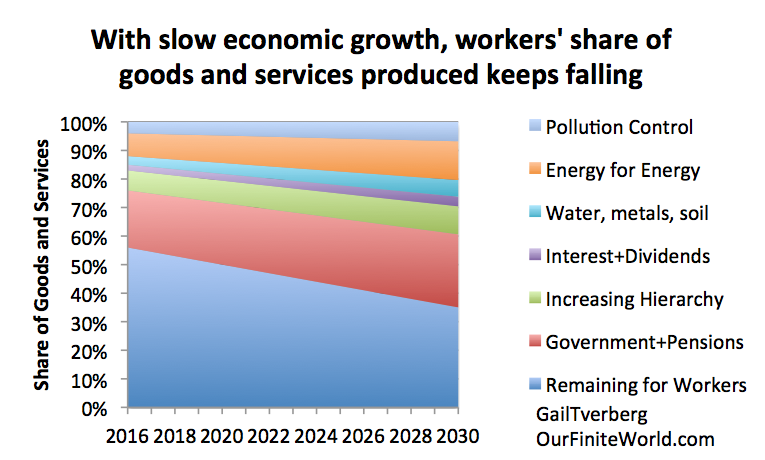
Figure 2. Author’s depiction of changes to workers share of output of economy, if costs keep rising for other portions of the economy. (Chart is only intended to illustrate the problem; it is not based on a study of the relative amounts involved.)
The reason for the workers’ declining share of the total is that we live in a finite world. We are using renewable resources faster than they replenish and continue to use non-renewable resources. The workarounds to fix these problems take an increasing share of the total output of the economy, leaving less for what I have called “ordinary workers.” The problems we encounter include the following:
- Pollution control. Pollution sinks are already full. Continuing to use non-renewable resources (including burning fossil fuels) adds increased pollution. Workarounds have costs, and these take an increasing share of the output of the economy.
- Energy used in energy production. When we started extracting energy products, the cheapest, easiest-to-extract energy products were chosen first. The energy products that are left are higher-cost to extract, and thus require a larger share of the goods the economy produces for extraction.
- Water, metals, and soil workarounds. These suffer from deteriorating quantity and quality, leading to the need for workarounds such as desalination plants, deeper mines, and more irrigated land. All of these take an increasingly large share of the output of the economy.
- Interest and dividends. Capital goods tend to be purchased through debt or sales of stock. Either way, interest payments and dividends must be made, leaving less for workers.
- Increasing hierarchy. Companies need to be larger in size to purchase and manage all of the capital goods needed to work around shortages. High pay for supervisors reduces funds available to pay lower-ranking employees.
- Government funding and pensions. Government programs grow in size in good times, but are hard to cut back in hard times. Pensions, both government and private, are a particular problem because the number of elderly people tends to grow.
It should be no surprise that this type of continuing pattern of eroding wages for ordinary workers leads to great instability. If nothing else, workers become increasingly disillusioned and want to change or overthrow the government.
It might be noted that globalization also plays a role in this shift toward lower wages for ordinary workers. Part of the reason for globalization is simply to work around the problems listed above. For example, if pollution becomes more of a problem, globalization allows pollution to be shifted to countries that do not try to mitigate the problem. Globalization also allows businesses to work around the rising cost of oil production; production can be shifted to countries that instead emphasized coal in their energy mix, with much lower energy used in energy production. With increased globalization, people who are primarily selling the value of their own labor find that wages do not keep up with the rising cost of living.
Studies of Previous Economies that Experienced Declining Wages of Ordinary Workers
Researchers Peter Turchin and Surgey Nefedov analyzed eight civilizations that collapsed in detail, and recorded their findings in the book Secular Cycles. According to them, the typical economic growth pattern of civilizations that collapsed was similar to Figure 3, below. Before the civilizations began to collapse (Crisis Stage), they hit a period of Stagflation. During that period of Stagflation, wages of ordinary workers tended to fall. Eventually these lower wages led to the downfall of the system.
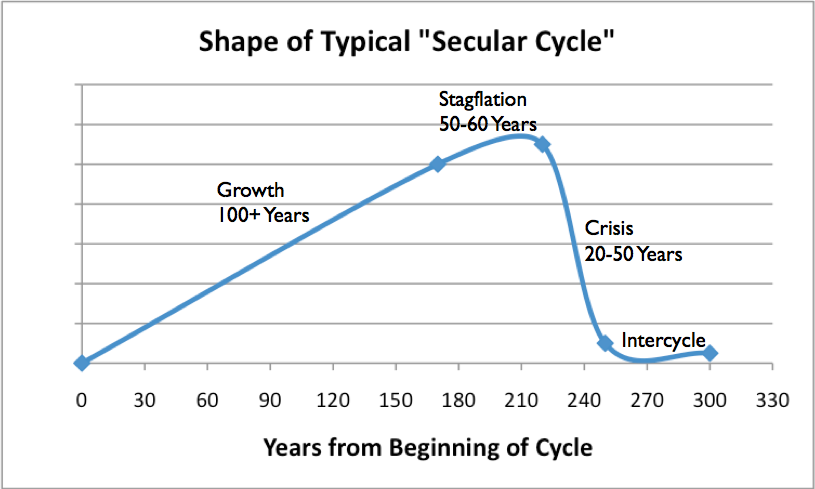
Figure 3. Shape of typical Secular Cycle, based on work of Peter Turchin and Sergey Nefedov in Secular Cycles. Chart by Gail Tverberg.
In many instances, a growth cycle started when a group of individuals discovered a way that they could grow more food for their group. Perhaps they cleared trees from a large plot of land so that they could grow more food, or they found a way to irrigate an area that was dry, again leading to sufficient food for more people. A modern analogy would be discovering how to use fossil fuels to grow more food, thus allowing population to rise.
At first, population grew rapidly, and incomes tended to grow as well, as the size of the group expanded to the carrying capacity of the improved land. Once the economy got close to the carrying capacity of the land, a period of Stagflation took place. There no longer was room for more farmers, unless plots of land were subdivided. Would-be farmers were forced to take lower-paying service jobs, or to become farmers’ helpers. In this changing world, debt levels rose, and food prices spiked.
To try to solve the many issues that arose, there was a need for more elite workers–what we today would call managers and high-level government officials. In some cases, a decision would be made to expand the army, in order to try to invade other countries to obtain more land to solve the problem of inadequate resources for a growing population. All of these changes led to a higher needed tax level and more high-level managers.
What tended to bring the system down was the growing wage inequality and the resulting low wages for ordinary workers. Governments needed ever-higher taxes to pay for their expanding services, but they had difficulty collecting sufficient tax revenue. If they raised taxes to an adequate level, workers found themselves without sufficient money for food. In their weakened state, workers became subject to epidemics. Governments with inadequate tax revenue tended to collapse.
Sometimes, rather than collapse, wars were fought. If the wars were successful, the resource shortage that ultimately led to low wages of workers could be addressed. If not, the end of the group might come through military defeat.
Today’s Fundamental Problem: The World Economy Can No Longer Grow Quickly
Because of our depleted resources and because of the world’s growing population, the only the way the world economy can now grow is in a strange way that assigns more and more output to various parts of “overhead” (Figure 2), leaving less for workers and for unemployed individuals who want to be workers.
Automation looks like it would be a solution since it can produce a large amount of goods, cheaply. It doesn’t really work, however, because it doesn’t provide enough employees who can purchase the output of the manufacturing system, so that demand and supply can stay in balance. In theory, companies that automate their operations could be taxed at a very high rate, so that governments could pay would-be workers, but this doesn’t work either. Companies have a choice regarding which country they operate in. If a tax is added, companies can simply move to a lower-tax rate jurisdiction, where no tax is required for automation.
The world is, in effect, reaching the end of the Stagflation period on Figure 3, and approaching the Crisis period on Figure 3. The catch is that the Crisis period is likely to be shorter and steeper than illustrated on Figure 3, because we live in a much more interconnected world, with more dependence on debt and world trade than in the past. Once the interconnected world economic system starts to fail, we are likely to see a rapid drop in the total amount of goods and services produced, worldwide. This will produce an even worse distribution problem–how does everyone get enough?
The low oil, natural gas, and coal prices we are now seeing may very well be the catalyst that brings the economy to the “Crisis Period” or collapse. Unless there is a rapid increase in prices, companies will cut back on fossil fuel production, as soon as 2016. With less fossil fuel production, the total quantity of goods and services (in other words, GDP) will drop. Most economists do not understand that there is a physics reason for this problem. The quantity of energy consumed needs to keep rising, or world GDP will decline. Technology gains and energy efficiency improvements provide some uplift to GDP growth, but this generally averages less than 1% per year.
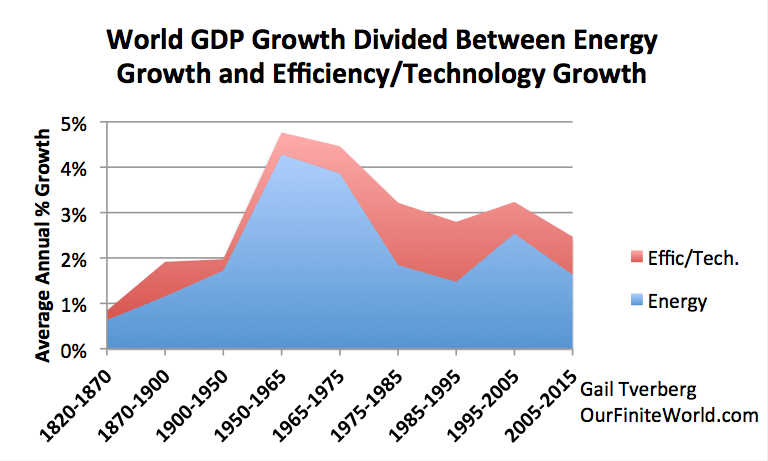
Figure 4. World GDP growth compared to world energy consumption growth for selected time periods since 1820. World real GDP trends for 1975 to present are based on USDA real GDP data in 2010$ for 1975 and subsequent. (Estimated by author for 2015.) GDP estimates for prior to 1975 are based on Maddison project updates as of 2013. Growth in the use of energy products is based on a combination of data from Appendix A data from Vaclav Smil’s Energy Transitions: History, Requirements and Prospects together with BP Statistical Review of World Energy 2015 for 1965 and subsequent.
Are There Political Strategies to Solve Today’s Wage Inequality Problem?
Unfortunately, the answer is probably, “No.” While some strategies look like they might have promise, they risk the possibility of pushing the economy further toward financial collapse, or toward war, or toward a major reduction in international trade. Any of these outcomes could eventually bring down the system. There also doesn’t seem to be much time left.
Our basic problem is that the world economy is growing so slowly that the ordinary workers at the bottom of Figure 2 find themselves with less than an adequate quantity of goods and services. This problem seems to be getting worse rather than better, over time, making the problem a political issue.
These are a few strategies that have been mentioned on political sites for fixing the problem:
- Provide a basic income to all citizens. The intent of this strategy is to try to capture a larger share of the world’s goods and services by printing money (or borrowing money), This money would hopefully allow citizens to purchase a larger share of the goods and services available on the world market. If the pool of goods and services is pretty much fixed in total, more goods and services purchased by one country would mean fewer goods and services purchased by other citizens of other countries. I would expect that this strategy would not really work, because of changing currency relativities: the level of the currency of the country issuing the checks would tend to fall relative to the currencies of other countries. The basic problem is that it is possible to print currency, but not goods and services. There is also a possibility that printing checks for everyone will encourage less work on the part of citizens. If citizens do less work, the country as a whole will produce less. Such a change would leave the country worse off than before.
- Lower interest rates, even negative interest rates. With lower interest rates, the interest portion of the Interest and Dividend sector shown on Figure 2 can theoretically mostly disappear, leaving more money for wages on Figure 2 and thus tending to “fix” the wage problem this way. Low interest rates also tend to reduce dividends, because companies will choose to buy back part of their stock and issue very low interest rate debt instead. If interest rates become negative, the sector can completely disappear. The ultra-low interest rates will have negative ramifications elsewhere. Banks are likely to have a hard time earning an adequate income. Pension funds will find it impossible to pay people the pensions they have been promised, creating a different problem.
- Get jobs back from foreign countries through the use of tariffs. Some jobs might be easier to get back from foreign countries than others. For example, programming, call center operations, and computer tech support are all “service type” jobs that can be done from anywhere, and thus could be transferred back easily. In situations where new factories need to be built, and materials sourced from around the world, the transfer would be more difficult. Businesses will tend to automate operations, rather than hire locally. The countries that we try to get the business from may retaliate by refusing to sell needed devices (for example, computers) and needed raw materials (such as rare earth minerals). Or a collapse may occur in a country we try to get jobs back from, so fewer goods and services are produced worldwide.
- Keep out immigrants. The theory is, “If there aren’t enough jobs to go around, why give them to immigrants?” In a world with sagging GDP, job growth will be slow or may not occur at all. There may be a particular point in keeping out well-educated immigrants, if there aren’t enough jobs for college-educated people who already live in a country. Of course, Europe has been doing the opposite–taking in more immigrants, in the hope that they will provide young workers for countries that are rapidly aging. (Another approach to finding more workers would be to raise the retirement age–but such an approach is not politically popular.)
- Medicare for all. Medicare is the US healthcare plan for those over 65 or having a disability. It pays a substantial share of healthcare costs. The concern I have with “Medicare for all” is that because of the way the economy now functions, the total amount of goods and services that we can choose to purchase, for all kinds of goods and services in total, is almost a fixed sum. (Some people might say we are dealing with a zero-sum game.) If we make a choice to spend more on medical treatment, we are simultaneously making a choice that citizens will be less able to afford other things that might be worthwhile, such as apartments and transportation. The US healthcare system is already the most expensive in the world, as a percentage of GDP. We need to fix the overall system, not simply add more people to a system that is incredibly expensive.
- Free college education for all. As the situation stands today, 45% of recent college graduates are in jobs that do not require a college degree. This suggests that we are already producing far more college graduates than there are jobs for college graduates. If we provide “free college education for all,” this offer needs to be made in the context of entrance exams for a limited number of spaces available (reduced from current enrollment). Otherwise, we sink a huge share of our resources into our education system, to no great benefit for either the students or the overall system. We are back to the zero-sum game problem. If we spend a large share of our resources on college educations that don’t really lead to jobs that pay well, more people of all ages will find themselves unable to afford apartments and cars because of the higher tax levels required to fund the program.
- Renewables to replace fossil fuels. Despite the popularity of the idea, I don’t think that adding renewables provides any significant benefit, given the scenario we are facing. Renewables are made using fossil fuels, and they tend to have pollution problems of their own. They don’t extend the life of the electric grid, if we are facing collapse. At most, they might be helpful for a few people living off grid, if the electrical grid is no longer operating. If the economic system is on the edge of collapse already, fossil fuel use will drop quickly, with or without the use of renewables.
Conclusion
It would be really nice to “roll back” the world economy to a date back before population rose to its current high level, resources became as depleted as they are, and pollution became as big a problem as it is. Unfortunately, we can’t really do this.
We are now faced with the question of whether we can do anything to mitigate what may be a near-term crisis. At this point, it may be too late to make any changes at all, before the downward slide into collapse begins. The current low prices of fossil fuels make the current situation particularly worrisome, because the low prices could lead to lower fossil fuel production, and hence reduce world GDP because of the connection between energy consumption and GDP growth. Low oil prices could also push the world economy downward, due to increasing defaults on energy sector loans and adverse impacts on economies of oil exporters.
In my view, a major reason why fossil fuel prices are now low is because of the low wages of “ordinary workers.” If these wages were higher, workers around the globe could be buying more houses and cars, and indirectly raising demand for fossil fuels. Thus, low fossil fuel prices may be a sign that collapse is near.
One policy that might be helpful at this late date is increased focus on contraception. In fact, an argument could be made for more permissive abortion policies. Our problem is too little resources per capita–keeping the population count in the denominator as low as possible would be helpful.
On a temporary basis, it is also possible that new programs that lead to rising debt–whether or not these programs buy anything worthwhile–may be helpful in keeping the world economy from collapsing. This occurs because the economy is funded by a combination of wages and by growing debt. A shortfall in wages can be hidden by more debt, at least for a short time. Of course, this is not a long-term solution. It simply leads to a larger amount of debt that cannot be repaid when collapse does occur.
69 Comments on "Why we have a wage inequality problem"
HARM on Tue, 29th Mar 2016 4:43 pm
As much as I like Gail and agree with much of her logic, depletion and decelerating growth do not tell the whole story, at least not in the U.S.
In the U.S., productivity –both aggregate and per capita– have been RISING over the past 40 years, not falling. Nonethless, median worker’s wages and share of total wealth have fallen or stagnated, whole the 1% –and especially the 0.01%– have grown enormously rich and vastly more powerful. Wealth inequality and political corruption has reached gargantuan proportions not seen since the 1920s. How does resource depletion and the (still unrealized) future end to Limits to Growth explain all that? A: it can’t.
There are other writers out there who have tried to explain a fuller picture and offer alternative (or at least more complete) explanations: Thomas Picketty, Robert Reich, Matt Taibi, Dylan Ratigan, etc. They point out that in the last 40 years we’ve seen:
1. The precipitous decline of labor unions and labor’s influence in general.
2. The unchecked deregulation of nearly all sectors of our economy –finance/banking, housing, education, healthcare, prisons, and the resulting disaster for the middle and working classes.
3. Acceptance of crony capitalism by the vast majority of the public as the “best” possible system, while anything to counter its most pernicious effects are disparaged as “Communism” (which Socialism and progressive taxation/social programs are inaccurately equated with). The Overton window of acceptable solutions has shifted so far to the hard-right that Reagan or Nixon could probably run as “liberals” today.
4. A political system that is so thoroughly corrupt that the rare politician or bureaucrat who refuses to be bribed by vested interests appears to the public as a “crazy wild-eyed radical commie-hippie”.
Seems to me, any of the above might equally explain what’s going on as thoroughly or better than resource depletion and slowing growth.
HARM on Tue, 29th Mar 2016 4:45 pm
Short version of my rebuttal:
The tide has actually been RISING for the past 40 years, not FALLING as Gail claims. So why is it that only the YACHTS have been lifted?
paulo1 on Tue, 29th Mar 2016 4:53 pm
Gail forgot a few things like:
The .01% owning the political process and their ability to control public policy for their benefit.
The .01% controlling the media to produce the message they wish ‘the exploited’ to believe.
The .01% war against Unions and other organizations they perceive as a threat to what they now control and possess.
The .01% exclusion of regular citizens from elite universities, with the exception of a few scholarship cases. This allows the ‘buddy-boy’ system to continue controlling society while limiting any vertical migration.
The role of propaganda in advertising that contributes to massive private debt levels in the general population. ‘Debt Serfs’ continue to enrich those who control/own the banks, and businesses that produce products people and ill-afford.
Of course the list is much longer.
(Starve the Beast by getting out of debt is a good first step)
HARM on Tue, 29th Mar 2016 5:08 pm
@Paulo,
I think we posted essentially the same rebuttal. 🙂
twocats on Tue, 29th Mar 2016 5:18 pm
Thus, low fossil fuel prices may be a sign that collapse is near. [gail]
or it could be a sign that the system has found a way to both maintain itself by reducing consumption in the developed world by lowering wages and worker participation, thus prolonging the date of collapse. she just arbitrarily suggests we might be reaching the end of the stagflationary cycle, without really providing evidence for the claim.
twocats on Tue, 29th Mar 2016 5:23 pm
A shortfall in wages can be hidden by more debt, at least for a short time. Of course, this is not a long-term solution. It simply leads to a larger amount of debt that cannot be repaid when collapse does occur. [gail]
yes, exactly. this is the last sentence for a reason. there is absolutely nothing bad that will happen if there is a mountain of debt at the time of crises due to physical limits of the system. that a bunch of people won’t get the payment of future energy that they were promised when making various “loan” and after those investments were spent on actual resources (that in the end will fail to have positive return on capital), has no significance whatsoever other than to those people who saved and invested a bunch of money and then never got to redeem those demands for future energy.
marmico on Tue, 29th Mar 2016 5:28 pm
Why would Tverberg use an income chart from Saez instead of a wage chart?
Income inequality has risen since 1980 but not nearly to the extent that Tverberg baldly asserts after considering post-tax, after-transfer income, as published by the Congressional Budget Office.
http://www.cbpp.org/income-gains-at-the-top-dwarf-those-of-low-and-middle-income-households
Tverberg continues to run away from her doom porn chart as fast as she can.
Plantagenet on Tue, 29th Mar 2016 6:17 pm
Wages respond to supply and demand just like oil and most everything else. The massive numbers of illegal aliens in the US have increased the supply of unskilled and low skilled workers, and as a result wages for unskilled workers have collapsed.
One of the side effects of Arizona’s new laws restricting employment opportunities for illegal aliens is that wages have gone up for US citizens.
Supply and demand—it works every time!
http://www.breitbart.com/big-government/2016/02/10/wsj-arizonas-pro-american-immigration-reform-boosts-wages-productivity-housing/
Davy on Tue, 29th Mar 2016 7:36 pm
And some of you want to call this growth!
“Made Out Of Sand” – A Dramatic Look Inside A Newly Built Chinese Apartment”
http://www.zerohedge.com/news/2016-03-29/made-out-sand-dramatic-look-inside-newly-built-chinese-apartment
LiveLeak footage shows two men in a supposedly “new apartment building” in China where the concrete walls crumble like sand. And the country is full of “ghost cities” and new apartment blocks waiting to be filled. Which is no surprise considering that China used about 6.4 gigatons of cement during their construction boom between 2011 and 2013, which is more than what the US used during the entire 20th century. However, those housing properties in China are frequently not built to stand the test of time: In 2010, officials revealed that many homes had a lifespan of just 20 years.
Apneaman on Tue, 29th Mar 2016 7:38 pm
marmi, stop stalking the professionals and let them do their jobs. No one pays attention to a wanna be failure like you…..except to laugh.
Apneaman on Tue, 29th Mar 2016 7:41 pm
Planty only frothing at the mouth conserveatards read breitbart.
Right-wing Policies Produce Worse Outcomes
http://hipcrime.blogspot.ca/2016/03/right-wing-policies-produce-worse.html
Boat on Tue, 29th Mar 2016 7:41 pm
Illegal aliens are only one small part of the problem. There are another 29 million legal foreign residents now and adding over 1 million per year. After the crash unemployment swelled to over 10 million and yet the policy continued.
Boat on Tue, 29th Mar 2016 7:51 pm
apeman,
Try learning how to read a chart you might learn. Being a blow hard jerk may sound cute to your girls but does get rather tiresome.
Apneaman on Tue, 29th Mar 2016 8:02 pm
Boat fuck your chart and fuck you retard.
“Spike in Defaults”: Standard & Poor’s Gets Gloomy, Blames Fed
“Hangover from years of lenient credit may become painful.”
“The Fed’s policies since the Financial Crisis have systematically destroyed the possibility to earn a visible real yield on low-risk corporate bonds or US Treasuries. So investors have embarked on a frantic search for yield, wherever they could find it, and they found it in junk bonds, and in chasing after junk bonds, they pushed those yields down too, and companies took advantage of it.
Since 2012, more than 75% of the companies issuing bonds were assigned on average a “B” category rating (B+, B, or B-), and thus deep into junk, with the “B-” rating carrying a 1-in-10 chance of default.
These companies were able to sell a record amount of junk-rated bonds – “above $300 billion” in three of the past four years.”
http://wolfstreet.com/2016/03/27/sp-gets-bearish-sees-spike-in-defaults-blames-fed/
makati1 on Tue, 29th Mar 2016 8:24 pm
Why the growing divide? The end of the fiat capitalist system is in sight and the elite are grabbing all they can get before it happens. You are not even dust under their feet.
In the middle on Tue, 29th Mar 2016 9:02 pm
Income inequality and skill inequality walk hand in hand.
Dave Thompson on Tue, 29th Mar 2016 9:30 pm
He who owns the gold rules.
makati1 on Tue, 29th Mar 2016 10:03 pm
Some porn for the techie crowd:
http://marketbusinessnews.com/human-colony-moon-2022-highly-likely/129991
LMAO
makati1 on Tue, 29th Mar 2016 10:03 pm
Dave, the gold is all moving East. I doubt the US has any. Only worthless paper.
paulo1 on Tue, 29th Mar 2016 10:10 pm
@Harm.
great minds think alike!!hah
Barbecued tonight after a hard work day cutting up wood. 8:08 pm and it is just dusk. Life is good and I hope my mindset continually reminds me of that fact. (Didn’t want to go to Harvard, anyway). 🙂
marmico on Tue, 29th Mar 2016 11:12 pm
Face facts fucktards. Losers lose and winners win. Im a winner. Guess where I am on the wage chart. I make more money collecting dividends from good investments than you fools do from working. I could stay home for a year just smoking speed and jerking off to anal porn and I’d still make more than you losers.
makati1 on Tue, 29th Mar 2016 11:17 pm
Good for you marmot. If it is even close to the truth. But that will vanish one of these days soon, and then what? Jerk off to porn on the tube? Oh, that’s right, that too will be gone. Oh well, there is always rat poison. Or a third story window.
GregT on Wed, 30th Mar 2016 12:40 am
” Losers lose and winners win. Im a winner. Guess where I am on the wage chart. I make more money collecting dividends from good investments than you fools do from working.”
Many of the people here that you consider to be losers marmico, don’t work anymore, and have no need, or desire, to gamble in the market casino. Like the age old adage, “A fool and his money are soon parted”. I can think of no better way in today’s volatile environment, to set one’s self up for an epic fail.
May lady ‘luck’ shine on you.
Harm on Wed, 30th Mar 2016 1:37 am
Let’s not feed the troll m’kay…
Davy on Wed, 30th Mar 2016 3:30 am
I am not for or against socialism. This post is pointing to the slippery slope the central banks are on in an attempt to stave off deflation and decay. We have seen QE and ZIRP. We are now seeing NIRP. There is talk about “helicopter money” and a cashless society. The next step is price controls. All of this is extend and pretend at the top. It can only continue so long before all options real and imaginary run out.
You cannot overpower the momentum of reality. We have built a society on growth that is limited by finite realities. We have hit limits of growth therefore we are at odds with reality. The system by its very nature must by necessity break to a lower level of activity. That break will rebalance consumption and population. It is as simple as that. You can complicate it with details and play the casino for timing. We are in the end game of modern man at all levels. This spells disaster for 7BIL people that have a normal postmodern carrying capacity of 700MIL to 1BIL.
“Price Controls May Be On the Way”
https://mises.org/library/price-controls-may-be-way
“If you thought negative interest rates were as bad as it could get with central banks, you might be in for a surprise. Central banks have been so spectacularly unsuccessful with their accommodative monetary policies that they are discussing pulling out all the stops to get the results they want. They fail to realize that the reason prices aren’t rising is because they really want and need to fall. Bad debts weren’t liquidated during the last financial crisis, the debtors were merely bailed out. Overpriced assets weren’t allowed to be reduced in price.”
“As Ludwig von Mises pointed out many decades ago, once you begin to institute price controls, you inevitably lead to socialism.”
It follows logically, after all, since central bankers are in the price-setting and price control game to begin with. The interest rates that central bankers target or set are themselves prices, prices of money being loaned overnight or of money being deposited with the central bank. The aim of targeting or setting those interest rates is to influence interest rates and prices in the broader economy. So if that limited price-fixing doesn’t work, governments will expand their efforts to fix even more prices. It may not come directly, at least at first, but rather through some sort of incentivization.
PracticalMaina on Wed, 30th Mar 2016 8:01 am
O I know, is it because money= free speech. The kind TPTB like, not the bad kind where you point out the short comings of the ones in power around you.
Here is an example of some corporate bullshit, An official spokesman from Peabody was telling reporters how confidant he was about the companys future yesterday. Today they told employees at one of their mines that they should not report to work at the end of the week, instead attend a meeting where I am confident they will get let go.
http://trib.com/business/energy/north-antelope-rochelle-on-edge-as-peabody-energy-informs-some/article_5feaf853-e95c-5981-a52c-9042fdb21cca.html
shortonoil on Wed, 30th Mar 2016 8:01 am
“In my view, a major reason why fossil fuel prices are now low is because of the low wages of “ordinary workers.”
Another cart before the horse economic approach! If wages went up a hundred fold the ratio of FF prices to wages would not change. For oil, the end consumer, is now paying the lowest price per BTU that they have since 1973. The producers, on the other hand, are going broke; having seen their total revenue fall by $5 trillion per year in the last 22 months.
The total energy pie is shrinking as a result of depletion. The entropy production that is mandated by physics has now overcome the ability to compensate by increasing production. Higher wages are not going to mitigate this situation. FF prices are at their lows because FFs are losing their ability to power the economy. Tinkering around with some outdated economic hypothesis is not going to alter the laws of physics. It will only serve to move hypothetical currency from one hypothetical pile to another.
Until the world begins to face its energy problem for what it is, an energy problem; economies will continue on their downward deflationary spiral. Printing piles of currency with no intrinsic value, or increasing wages are just exercises in futility. They are processes that will have an effect similar to what moving the deck chairs around did on the Titanic!
http://www.thehillsgroup.org/
JuanP on Wed, 30th Mar 2016 8:27 am
“One policy that might be helpful at this late date is increased focus on contraception. In fact, an argument could be made for more permissive abortion policies. Our problem is too little resources per capita–keeping the population count in the denominator as low as possible would be helpful.”
I couldn’t agree more. I would add free and easily available sterilizations in every corner of the world to the list, too. And subsidies and benefits for having more than one child should be ended, too, but that one child should be well provided for by all.
Kenz300 on Wed, 30th Mar 2016 8:44 am
The top 1% want it all….. and the RepubliCON party will give it to them………..
What do RepubliCONS believe…….. depends who is paying….. follow the money……. fossil fuels….. oil, coal natural gas…, nuclear, NRA………the top 1%
Are RepubliCONS the real EVIL DOERS………..they want to end Social Security, Medicare and access to contraception…….
Hello on Wed, 30th Mar 2016 8:47 am
Automation of more and more complex tasks is not in favor of the unskilled and uneducated worker.
The more surprising are the policies of the West to import as many unskilled/uneducated personnel as possible.
peakyeast on Wed, 30th Mar 2016 6:56 pm
@All: Thanks for all the good links and comments.
Boat on Wed, 30th Mar 2016 7:47 pm
Progress in the global war on poverty
http://www.csmonitor.com/World/2016/0207/Progress-in-the-global-war-on-poverty
Almost unnoticed, the world has reduced poverty, increased incomes, and improved health more than at any time in history.
Boat on Wed, 30th Mar 2016 7:47 pm
Progress in the global war on poverty
http://www.csmonitor.com/World/2016/0207/Progress-in-the-global-war-on-poverty
Almost unnoticed, the world has reduced poverty, increased incomes, and improved health more than at any time in history.
makati1 on Wed, 30th Mar 2016 8:10 pm
All of those who claim that population is the problem are looking at the world thru their Western brainwashed minds. One billion of us consume 60% of the world’s resources. The other 6+ billion consume the other 40% Do you see the problem here? It is not the 6 billion+ who are causing the problems, but the One billion obese, spoiled, greedy consumers in the West. If 6 billion+ can live on their small share, how many could live if the other 60% were to be shared at the same rate? Hmm. I figure about 8-10 billion more of us or maybe 15 billion living a basic lifestyle.
Did I lose you? Did you even read past my assertion about the greedy, fat, privileged Westerners?
Perspective people, perspective.
Pass the popcorn.
makati1 on Wed, 30th Mar 2016 8:29 pm
BTW: “Sadly, I truly believe that if people of average intellect from the 1950s and 1960s were transported to 2016, they would likely be considered mental giants compared to the rest of us.”
http://www.zerohedge.com/news/2016-03-30/depressing-survey-results-show-how-extremely-stupid-america-has-become
Those of us educated in those years can see the truth in that statement.
Davy on Wed, 30th Mar 2016 8:42 pm
Both population and consumption are an issue in different ways and both must be seen together. Take Asia as an example of the worst of both. The West is especially vulnerable to overconsumption vulnerabilities but is also vulnerable with large urban areas that are unsupportable. The worst is existing 3rd world countries at their very limit in all danger categories. A prime example would be Egypt. We have climate vulnerable nations to mix into overpopulation and overconsumption mix. Anyone discounting gross numbers of people as not being an issues is smoking some Filipino meth.
IFuckYouOver on Thu, 31st Mar 2016 12:01 am
Progress is now reaching a point of negative return.
BMW cars went full ahead with electronics computers and their cars and now pure crap.
https://www.youtube.com/watch?v=fQCvvnVDQIo
Ford Ecoboost motor is a total failure too. It is developing carbon on the valve.
https://www.youtube.com/watch?v=-ynGWxzJHjA
https://www.youtube.com/watch?v=nK2eXdaydqI
The comment section is technical but really instructive for people that have the knowledge.
theedrich on Thu, 31st Mar 2016 5:10 am
Clinton = BAU, Trump = Change. That is the true reason why the media-controlling bribe-ocracy is waging a fanatical war against Trump. It wants more of the same corruption. Among other things, the international narcotics mafias are clandestinely slipping heavily laundered $billions to our congressional power wielders. (Over half a decade ago, it was revealed that international banks were accepting drug cartel money. These — and now presumably even more — octopi are the same banks that pay $250K to Hotflash Clitory for a half-hour speech. Such banks do not want change of any kind.
Mexico is largely a narco-state. According to FBI director James Comey, almost all of the heroin supplied to this country comes from that criminal nation. The Mexicans have four major sources of income: oil exports from Cantarell and other fields; remittances from their many millions of illegals in the U.S.; Gringo tourism to Puerto Vallarta, Cancun, etc.; and narcotics exports. The narco-money flowing to our national politicians (especially those of the Demonic Party) is a major reason why no wall has been built against the torrential influx of Spic parasites. Of course the politicoes deny it all, since it is in the nature of politicians to lie. But they know very well which side their bread is buttered on.
On the demand side of the drug horror, it has gotten so bad that even the White House Negro was recently compelled willy-nilly to participate in a panel discussion about opioid abuse, which leads, as is widely known, to ~47,000 U.S. overdose deaths a year, plus a far greater number of lives and families destroyed by the curse. But no action is being taken. Congress has been having “talks” about the opioid problem for years, but nothing serious has been done. The pharmaceutical companies simply offer too much in bribes. The medical profession seems clueless about the issue, and keeps handing out “painkillers” (actually people killers) like candy. And the pandemic is expanding exponentially.
Action against the supply of Mexican heroin and Asian meth is blocked by screams of “racism” and “xenophobia” whenever Trump proposes halting the inundation. Because the Demonic Party and their Repub toadies cannot do without their mother’s milk. In addition, unicorn-minded plutocrats like Georg Sörös and Bill Gates, well insulated from the poison, seek to impose their totalitarian views on the country through yet more bribery.
In many ways, the country is now changing rapidly. Economic growth is slowing markedly, with increasing joblessness or underemployment as a result: half of all law-school graduates, it is said, cannot find jobs in the fields which they have taken out enormous student loans (themselves a grotesque scandal) to prepare for. On the pulpit front, the Pew Research Center found that the percentage of people unaffiliated with any religious denomination had grown from 13% in 2010 to 20% in 2015, and that among U.S. citizens under 31 years of age, the 2015 number was 33%. The obverse of this coin is that these newly “unchurched” sheep will probably be sucked into some new opiate even worse than what they left. The Demonic Party is drowning the country with unassimilable aliens both legal and illegal; is engaging in insane “do-good” wars in the Middle East; is supporting 40%-50% of the populace (both legal and illegal) with various kinds of government assistance; and is turning the country into a one-party dictatorship.
It all reminds one of ancient Rome’s change, in the first century B.C., from a bribery-corrupted republic of plutocrats to an imperial dictatorship doling out bread and circuses to the masses. Today, the left-leaning rabble is successfully promised anything it wants by Hotflash and Bernie. (This seems especially true on the U.S. left coast.) The newest ploy seems to be to decriminalize as much crime as possible in the name of “fairness.” In other words, to revert to the jungle.
Unbeknownst to the mindless masses, Mother Nature is slowly preparing to end this show. We are becoming the criminal species that Fred Hoyle once warned about, a species that refuses to leave infantilism behind and grow up. But in her universe, the end of such refusal is death.
yellowcanoe on Thu, 31st Mar 2016 6:29 am
I posted a link to Gail’s article on my Facebook page and got zero response — no likes or comments. I’d guess that the Progressives on my Friends list simply don’t believe in limits to growth — all that ails our society is due to corrupt politicians and evil corporations.
HARM on Thu, 31st Mar 2016 7:57 pm
@Boat,
Oh, thank goodness! I was worried that human beings were stuck in an impossible quandary of exponential population overshoot and resource depletion, which would inevitably result in a catastrophic crash of both population and civilization. I’m so relieved to know that trees can grow to the sky. *Whew*
Boat on Thu, 31st Mar 2016 8:55 pm
HARM,
Don’t get to excited. Were all going to die anyways. Aren’t you supposed to love the poor, hate the rich and call everyone else slaves? A popular doomer narrative.
GregT on Fri, 1st Apr 2016 12:30 am
“Almost unnoticed, the world has reduced poverty, increased incomes, and improved health more than at any time in history.”
What a complete crock of shit Boat. What else would you expect from the World Bank, or the DC based think tank “The Brookings Institution’.
As of 2008, 80% of the world’s population lived on less than $10 per day, and 50% lived on less than $2.50 per day. The minimum wage in the US is $10 per hour, not $10 per day,
and there are some 50 million people in the states now, or almost one out of every 6 people, that rely on food assistance programs to feed themselves. At the same time, 1% of the US
population hoards 40% of all the wealth, while the bottom 80% holds 7% of the wealth, and that disparity is growing at an alarming rate.
Not ‘a popular doomer narrative’ dumboat, but a reality. Yet one more that your lonely braincell is completely incapable of comprehending. That’s about to change.
makati1 on Fri, 1st Apr 2016 2:31 am
GregT, reality is not part of Boat’s life. Laborers here in the Ps make about 400 Pesos per day. That is about $9/day for hard construction labor. That comes to about $2,200.00 per year. And they are the lucky ones.
A pound of rice is P40.
A pound of chicken is P100.
Riding the bus is P40.
A Big Mac meal at McDonald’s is P189.
P400 does not buy much for a days sweat, usually in 90+ degree heat and sun
Any Westerner should kiss the ground they live on, even if they are in the lowest levels of income. 99.99% of them have no idea of how the rest of the world lives. Nor do they care. Just “gimmi more”!
Boat on Fri, 1st Apr 2016 11:58 am
GregT,
In the US you can qualify for all kinds of programs while making $10,000 per year. They have ac, tv, medical care, food and hot water to shower. Much better off than the 1960 poor. Your middle class starts at $40,000 to over $100,000. They have cars.
They might not have wealth but there is no reason they can’t have happy productive lives.
GregT on Fri, 1st Apr 2016 12:46 pm
@Boat,
If you don’t throw some crumbs to the disenfranchised, they will revolt. When a large enough percentage of the middle class has been marginalized, the only options left will be marshall law, and/or civil unrest, and calls for revolution. Same as it ever was.
GregT on Fri, 1st Apr 2016 12:52 pm
If these programs were so widely appreciated, why would a megalomaniac like Trump garner so much support with his campaign to “Make America Great Again”?
Boat on Fri, 1st Apr 2016 1:17 pm
Both Trump and Sanders have tapped into Washington dissatisfaction. The crash, previous unemployment, immigration, unneeded wars, Obama care, national debt.
Much of the public does not want another Washington insider.
Over 1/2 of the population would rather see a balanced budget and the debt paid with much smaller budgets for social programs.
The voter simply does not see either party capable of problem solving.
Boat on Fri, 1st Apr 2016 1:20 pm
GregT
“If you don’t throw some crumbs to the disenfranchised, they will revolt. When a large enough percentage of the middle class has been marginalized, the only options left will be marshall law, and/or civil unrest, and calls for revolution. Same as it ever was”.
The American public disagrees with you.
GregT on Fri, 1st Apr 2016 1:30 pm
“The American public disagrees with you.”
The entire history of mankind on Planet Earth does not. Of course blind exceptionalism always trumps sober reality, until it doesn’t.
The same as it ever was.
Boat on Fri, 1st Apr 2016 1:54 pm
GregT,
Hard work and taking care of your own is how this American was raised. What can I do for my country, not what can get from it. You man up and help others? It’s good for your mental well being.