
Peak Oil is You

Donate Bitcoins ;-) or Paypal :-)


Page added on January 8, 2015

The Limits Of A Finite World In 2015-16
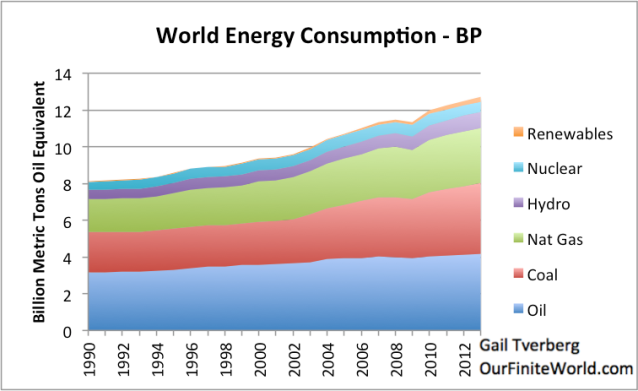
The price of oil is down. How should we expect the economy to perform in 2015 and 2016?
Newspapers in the United States seem to emphasize the positive aspects of the drop in prices. I have written Ten Reasons Why High Oil Prices are a Problem. If our only problem were high oil prices, then low oil prices would seem to be a solution. Unfortunately, the problem we are encountering now is extremely low prices. If prices continue at this low level, or go even lower, we are in deep trouble with respect to future oil extraction.
It seems to me that the situation is much more worrisome than most people would expect. Even if there are some temporary good effects, they will be more than offset by bad effects, some of which could be very bad indeed. We may be reaching limits of a finite world.
The Nature of Our Problem with Oil Prices
The low oil prices we are seeing are a symptom of serious problems within the economy–what I have called “increased inefficiency” (really diminishing returns) leading to low wages. See my post How increased inefficiency explains falling oil prices. While wages have been stagnating, the cost of oil extraction has been increasing by about ten percent a year, described in my post Beginning of the End? Oil Companies Cut Back on Spending.
Needless to say, stagnating wages together with rapidly rising costs of oil production leads to a mismatch between:
- The amount consumers can afford for oil
- The cost of oil, if oil price matches the cost of production
The fact that oil prices were not rising enough to support the higher extraction costs was already a problem back in February 2014, at the time the article Beginning of the End? Oil Companies Cut Back on Spending was written. (The drop in oil prices did not start until June 2014.)
Two different debt-related initiatives have helped cover up the growing mismatch between the cost of extraction and the amount consumers could afford:
- Quantitative Easing (QE) in a number of countries. This creates artificially low interest rates and thus encourages borrowing for speculative activities.
- Growth in Chinese spending on infrastructure. This program was funded by debt.
Both of these programs have been scaled-back significantly since June 2014, with US QE ending its taper in October 2014, and Chinese debt programs undergoing greater controls since early 2014. Chinese new home prices have been dropping since May 2014.
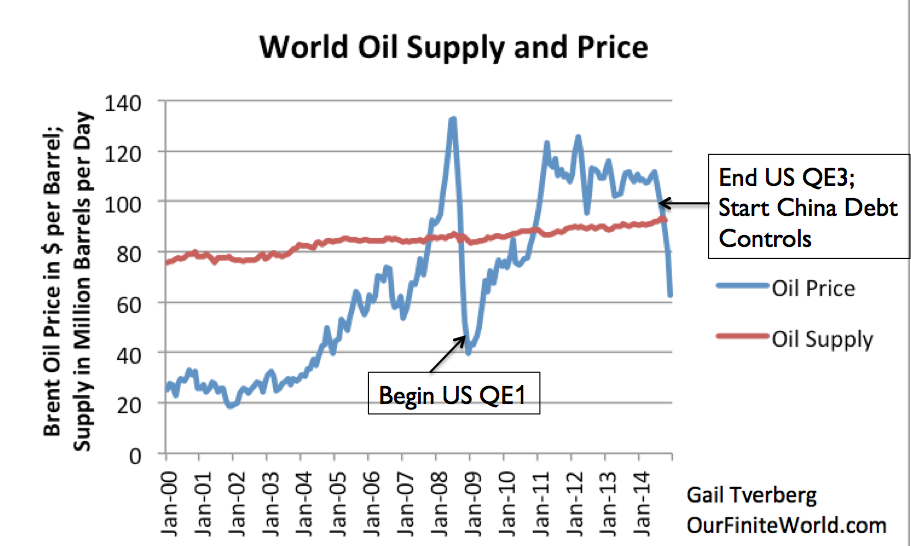
The effect of scaling back both of these programs in the same timeframe has been like a driver taking his foot off of the gasoline pedal. The already slowing world economy slowed further, bringing down oil prices. The prices of many other commodities, such as coal and iron ore, are down as well. Instead of oil prices staying up near the cost of extraction, they have fallen closer to the level consumers can afford. Needless to say, this is not good if the economy really needs the use of oil and other commodities.
It is not clear that either the US QE program or the Chinese program of infrastructure building can be restarted. Both programs were reaching the limits of their usefulness. At some point, additional funds begin going into investments with little return–buildings that would never be occupied or shale operations that would never be profitable. Or investments in Emerging Markets that cannot be profitable without higher commodity prices than are available today.
First Layer of Bad Effects
- Increased debt defaults. Increased debt defaults of many kinds can be expected, including (a) Businesses involved with oil extraction suffering from low prices (b) Laid off oil workers not able to pay their mortgages, (c) Debt repayable in US dollars from emerging markets, including Russia, Brazil, and South Africa, because with their currencies now very low relative to the US dollar, debt is difficult to repay (d) Chinese debt related to overbuilding there, and (e) Debt of failing economies, such as Greece and Venezuela.
- Rising interest rates. With defaults rising, interest rates can be expected to rise, so that those making the loans will be compensated for the rising risk of default. In fact, this is already happening with junk-rated oil loans. Furthermore, it is possible that the US Federal Reserve will raise target interest rates in 2015. This possibility has been mentioned for several months, as part of normalizing interest rates.
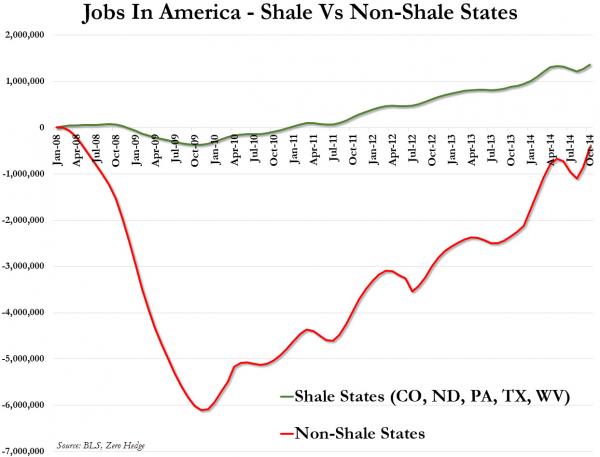
- Rising unemployment. We know that nearly all of the increased employment since 2008 in the US took place in states with shale oil and gas production. As these programs are cut back, US employment is likely to fall. The UK and Norway are likely to experience drops in employment related to oil production, as their oil programs are cut. Countries of South America and Africa dependent on commodity exports are likely to see their employment cut back as well.
- Increased recession. The combination of rising interest rates and rising unemployment will almost certainly lead to recession. At first, some of the effects may be offset by the impact of lower oil prices, but eventually recessionary effects will predominate. Eventually, broken supply chains may become a problem, if companies with poor credit ratings cannot get financing they need at reasonable rates.
- Decreased oil supply, starting perhaps in late 2015. The timing is not certain. Businesses are likely to continue extraction where wells are already in operation, since most costs have already been paid. Also, some businesses have purchased price protection in the derivative market. They will likely continue drilling.
- Disruptions in oil exporting countries, such as Venezuela, Russia, and Nigeria. Oil exporters generally get the majority of their government revenue from taxes on oil. If oil prices remain low, oil-related tax revenue will drop greatly, necessitating cutbacks in food subsidies and other programs. Some countries may experience overthrows of existing governments and a sharp drop in oil exports. Central governments may even disband, as happened with the Soviet Union in 1991.
- Defaults on derivatives, because of sharp and long-lasting changes in oil prices, interest rates, and currency relativities. Securitized debt may also be at risk of default.
- Continued low oil prices, except for brief spikes, because of high interest rates, recession, and low “demand” (really affordability) for oil.
- Drop in stock market prices. Governments have been able to “pump up” stock market prices with their QE programs since 2008. At some point, though, higher interest rates may draw investors away from the stock market. Stock prices may also decline reflecting the poor prospects of the economy, with rising unemployment and fewer goods being manufactured.
- Drop in market value of bonds. When interest rates rise, the market value of existing bonds falls. Bonds are also likely to experience higher default rates. The combined effect is likely to lead to a drop in the equity of financial institutions. At least at first, this effect is likely to occur mostly outside the US, because the “flight to security” will tend to raise the level of the US dollar and lower US interest rates.
- Changes in international associations. Already, there is discussion of Greece dropping out of the Eurozone. Associations such as the European Union and the International Monetary Fund will find it increasingly difficult to handle problems, as their rich countries become poorer, and as loan defaults become increasing problems.
In total, eventually we are likely to experience a much worse situation than we did in the 2007-2009 period, although this may not be evident at first. It will be only over a period of time, after some of the initial “dominoes fall” that we will see what is really happening. Initially, economies of oil importing countries may appear to be doing fairly well, thanks to low oil prices. It will be later that the adverse impacts begin to take over, and eventually dominate.
Major Concerns
Inability to restart oil supply, even if prices should temporarily rise. The production of oil from US shale formations has been enabled by very low interest rates. If there is a major round of debt defaults by the shale industry, interest rates are unlikely to fall back to previously low levels. Because of the higher interest rates, oil prices will have to rise to an even a higher price than required in the past–in other words, to more than $100 barrel, say $125 to $140 barrel. There will also be a lag in restarting production, meaning that high prices will need to be maintained for some time. Bringing oil prices to a high level for a long time seems impossible without crashing the economies of oil importers. See my post, Ten Reasons Why High Oil Prices are a Problem.
Derivatives and Securitized Debt Defaults. The last time we had problems with these types of financial instruments was 2008. Governments around the world made huge payments to banks and other financial institutions, in order to bail them out of their difficulties. The financial services firm Lehman Brothers was allowed to go bankrupt.
Governments have declared that if this happens again, they will do things differently. Instead of bailing institutions out, they will make changes that will make these events less likely to happen. They will also make changes in how shortfalls are funded. In many cases, the result will be a bail-in, where depositors share in the losses by “haircuts” to their deposits.
Unfortunately, from what I can see, the changes governments have made are basically too little, too late. The new sharing of losses will have as bad, or worse, impacts on the economy than the previous government bailouts of banks. Regulators do not seem to understand that models used in pricing derivatives and securitized debt are not designed for a finite world. The models appear to work reasonably well when the economy is distant from limits. Once the economy gets close to limits, many more adverse events occur than the models would have predicted, potentially causing huge problems for the system.1
What we are likely to be encountering now is a combination of defaults of many kinds simultaneously–derivatives, securitized debt, and “ordinary” debt. Many of these risks will be shared among institutions, so that banking problems will be widespread. The sizes of the losses are likely to be very large. Businesses may find that funds intended for payroll or needed to pay suppliers are subject to haircuts. How can they operate in such a situation?
It is even possible that accounts under deposit insurance limits will be subject to haircuts. While deposit insurance is available in theory, the amount held in reserve is not very great. It could easily be exhausted by a few large claims (the scenario in Iceland a few years ago). If governments choose not to make up for shortfalls in funding of the insurance programs, the shortfalls could end up with depositors.
Peak Oil. There seems to be a distinct possibility that we will be reaching the peak in world oil supply very soon–2014 or 2015, or even 2016. The way we reach this peak though, is different from what most people imagined: low oil prices, rather than high oil prices. Low oil prices are brought about by low wages and the inability to add sufficient new debt to offset the low wages. Because the issue is one of affordability, nearly all commodities are likely to be affected, including fossil fuels other than oil. In some sense, the issue is that a financial crash is bringing down the financial system, and is bringing commodities of all kinds with it.
Figure 2 shows an estimate of future energy production of various types. The steep downslope is likely because of the financial problems we are headed into.2
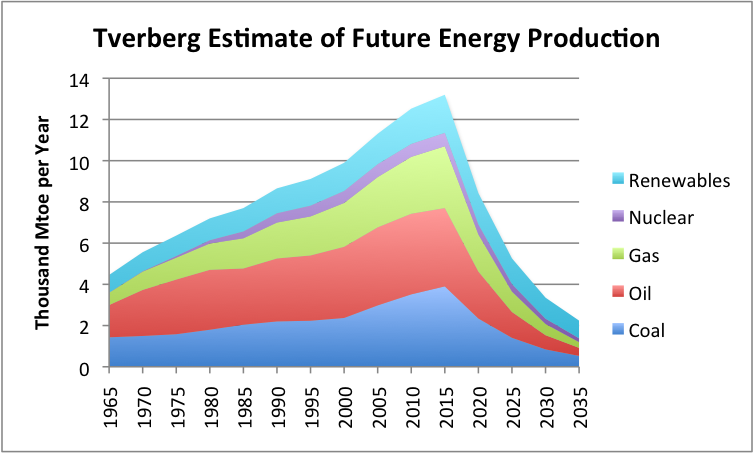
A major point of this chart is that all fuels are likely to decline simultaneously, because the cause is financial. For example, how does an oil company or a coal company continue to operate, if it cannot pay its employees and suppliers because of bank-related problems?
Our Long-Term Debt Problem. Long-term debt is an important part of our current system because (a) it enables buyers to afford products, and (b) it helps keep commodity prices high enough to encourage extraction. Unfortunately, long-term debt seems to require economic growth, so that we can repay debt with interest.
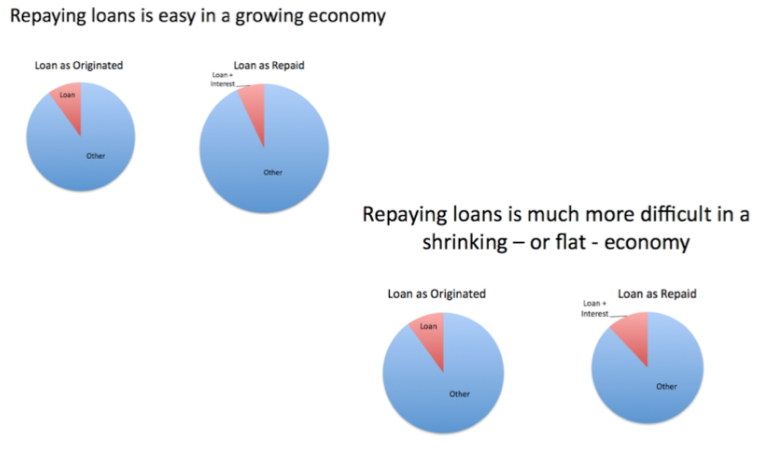
Economists conjecture that economic growth can continue, even if the extraction of fossil fuels and other commodities declines (as in Figure 2). But how likely is this in practice? Without fossil fuels, we can exchange baby-sitting services and we can give each other back rubs, but how much can we really do to grow the economy?
Almost any economic activity we can think of requires the use of petroleum or electricity and the use of commodities such as iron and copper. A more realistic view would seem to be that without the materials we generally use, our economy is likely to shrink. With this shrinkage, long-term debt will become increasingly impossible. This is one of the big problems we are encountering.
Our Physics Problem. Politicians and businesses of all types would like to advance the idea that our economy will continue forever; the politicians and businesses of every kind are in charge. Everything will turn out well.
Unfortunately, history is littered with examples of civilizations that hit diminishing returns, and then collapsed. Research indicates that the when early economies underwent collapse, the shape of the decline wasn’t straight down–declines tended to take a period of years. Not everyone died, either.
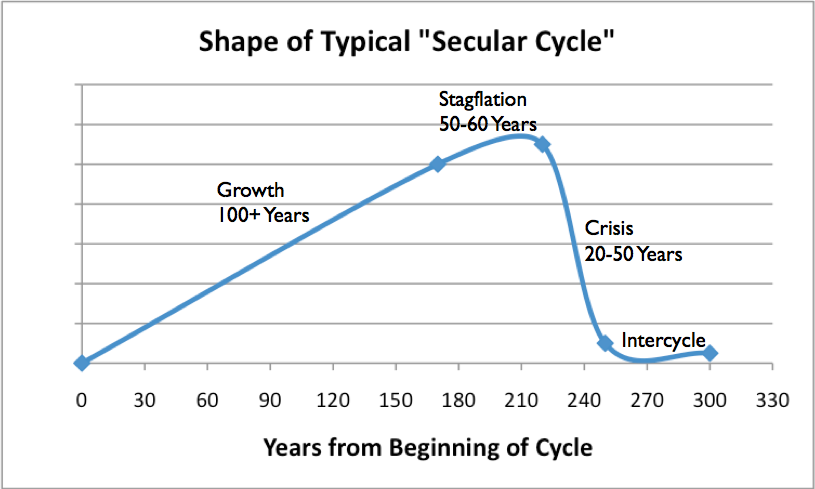
Physics gives us a reason as to why such a pattern is to be expected. Physics tells us that civilizations are dissipative structures. The world we live in is an open system, receiving energy from the sun. Examples of other dissipative structures include galaxy systems, the solar system, the lives of plants and animals, and hurricanes. They are born, grow, and eventually stop dissipating energy and die. New dissipative structures often arise, if sufficient energy sources are available to dissipate. Thus, there may be new economies in the future.
We would like to think that we can stop this process, but it is not clear that we can. Perhaps economies are expected to reach limits and eventually collapse. It is only if economies can add large amounts of inexpensive energy resources (for example, by discovering how to make use of fossil fuels, or by discovering a less-settled area of the world, or even by adding China to the World Trade Organization in 2001) that this scenario can be put off.
What Can We Do?
Renewable energy is has recently been advertised as the solution to nearly all of our problems. If my analysis of our problems is correct, renewable energy is not a solution to our problems. I mentioned earlier that adding China to the World Trade Organization in 2001 temporarily helped solve world energy problems, with its ramp up of coal production after joining (note bulge in coal consumption after 2001 in Figure 5). In comparison, the impact of non-hydro renewables has been barely noticeable in the whole picture.

Guaranteed prices for renewable energy are likely to be an increasing problem, as the cost of fossil fuel energy falls, and as buyers become increasingly unable to afford high energy prices. Issues with banks, making it difficult to pay employees and suppliers, are likely to be a problem whether an energy company uses renewable energy sources or not.
The only renewable energy sources that may be helpful in the long term are one that do not require buying goods from a distance, and thus do not require the use of banks. Trees growing in a local forest might be an example of such renewable energy.
Another solution to the problems we are reaching would seem to be figuring out a new financial system. Unfortunately, debt–and in fact growing debt–seems to be essential to our current system. We can’t extract fossil fuels without a debt-based system, in part because debt allows profits to be moved forward, and thus lightens the burden of paying for products made with a fossil-fuel based system. If a financial system uses only on the accumulated profits of a system without fossil fuels, it can expand only very slowly. See my post Why Malthus Got His Forecast Wrong. Local currency systems have also been suggested, but they don’t fix the problem of, say, electricity companies not being able to pay their suppliers at a distance.
Adding more debt, or taking steps to hold interest rates even lower, is probably the closest we can come to a reasonable way of temporarily putting off financial collapse. It is not clear where more debt can be added, though. The reason current debt programs are being discontinued is because, after a certain level of expansion, they primarily seem to create stock market bubbles and encourage investments that can never pay back adequate returns.
One possible solution is that a small number of people with survivalist skills will make it through the bottleneck, in order to start civilization over again. Some of these individuals may be small-scale farmers. The availability of cheap, easy to use, local energy is likely to be a limiting factor on population size, however. World population was one billion or less before the widespread use of fossil fuels.
We don’t have much time to fix our problems. In the timeframe we are looking at, the only other solution would seem to be a religious one. I don’t know exactly what it would be; I am not a believer in The Rapture. There is great order underlying our current system. If the universe was formed in a big bang, there was no doubt a plan behind it. We don’t know exactly what the plan for the future is. Perhaps what we are encountering is some sort of change or transformation that is in the best interests of mankind and the planet. More reading of religious scriptures might be in order. We truly live in interesting times!
73 Comments on "The Limits Of A Finite World In 2015-16"
Makati1 on Thu, 8th Jan 2015 7:49 am
Religion from Gale…lol.
How long will these people be able to make a living pushing BS into huge piles and calling it peanut butter fudge? Psychologists, economists, sociologists,etc., are all going to be unemployed in the barter economy to come.
No useful skills and an inability to see reality will mean a short lifespan. Ditto for most college/university professors of “Liberal Arts” and the esoteric engineering schools.
Think 200 years ago for an idea of the world in the year 2100, IF the human species makes it that far. I will not live to see it and neither will you.
dave thompson on Thu, 8th Jan 2015 8:17 am
The drop in oil price took what, six months? The rise back up to $125 plus will be a matter of the next few weeks.
bobinget on Thu, 8th Jan 2015 8:34 am
Left hand Gail tells us Earth gets all it’s energy from the sun. Right hand Gail tells us (US centric folks) renewable energy won’t get us there.
Her last word: learn to make fire with wet wood.
Skotland peoples look like you.
http://www.sustainablebusiness.com/index.cfm/go/news.display/id/26073
At another end of skin color spectrum, Nicaragua
(and Costa Rica, for that matter)
http://cleantechnica.com/2013/01/06/94-renewable-energy-by-2017-is-goal-for-nicaragua/
Nigeria aims a bit lower, 10% by 2025. It’s grounds oil soaked, its air that can be trusted because it can be seen, even in some controlled circumstances, breathed.
http://en.wikipedia.org/wiki/Nigeria_Renewable_Energy_Master_Plan
in oil, it
penury on Thu, 8th Jan 2015 8:37 am
This article illustrates what most Americans (at least) born after 1950 fail to understand. Growth of the economy is not assured. Contraction when it occurs will change everything. If Dave T is correct than I afraid that we will find that the increase in price will result in a further decline in demand. Read Bill Gross latest letter, he and Kuntsler nailed it. The Good Times are over, and it is too late to start preparations for what is coming down the road.MAK think Pasay instead of Makati.
Rodster on Thu, 8th Jan 2015 9:07 am
@Penury “This article illustrates what most Americans (at least) born after 1950 fail to understand. Growth of the economy is not assured.”
I’d take it a step further. Infinite economic growth always ends in a collapse. This time is different because the ENTIRE Planet got on the same train heading towards the side of a mountain at 200 MPH.
Apneaman on Thu, 8th Jan 2015 9:56 am
Makati1
I would imagine 99% of people who work in an office environment will be out of work along with many others. Of course, the least deserving of their wages, administrators/intermediaries, will be the last to go since they make the decisions. This will only speed the collapse as useful and necessary workers are sacrificed so they can hold on to their positions longer. Been well underway for awhile.
GregT on Thu, 8th Jan 2015 10:25 am
“Growth of the economy is not assured”
What is assured, is that at some point the economy will no longer be able to grow.
J-Gav on Thu, 8th Jan 2015 10:42 am
On Gail’s conclusion: I’ve done a lot of ‘scripture reading’ on a number of the world’s ‘major’ religions and my own conclusion is that none of these mostly violent, expansionist, racist mythologies with their Bronze Age superstitions is capable of generating the sort of ‘Great Spiritual Transformation’ that many claim to see coming.
A transformation there will be. But those expecting it to come in the form of a world community holding hands and dancing around some universal-campfire singing Kumbaya are going to be sorely disappointed I’m afraid.
ghung on Thu, 8th Jan 2015 10:46 am
Yeah, J-Gav, what does it say that most people prefer their angry, vengeful Gods? Still haven’t figured out the Jesus people, killing in the name of ….
J-Gav on Thu, 8th Jan 2015 10:48 am
Remember the old joke about the Bouddhist and the hot-dog vendor?
Vendor says: “What’ll it be?”
Bouddhist says: “Make me One with everything,” gets served and hands over a $20 bill.
After waiting for a few minutes he says: “What about my change?”
Vendor says: “You’re a Bouddhist. You should know that change can only come from within.”
ghung on Thu, 8th Jan 2015 10:50 am
Amen to that, and those vegan dogs are pricey.
J-Gav on Thu, 8th Jan 2015 11:07 am
Yeah Ghung – I thought somebody might notice that …
However, the Theravada Buddhist tradition does allow the eating of pork.
Northwest Resident on Thu, 8th Jan 2015 11:29 am
When they come up with a “major” religion that emphasizes worship of nature, of the God(s) that created and watch over nature, and where the daily religious rituals consist of activities that promote sustainability and seek to preserve and enhance our natural surroundings, THEN I’ll convert, gladly. I would also like to see a weekly sacrifice of a sociopath with mandatory attendance for all, with a long slow brutal and painful death so that the screams and torments of the sacrificial sociopath will echo through the heavens and symbolically wash away the oceans of dreadful sins that have been committed by sociopaths over the centuries in the name of rape, pillage, conquest, exploitation and destruction of the natural environment that sustains us all. If the religion would tend to emphasize eroticism, pleasure and sensuality instead of vengeance, violence and conflict then I’ll be even more satisfied with my choice to convert.
Rodster on Thu, 8th Jan 2015 11:35 am
Is J-Gav, Paul/WWW from Gails’s message boards? 😉
J-Gav on Thu, 8th Jan 2015 11:37 am
Rodster – Not at all. Never heard of that particular individual and don’t read Gail’s message boards …
Speculawyer on Thu, 8th Jan 2015 11:46 am
” In the timeframe we are looking at, the only other solution would seem to be a religious one.”
Gail is really going off the deep end now it seems.
J-Gav on Thu, 8th Jan 2015 11:48 am
NW – Well, I wouldn’t revel in prolonged human suffering of any kind, especially when it’s meant to lead to death. But I understand your pissed-offedness.
And I totally agree that any true spirituality must be nature-based. “Deus sive Natura”, as 17th C. Dutch philosopher Baruch Spinoza put it. Meaning, “God, which is to say, Nature.” He was a pantheist, perhaps even an atheist but you couldn’t go public with that at the time. He was of course excommunicated in particularly vicious terms by the Jewish authorities of that time. His ‘Ethics,’ (published posthumously and not an easy read) is one of the great works of modern philosophy IMHO.
GregT on Thu, 8th Jan 2015 11:55 am
“The nations were filled with wrath, but now the time of your wrath has come. It is time to judge the dead and reward your servants the prophets, as well as your holy people, and all who fear your name, from the least to the greatest. It is time to destroy all who have caused destruction on the earth.”
Rev 11:18
“The acts of the flesh are obvious: sexual immorality, impurity and debauchery; idolatry and witchcraft; hatred, discord, jealousy, fits of rage, selfish ambition, dissensions, factions and envy; drunkenness, orgies, and the like. I warn you, as I did before, that those who live like this will not inherit the kingdom of God.
But the fruit of the Spirit is love, joy, peace, forbearance, kindness, goodness, faithfulness, gentleness and self-control. Against such things there is no law.
Galatians 5:19-23
There is a big difference between religions, and one’s own personal spirituality NWR.
Rodster on Thu, 8th Jan 2015 12:08 pm
We can all agree that on it’s current glidescope this all ends very BADLY. It always has throughout history.
I’m also reminded of one favorite lyric from songwriter Jimmy Buffett who sang: “In a hundred years this all won’t matter”.
Enjoy life while you can. Some of the machinations being done behind the scenes, we have little control over until events take place. Voting for the Repubs or Dems is useless because they are one and the same. Buckle up because the ride will get bumpy.
ghung on Thu, 8th Jan 2015 12:09 pm
NWR: “When they come up with a “major” religion that emphasizes worship of nature, of the God(s) that created and watch over nature, and where the daily religious rituals consist of activities that promote sustainability and seek to preserve and enhance our natural surroundings, THEN I’ll convert, gladly.”
All major religions have to start somewhere. I’m surprised no one has mentioned the Archdruid yet. From this weeks post:
“Within those limits, the question I’ve posed may seem preposterous. I grant that for a phenomenon that practically defines the far edges of the internet—a venue for lengthy and ornately written essays about wildly unpopular subjects by a clergyman from a small and distinctly eccentric fringe religion—The Archdruid Report has a preposterously large readership, and one that somehow manages to find room for a remarkably diverse and talented range of people, bridging some of the ideological and social barriers that divide industrial society into so many armed and uncommunicative camps. Even so, the regular readership of this blog could probably all sit down at once in a football stadium and still leave room for the hot dog vendors. Am I seriously suggesting that this modest and disorganized a group can somehow rise up and take meaningful action in the face of so vast a process as the fall of a civilization? “
http://www.thearchdruidreport.blogspot.com/2015/01/a-camp-amid-ruins.html
Seems like a more pragmatic set of beliefs is out there. Greer goes on:
“I’ve noted before more than once that the collapse of industrial society isn’t something located off in the nearer or further future; it’s something that got under way a good many years ago, has been accelerating around us for decades, and is simply hitting one of the rougher patches of the normal process of decline and fall just now. Most of the nonserious proposals just referred to start from the insistence that that can’t happen. Comforting in the short term, that insistence is a rich source of disaster and misery from any longer perspective, and the sooner each of us gets over it and starts to survey the wreckage around us, the better. Then we can make camp in the ruins, light a fire, get some soup heating in a salvaged iron pot, and begin to talk about where we can go from here.”
Better get right with Gaia (or whomever) pretty soon, if that’s what you think you need.
Amen!, Brothers and Sisters, and shalom.
Northwest Resident on Thu, 8th Jan 2015 12:11 pm
Hey, just for the record, I thought about that sociopath sacrifice idea. And, as much as we’d all like to see that religious edict put into practice in our wildest fantasies, the actual implementation would actually conflict with the basic tenets of the religion and would be a bloody stain on an otherwise fabulous religion. Anyway, we’d eventually run out of sociopaths (and not a moment too soon), then what? So, instead of sacrificing an actual sociopath, we’ll instead burn an effigy of selected well known historical sociopaths with a different one each week — that should keep us going for a few centuries at least, and any currently living sociopaths will be sure to “get the message” and turn from their evil ways. If not, we reserve the right to burn a real one in place of an effigy, just to make it interesting.
GregT on Thu, 8th Jan 2015 12:16 pm
” In the timeframe we are looking at, the only other solution would seem to be a religious one.”
Gail is really going off the deep end now it seems.
It seems that you Spec, as usual, have no idea about what you are talking about.
We have in all likelihood passed the point of no return for the continuation of our species on this planet. Whether it takes a decade or until the end of this century really doesn’t make much difference. If we are incapable of doing our part to safeguard the Earth for future generations, then there was little point in our existence to begin with. At this point in time, short of an Alien invasion or divine intervention, our species is doomed to an inhospitable planet at best, or near term extinction at worst.
J-Gav on Thu, 8th Jan 2015 12:20 pm
Ah, GregT, some scripture!
Well, it’s not very peak oily so nobody else will want to read this, but I’ll pick up on it …
The worst of the old testament is in Deuteronomy and Leviticus I reckon but there is no mention of eternal hell-fire there. Gotta wait for the New Testament, which people generally regard as all lovey-dovey, to get that.
Enter gentle Jesus, meek and mild who, according to Luke 19:27, said: “But those mine enemies, which would not that I reign over them, bring hither and slay them in front of me.” Cool dude, eh? Sounds rather totalitarian to me.
J-Gav on Thu, 8th Jan 2015 12:25 pm
Ah, GregT, some scripture!
Well, it’s not very peak oily so nobody else will want to read this, but I’ll pick up on it …
The worst of the old testament is in Deuteronomy and Leviticus I reckon but there is no mention of eternal hell-fire there. Gotta wait for the New Testament, which people generally regard as all lovey-dovey, to get that.
Enter gentle Jesus, meek and mild who, according to Luke 19:27, said: “But those mine enemies, which would not that I reign over them, bring hither and slay them in front of me.” Cool dude, eh? Sounds rather totalitarian to me. For a better,updated version of spirituality, I’d be more likely to turn to Druidism, were I so inclined.
Northwest Resident on Thu, 8th Jan 2015 12:27 pm
J-Gav — The New Testament is for sissies. If you want really gruesome violence, slavery, slaughter of entire cities, incest and child sex abuse — all on orders from on high — then the Old Testament is the way to go. You know that already, of course. Just saying, for the record… God of “love”, my ass. Tough love, maybe.
JuanP on Thu, 8th Jan 2015 12:31 pm
I’ve been reading what Gail writes since she started publishing at TOD. I lost interest in her work soon after she opened her website. I think she got really lost in her own mumbo jumbo, but some of the things she says make sense.
I completely agree with Gail that people who believe in FDIC guarantees are being foolish and ignorant. I haven’t had any money in the bank since 2008. I receive my direct deposits, pay my bills, and withdraw the balance within a week every month, leaving only $500 in the account to cover any unforeseen expenses or fees.
I will be buying about $100,000 in Gold in the next days with the money I got from selling my Miami Beach condo. My grandfather taught me to sell high and buy low. I am selling my condo and dollars because they are overvalued, IMO, and buying Gold because I believe it is too low and will go up big time when currencies fail.
I have been buying tools, materials, long shelf life food, appliances, electric mountain bikes, and supplies for my farm these past few months and will be sending a container to Uruguay after I finish filling it up. I will still keep about $ 30,000 cash in a family safe in Uruguay because I don’t need more supplies.
As far as a new religion being the solution to the problems created by existing religions goes, that is a load of unbelievable delusional crap, as far as I’m concerned, but to each their own. I prefer to believe in fairies and mermaids because they are very cute.
This is probably my last comment until I come back from South America. Best of luck to all and stay safe!
ghung on Thu, 8th Jan 2015 12:42 pm
Juan: “As far as a new religion being the solution to the problems created by existing religions goes, that is a load of unbelievable delusional crap, as far as I’m concerned, but to each their own. I prefer to believe in fairies and mermaids because they are very cute.”
Never forget that you are the exception. Societies need their stories; always have.
Have you gotten your PV yet? I suggest Sun Electronics, right there in Miami. John will work a deal, especially on their not-for-USA stuff (less duty/taxes or something). Shove about 5kW in that container, for a sunny day. Great price there on an Outback FM80 charge controller as well.
Stay loose!
Northwest Resident on Thu, 8th Jan 2015 12:43 pm
JuanP — Happy travels! Hopefully you’ll find an internet connection somewhere and be able to keep us up to date on your most excellent dude ranch developments. Good luck!
P.S. You’re coming back?!
Apneaman on Thu, 8th Jan 2015 12:49 pm
Gail is simply expressing her well founded despair and hopelessness. Crisis cults, new or old, are the norm in troubled times. As it becomes apparent to more people what we have done and what it means we will only see more of this very normal crazy human behaviour. Rational progress worshiping carbon man was an illusion; we are not rational creatures, we are rationalizers who operate on emotions. I’m not the least bit worried; I’m in tight with Ray Kurzweil, I gots me a first class ticket to the cyber rapture.
Perk Earl on Thu, 8th Jan 2015 12:51 pm
I think maybe (although I can’t speak for Gail), it may be she was mentioning religion because when people become humbled through adversity they often turn to theology. Not me, I’ve kept my head above water, but the born agains are usually people that bottomed out in life and turn to something that will accept them.
In the throes of severe collapse (and so far it is just warmed over collapse) people will come unglued, unhinged because their neon god (civilization with all it’s trimmings) will have abandoned them via a net energy Seneca cliff, so they will get all weepy and on bended knee get drawn to a different kind of following.
I am certain there will be all sorts of extremist religious cult agri-communes post collapse, that require their soil tillers (slaves) adhere to strict religious edict. As evidence of this we can already see the rise of ISIL in the middle east. I’m sure that’s just the tip of the extremist theology iceberg to come.
JuanP on Thu, 8th Jan 2015 12:53 pm
Thanks, Ghung. Ihaven’t bought the PVs yet, but have your sunelec recommendation in mind.
Thanks, NWR. Yes, I will come back. All these preparations are so that we can stay here, in the USA, as long as possible. My wife and I wish to stay here until we absolutely can’t, hopefully a few more decades. 😉
I’m travelling alone because my wife doesn’t want to go. Her mother’s way too long visit a couple of months back was an exhausting experience for her and she needs a break.
Speculawyer on Thu, 8th Jan 2015 12:54 pm
There are definitely problems with low oil prices. There could be lots of bond defaults and bankruptcies. Oil patch jobs will become scarce. Etc.
However, when a person has been saying that “high oil prices are bad” for years as Gail has and then starts saying “low oil prices are bad” . . . that person just comes off as an EVERYTHING IS BAD person. It is kinda hard to take such pronouncements seriously.
JuanP on Thu, 8th Jan 2015 12:57 pm
I do expect religion to become increasingly important for most people as collapse set in. Once the world crashes around us, hope and faith will allow many to survive our grim reality. All I am saying is that, unfortunately, that won’t work for me. I wish I could believe in any of those things, they make living in this world more bearable.
Northwest Resident on Thu, 8th Jan 2015 1:00 pm
Speculawyer — High oil prices are bad. And low oil prices are bad. Both are good and both are bad. Each comes with a set of positives and a set of negatives. The “goldilocks range” for oil price has always been a moving target and due to competing physical and economic forces, a rather difficult target to hit. Extremely high oil prices like we had for a while brought much more negative consequences than beneficial consequences. Now, extremely “low” oil prices (relative to the extremely high prices) are also coming with a major set of negative consequences that are NOT offset by the benefits of the lower prices. All that is very easy to understand if you spend enough time objectively reviewing the facts and thinking deeply on the subject.
Northwest Resident on Thu, 8th Jan 2015 1:07 pm
JuanP — BTW, I built my own rocket stove and special designed table to put it on so it is waist level and easy to access. It is an “L” shape design with a 4-inch “tube” that I built inside of it, encased by 2 inches of quick dry concrete on the outside. Within the tube, where the wood is inserted, I embedded 5-inch steel rods to form a “grill” upon which to place the wood. I fired it up for the first time last week and OMG! That thing roars like a jet engine once it gets burning — just on little sticks! After I burned though a small pile of hardwood sticks and I let the embers die out, I emptied the ash. It is all a fine dust that barely sprinkled the ground — in other words, a totally efficient burn. Now I have plans to build another one, same design, except this time I’m going to buy some special kiln-fire clay to pour for the casing instead of quick dry concrete. Very cool! With a million sticks in and around where I live, I’ll never run out of fuel, and never have to cut down any trees to get more fuel. Thanks for cluing me in to the amazing rocket stove!
GregT on Thu, 8th Jan 2015 1:11 pm
I have no time for organized religion. I can see it for what it is, nothing more than a political tool for controlling the masses, and generating wealth.
That being said, I am open to exploring all avenues available to me. I do find it interesting however, how so much of what was prophetised some 2000 years ago now appears to be coming true. If when I die I simply fade to black, so be it, it is what it is. There is no point in worrying about it, and I have accepted that that may very well be the case. I will live my life to the best of my capabilities, see and experience as much as possible, and do everything in my ability to leave a legacy for my children, regardless of what remains to be seen.
Believing in something that cannot be seen, whether an afterlife, eternal nothingness, reincarnation, or whatever one chooses to believe, are all nothing more than one’s own personal beliefs. Nobody ‘knows’ with any certainty what lies beyond, every person’s beliefs are as valid as the next.
yellowcanoe on Thu, 8th Jan 2015 1:18 pm
I always get a laugh when I read an opinion piece in the local paper which suggests that we need to stimulate growth to deal with our problems. Anyone who writes such a story is oblivious to the fact that this has been the game plan for virtually every politician for at least the last 50 years. Economic growth lowers unemployment, enables public sector workers to be given generous salary increases every year and reduces the government debt to GDP ratio. Without economic growth our society becomes much more of a zero sum game and government debt needs to be repaid. The signs that we are reaching the limits of growth are there, but it isn’t a message the average person wants to hear and it won’t get politicians reelected. We will dig ourselves into a pretty deep hole before the majority of people come to accept the fact that we are not going to go back to having a robust amount of economic growth.
GregT on Thu, 8th Jan 2015 1:18 pm
NWR,
Have you checked out the rocket mass heater principle?
http://www.inspirationgreen.com/rocket-mass-heaters.html
JuanP on Thu, 8th Jan 2015 1:21 pm
NWR, you are welcome. It makes me very happy to hear you built it. An L shaped, table top with 4″ internal diameter and a built in grill for the wood sounds like a perfectly efficient and comfortable design. Free cooking and water boiling forever. Pass it on! 😉
Dredd on Thu, 8th Jan 2015 1:27 pm
” … we are in deep trouble with respect to future oil extraction …”
In more ways than appears at first blush (Petroleum Civilization: The Final Chapter (Confusing Life with Death) – 2).
Northwest Resident on Thu, 8th Jan 2015 1:30 pm
GregT — Thanks very much for that link. I had done a lot of searching on the internet for a rocket stove design that could be used for home heating. I have a fireplace that we almost never use because it is so inefficient. I bookmarked that link, and having scanned through it, now my mind is active with all the raw materials that I would need to get and store in my garage for the theoretical day in the future where electric grid goes down and I need to build an alternate source of heating in my home. Isn’t it interesting that the article claims the only place where the code allows for this type of stove is in Portland, OR — the “big” city closest to me. Thanks!
JuanP on Thu, 8th Jan 2015 1:31 pm
Greg, I read the Bible regularly for many years in my youth and have to agree with you that many of the stories contained in it are incredibly insightful and very difficult to explain logically. Some of those prophets definitely appear to have seen things that contemporary science can’t explain.
JuanP on Thu, 8th Jan 2015 1:32 pm
NWR, remember those ashes are fertilizer!
Davy on Thu, 8th Jan 2015 1:34 pm
My kids are in a Catholic school and I go to mass at least once a month and even say the rosary with the old ladies occasionally. Religion is what you make of it. I find 2000 years of tradition and community of the Catholic Church as something of value. Go into a Gothic Cathedral and try to tell me you are not touched by something. I see my small perish a community of people helping and supporting each other. This perish pulls together against difficult odds to support a school. The kids are good kids with excellent social values.
My religious affiliations are eclectic. I read about many religions and get what I can from them. Do I believe everything? No, but I am not going to bash religions like I have the magic answers. My other influences are Native American approaches to nature and Taoism and Buddhism. I have pull my meaning from many different traditions. I don’t claim any one of them my religion but I do respect all of them. Any religions near the top are corrupted but at the bottom there is value and meaning.
Sometimes I think us PO forum boys are too smart for our own good. This gives us a lack of humility. We talk like assholes and claim mental superiority as if we are supermen. We are only deceiving ourselves that we are special. When this collapse comes we are going to be seriously humbled. Any of you supermen that think you are above humility good luck.
GregT on Thu, 8th Jan 2015 1:39 pm
A buddy of mine built a house on Vancouver island. He had a custom built fireplace made out of soapstone. An absolute work of art. It worked on the same principle as a rocket mass heater, used very little wood to heat up, and the ‘mass’ would keep the house at a comfortable temperature for over a day. There was negligible heat loss up the chimney, and the ashes left were a very fine power. Thanks for the reminder, I’m going to get in touch with him to find out who the builder was.
Northwest Resident on Thu, 8th Jan 2015 1:47 pm
Dredd — Nice write-up! A careful and thoughtful and objective analysis of the facts reveals one fundamental conclusion: we are screwed. To what extent we (humanity) are screwed is the only question. The only remaining issue as yet to be decided by our actions or inactions is, how badly do we screw ourselves in regards to climate change and pollution of our biosphere. Totally? Or do we pull back at the last minute? Everything else is already baked into the cake.
From a purely logical point of view, it makes sense for “TPTB” to just pull the plug on this version of civilization now or tomorrow or at some point in the very near future. Shut down the global economy. Collapse it to dust. Put a plug in the oil wells and methane holes, to the greatest extent possible. Maintain religiously or totally decommission nuclear plants. Then, sit and wait for the dust to clear, then move forward slowly, cautiously and judiciously with any new fossil fuel use.
For long term survival of humanity on planet earth, that makes logical sense. But do TPTB possess the collective will to make that happen? Very doubtful. Still, it makes for interesting speculation.
What would it take to collapse this global economy and very quickly? Easy. Just end the stimulus. Stop pumping new money into the system. Stop propping up stock prices. It will all cave in instantly, dragging credit and global commerce and manufacturing and jobs and everything else with it into a pile of dust. Easy.
Northwest Resident on Thu, 8th Jan 2015 1:50 pm
Davy — I have read that the quickest way to convert an atheist to religion is to put him in a foxhole on the front line under constant threat of instant death. I imagine that is true. Under extreme duress, all of us have a genetic inclination to “turn religious”, to reach out spiritually for a greater force that we can connect with. It is human nature, as much as we might try to deny it.
GregT on Thu, 8th Jan 2015 1:54 pm
Davy,
I also have explored Buddhism, I even spent time in Nepal with some Tibetan monks! I have had a great deal of exposure over the years to West Coast native cultures as well. If I were to choose any one culture to return to in my next life ( 🙂 ), it would be the Haida culture of BC’s Queen Charlotte Islands. I have spent time there as well. I have never experienced such an overwhelming spiritual connection anywhere else I have travelled. My wife thinks that I am partially native. I have no idea for sure, as I was adopted and have not been able to trace my heritage.
Northwest Resident on Thu, 8th Jan 2015 1:54 pm
“NWR, remember those ashes are fertilizer!”
They are? I heard/read that putting ashes into your compost pile or fertilizer mix is not a good idea. Which doesn’t make sense to me because I know the Indians/natives used to burn entire forests to create highly nutritional areas in which to plant their crops. What am I missing?
JuanP on Thu, 8th Jan 2015 2:03 pm
NWR, my understanding is that small amounts of ashes spread and mixed in the soil is good, but maybe someone here knows more about it. Do not compost it, it interferes with the composting process, I believe. If you spread ashes on grass it turns greener, if you don’t kill it by pouring too much. Google “ashes as fertilizer” for some links.
http://m.wikihow.com/Use-Ashes-As-Fertilizer