
Peak Oil is You

Donate Bitcoins ;-) or Paypal :-)


Page added on June 21, 2018

Richard Heinberg: Electric Cars to the Rescue?

My wife Janet and I recently bought a used Nissan Leaf from a friend. We are now proud electric vehicle (EV) owners, and we love our plug-in, battery-powered car: some days we almost fight over who gets to drive it. If this essay were a consumer review, it would glow in the dark. The car is quiet, built solidly, cheap to operate, problem free, and nearly guilt free.
But a testimonial is not what I have in mind. I now have a personal stake in the EV transport revolution, which is key to the post-hydrocarbon energy transition, which in turn is key to collectively surviving climate change and oil depletion. A lot of hope is riding on the wheels of the world’s three million electric cars. So, how’s the EV revolution going? And even if it’s going well, is it really the best strategy? Those are the questions I want to address here. And, as one might expect, the evidence is open to widely varying interpretations.
The Boosters: EVs Are the Future!
Owner satisfaction for EVs is generally high. That’s partly because the overwhelming majority of buyers (so far) have been motivated by environmental concerns. And in this department electric cars deliver: even if the electricity to charge an EV’s battery comes from a typical combination of coal, natural gas, and hydro sources, the high efficiency of its electric motor means that its full lifecycle carbon emissions will likely be lower than those from a conventional gasoline-burning internal combustion engine. Add some rooftop solar panels, and seriously low-carbon personal transport is within reach.
Moreover, the appeal of EVs is gradually extending beyond the eco-hip. A recent AAA survey found that 20 percent of Americans want their next vehicle to be an electric car. Among millennials, the proportion is much higher.
For the past few years, automakers have seen the handwriting on the wall. Even if some governments (such as the Trump administration) eschew climate policy, existing international emissions reduction commitments mean that, over the long haul, there will be incentives for low-carbon transport options and disincentives for gas guzzlers. Many states and nations already offer significant subsidies to EV purchasers and some have passed legislation to ban sales of new internal combustion engines altogether (though in most cases these won’t go into effect for decades). Automakers are also aware that, while world oil production has been bolstered recently by a glut of U.S. fracked shale oil, the longer-term prospects for the global petroleum industry are dismal. Therefore some alternative to petroleum-powered transport is needed.
As a result of this analysis, automakers have begun retooling, and have many new EV models in the pipeline. The Chinese auto industry, which has been growing by leaps and bounds in recent years, is committed to producing more EVs as a way for the nation to curb the horrific pollution from its burgeoning traffic and coal power plants (the nation’s long-term energy plan also entails a transition to renewables and nuclear power). The Volvo car company, now owned by the Chinese car company Geely, announced last year that starting in 2019 it will phase out conventional gasoline and diesel engines altogether in favor of hybrids and EVs.
Batteries, which represent about half the manufacturing cost of a typical EV, are getting cheaper and better. According to a recent Bloomberg New Energy Finance (BNEF) report, electric vehicles will be less expensive than comparable conventional cars in just five years. Meanwhile, battery range (which has been the bane of EVs since the dawn of the automobile age) is increasing rapidly. The range of my 2013 Nissan Leaf, which represents the first generation of mass produced modern EVs, is a mere 80 miles; as a result, I can’t practically use it for occasional long trips. But more expensive and newer electric cars do better in this department (the current Tesla Model S will travel up to 337 miles on a charge, while the 2018 Chevy Bolt hatchback can go a maximum 238 miles).
BNEF expects electric car sales to top 1.6 million in 2018, expanding to 11 million annually by 2025 and 30 million by 2030. By 2040, it anticipates that more than half of all light vehicles (sedans, pickup trucks, SUVs) sold will be EVs, and China will dominate the market.
For the time being, though, Norway—ironically, an oil-exporting nation—has the highest growth rates and highest market penetration of EVs in the world. This is due to the world’s most generous tax breaks and incentives (including free city tolls and parking), along with heavy taxes on diesel and gasoline engines.
All of the above serves to bolster what might be called the happy, easy EV transition story. In this story, EVs will grow rapidly in market share, helping to electrify society’s energy usage. At the same time, low-carbon energy sources (including solar and wind) will replace coal and natural gas for power generation. Oil demand will decline before geology and economics force a peak of production (according to BNEF, the penetration of EVs into the light-duty vehicle market will reduce oil demand by 7.3 million barrels per day by 2040, or roughly 8 percent of today’s demand). Even if the oil business eventually fails as a result of the depletion of non-renewable petroleum, it will do so at a point when we don’t really need the stuff anyway. In this story, the auto industry survives, we survive, and all is well.
The Critics: EVs Are Too Little, Too Late!
However, all observers are not convinced.
While EVs are catching on, some argue, they are doing so too slowly to make much of a difference anytime soon. That’s because it will take decades to change out the global fleet of light vehicles, each of which stays on the road for an average of 20 years. Even when over half of all light vehicles being sold are EVs, perhaps by 2040, the overwhelming majority of the world’s existing cars will still be petro-burners. Thus it will take time for the trend toward EVs to result in a corresponding decline in oil consumption, especially if the number of cars on the road—like global population—continues to rise. One gauge of this delay is the fact that Norway only began to see a fall in oil consumption in 2017, years after implementing the world’s most vigorous pro-EV policies.
Batteries are improving in terms of both cost and performance, but those improvements will have to accelerate in order for rosy EV projections to materialize. So far, car companies are banking on lithium-ion batteries—but even Tesla founder Elon Musk has said that the ultimate price/performance potential for this technology may soon be reached. Other battery technologies are being researched, but starting from scratch with a different set of elements will entail an R&D learning curve and a build-out of manufacturing capacity that could take another couple of decades.
With current battery technology, EVs are more expensive than comparable gasoline-powered cars. This persistent fact, in combination with rapid technology shifts and many governments’ and carmakers’ efforts to increase EV market penetration, has created some bizarre pricing realities. While EV owners like their vehicles, the resale value of electric cars is abysmal: many five-year-old Leafs, which cost $30,000 new, sell for less than $10,000. This is partly because buyers want the latest battery technology, and partly because they don’t want to purchase a car with batteries that are already somewhat degraded. Given the steep depreciation of new EVs, most would-be buyers end up leasing cars. But even leases are now being steeply discounted: BMW has recently been leasing its model i3 plug-in car, which sells for $50,000, for a mere $54 a month.
It’s no wonder, therefore, that carmakers have a tough time making a profit on EVs. Reportedly, Fiat loses $20,000 on each model 500e it sells. And according to credit agency Moody’s, overall returns on auto industry investments in EVs are likely to remain elusive until the 2020s.
So, while many automakers are beginning to bet their futures on EV technology, they are stuck with the fact that they must make a profit in the meantime to stay in business. While car companies in Europe and China are preparing to switch entirely to electrics and hybrids, Ford in the U.S. is discontinuing production of nearly all its sedans—including its Focus electric—and shifting toward an all-SUV and truck lineup, simply because these larger (and thus inherently less efficient) vehicles generate more profit. Of course, it’s possible that some of Ford’s SUVs and trucks will eventually be electric. But if EVs are generally less financially rewarding to manufacture and market than gasoline-burners, other carmakers may eventually be forced to make decisions as drastic (and some would say perverse) as Ford’s.
There is no marque more emblematic of EV potentials and problems than Tesla. Driven by a compelling vision and a passion for quality, Elon Musk has managed to do what most industry observers thought impossible—start a large-scale car company from scratch. Naturally, this effort has required massive investment. Tesla now has a market valuation of $46 billion—compared to $54 billion for GM and $45 billion for Ford. Yet Tesla so far has made cars that are affordable only to an upscale niche market, (it sold only 50,000 cars last year); meanwhile, its entry-level Model 3, intended for the masses, is largely stalled. Although Musk promised a $35,000 price point for the car, so far only versions heavily weighted with expensive options—and thus selling for $50,000 or more—have been delivered. That’s presumably because Tesla hasn’t yet figured out how to make a no-frills Model 3 profitably. If the company doesn’t sort that problem out soon, investors may head for the exits.
While EVs are a first step in electrifying transport, further steps need to be considered. We transport goods, including food (the weight of which exceeds the weight of people moved in cars by 800 times) with trucks, ships, trains, and airplanes, and these transport modes (with the partial exception of rail) will be a challenge to electrify: batteries would be extraordinarily and often prohibitively heavy.
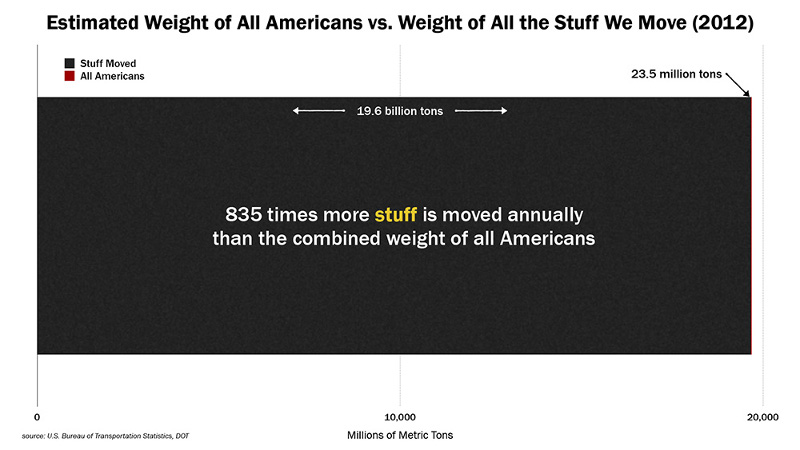
Even assuming the transition to electric cars goes quickly and smoothly, the transport revolution will fail if we cannot find low-carbon solutions for shipping, freight hauling, and aviation.
Finally there is the question of supplies of ores and metals, especially lithium for batteries. Many analysts expect demand for lithium to double or triple by 2030, even with more recycling. Just since 2015, the cost of lithium has more than doubled, which has led to increased EV production costs. There’s little risk of the world’s lithium resources being exhausted any time soon; however, as with all mineral resources, we are harvesting the low-hanging fruit (i.e., the most concentrated ores) first. The real danger is that the rate of extraction for lithium won’t keep up with soaring demand. Argonne National Laboratory reports that, “Known lithium reserves could meet world demand to 2050.” But that’s only a little over three decades from now. By 2050 the auto industry will have nearly finished building its first full fleet of EVs—assuming the easy transition scenario. Presumably batteries for the following generation of cars, if there is one, will rely on other, more abundant chemical elements.
Wild Card: The Economy
As we’ve seen, a great deal hinges on the questions of investment and profitability—the success of carmakers, the build-out of charging stations, and the growth of the electric power industry so it can charge the world’s massive future EV fleet (while also switching to low-carbon energy sources). Indeed, the health of the world’s banking and financial sector may be even more important to the success of EVs than the development of better batteries. So, while the subject might seem tangential, it’s fair to consider whether financial markets are headed for many years of smooth sailing, or toward a “correction,” perhaps on the scale of 2008 or worse.
I don’t propose to make a specific or detailed economic forecast; that’s the job of financial analyst—who usually get it wrong in any case. Everyone agrees that—following the global financial crisis of 2008 and subsequent years of massive deficit spending, quantitative easing, and zero interest rate policy (ZIRP)—we’re now enjoying one of the longest uninterrupted recoveries since World War II (tepid and unequal though it may be). However, the political and economic situation in Italy has many observers worried. George Soros is warning of a major financial crisis stemming from the “existential” euro dilemma; other economic observers are concerned about rising interest rates and new U.S. tariffs on products from China, Europe, Mexico, and Canada. Still another issue is the enormous current debt bubble based on subprime auto loans. Again, I have no idea whether we do in fact face an imminent economic Armageddon. But no boom lasts forever, and a cyclical downturn of the economy is inevitable. To plan as though no such thing could occur seems at least as foolish as to pretend to know the exact timing and magnitude of a coming crash.
Recent experience suggests that the auto industry may be highly vulnerable to even a brief bout of economic contraction. In 2008 the U.S. economy nearly lost General Motors and Chrysler. Instead, these giant companies downsized and consolidated, and were partly bailed out by taxpayers (the loans were later mostly repaid). But, in the process, the Mercury, Oldsmobile, Pontiac, Hummer, and Plymouth brands disappeared. Chrysler was absorbed by the Italian automaker Fiat. Imagine the possible consequences of a similar downturn today, a decade later. Would Tesla survive? Would Fiat-Chrysler continue making an EV model on which the company loses $20,000 with each unit sold?
Perhaps Chinese carmakers would be more resilient than American ones in the face of a global recession, because the Chinese government more actively manages the country’s powerhouse economy and could easily bail out a seriously ailing auto industry. However, some argue that China’s economy is actually quite fragile and corrupt. Even though the Chinese government is in the habit of propping up unprofitable enterprises, in a cascading financial meltdown it might be unable to continue doing so.
In short, while the happy EV transition story assumes no recurrence of global financial turmoil, the real world may not be so kind.
In addition to crippling the EV transition, another financial crash might also wipe out the mostly unprofitable U.S. fracking industry, thus reducing world oil output. This might increase demand for EVs, but it would also likely impact the overall economy, leaving us approximately in the dreary place that peak oil analysts warned about a decade ago. Except that we might find the culprit to be not just geological limits; rather, both the oil industry and our car-centric way of life—whether petro-powered or electric—might turn out to be just as vulnerable to fluctuations in the world of finance.
Beyond EVs: We Can Do Better than Cars
Modern industrial society is in the early stages of two historically pivotal shifts—from internal combustion engines to battery-powered electric motors, and from fossil fuel-sourced electrical power to low-carbon sources. If these shifts are successful, then we may have a shot at addressing a panoply of converging ecological crises including not just climate change, but also species extinctions, toxic pollution, and resource depletion. If these shifts fail, then the whole scaffolding of modern industrial society could come unglued. Either way, the auto industry can’t continue in its current configuration. If it cannot transform itself, it will eventually disappear.
This brings us to the mostly unspoken tragedy at the heart of our transport dilemma. That is the fact that hundreds of millions of people worldwide have no alternative to the automobile. For decades, sustainable transport experts have pointed out that cars are inherently inefficient (so much metal, glass, and plastic needed to transport what is usually a single occupant); that highways destroy landscapes and neighborhoods; and that people are happier in communities that are walkable and bikable, and that have robust public transit systems.
Some countries and cities have followed these experts’ recommendations. But for most of America, the car is still king. There is often no other practical means of getting to work, to the store, or to school.
For suburban Americans, the EV is an imperfect, hopefully temporary workaround to this conundrum. If those of us who live in car-centric regions want to contribute to the energy transition, the first thing we should do is to work to reduce our community’s prioritization of automobile transportation in planning and investment, and push for public transit and people-centered neighborhoods (with attendant shifts in land use, building codes, and zoning). As an afterthought, there’s a good argument to be made for electric cars, and for making the EV transition now rather than waiting for the perfect car to arrive. If my experience with the Nissan Leaf is any indication, there’s little reason, from a driver’s point of view, not to do so.
144 Comments on "Richard Heinberg: Electric Cars to the Rescue?"
Davy on Fri, 22nd Jun 2018 12:32 pm
mm, you just gave me an empty comment. Please reference titles, links, and associated content supporting your assertion. GEEZE, kids.
GregT on Fri, 22nd Jun 2018 12:33 pm
“The global population is growing by more than 80 million people and to stop this we need unprecedented human suffering.”
Not to mention ~6.6 billion humans in excess of the Earth’s environmental carrying capacity. The longer this drags on, tragically, the more suffering there will be.
MASTERMIND on Fri, 22nd Jun 2018 12:34 pm
Davy
Thanks antius for lying..and backing it up with zero evidence..you question everything and make excuses when I post anything..But when Antius just spews some lie without any evidence..you say ‘thank you sir”..You have shit for brains davy..you no different than clogg..Your days are numbered you dumb fucking little certain pussy. Your whole is going to turn upside down..
MASTERMIND on Fri, 22nd Jun 2018 12:38 pm
Davy
You have an empty brain..
GregT on Fri, 22nd Jun 2018 12:40 pm
IMA,
No amount of alternate energy production is going to solve the predicament of human population overshoot, which in of itself, is the result of a surplus of energy.
MASTERMIND on Fri, 22nd Jun 2018 12:44 pm
Im going back to OFW..Where only the bright minds survive..None of these old crusty and ignorant neckbeared Nazi scum bags..
When shit hits the fans in a few years..You will remember MM! Cause i’ll be laughing my head off when your burning in hell!
LMFAO!
MASTERMIND on Fri, 22nd Jun 2018 12:52 pm
They will do everything they possibly can trying to fend off another 2008 moment — they will print and stimulate and bail and loan…. they will use every bullet in the box … they will throw the empty gun at this — then their will rip off the kitchen sink and throw it too. I guarantee you they will do ‘whatever it takes’ to hold this moment off for as long as possible.
But the moment will arrive — that is guaranteed.
And when it does there will be nothing left to throw. Global trade will completely stop — factories will close — spare parts to run the system will not be available — all energy sources will cease to operate — refineries will shut down — oil rigs will go offline — everything – and I mean everything will stop on a dime.
Than the shops will be looted and emptied — the electricity will go off… the violence and disease and suffering and starvation will follow.
And you will be dead – I will be dead – and the central bankers will be dead..
https://imgur.com/a/pYxKa
MASTERMIND on Fri, 22nd Jun 2018 12:55 pm
Financial catastrophe resulting from resource depletion and a debasement of value of fiat currencies. Then a 12-month window of tyranny and government lockdown on citizens, followed by a 6-month window of absolute carnage and death. Then, a period of about 6 months of slow die-off and that’s pretty much that. Oh, and starting sometime within the next 5 years or so…
https://imgur.com/a/pYxKa
https://imgur.com/a/rBtIrfg
GregT on Fri, 22nd Jun 2018 12:57 pm
“And you will be dead – I will be dead – and the central bankers will be dead..”
Obviously you aren’t addressing the people who’s descendants will make up the ~4 billion people that the LTG model predicts will still be alive in 2100.
You could be correct. Perhaps none of them own computers.
GregT on Fri, 22nd Jun 2018 12:59 pm
“Then a 12-month window of tyranny and government lockdown on citizens, followed by a 6-month window of absolute carnage and death.”
I would be moving to a country that doesn’t have the ability to lock down it’s citizens if I was you MM.
That doesn’t sound like much fun to me.
GregT on Fri, 22nd Jun 2018 1:11 pm
“Then a 12-month window of tyranny and government lockdown on citizens, followed by a 6-month window of absolute carnage and death. Then, a period of about 6 months of slow die-off and that’s pretty much that. Oh, and starting sometime within the next 5 years or so…”
So 5 years (or so) plus 12 months, plus 6 months, plus another 6 months. Hmmm, 7 years from now (or so), global mass extinction.
And to think that you call Guy McPherson a whack job. News flash MM. Dr. McPherson has nothing on you in the whack job department son.
Cloggie on Fri, 22nd Jun 2018 1:13 pm
“Im going back to OFW..Where only the bright minds survive..None of these old crusty and ignorant neckbeared Nazi scum bags..”
…only to return under yet another nick. It doesn’t make sense for apneaman/millimind to post his anti-white messages if his posts can be related to his tribal identity.
Nevertheless, bye-bye millimind. Mind the step on your way out. You lost.
MASTERMIND on Fri, 22nd Jun 2018 2:20 pm
Greg
I will admit the collapse I hypothesized does sound extreme and fast..But a collapse by definition is fast..A slow collapse is an oxymoron..An example of a collapse would be the world trade centers coming down..I doubt before that happened anyone could have thought they could be turned to rubble that quickly either..And like I told Davy before..The global economy has been falling for over four decades straight..So if you connect the last four decades to the upcoming one I am predicting, that would mean the collapse took half a century to occur..And that is not so impossible to imagine..The only wild card that is left or possible black swan is a major war of some sort breaking out..
https://imgur.com/a/pYxKa
Davy on Fri, 22nd Jun 2018 2:32 pm
“A slow collapse is an oxymoron.”
you contradict yourself here:
“The global economy has been falling for over four decades straight.”
Collapse is a process hence elements of time. It has locus so place and places are factors. It has scale of degree and duration. It has levels of abstract and physical. It has convergence both positive and negative. It is natural and human. Collapse is all over the place mm. Get a grip on that. Maybe it will be total and soon but maybe not. No one here knows this especially not a dumb kid like you who thinks he does.
MASTERMIND on Fri, 22nd Jun 2018 2:47 pm
Davy
Asserting nobody knows what lies ahead..Is just your pathetic thought stopping technique..
And I am not some kid..I am a young man..You are the one who is old and out of touch..Its your generation that still buys Itunes giftcards. And gets scammed over the phone to pay their taxes..LOL
I showed you an email from a professor on energy economics..Who agreed with me..End of story..
GregT on Fri, 22nd Jun 2018 2:49 pm
“..But a collapse by definition is fast..”
“So if you connect the last four decades to the upcoming one I am predicting, that would mean the collapse took half a century to occur.”
Collapse is a process MM, and the speed at which something collapses is relative to the observer’s perspective of time.
For example, many of the ocean’s fisheries have collapsed over the past century. That does not mean that there no longer remains any fish, and the process of fisheries collapse has occurred over an entire century.
GregT on Fri, 22nd Jun 2018 3:00 pm
MM,
You have presented your opinion, and by now I am sure there isn’t a single forum member that does not fully understand what that opinion is. I would also posit that there isn’t a single person here that fully agrees with your opinion either.
At this point in time, all you are doing is attempting to ram your opinion down other peoples’ throats. This reflects very poorly on yourself, and is a complete waste of your time as well as everybody else’s.
onlooker on Fri, 22nd Jun 2018 3:22 pm
Also, MM is unfamiliar with the concept of catabolic collapse taken from bodily processes and made analogous to collapse of civilization by JMG. A fairly slow descent into smaller inits and simplicity. See Tainters book on Complex societies and why they fail. Above all some of us have been saying that collapse will be uneven in time and space. Even now compare a country like Sweden with Venezuela and you see that
Cloggie on Fri, 22nd Jun 2018 3:28 pm
“You have presented your opinion, and by now I am sure there isn’t a single forum member that does not fully understand what that opinion is.”
Yep, he wants to rape Taylor Swift, he wants to initiate a nuclear first strike against Russia, he thinks that whitey does not have the right to exist “because we can’t dance” and finally he thinks that peak oil is next year and that directly after that event, the industrial world will fall of an energy supply cliff and everybody is going to eat his babies. Oh yes, and right-wingers are “neckbeards”
Boy, are we going to miss millimind!
Not really, that was a joke. My fear is that we will be stuck with him forever though.
MASTERMIND on Fri, 22nd Jun 2018 3:41 pm
Onlooker
JMG runs a spirituality and Astrology blog now..He just argues a slow collapse to sell his books..A collapse profiteer..
Oh and you mention Tainters book..Here is my favorite part,
“Humans are very good at propping up the unsustainable, and this often leads to a fast and unexpected collapse” (Tainter 88)
This isn’t checkers son, this is chess, and you are playing with a master! No pun intended! LOL
MASTERMIND on Fri, 22nd Jun 2018 3:43 pm
Greg
Comparing fisheries collapse to the collapse of global civilization, is a false equivalency..
Now run along before your cell phone starts recording you..
LMFAO!
Antius on Fri, 22nd Jun 2018 3:47 pm
“If 11.5MJ of mechanical power are needed to travel 40km and heat is converted to motion with 10% efficiency, then a tank containing 34kg of hot water would be sufficient to power the car 40km”
I made a mistake earlier. It would actually take 340 litres of hot water to travel 40km. So 60km would be about the limit of range for a solar hot water powered car-sized vehicle.
A 60km range is far enough to be useful for a large portion of journeys. 60km is about the distance between central Amsterdam and The Hague in Cloggie’s Netherlands. But the need to refill with hot water limits it to journeys that take it past a solar thermal heat store. Ideally, this technology would be used for transport between towns. One could imagine building a solar thermal collector plant between them and refilling a bus with perhaps a few tonnes of hot water on each leg of the journey.
Given that hot water can be stored in insulated tanks for long periods, heat gathered in the summer can power the bus all year round. An interesting thought experiment.
Antius on Fri, 22nd Jun 2018 4:02 pm
“You have presented your opinion, and by now I am sure there isn’t a single forum member that does not fully understand what that opinion is. I would also posit that there isn’t a single person here that fully agrees with your opinion either.”
Yeah. The man needs a good dose of Zyklon B. Listening to his anti-white rants on this board has been an education for me, so I do owe him a debt of sorts. Under the cloak of anonymity, he reveals all the fanaticism, spite and manipulation that his people are famous for. He actively cheers the downfall of western civilization and dreams of mass murder of the white nations that have given his people so much. He optimises all of the traits that have led to his people being distrusted, feared and loathed for centuries. A bad egg.
GregT on Fri, 22nd Jun 2018 4:10 pm
“Comparing fisheries collapse to the collapse of global civilization, is a false equivalency”
From the perspective of a historian 2,000,000 years into the future, both would have occurred in a mere blip in time. From the perspective of someone born in 1900, both would have taken longer than an entire lifetime.
And I would agree MM, the collapse of global civilization is not an existential threat to humanity, the complete collapse of global fisheries would be.
MASTERMIND on Fri, 22nd Jun 2018 4:14 pm
How the US has prepared for nuclear Armageddon – in pictures
https://www.theguardian.com/us-news/gallery/2018/jun/22/nuclear-armageddon-us-preparations-doomsday-war-in-pictures
onlooker on Fri, 22nd Jun 2018 4:23 pm
Seems to me a slow collapse doesn’t sell as well as a fast collapse. Or is he selling Tarot
Cards. As for time frames well who really is to say but you missed the two points of Greg and I. It is a process not an event and its uneven ie. experienced with different degrees of intensity depending on time and place \Here: https://www.youtube.com/watch?v=VPksusPiDdU
MASTERMIND on Fri, 22nd Jun 2018 4:37 pm
Rule of law ‘virtually absent’ in Venezuela, UN report says
Government forces carry out killings with impunity. ‘Credible, shocking’ reports of unlawful killings of young men.
https://www.theguardian.com/world/2018/jun/22/venezuela-rule-of-law-virtually-absent-un-report?CMP=twt_gu
Coming to a world near you!
onlooker on Fri, 22nd Jun 2018 4:39 pm
To illustrate my point both Makati and Davy are right: PHIL is in the heart of a very overpopulated area of Asia especially relative to some key resources ie water thus food and oil plus poor infrastructure leaves this area vulnerable to pandemic and natural calamities. Plus they are poor
On the other hand US is also vulnerable due to overreliance on FF energy, a crumbling social edifice, a sickly and relatively helpless population. So depending on Geopolitics along with depletion rates of some resources and economic fortunes along with other unforeseen things one or the other area may experience utter disaster sooner or later
MASTERMIND on Fri, 22nd Jun 2018 4:44 pm
“If you’re wondering about the silence from the U.S. government and media on peak oil, it’s probably because they’re afraid acknowledging it would cause stock markets to crash world-wide. Congress is certainly aware of the problem (see the senate and house hearings here). If preparation is being made, it’s being done in top secret departments of homeland security and the military (i.e. rationing, refugee camps to stop mass migrations overwhelming areas that are still ecologically viable, etc).”
http://energyskeptic.com/2017/german-military-peak-oil-summary/
Secrets Secrets are no fun..haha
Cloggie on Fri, 22nd Jun 2018 4:46 pm
“Rule of law ‘virtually absent’ in Venezuela, UN report says
Government forces carry out killings with impunity. ‘Credible, shocking’ reports of unlawful killings of young men.”
Leave it to lefties to thoroughly destroy a country. China, Russia, North-Korea, Cambodja, you name it. Some charismatic socialist began to nationalize the economy. Now most production has come to a stand-still. Has nothing to do with “peak oil”, but everything with letting loons at the levers of power.
MASTERMIND on Fri, 22nd Jun 2018 4:53 pm
U.N. report: With 40M in poverty, U.S. most unequal developed nation
https://www.upi.com/Top_News/US/2018/06/22/UN-report-With-40M-in-poverty-US-most-unequal-developed-nation/8671529664548/
When the rich can’t get more by producing real wealth they start to use their power to take from lower segments.
-Dennis Meadows
MASTERMIND on Fri, 22nd Jun 2018 4:58 pm
Clogg
Venezuela is not socialist..You don’t understand what socialism means..Because you have never read Marx’s work..And Detroit, Greece, Puerto Rico are in the same shape and they are capitalist..
Peak oil in Venezuela: El Furrial oil field
http://crudeoilpeak.info/peak-oil-in-venezuela-el-furrial-oil-field
Looks like the data says they peaked..And the US has hammered them with sanctions to purposely try to destroy them..
You are a globalist cuck clog..
MASTERMIND on Fri, 22nd Jun 2018 5:00 pm
Clog
Just wait til the rule of law is gone in your country..I hope you have extra batteries for your wal mart scooter, you fat tub o lard..
LMFAO!
onlooker on Fri, 22nd Jun 2018 5:02 pm
That is why the socialist scandinavian countries are such a basket case Clog right?
The usual suspects: Overpopulation, Hard to exploit energy resource ie. Venezuelan tar sands. meddling/exploitation by the rich countries (the local ruling elites implicated)
and droughts are becoming a problem
onlooker on Fri, 22nd Jun 2018 5:05 pm
I hope you have extra batteries for your wal mart scooter, you fat tub o lard..
haha kind of funny
onlooker on Fri, 22nd Jun 2018 5:08 pm
When the rich can’t get more by producing real wealth they start to use their power to take from lower segments.
-Dennis Meadows
MM not much more they can take from 3 billion or so, so we are all that is left
Cloggie on Fri, 22nd Jun 2018 5:10 pm
“Venezuela is not socialist..You don’t understand what socialism means..Because you have never read Marx’s work”
Even your buddies ar the Beep do not refer to “peak oil” in order to “explain Venezuela”. It had everything to do with interfering with the market, by imposing price controls, driving producers out of business, causing lack of elementairy means of living.
https://www.bbc.com/news/world-latin-america-36319877
Cloggie on Fri, 22nd Jun 2018 5:18 pm
“That is why the socialist scandinavian countries are such a basket case Clog right?”
They are not socialist, but capitalist with relatively high personal tax levels. Absolutely not socialist. Free enterprise rules in Scandinavia.
https://taxfoundation.org/how-scandinavian-countries-pay-their-government-spending/
While Scandinavian countries raise a lot of revenue from individuals through the income tax, payroll taxes, and the Value-added tax, they don’t really raise much more revenue than the United States from capital and business taxes and don’t have much higher marginal rates on capital income. In fact, their marginal corporate income tax rates are much more competitive than the United States’ rate.
Scandinavian countries are corporate tax heavens.
“Socialist”, my foot.
onlooker on Fri, 22nd Jun 2018 5:30 pm
Think again Clog
They are welfare states with extensive public ownership , centralized control of large industries like the healthcare and education
http://mattbruenig.com/2017/07/28/nordic-socialism-is-realer-than-you-think/
Cloggie on Fri, 22nd Jun 2018 5:35 pm
healthcare and education are not “industries”, but almost everywhere government-run, since these “industries” by nature make no profit.
onlooker on Fri, 22nd Jun 2018 5:37 pm
No profit haha US healthcare is swimming in it
MASTERMIND on Fri, 22nd Jun 2018 5:39 pm
Is socialism to blame for Venezuela’s never-ending crisis?
First, it is important to realise that Chavez chose to call his transformative project “21st-century socialism”, but Venezuela’s economy remained market-based and private-sector dominated throughout his time in office. the private sector was expected to remain dominant, and it did.
A centrally planned socialist economy like Cuba’s was neither the aim nor the reality.
https://www.aljazeera.com/indepth/opinion/socialism-blame-venezuelas-crisis-180530095418091.html
We get it clog you love Globalism ie Capitalism..You are a globalism cock sucker that is why you love Putin and Trump so much..
MASTERMIND on Fri, 22nd Jun 2018 5:40 pm
Clogg
There are no socialist countries existing today. Socialism is not when the government does stuff. Socialism is the process of putting the means of production into the hands of the workers and social ownership of that property. The reason it doesn’t work in modern countries is because the US doesn’t want it to work. Why? Who knows. Could be fear of revolution. The point is; socialism is very often misinterpreted as something it isn’t. Canada isn’t socialist, Norway isn’t socialist, Venezuela isn’t socialist, the USSR wasn’t socialist(it was state capitalism). The only example of Socialism was France immediately after the revolution..
Davy on Fri, 22nd Jun 2018 5:41 pm
Scandinavian counties are hybrid socialist/capitalist. This is something that can be done in these kind of places. Small, wealthy, and educated makes this possible.
MASTERMIND on Fri, 22nd Jun 2018 5:42 pm
Alex Jones: The Pentagon has “weaponized perfumes” that make men gay to prevent them from having kids
https://www.mediamatters.org/video/2018/06/22/alex-jones-pentagon-has-weaponized-perfumes-make-men-gay-prevent-them-having-kids/220524
This is who clog listens to..Another paranoid whack job like Greg and madkat..the whole world is going batshit insane more and more everyday..
MASTERMIND on Fri, 22nd Jun 2018 5:44 pm
Davy
Read my comment above..And next time before you put your foot in your mount..make sure you actually do some research..I know its hard to teach old dogs new tricks though..
onlooker on Fri, 22nd Jun 2018 5:45 pm
Davy is totally. And Clog you cannot have your cake and eat it too. Globalized Capitalism is NWO. That boat already sailed
onlooker on Fri, 22nd Jun 2018 5:45 pm
Davy is totally right
Davy on Fri, 22nd Jun 2018 5:47 pm
Mm, I don’t read your comments unless you address them to me. What is your question?
onlooker on Fri, 22nd Jun 2018 6:02 pm
Oh and Clog in modern countries I would think based on manpower employed and resources used, both healthcare and education would be considered industries albeit heavily subsidized ones