
Peak Oil is You

Donate Bitcoins ;-) or Paypal :-)


Page added on June 21, 2018

Richard Heinberg: Electric Cars to the Rescue?

My wife Janet and I recently bought a used Nissan Leaf from a friend. We are now proud electric vehicle (EV) owners, and we love our plug-in, battery-powered car: some days we almost fight over who gets to drive it. If this essay were a consumer review, it would glow in the dark. The car is quiet, built solidly, cheap to operate, problem free, and nearly guilt free.
But a testimonial is not what I have in mind. I now have a personal stake in the EV transport revolution, which is key to the post-hydrocarbon energy transition, which in turn is key to collectively surviving climate change and oil depletion. A lot of hope is riding on the wheels of the world’s three million electric cars. So, how’s the EV revolution going? And even if it’s going well, is it really the best strategy? Those are the questions I want to address here. And, as one might expect, the evidence is open to widely varying interpretations.
The Boosters: EVs Are the Future!
Owner satisfaction for EVs is generally high. That’s partly because the overwhelming majority of buyers (so far) have been motivated by environmental concerns. And in this department electric cars deliver: even if the electricity to charge an EV’s battery comes from a typical combination of coal, natural gas, and hydro sources, the high efficiency of its electric motor means that its full lifecycle carbon emissions will likely be lower than those from a conventional gasoline-burning internal combustion engine. Add some rooftop solar panels, and seriously low-carbon personal transport is within reach.
Moreover, the appeal of EVs is gradually extending beyond the eco-hip. A recent AAA survey found that 20 percent of Americans want their next vehicle to be an electric car. Among millennials, the proportion is much higher.
For the past few years, automakers have seen the handwriting on the wall. Even if some governments (such as the Trump administration) eschew climate policy, existing international emissions reduction commitments mean that, over the long haul, there will be incentives for low-carbon transport options and disincentives for gas guzzlers. Many states and nations already offer significant subsidies to EV purchasers and some have passed legislation to ban sales of new internal combustion engines altogether (though in most cases these won’t go into effect for decades). Automakers are also aware that, while world oil production has been bolstered recently by a glut of U.S. fracked shale oil, the longer-term prospects for the global petroleum industry are dismal. Therefore some alternative to petroleum-powered transport is needed.
As a result of this analysis, automakers have begun retooling, and have many new EV models in the pipeline. The Chinese auto industry, which has been growing by leaps and bounds in recent years, is committed to producing more EVs as a way for the nation to curb the horrific pollution from its burgeoning traffic and coal power plants (the nation’s long-term energy plan also entails a transition to renewables and nuclear power). The Volvo car company, now owned by the Chinese car company Geely, announced last year that starting in 2019 it will phase out conventional gasoline and diesel engines altogether in favor of hybrids and EVs.
Batteries, which represent about half the manufacturing cost of a typical EV, are getting cheaper and better. According to a recent Bloomberg New Energy Finance (BNEF) report, electric vehicles will be less expensive than comparable conventional cars in just five years. Meanwhile, battery range (which has been the bane of EVs since the dawn of the automobile age) is increasing rapidly. The range of my 2013 Nissan Leaf, which represents the first generation of mass produced modern EVs, is a mere 80 miles; as a result, I can’t practically use it for occasional long trips. But more expensive and newer electric cars do better in this department (the current Tesla Model S will travel up to 337 miles on a charge, while the 2018 Chevy Bolt hatchback can go a maximum 238 miles).
BNEF expects electric car sales to top 1.6 million in 2018, expanding to 11 million annually by 2025 and 30 million by 2030. By 2040, it anticipates that more than half of all light vehicles (sedans, pickup trucks, SUVs) sold will be EVs, and China will dominate the market.
For the time being, though, Norway—ironically, an oil-exporting nation—has the highest growth rates and highest market penetration of EVs in the world. This is due to the world’s most generous tax breaks and incentives (including free city tolls and parking), along with heavy taxes on diesel and gasoline engines.
All of the above serves to bolster what might be called the happy, easy EV transition story. In this story, EVs will grow rapidly in market share, helping to electrify society’s energy usage. At the same time, low-carbon energy sources (including solar and wind) will replace coal and natural gas for power generation. Oil demand will decline before geology and economics force a peak of production (according to BNEF, the penetration of EVs into the light-duty vehicle market will reduce oil demand by 7.3 million barrels per day by 2040, or roughly 8 percent of today’s demand). Even if the oil business eventually fails as a result of the depletion of non-renewable petroleum, it will do so at a point when we don’t really need the stuff anyway. In this story, the auto industry survives, we survive, and all is well.
The Critics: EVs Are Too Little, Too Late!
However, all observers are not convinced.
While EVs are catching on, some argue, they are doing so too slowly to make much of a difference anytime soon. That’s because it will take decades to change out the global fleet of light vehicles, each of which stays on the road for an average of 20 years. Even when over half of all light vehicles being sold are EVs, perhaps by 2040, the overwhelming majority of the world’s existing cars will still be petro-burners. Thus it will take time for the trend toward EVs to result in a corresponding decline in oil consumption, especially if the number of cars on the road—like global population—continues to rise. One gauge of this delay is the fact that Norway only began to see a fall in oil consumption in 2017, years after implementing the world’s most vigorous pro-EV policies.
Batteries are improving in terms of both cost and performance, but those improvements will have to accelerate in order for rosy EV projections to materialize. So far, car companies are banking on lithium-ion batteries—but even Tesla founder Elon Musk has said that the ultimate price/performance potential for this technology may soon be reached. Other battery technologies are being researched, but starting from scratch with a different set of elements will entail an R&D learning curve and a build-out of manufacturing capacity that could take another couple of decades.
With current battery technology, EVs are more expensive than comparable gasoline-powered cars. This persistent fact, in combination with rapid technology shifts and many governments’ and carmakers’ efforts to increase EV market penetration, has created some bizarre pricing realities. While EV owners like their vehicles, the resale value of electric cars is abysmal: many five-year-old Leafs, which cost $30,000 new, sell for less than $10,000. This is partly because buyers want the latest battery technology, and partly because they don’t want to purchase a car with batteries that are already somewhat degraded. Given the steep depreciation of new EVs, most would-be buyers end up leasing cars. But even leases are now being steeply discounted: BMW has recently been leasing its model i3 plug-in car, which sells for $50,000, for a mere $54 a month.
It’s no wonder, therefore, that carmakers have a tough time making a profit on EVs. Reportedly, Fiat loses $20,000 on each model 500e it sells. And according to credit agency Moody’s, overall returns on auto industry investments in EVs are likely to remain elusive until the 2020s.
So, while many automakers are beginning to bet their futures on EV technology, they are stuck with the fact that they must make a profit in the meantime to stay in business. While car companies in Europe and China are preparing to switch entirely to electrics and hybrids, Ford in the U.S. is discontinuing production of nearly all its sedans—including its Focus electric—and shifting toward an all-SUV and truck lineup, simply because these larger (and thus inherently less efficient) vehicles generate more profit. Of course, it’s possible that some of Ford’s SUVs and trucks will eventually be electric. But if EVs are generally less financially rewarding to manufacture and market than gasoline-burners, other carmakers may eventually be forced to make decisions as drastic (and some would say perverse) as Ford’s.
There is no marque more emblematic of EV potentials and problems than Tesla. Driven by a compelling vision and a passion for quality, Elon Musk has managed to do what most industry observers thought impossible—start a large-scale car company from scratch. Naturally, this effort has required massive investment. Tesla now has a market valuation of $46 billion—compared to $54 billion for GM and $45 billion for Ford. Yet Tesla so far has made cars that are affordable only to an upscale niche market, (it sold only 50,000 cars last year); meanwhile, its entry-level Model 3, intended for the masses, is largely stalled. Although Musk promised a $35,000 price point for the car, so far only versions heavily weighted with expensive options—and thus selling for $50,000 or more—have been delivered. That’s presumably because Tesla hasn’t yet figured out how to make a no-frills Model 3 profitably. If the company doesn’t sort that problem out soon, investors may head for the exits.
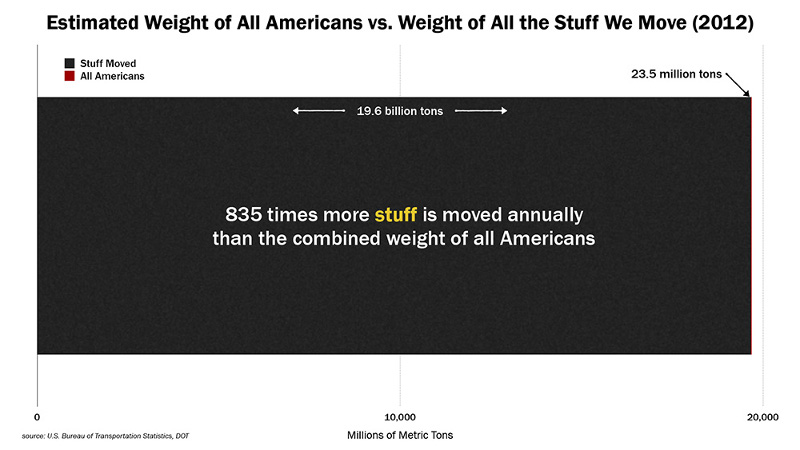
While EVs are a first step in electrifying transport, further steps need to be considered. We transport goods, including food (the weight of which exceeds the weight of people moved in cars by 800 times) with trucks, ships, trains, and airplanes, and these transport modes (with the partial exception of rail) will be a challenge to electrify: batteries would be extraordinarily and often prohibitively heavy.
Even assuming the transition to electric cars goes quickly and smoothly, the transport revolution will fail if we cannot find low-carbon solutions for shipping, freight hauling, and aviation.
Finally there is the question of supplies of ores and metals, especially lithium for batteries. Many analysts expect demand for lithium to double or triple by 2030, even with more recycling. Just since 2015, the cost of lithium has more than doubled, which has led to increased EV production costs. There’s little risk of the world’s lithium resources being exhausted any time soon; however, as with all mineral resources, we are harvesting the low-hanging fruit (i.e., the most concentrated ores) first. The real danger is that the rate of extraction for lithium won’t keep up with soaring demand. Argonne National Laboratory reports that, “Known lithium reserves could meet world demand to 2050.” But that’s only a little over three decades from now. By 2050 the auto industry will have nearly finished building its first full fleet of EVs—assuming the easy transition scenario. Presumably batteries for the following generation of cars, if there is one, will rely on other, more abundant chemical elements.
Wild Card: The Economy
As we’ve seen, a great deal hinges on the questions of investment and profitability—the success of carmakers, the build-out of charging stations, and the growth of the electric power industry so it can charge the world’s massive future EV fleet (while also switching to low-carbon energy sources). Indeed, the health of the world’s banking and financial sector may be even more important to the success of EVs than the development of better batteries. So, while the subject might seem tangential, it’s fair to consider whether financial markets are headed for many years of smooth sailing, or toward a “correction,” perhaps on the scale of 2008 or worse.
I don’t propose to make a specific or detailed economic forecast; that’s the job of financial analyst—who usually get it wrong in any case. Everyone agrees that—following the global financial crisis of 2008 and subsequent years of massive deficit spending, quantitative easing, and zero interest rate policy (ZIRP)—we’re now enjoying one of the longest uninterrupted recoveries since World War II (tepid and unequal though it may be). However, the political and economic situation in Italy has many observers worried. George Soros is warning of a major financial crisis stemming from the “existential” euro dilemma; other economic observers are concerned about rising interest rates and new U.S. tariffs on products from China, Europe, Mexico, and Canada. Still another issue is the enormous current debt bubble based on subprime auto loans. Again, I have no idea whether we do in fact face an imminent economic Armageddon. But no boom lasts forever, and a cyclical downturn of the economy is inevitable. To plan as though no such thing could occur seems at least as foolish as to pretend to know the exact timing and magnitude of a coming crash.
Recent experience suggests that the auto industry may be highly vulnerable to even a brief bout of economic contraction. In 2008 the U.S. economy nearly lost General Motors and Chrysler. Instead, these giant companies downsized and consolidated, and were partly bailed out by taxpayers (the loans were later mostly repaid). But, in the process, the Mercury, Oldsmobile, Pontiac, Hummer, and Plymouth brands disappeared. Chrysler was absorbed by the Italian automaker Fiat. Imagine the possible consequences of a similar downturn today, a decade later. Would Tesla survive? Would Fiat-Chrysler continue making an EV model on which the company loses $20,000 with each unit sold?
Perhaps Chinese carmakers would be more resilient than American ones in the face of a global recession, because the Chinese government more actively manages the country’s powerhouse economy and could easily bail out a seriously ailing auto industry. However, some argue that China’s economy is actually quite fragile and corrupt. Even though the Chinese government is in the habit of propping up unprofitable enterprises, in a cascading financial meltdown it might be unable to continue doing so.
In short, while the happy EV transition story assumes no recurrence of global financial turmoil, the real world may not be so kind.
In addition to crippling the EV transition, another financial crash might also wipe out the mostly unprofitable U.S. fracking industry, thus reducing world oil output. This might increase demand for EVs, but it would also likely impact the overall economy, leaving us approximately in the dreary place that peak oil analysts warned about a decade ago. Except that we might find the culprit to be not just geological limits; rather, both the oil industry and our car-centric way of life—whether petro-powered or electric—might turn out to be just as vulnerable to fluctuations in the world of finance.
Beyond EVs: We Can Do Better than Cars
Modern industrial society is in the early stages of two historically pivotal shifts—from internal combustion engines to battery-powered electric motors, and from fossil fuel-sourced electrical power to low-carbon sources. If these shifts are successful, then we may have a shot at addressing a panoply of converging ecological crises including not just climate change, but also species extinctions, toxic pollution, and resource depletion. If these shifts fail, then the whole scaffolding of modern industrial society could come unglued. Either way, the auto industry can’t continue in its current configuration. If it cannot transform itself, it will eventually disappear.
This brings us to the mostly unspoken tragedy at the heart of our transport dilemma. That is the fact that hundreds of millions of people worldwide have no alternative to the automobile. For decades, sustainable transport experts have pointed out that cars are inherently inefficient (so much metal, glass, and plastic needed to transport what is usually a single occupant); that highways destroy landscapes and neighborhoods; and that people are happier in communities that are walkable and bikable, and that have robust public transit systems.
Some countries and cities have followed these experts’ recommendations. But for most of America, the car is still king. There is often no other practical means of getting to work, to the store, or to school.
For suburban Americans, the EV is an imperfect, hopefully temporary workaround to this conundrum. If those of us who live in car-centric regions want to contribute to the energy transition, the first thing we should do is to work to reduce our community’s prioritization of automobile transportation in planning and investment, and push for public transit and people-centered neighborhoods (with attendant shifts in land use, building codes, and zoning). As an afterthought, there’s a good argument to be made for electric cars, and for making the EV transition now rather than waiting for the perfect car to arrive. If my experience with the Nissan Leaf is any indication, there’s little reason, from a driver’s point of view, not to do so.
144 Comments on "Richard Heinberg: Electric Cars to the Rescue?"
"Lucifer" on Thu, 21st Jun 2018 8:48 pm
You all might as well give up now, because electric cars, trucks, trains or whatever are not going to save you. All they will do is delay the inevitable, which is most of the human race self destruction.
Kevin Cobley on Thu, 21st Jun 2018 10:30 pm
The only EV that is going to work is Public transit, a road traffic lane can only carry 1200 cars per hour at it’s most efficient speed 20kph. A Mass Transit Metro on the same lane can carry 30,000 passengers per hour at 60-80kph. At 80kph a car occupies 350 sqm of land, cars occupy too much space to ever be an efficient transport system.
“Electric Cars” suffer from the same problems as their oil-fueled counterparts, the resources required to operate them just don’t exist for a billion vehicles.
LetStupidPeopleDie on Thu, 21st Jun 2018 10:35 pm
If the main concern is to save fuel to keep it for important transportation task such as food, agricultural equipment why not use small scooter. The energy needed to build in electrical is too much.
It will easier to force people to use small 50 cc scooter. They are doing in Taiwan and Thailand.
LetStupidPeopleDie on Thu, 21st Jun 2018 10:41 pm
Taiwan scooter informative video.
https://www.youtube.com/watch?v=wllHZUKwSKQ
Dark Fired Tobacco on Fri, 22nd Jun 2018 12:17 am
Oddly, no mention of autonomous vehicles and a connected, shared transport system. Why own a vehicle when you can summon one from your phone, ride to a transfer point near an expressway, take a much large mass transit unit to a similar point, then catch a similar autonomous vehicle to your destination? No more parking lots, personal vehicles idle 95 percent of the time, and few if any accidents.
Makati1 on Fri, 22nd Jun 2018 12:58 am
Dark, you see the solution. It is the one we use here in the Philippines. In the city you go by local bus or taxi to connect with trains or planes o other transport. Where I live there are no taxis but there are motor trikes on call to get you to connections. A car is not necessary and not a real convenience. Just a money pit.
Cloggie on Fri, 22nd Jun 2018 3:35 am
Heinberg is missing the point completely, as DFT already indicated.
Big picture:
Planet: 1 billion cars, driving perhaps 2-3% of the time. Americans drive 293 hours/year = 3.3%, but they are glued to their cars, so the global average is probably lower, let’s for arguments sake say 2.5%. Average occupation rate of a 5-seater sedan: 1.25 (Dutch figure).
What a terrible waste of resources!!!
Now there is a recent game-changing development: everybody and his mother own a location aware smart-phone, able to interact information with a central server and as such express transportation wishes. In return the server can pass information to the user about potential transportation opportunities in his direct surroundings and indicate where the vehicle is that is about to pick you up. Let’s assume a transport system based on vehicles like the Volkswagen-Moya:
https://www.youtube.com/watch?v=cxFRVkMYWOE
Assume an occupation rate of 5 and an on-the-road time of 25%. This would imply that the current transportation performance, realized by a global car fleet of 1 billion, driving on average 2.5% of the time with an occupation rate of 1.25, could be realized by a fleet of 1 billion/(5*10) = 20 million vehicles!!!
A British consultancy has calculated that the per kilometer price would decrase by a factor of 4 for luxury car owners to 10, for Toyota Starlet drivers:
https://deepresource.wordpress.com/2017/05/16/by-2030-you-wont-own-a-car/
Regarding the battery problem: their is none. Recent development from Sweden:
https://deepresource.wordpress.com/2018/05/08/e-road-e-vehicles-breakthrough-in-sweden/
https://deepresource.wordpress.com/2018/06/13/e-road-the-somewhat-different-railroad/
Trains are powered via a catenary for ages now. Why not do the same for cars? All you need to do is screw a conductor to the surface of the road and you’re good. While driving over the main roads, equiped with a conductor the battery of the car is charged, while driving. Only during the last 30 miles or so, the car needs to be powered by the battery. This would result in say a 50 kilo battery, rather than a 400 kilo one.
Transport system of the future: highspeed rail between big cities, autonomous driving cars on the high way, ride-sharing with driver in the cities. IT-systems will guide the passenger through a journey with potentially several legs. The embedded energy in a car fleet of 20 million will be neglegible in comparrison with the current one. Fuel/electricity consumption for private passenger transport would be slashed with a factor of 4-5. It would mean a softlanding of the global car system: maintaining mobility at a fraction of the environmental and financial cost.
Cloggie on Fri, 22nd Jun 2018 3:38 am
“the per kilometer price would decrease by a factor of 4 for luxury car owners to 10, for Toyota Starlet drivers”
It is the other way around.
Simon on Fri, 22nd Jun 2018 3:44 am
Hi Cloggie
I was thinking about your optimistic view, and my 1890’s view.
Have you taken into account the lost tax revenue from oil and car ownership that the Gov. will need to replace. Let alone the benefits now needed by the unemployed taxi drivers.
I believe this would be put on the Autonomous vehicles per Km driven, thus making this not a cheap propostion
Simon
dave thompson on Fri, 22nd Jun 2018 3:51 am
Electric cars are one small transportation vehicle that make zero difference. Liquid FF transportation has no replacement. The idea of transition from FF to some other pie in the sky system is provably false. Just take a look at the amount of FF being consumed year over year world wide. FF consumption only has increased.
Kat C on Fri, 22nd Jun 2018 3:55 am
Heinberg has gone a long way in the wrong direction since he first started writing about peak oil. I recall him saying the best way to cut fuel was to carry another person in your car. Now he is promoting EV’s Among the other faults with his article nowhere does he address the problem of the grid. Already our electric grid is in trouble and to carry extra load for cars means a huge upgrading of the grid is in order. Besides the fuel for that (seen any electric run utility vehicles yet) where is the money? I have become disappointed with Heinberg recently and am more so now.
Cloggie on Fri, 22nd Jun 2018 4:03 am
Have you taken into account the lost tax revenue from oil and car ownership that the Gov. will need to replace. Let alone the benefits now needed by the unemployed taxi drivers.
I believe this would be put on the Autonomous vehicles per Km driven, thus making this not a cheap propostion
You can tax anything: kwh’s from privately owned solar panels, usage of the pavement by pedestrians, farts, being old and still alive, etc., etc. The government is guaranteed to come up with a tax opportunity.
The proposed shared/autonomous driving car system would imply a huge relief of private household budgets. So it would play into the hands of the many doomers here who predict financial collapse. Well, even if that would happen, this transportation system would be one for the apparent immanent Great Depression 2.0.
Makati1 on Fri, 22nd Jun 2018 4:03 am
His “electric” car runs on FFs unless he charges it from solar panels on his roof, which I doubt very much. Even solar panels required oil to be made, and end up on his roof. All other electric comes from FFs in one way or another. Even nuclear.
And, yes, add a 100 million electric cars to the Us electric grid and watch it melt down. That is about 40% of the existing cars in the Us.
Besides, new car sales are dropping like rocks because so are the buyer’s incomes. The whole industry is imploding. Soon they will have to have 10 year financing to sell any.
Antius on Fri, 22nd Jun 2018 4:07 am
Autonomous grid powered vehicles. It could be made to work, but it would require a coordinated and sustained push by governments to build the necessary infrastructure.
It is a mistaken belief that great things can be accomplished by governments that sit by and write strategy papers, leaving the actual investment and development to ‘private industry’. This mind set is part of what has reduced the western world to the sorry state that it is in; the Thatcherite belief that government is there simply to make laws and control borders. That ideal robbed the west, Britain in particular, of much of its industry.
Accomplishing large changes like this requires a critical mass of resources concentrated on specific goals that only governments can muster. Not something that private industry can do unless it is mustered as part of a state project.
Cloggie on Fri, 22nd Jun 2018 4:26 am
Autonomous grid powered vehicles. It could be made to work, but it would require a coordinated and sustained push by governments to build the necessary infrastructure.
Expect Norway, Sweden and hyper-congested Holland come to the rescue:
https://www.metronieuws.nl/techgadgets/2018/01/nederland-het-meest-klaar-voor-zelfrijdende-autos
KPMG: “Netherlands best prepared for self-driving car”.
The Netherlands with 440/km2 is closest to a traffic infarct and something needs to be done. More asphalt is no option. Car-pooling is a well-meant initiative, had some success but never really took off, too restrictive. The self-driving, ride-shared car is THE solution for congestion. Replace 5 cars with one Ford Transit.
Anonymouse1 on Fri, 22nd Jun 2018 5:03 am
Whineberg has long ceased to be a credible …advocate?, if he ever was one to begin with. If anyone had any lingering doubts about his credibility, or even his intelligence, this article stupid should put those to rest.
Kevin is quite right of course, the only EV that actually works, is electric mass transit.
From the horse’s as… mouth.
“As an afterthought, there’s a good argument to be made for electric cars, and for making the EV transition now rather than waiting for the perfect car to arrive. If my experience with the Nissan Leaf is any indication, there’s little reason, from a driver’s point of view, not to do so.”
Actually, there are very few arguments to be made for CARS, period. And afterthought is the right word for it, as whineberg clearly hasn’t given the issue much thought at all. The EV as it currently being promoted, is simply an endorsement, and extension, of the status quo, but with better optics, and generous coat of greenwash to go with it. Its little different that corporate shills that keep insisting natural gas, is a ‘bridge’ fuel to the mythical, ‘clean energy future'(tm). That argument is a facile as it comes, yet whineberg has no problem using this same line of logic by declaring EVs are a bridge car to…….the car-free future?
Sure rick, whatever.
This latest turdfest of an article from him, almost sounds like a paid advertisement. This should not be surprising, as many amerikan corporate ‘faux’ green orgs and individuals alike, like Whineberg here, have given car-dependency their whole-hearted seal of approval.
Davy on Fri, 22nd Jun 2018 6:03 am
I like Heinberg but he is selling optimism to his fold. I have read a Heinberg who has been honest occasionally with the science and said he saw little to point to a future. He is just trying to remain optimistic or maybe he drifts in and out of that stupor.
“The car is quiet, built solidly, cheap to operate, problem free, and nearly guilt free.”
Guilt free??? Cars are what has brought our species to the brink. If we could have had the wisdom to stick with trains and horses like Simon’s 1890 view we might have had a chance. Now we will try to do what theoretically is possible but in reality is likely not. We no longer have the room or the resources to transition to a modern electric culture with renewables and EV’s. Sadly, the alternative of 1890’s is not workable either except maybe some places that shake out from a decline of civilization. It is possible some regions may adapt a hybrid of current modern with a 1890’s technological world. Going all 1890’s with 7BIL plus or all nedermodern with his vision of a renewable civilization and autonomous EV’s is likewise not possible AS-IS. The AS-IS is overshoot with carrying capacity and systematically being near boundaries of bifurcation of economies, networks, and social stability.
“Which is key to the post-hydrocarbon energy transition, which in turn is key to collectively surviving climate change and oil depletion.”
There are no “keys” to transition because it is not possible AS-IS and as-is is what we talk about because the alternative is horrible. To reduce populations to half which is necessary to make something like a transition possible requires millions of deaths over births a year on average for the foreseeable future. It means 1860’s death profiles. This is not only socially unacceptable but economically dubious. How do you grow a civilization and economy reducing population? I don’t think it is systematically possible. It has never been done. Possibly a transition in behavior could occur from a profound crisis but that is a whole other story from the technology. The “key” is behavior and I don’t see wisdom in our species not at the level of population we are at so our current lack of wisdom will end us eventually at least AS-IS, modern and powerful.
“Indeed, the health of the world’s banking and financial sector may be even more important to the success of EVs than the development of better batteries.”
I have been saying this for years now and you see this talk very few places especially here with the cornucopian techno optimist. It is the economy stupid and the economy is near boundaries of failure either partly or the whole ball of wax.
“Beyond EVs: We Can Do Better than Cars”
Yea, but again this is theoretical because we are stuck with cars if you want a modern world. We likely can’t afford a nedermodern world and there are too many people for a Simon world of 1890’s. Behavior is also the problem with a 1890’s Simon world. How many people would give up their comforts or could even if they wanted to? You can’t do this just regionally either, because the whole world has been globalized and resources must be sourced globally. Manufacturing and distribution is global today. It might be the case we can suffer a die down and a technological rationalization to a lower living level. We may hold together a civilized world in some places. This “some places” is a horrible quick decline where some survive. It might also be an extreme arrangement of a few rich cultures and the bulk of the world kept as poor serfs, a white European nederworld as an example. It should be clear to “science honest” people that our current urban arrangements of high population and high consumption will not survive a down turn of any kind. They will have to depopulate. Areas without good local food, water, and energy access and in climate extreme areas will not be maintained. Look at Saudi Arabia to see a place that will depopulate. Cars will be the last thing to go as we go.
Let’s get real and honest with the science pointing to decline from climate change, resource depletion, and consumption/population overshoot. Let’s realize we still have time to create “hospices and lifeboats” to make this decent into a world of lower survivability and lower comforts less painful. We can adapt and mitigate the worst. We can do this locally and in small communities because the top is fixated on more of the same or a nedermodern renewable transition. We have a few decades to change ourselves individually and locally to prepare for the big existential storm that will come this century. Be aware this storm could come tomorrow because we are so unstable on many plane of existence but we are by no means at the point currently.
Sissyfuss on Fri, 22nd Jun 2018 6:13 am
“Fiat loses $20,000 on each model 500e it sells.” Gee, it must have adopted the business model of the fracking industry.
Antius on Fri, 22nd Jun 2018 7:33 am
Cloggie may have found the ultimate solution for post-peak oil transport. I am sceptical that it will actually happen, but if it does it opens up a huge number of options. The public autonomous vehicles that he envisages are essentially taxis without drivers. This being the case, there would appear to be far less need for a rail-in-road system, because an AI can coordinate journeys and assign the appropriate vehicle accordingly.
Most road journeys in European country’s (80+%) are less than 40km. A substantial fraction will be no more than 10km, only a very small fraction is greater than 100km. That means that for most journeys, a battery electric vehicle has more than adequate range to meet demands. Short range vehicles can meet local travel duty and a much smaller number of vehicles will need to have longer range capability, based either on a larger battery or IC engine or some other technology entirely.
If I buy a vehicle, I need it to meet all future demands that I might place on it over the next several years. But if I rent a car for a day, or even just rent a seat in that car for one journey, then I only need it to meet the demands of that day or journey. I do not need the assurance that it can take me 500km between recharge, if I only need to travel 50km that day. If I need a car that travels further then I rent a car that can meet that specific demand. The car that takes me home need not even be the same one that takes me out in the first place. In much the same way, most people traveling long distances by road tend to stop off at service stations every 150km or so, for toilet breaks and refreshment. The car you take from that service station need not be the same one that takes you to it, though it would be more awkward if you have heavy luggage. Hence, even the long range vehicles do not need a range much greater than 150km if recharging / refilling can take place at the service station.
BEVs aren’t the only technological option if a journey can be met by a short range vehicle. In fact, as required range decreases, the number of options expands dramatically and the required complexity and cost of the vehicle decreases. Cheaper, lower-performance batteries; supercapacitors; flywheels; compressed air; stored cryogenic liquid; stored heat engines; lightly compressed hydrogen; biogas and probably even more options that I cannot think of – all become viable as required range decreases, because there are plenty of low energy-density storage options.
A stored heat engine is a particularly intriguing idea. How about a car that runs on hot water? According to the site below, an electric vehicle typically needs 10kWh of stored power to travel 80-100km, that’s about 0.1kWh per km.
https://www.energuide.be/en/questions-answers/how-much-power-does-an-electric-car-use/212/
DC motors are typically 80% efficient, so that’s 0.08kWh of mechanical energy per km. So for a journey of up to 40km, we need 3.2kWh (11.5MJ) of mechanical energy. Let us imagine a heat engine using a low boiling point fluid, whose hot source is a tank of hot water at 100C and cold source, is the outside air at 0-20C. Let us assume that the heat engine achieves half of the Carnot efficiency, i.e. an efficiency of 10%. Raising the temperature of water from 20C to 100C consumes 336KJ per kg and the same amount is released during cooling. If 11.5MJ of mechanical power are needed to travel 40km and heat is converted to motion with 10% efficiency, then a tank containing 34kg of hot water would be sufficient to power the car 40km. No one would ever buy a car with such low range. But for urban taxis that never need to go further, it is adequate.
If we had to heat the water using electric power, this would be a very wasteful means of propelling a vehicle, given that recovery efficiency is only 10%. But imagine if the water could be heated using vacuum solar thermal panels or waste heat and stored inter-seasonally in large soil-insulated tanks. Every 40km, the car would discharge cool water into a cold tank at a solar heating station and refill with hot water. It is possible to foresee a situation in which 80% of human travel is powered by interseasonally stored solar hot water.
No doubt there are all sorts of things that will prevent this from being practical. The EROI of solar thermal heat engines between these temperature limits would be low; at a temperature of 100C, the heat transfer surfaces in the engine would be large, making it very heavy; and the area of solar thermal panels needed to meet annual transport needs would likely be much more than we could accommodate in an urban area. But the example does help illustrate the sort of flexibility that autonomous public taxis could introduce into our transport system.
Shortend on Fri, 22nd Jun 2018 7:35 am
Rented a Ford Fusion…really nice electric car…loved it!…now all is needed for them to make it out of bamboo, coconut shells and old plastic bags….we got something kids.
Other that…its not really meaningful.
Cloggie on Fri, 22nd Jun 2018 7:40 am
It should be clear to “science honest” people that our current urban arrangements of high population and high consumption will not survive a down turn of any kind. They will have to depopulate.
Davy has a dream: several billion people wiped of the planet. Not in his country of course, that would be “anti-American” and we are glad we are not like that.
Seriously, regardless of how desirable it indeed would be to have 1 billion rather than 7+… it simply is not going to happen. The proponents of depopulation seldom give the good example and take a hike themselves. Nobody does.
That is precisely why the Daver is fighting tooth and nail against anybody who thinks he has a solution, renewable or otherwise. Davy doesn’t want no stinking solutions, he wants a clean slate.
We have a few decades to change ourselves individually and locally to prepare for the big existential storm that will come this century.
Moving the goal posts, now are we? “Few decades”.
Meanwhile there are encouraging signals that the problem is solving itself:
https://deepresource.wordpress.com/2018/03/19/the-population-bomb-has-been-defused/
What needs to be done, after the empire, essentially a kosher-run terrorist organisation, has been thrown in the trash can of history where it belongs, we can create a new global order, not based on the victors of WW2 (UN, IMF, WB, etc.), but according to the vision of Samuel Huntington a truly, identitarian multipolar world, based on millennia old cultures and religions.
http://tinyurl.com/y8ydx6a9
deadly on Fri, 22nd Jun 2018 8:07 am
I need a ice vehicle for business and that is not going to change. It sips gas as it goes, not gobble up a bunch of electricity just to be wasted moving your lazy bones down the road. lol
In any event, you’ll have to pry my cold dead fingers from the steering wheel.
The insurance on a Tesla must be more than the ordinary auto insurance. I suppose there is no coverage if the Tesla spontaneously combusts.
Each and every Tesla is a huge waste of resources.
That’s how it all rolls here in the wide wide world of sports.
Now Saudi Arabia is allowing women to drive. It can only make matters worse. lol
JuanP on Fri, 22nd Jun 2018 8:11 am
Electric cars are a small part of a temporary solution, and no solution by themselves. Solutions will be local in nature. Some things make a lot of sense in some places, but not in others.
In Miami Beach, some trends have been clear for years now. There is an increasing number of bikes and scooters on the streets, both electric and ICE. There is a very popular bike share program that works very well and covers the whole city, too, and now includes electric bikes, too. Trolleys are gaining ground, too, and could be easily electrified. The city of MB has a network of FREE trolley routes that covers the whole city and is very popular among the poor, tourists, and the elderly.
Uber, Lyft, and other ride ride share services are increasingly popular and extremely practical. Electric cars are more common, but still rare. My younger brother and his wife have a Nissan Leaf and love it. I have two friends that had Teslas and sold them. The resale value of a Tesla is the same as MSRP for a new one. Both changed their cars to non electric models. I considered buying a Prius, when I bought a new car this month, but decided against it because of our flooding streets. These trends are noticeable, but most people still drive personal ICE cars.
Davy on Fri, 22nd Jun 2018 8:18 am
“several billion people wiped of the planet. Not in his country of course, that would be “anti-American” and we are glad we are not like that.”
Where did I say that? The US and Europe both have overpopulated cities engaged in overconsumption add to that many areas having extreme climates. The nederliar can’t argue with that and I said that not what he said I said. I hate liars.
Davy on Fri, 22nd Jun 2018 8:24 am
“That is precisely why the Daver is fighting tooth and nail against anybody who thinks he has a solution, renewable or otherwise. Davy doesn’t want no stinking solutions, he wants a clean slate.”
More nederlies, he can’t argue my position so he rephrased what I say through lies. Neder, reference where I said that I don’t want solutions. I am as renewable as you are and more green. There are solution just not happy ending ones like you proselytize. I am fighting for the truth and the truth is calling into question your cornucopians techno optimism propaganda.
Davy on Fri, 22nd Jun 2018 8:26 am
Neder, BTW, how do we jump from cars to kosher run empires. Stay on topic please.
Antius on Fri, 22nd Jun 2018 8:26 am
Remember the Arab Spring? Amongst other things, that was aggravated by rising food prices, resulting from high oil prices.
If we do suffer a significant oil shortage in the coming years, a food shortage will quickly follow. There will be a die off in less affluent countries. It may not happen suddenly, but as food availability drops, there will be a gradual uptick in mortality rates, leading to a tapering down of population in these places.
It won’t be pretty. No one will want to see it. There will be many well-meaning people that want to help and don’t really have any idea as to what is going on. They will blame everything and everyone, but won’t face up to the inevitable fact – with falling energy availability, the planet’s carrying capacity will gradually decline.
MASTERMIND on Fri, 22nd Jun 2018 8:40 am
Clogg and Davy
We don’t have a few decades..We have one decade at the most and likely five or so years before total collapse..EV’s are shit and catch on fire just like smartphones..
Existing oil reserves are scheduled to begin a catastrophic crash within 1 to 3 years. When it hits the economic and social damage will be catastrophic. The end of Western Civilization, from China to Europe, to the US, will not occur when oil runs out. The economic and social chaos will occur when supplies are merely reduced sufficiently….
https://imgur.com/a/6dEDt
https://arxiv.org/pdf/1708.03150.pdf
https://www.scientificamerican.com/article/has-peak-oil-already-happened/
http://www.sciencedirect.com/science/article/pii/S0301421509001281
https://www.scribd.com/document/375110698/The-end-of-Peak-Oil-Why-this-topic-is-still-relevant-despite-recent-denials-Chapman-2014
https://www.scribd.com/document/375110317/Projection-of-World-Fossil-Fuels-by-Country-Mohr-2015
http://www.energybulletin.net/sites/default/files/Peak%20Oil_Study%20EN.pdf
http://www.scribd.com/document/367688629/HSBC-Peak-Oil-Report-2017
JuanP on Fri, 22nd Jun 2018 8:49 am
Antius “It may not happen suddenly, but as food availability drops, there will be a gradual uptick in mortality rates, leading to a tapering down of population in these places”
Considering that the poorer areas of the world are the ones experiencing fastest population growth that uptick in mortality rates will need to be quite significant to stop population growth, much less reverse it. Population statistics prove that dieoffs will have to be essentially unprecedented to stop population growth. Fertility and natality are likely to increase in collapsing areas, too, as medical services and access to contraceptives decline, too. Population declines will happen, but the process will be more brutal and long lasting than most people can imagine. The global population is growing by more than 80 million people and to stop this we need unprecedented human suffering.
Davy on Fri, 22nd Jun 2018 9:07 am
Mm, one decade is more reasonable to me too but you and I are not smat enough to know about the following decade. Just like cornucopians techno optimist like neder don’t know. Your redundant, moldy, and unfocused collection of peer reviewed studies is little more than a teaser. When you reference these things without titles and corresponding content related to you assertion they are also empty.
MASTERMIND on Fri, 22nd Jun 2018 9:23 am
Davy
BWwwWAAAA!!
Projection of world fossil fuels by country (Mohr, 2015)
Over 900 different regions and subfuel situations were modeled using three URR scenarios of Low, High, and Best Guess. All three scenarios indicate that the consistent strong growth in world fossil fuel production is likely to cease after 2025. The Low and Best Guess scenarios are projected to peak before 2025 and decline thereafter. The High scenario is anticipated to have a strong growth to 2025 before stagnating in production for 50 years and thereafter declining.
https://www.scribd.com/document/375110317/Projection-of-World-Fossil-Fuels-by-Country-Mohr-2015
Recently, the HSBC oil report stated that 80% of conventional oil fields were declining at a rate of 5-7% per year. This means that there will be an oil shortage of ~30 million barrels per day by 2030 and ~40 million barrels per day by 2040.
http://www.scribd.com/document/367688629/HSBC-Peak-Oil-Report-2017
What is mentioned far less often is that annual oil discoveries have lagged annual production since the 1980s.
https://imgur.com/a/6dEDt
Now, this problem has nothing to do with the recent decline in the oil price, which started in 2014. This has been an on-going problem for the past 30 years. Now, the IEA is predicting oil shortages by ~2020 due to declining exploration.
https://www.wsj.com/articles/iea-says-global-oil-discoveries-at-record-low-in-2016-1493244000
Here, the IEA blames this problem on the low oil price. But, this problem started in the 1980s. The problem is geological: we are running out of conventional cheap oil. Shale and tar sands are not the answer, either. Those resources are far too expensive, compared to conventional oil, because the global economy is based on cheap conventional oil. Expensive oil is not a replacement for cheap oil.
Based upon the HSBC report and the IEA, the End of Oil Age will start around ~2020: there will be a dramatic economic depression due to exhaustion of cheap oil. This will cause a global economic collapse.
Now watch Davy will disappear into atomic dust..And will just scroll right past everything i posted..And in a few days I will post link again..And he will again attack me for citing empty links and not posting sections of them..
MASTERMIND on Fri, 22nd Jun 2018 9:25 am
Davy
I emailed Professor Douglas B Reynolds PhD, Oil and Energy Economics, University of Alaska.
http://uaf.edu/files/som/REYNOLDS-Doug-2016-CV.pdf
And I asked him if our upcoming oil shortage will cause a global economic collapse?
https://imgur.com/a/rBtIrfg
He replied;
“Yes, it will be like that, but may be worse with other extenuating circumstances such as war or the decline of international trade. Hyperinflation as happened in the Soviet and Post Soviet economy is a certainty.”
https://imgur.com/a/rktmHdt
MASTERMIND on Fri, 22nd Jun 2018 9:26 am
Clinton: Trump using kids as ‘political pawns’
“Vladimir Putin has positioned himself as the leader of an authoritarian, white supremacist, and xenophobic movement that wants to break up the EU, weaken America’s traditional values alliances and undermine democracy,”
https://www.detroitnews.com/story/news/politics/2018/06/22/hillary-clinton-donald-trump-using-children-political-pawns/36272047/
Dredd on Fri, 22nd Jun 2018 9:29 am
The sooner we leave fossil fuels in the ground by switching to solar, wind, etc. the better (Proof of Concept – 9).
Davy on Fri, 22nd Jun 2018 9:39 am
Mm, you only referenced your pet links. What about economic demand destruction opening up supply? What about the strong growth of renewables offsetting supply? Doomers all got fracking and central bank intervention wrong. What about that holding? Your articles are dated a few years. I felt something similar two years ago. These articles are not all right either. Many if not most peak oil studies have been flawed in the short term. Some just simply wrong. Longer term I see many points are correct but we are talking shorter term. You are trying to use extreme arguments too generally in scale and time.
Everything I see points to another 10 years of status quo in decline but holding albeit if most things go right. After that it is wide open. Yet, another decade is possible and no amount of your loose and vague references can tell us what will happen then.
Sorry, buddy, I know you are invested mentally and monitarilly in a quick collapse. This is naturally pressuring your opinions in favor of the worst. That is not real science. It is emotional agenda based subjectivity trying to evaluate vague science.
Cloggie on Fri, 22nd Jun 2018 9:51 am
Enyway – kWh Flea Market
https://deepresource.wordpress.com/2018/06/22/enyway-kwh-flea-market/
MASTERMIND on Fri, 22nd Jun 2018 9:51 am
When the rich can’t get more by producing real wealth they start to use their power to take from lower segments.
-Dennis Meadows
MASTERMIND on Fri, 22nd Jun 2018 10:01 am
Davy
You can’t just accept that your days as the status quo are history soon..I understand though, you likely have the most to lose, hence the harder it is to accept..Just go ahead and us make believe and say its not real science, its fake science..
You can’t handle the truth because you are a pussy..You have soft hands, from counting money all day..
LMFAO!
You’ll remember MM when the shit hits the fan in a few years..
Davy on Fri, 22nd Jun 2018 10:18 am
Geeze, mm, spare me your childish drama. I am either called too doomer by some here or not enough by your extremist version. I have been at this a long time and you are not impressing me. Most of your references I have read and digested. You have not had enough life experience to understand what is going on. You are a kid that lacks humility and respect.
MASTERMIND on Fri, 22nd Jun 2018 10:32 am
Davy
Oil discoveries in 2017 hit all-time low –Houston Chronicle
https://www.chron.com/business/energy/article/Oil-discoveries-in-2017-hit-all-time-low-12447212.php
That is all you need to know..we are using the most oil ever and finding the least oil ever..Do the math..
This ain’t checkers its chess..And you just played with a master..
Davy on Fri, 22nd Jun 2018 11:30 am
More to it then discoveries if you are trying to zero in on a short term collapse date like you are doing. BTW, this is not a game but you treat life like it is. Young people do this until life kicks their ass then their attitude changes.
MASTERMIND on Fri, 22nd Jun 2018 11:37 am
UN says Trump separation of migrant children with parents ‘may amount to torture’, in damning condemnation
https://www.independent.co.uk/news/world/americas/us-politics/un-trump-children-family-torture-separation-border-mexico-border-ice-detention-a8411676.html?utm_source=reddit.com
MASTERMIND on Fri, 22nd Jun 2018 12:02 pm
Davy
The global economy has been contracting for four decades..And within the next decade we are going to start to run out of oil and the price will spike and the global economy will collapse..This is not a fast collapse situation it is a half century situation..You are just taking the evidence and my arguments out of context. To try to make them seem more unreasonable. If you read my manifesto you would see I clearly focused on these points at the very start using data from the world bank.
https://imgur.com/a/pYxKa
I guess we will just have to agree to disagree.
Davy on Fri, 22nd Jun 2018 12:15 pm
“The global economy has been contracting for four decades..”
Ahh, no, the rate of growth is declining, big difference. There are many growth indicators and many different regions. Quit spitting out empty generalizations.
“And within the next decade we are going to start to run out of oil and the price will spike and the global economy will collapse.”
Who says this is going to happen within this decade? Too many variables besides oil that are just as important to consider. We may not even make it a decade. We may make it more. Who says oil prices will spike? Oil could go very low in an economic depression type setting.
“This is not a fast collapse situation it is a half century situation.”
Not sure I catch your drift. Are you saying half century as in the past coming forward or from here going forward?
You are just taking the evidence and my arguments out of context.
References? Evidence in particular? What context?
To try to make them seem more unreasonable.
I am not trying to do anything in particular. You are the one trying to shape the discussion your way in an inflexible personal and emotional way.
“If you read my manifesto you would see I clearly focused on these points at the very start using data from the world bank.”
All manifestos are suspect including my own so no I have not read your manifesto but if you properly reference it I will read your references.
“I guess we will just have to agree to disagree.”
Ah, I don’t think we are all that different on many topics just different degrees of scale and timing. My point is you can’t pinpoint with accuracy the things you are claiming.
GregT on Fri, 22nd Jun 2018 12:16 pm
The US ZOG doesn’t care what the rest of the world thinks MM.
U.N. resoundingly rejects U.S. decision on Jerusalem in pointed rebuke
“The U.N. General Assembly on Thursday overwhelmingly passed a measure rejecting the Trump administration’s recognition of Jerusalem as Israel’s capital, a stunning rebuke of a U.S. decision that allies and adversaries alike warned would undermine prospects for peace.”
“Despite U.S. threats to cut aid to countries that backed the resolution and even funding for the United Nations itself, 128 countries voted in favor of the measure. Only nine countries — including the United States and Israel — voted against it.”
“Characterizing the United States as “disrespected,” Haley said the U.S. Embassy will be moved to Jerusalem regardless.”
https://www.washingtonpost.com/world/national-security/un-begins-debate-on-jerusalem-resolution/2017/12/21/37cf9bf8-e65d-11e7-833f-155031558ff4_story.html?utm_term=.e13c732923e7
U.S. withdraws from UN human rights body, cites bias against Israel
“The United States withdrew from a “hypocritical and self-serving” United Nations Human Rights Council on Tuesday over what it called chronic bias against Israel and a lack of reform, a move activists warned would make advancing human rights globally even more difficult.”
https://www.theglobeandmail.com/world/article-us-to-withdraw-from-un-human-rights-body-source/
Antius on Fri, 22nd Jun 2018 12:18 pm
“UN says Trump separation of migrant children with parents ‘may amount to torture’, in damning condemnation”
Does that mean that Obama is guilty of torture, seeing as he did exactly the same thing? Or is it more to do with Trump being the wrong sort of person and therefore worthy of criticism where Obama was not?
Davy on Fri, 22nd Jun 2018 12:26 pm
Thanks Antius, I was also going to mention that but didn’t.
MASTERMIND on Fri, 22nd Jun 2018 12:28 pm
Davy
Who says this is going to happen within this decade?
The IEA, Saudi’s,UAE, HSBC, Citigroup, UBS, Goldman Sachs, Total, Halliburton,Saudi Aramco, Wood Mackenzie, Former Head of EIA, (Jefferson 2015), (Mohr 2015), (Dittmar 2017), (Hirsch, 2005)..
https://imgur.com/a/rBtIrfg
Your screams of denial sound like the squealing of a pig beginning delivered to the butchers shop. The volume of their protestations being directly proportional to the proximity of their inevitable fate..
MASTERMIND on Fri, 22nd Jun 2018 12:31 pm
Antius
Obama didn’t separate children from their parents..This was a policy Trump put in place called ‘zero tolerance”..
Keep torturing children you scum of society..Just wait til the oil starts to run out in a few years..Karma will be a mother fucker..
Cloggie on Fri, 22nd Jun 2018 12:31 pm
“The United States withdrew from a “hypocritical and self-serving” United Nations Human Rights Council on Tuesday over what it called chronic bias against Israel and a lack of reform, a move activists warned would make advancing human rights globally even more difficult.”
It looks like the world community isn’t going to accept Israel as the “first nation among nations” after all. The world will be truly liberated if even the majority of the American population finally rejects that idea.
Meanwhile, my condolences to TalmudTurk millimind. Sorry old chap. Not a chosenite after all, just a rapist-in-waiting.
https://www.youtube.com/watch?v=8xg3vE8Ie_E