
Peak Oil is You

Donate Bitcoins ;-) or Paypal :-)


Page added on May 8, 2015

The Death of the Green Energy Movement
The green energy movement in America is dead. May it rest in peace. No, a majority of American energy over the next 20 years is not going to come from windmills and solar panels. One important lesson to be learned from the green energy fad’s rapid and expensive demise is that central planning doesn’t work.
What crushed green energy was the boom in shale oil and gas along with the steep decline in the price of fossil fuel that few saw coming just a few years ago.
A new International Energy Agency report concedes that green energy is in fast retreat and is getting crushed by “the recent drop in fossil fuel prices.” It finds that the huge price advantage for oil and natural gas means “fossil plants still dominate recent (electric power) capacity additions.”
This wasn’t supposed to happen.
Most of the government experts–and many private investors too–bought into the “peak oil” nonsense and the forecasts of fuel prices continuing to rise as we depleted the oil from the earth’s crust. Oil was expected to stay way over $100 a barrel and potentially soon hit $200 a barrel. National Geographic infamously advertised on its cover in 2004 “The End of Cheap Oil.”
Barack Obama told voters that green energy was necessary because oil is a “finite resource” and we would eventually run out. Apparently, Obama never read “The Ultimate Resource” by Julian Simon which teaches us that human ingenuity in finding new resources outpaces resource depletion.
When fracking and horizontal drilling technologies burst onto the scene, U.S. oil and gas reserves nearly doubled almost overnight. Oil production from 2007-14 grew by more than 70 percent and natural gas production by nearly 30 percent.
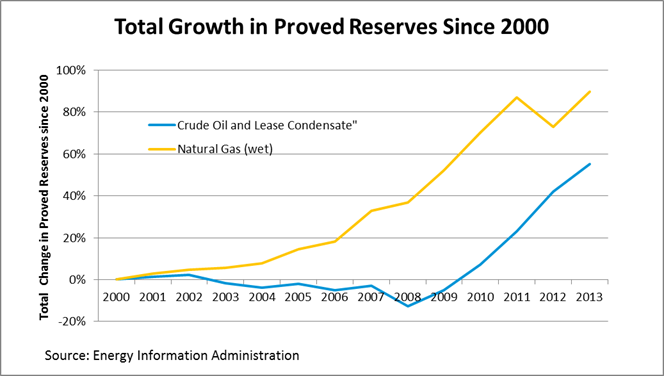
The shale revolution is a classic disruptive technology advance that has priced the green movement out of the competitive market. Natural gas isn’t $13, but is now close to $3, an 80 percent decline. Oil prices have fallen by nearly half.
Green energy can’t possibly compete with that. Marketing windpower in an environment of $3 natural gas is like trying to sell sand in the Sahara. Instead of letting the green energy fad die a merciful death, the Obama administration only lavished more subsidies on the Solyndras of the world.
Washington suffered from what F.A. Hayek called the “fatal conceit.” Like the 1950s central planners in the Politburo, Congress and the White House thought they knew where the future was headed. According to a 2015 report by the Taxpayers Protection Alliance, over the past 5 years, the U.S. Government spent $150 billion on “solar power and other renewable energy projects.” Even with fracking changing the energy world, these blindfolded sages stuck with their wild green-eyed fantasy that wind turbines were the future.
Meanwhile, the return of $2.50 a gallon gasoline at the pump is flattening the battery car market. A recent report from the trade publication Fusion notes: “electric vehicle purchases in the U.S. have stagnated.” According to auto analysts at Edmunds.com, “only 45 percent of this year’s hybrid and EV trade-ins have gone toward the purchase of another alternative fuel vehicle. That’s down from just over 60 percent in 2012.”
Oil production from 2007-14 grew by more than 70 percent and natural gas production by nearly 30 percent.
Edmunds.com says that “never before have loyalty rates for alt-fuel vehicles fallen below 50 percent” and it speculated that “many hybrid and EV owners are driven more by financial motives rather than a responsibility to the environment.” That’s what happens when the world is awash in cheap fossil fuels.
This isn’t the first time American taxpayers have been fleeced by false green energy dreams. In the late 1970s the Carter administration spent billions of dollars on the Synthetic Fuels Corporation which was going to produce fuel economically and competitively. Solar and wind power were also brief flashes in the pan. It all crash landed by 1983 when oil prices crashed to as low as $20 a barrel after Reagan deregulated energy. The Synthetic Fuels Corporation was one of the great corporate welfare boondogggles in American history.
A lesson should have been learned there–but Washington went all in again under Presidents Bush and Obama.
At least private sector investors have lost their own money in these foolish bets on bringing back energy sources from the Middle Ages-like wind turbines. The tragedy of government as venture capitalist is that the politicians lose our money. These government-backed technologies divert private capital away from potentially more promising innovations.
Harold Hamm, president of Continental, and one of the discoverers of the Bakken Shale in North Dakota tells the story of meeting with Barack Obama at the White House in 2010 to tell him of the fracking revolution. Obama arrogantly responded that electric cars would soon replace fossil fuels. Was he ever wrong.
We don’t know if renewables will ever play a significant role in America’s energy mix. But if it does ever happen, it will be a result of market forces, not central planning.
70 Comments on "The Death of the Green Energy Movement"
StevenJ on Fri, 8th May 2015 4:53 pm
I never cease to be amazed by the size of the partisan blinkers some ppl wear.
antaris on Fri, 8th May 2015 5:24 pm
Garbage article
dissident on Fri, 8th May 2015 5:37 pm
We are headed for an oil utopia. Woohoo!
Plantagenet on Fri, 8th May 2015 6:08 pm
Just because we are in an oil glut now doesn’t mean that supplies will never tighten and prices will never rise in the future.
Don’t give up on alternative energy just yet—-we’re going to need it before this is all over.
Speculawyer on Fri, 8th May 2015 6:33 pm
LOL! Stephen Moore. That Heritage Foundation and Club For Growth jackhole. Hard-right propaganda on tap.
Speculawyer on Fri, 8th May 2015 6:35 pm
BTW, Wind, hydropower, geothermal, and solar make up the majority of new electricity generating capacity being added to the grid. This guy is just partisan hack.
http://cleantechnica.com/2015/02/03/solar-wind-53-new-us-electricity-capacity-2014/
Speculawyer on Fri, 8th May 2015 6:41 pm
“It finds that the huge price advantage for oil and natural gas means “fossil plants still dominate recent (electric power) capacity additions.””
Huge price advantage for OIL for generating electricity? This guy may indeed be the dumbest man on the planet. How can anyone listen to such dreck?
“When fracking and horizontal drilling technologies burst onto the scene, U.S. oil and gas reserves nearly doubled almost overnight.”
Rockman needs to set this man straight. Or T.Boone Pickens who saw his first frack job in 1952. But what does T.Boone know about oil?
https://finance.yahoo.com/video/saw-first-frack-job-1952-164423278.html
vegeholic on Fri, 8th May 2015 7:52 pm
This piece must be satire because it is just not possible for a sentient being to pack that quantity of delusions into an energy essay. I especially liked the part about investors losing their money on middle age-like wind turbines. I wonder how the investors feel who loaned low interest money to the fracking companies. I am guessing that they will soon be crying to the central planners for a bailout.
apneaman on Fri, 8th May 2015 8:04 pm
Renewable energy isn’t a shortcut to reversing global warming
https://systemicdisorder.wordpress.com/2015/05/07/renewable-energy-global-warming/
zoidberg on Fri, 8th May 2015 8:19 pm
Lol you guys. Renewables require a fossil fuel subsidy to Be effective. You can’t pretend it’s economic.
Nony on Fri, 8th May 2015 8:20 pm
massive bunch of govt subsidies and research grants. Sunfuels redux. Jimmy Carter redux.
GregT on Fri, 8th May 2015 9:29 pm
“Govt subsidies and research grants. Sunfuels redux. Jimmy Carter redux.”
We didn’t learn then, and apparently some of us are still too dense to figure things out now.
Dave on Fri, 8th May 2015 9:40 pm
Give it up Nony! Renewables are the wave of the future. Not every year will be a banner year given the volatility of the alternatives. Nonetheless, all one has to do is look back a few years to see how far we’ve come. A renewable future is coming to a place near you and sooner that you might imagine.
GregT on Fri, 8th May 2015 10:03 pm
“Renewables are the wave of the future.”
If we don’t completely destroy the Earth’s natural ecosystems first, true. The only renewables are anything that doesn’t require finite resources. Everything else is non- renewable, and non sustainable.
SilentRunning on Fri, 8th May 2015 10:10 pm
Clearly, we have discovered an infinite source of energy that will never be exhausted in shale oil/gas…. yeah, right.
Meanwhile, back in reality, shale wells continue their precipitous decline, and the drillers have stopped drilling because they can’t even pretend to make money at these prices. So delivery rates are plummeting… And the prices are creeping up….
Davy on Fri, 8th May 2015 10:13 pm
Well, from the standpoint of doom we are going to need all of the above to mitigate and adjust to the descent. Little will be built out fossils fuel or AltE when economic activity plummets.
What we have above is the Greens and the Browns under the BAUtopian spell. Both with a twinkle in their eye how their brand of BAU is going to triumph.
Maybe we should practice a little humility for what is coming and realize this is going to be a salvage economy with a hybrid of pre-fossil lifestyles and modern FF & AltE. We are going to be lucky to keep the lights on regularly, the frig stocked, and gas tank full. This author makes me sick not because I dislike brownies but because I dislike assholes.
yoananda on Sat, 9th May 2015 4:23 am
If this article was written one year ago, it would not be stupid !
rockman on Sat, 9th May 2015 6:50 am
As Yogi said: “Predictions are difficult…especially about the future.” We’ll have to wait to see if lower ff prices will have a significant impact on the rapid expansion of wind power in Texas. My guess is no. Bottom line: although not a big fan of govt intruding itself into business alt expansion requires such a “partnership” IMHO. And continued resistance in many states, unlike the support from the Texas govt, will likely be as big an impediment as lower fossil fuel prices. After all if the govt of the largest fossi fuel producer in the country can throw so much support behind alt energy why can’t the others?
First, thanks to a huge investment ($7 billion) by the state in the grid a big chunk of expansion infrastructure is already in place. New wind farms don’t have to include costs for transmission capability.
Second, wind was already competing against a very inexpensive fossil fuel when it boomed here: lignite. Based upon projected growth in electricity demand Texas has a 100+ year supply. In fact, the largest CO2 sequestration project on the planet is under construction that will capture the second largest single source of GHG in the country. Half that volume comes from burning coal.
Third, wind was never planned as a replacement for existing ff generation but to supplement it. A very important aspect of that potential was the state deregulating electricity generation. This allowed a tremendous advantage to independently funded wind projects and allowed communities, such as Austin consumers, to vote for and help finance alt sourced energy. In fact, as mentioned in the article below, many consider wind generator have been handed a generous advantage over other power generators thanks to subsidies such as the citizens paying 100% of the $7 billion grid expansion. Thus some moves toward having wind generators chip into to future infrastructure expansion.
Details: ” Govenor Perry also backed a $7 billion electrical transmission project to connect windy, largely empty West Texas to growing cities demanding more power. Completed a year ago, the Competitive Renewable Energy Zone, or CREZ, initiative stretches nearly 3,600 miles and can send up to 18,500 megawatts of power across the state.
“That we were able to build thousands of miles of high-capacity transmission from West Texas to the Panhandle without landowners marching on the Capitol with pitchforks, it’s pretty remarkable,” said Railroad Commissioner Barry Smitherman, whom Perry appointed to the Public Utility Commission in 2004 and reappointed in 2007.
Along with decisions that specifically targeted wind, Smitherman said, Perry’s oversight while the state shifted to a competitive electricity market hastened investment in a variety of fuels, leaving Texas with a balanced energy portfolio.
Kathleen Hartnett White, whom Perry appointed to the Texas Commission on Environmental Quality in 2001, said the governor’s policies — including his support of a competitive energy market — were responsible for the wind surge “with some qualifications.” Other factors, she said, included generous federal incentives, such as a now-lapsed 2.3-cent-per-kilowatt-hour tax credit for renewable energy.
Hartnett White is not the only Texas Republican scrutinizing wind policy as Perry exits office. Comptroller Susan Combs suggested in September that wind energy has “an unfair market advantage over other power sources.” And PUC Chairwoman Donna Nelson, appointed by Perry in 2011, has called for study into whether wind energy companies should chip in for power line upgrades — something no other types generator has been asked to do.
Asked about those rumblings, Lucy Nashed, Perry’s spokeswoman, said “tax credits or incentives should always be appropriately limited in scope and duration,” and she attributed the wind bonanza to an “all-of-the-above strategy to meet our state’s energy needs.”
“In Texas we have implemented common-sense policies that have enabled us to build a successful wind industry that can thrive on its own,” Nashed added.”
sunweb on Sat, 9th May 2015 7:25 am
All the things in our world have an industrial history. Behind the computer, the T-shirt, the vacuum cleaner is an industrial infrastructure fired by energy (fossil fuels mainly). Each component of our car or refrigerator has an industrial history. Mainly unseen and out of mind, this global industrial infrastructure touches every aspect of our lives. It pervades our daily living from the articles it produces, to its effect on the economy and employment, as well as its effects on the environment.
Solar energy collecting devices and their auxiliary equipment also have an industrial history. It is important to understand the industrial infrastructure and the environmental results for the components of the solar energy collecting devices so we don’t designate them with false labels such as green, renewable or sustainable.
This is a challenge to ‘business as usual’. If we teach people that these solar devices are the future of energy without teaching the whole system, we mislead, misinform and create false hopes and beliefs. They are not made with magic wands.
This information is provided by the various industries themselves, I have posted both charts and videos for the solar cells, modules, aluminum from ore, aluminum from recycling, aluminum extrusion, inverters, batteries and copper.
Please note each piece of machinery you see in each of the videos has its own industrial interconnection and history.
http://sunweber.blogspot.com/2015/04/solar-devices-industrial-infrastructure.html
ghung on Sat, 9th May 2015 8:01 am
Sunweb: ” If we teach people that these solar devices are the future of energy without teaching the whole system, we mislead, misinform and create false hopes and beliefs. They are not made with magic wands.”
While you’re at it Sun, be sure to teach them the ‘industrial history’ of that can of Coke, Their Starbucks coffee, that new Ninja Blender, and the ‘clean’ coal plants they get almost 40% of their electricity from. Wouldn’t want to hold so-called “renewables” to a higher standard. Maybe you’ll find out that most folks don’t give a shit about the “industrial history” of the things they invest in.
Even if you did an apples-to-apples comparison of the industrial history of their energy sources (something I haven’t seen you do) they won’t pay much attention. They just want a sense that their BAU will continue. Telling them otherwise; that there are no solutions to overshoot that they’ll like, hasn’t changed their behavior much.
rockman on Sat, 9th May 2015 8:14 am
“If we teach people that these solar devices are the future of energy without teaching the whole system”. A very good point IMHO. I won’t take up space here with the details but throughout the entire pitch for wind power in Texas the entire focus directed at the public beat that point to death. I don’t recall a single statement by any of the govt/industry supporters of the alts that emphasized “saving the planet” or “going green”.
It was always presented as a needed SYSTEM upgrade vital to the economic interests of the state. That was the driving motivation: self interest. In fact, the only negatives put out about wind expansion came from the PETA wing of the environmentalists: the turbines would kill some birds. Which wasn’t much of an issue in a state where we shoot millions of birds every year during hunting season. Bacon-wrapped dove breasts…mmm! LOL.
ulenspiegel on Sat, 9th May 2015 8:19 am
The author of the piece, Stephen Moore, is perfect proof that the war on drugs has failed yet.
Kenz300 on Sat, 9th May 2015 8:35 am
Wind and solar are the future despite what the fossil fuel interests say……..
How Fossil Fuel Interests Attack Renewable Energy
http://www.renewableenergyworld.com/rea/news/article/2014/05/how-fossil-fuel-interests-attack-renewable-energy
—————
Renewables Account for 75 Percent of New US Generating Capacity in First Quarter of 2015
http://www.renewableenergyworld.com/rea/news/article/2015/04/renewables-account-for-75-percent-of-new-us-generating-capacity-in-first-quarter-of-2015
Kenz300 on Sat, 9th May 2015 8:36 am
The Renewable Revolution | Michael T. Klare
http://www.huffingtonpost.com/michael-t-klare/the-renewable-revolution_b_7078904.html
———————
Fossil Fuels Just Lost the Race Against Renewables
http://www.renewableenergyworld.com/rea/news/article/2015/04/fossil-fuels-just-lost-the-race-against-renewables
rockman on Sat, 9th May 2015 8:37 am
“They just want a sense that their BAU will continue.” And that’s exactly what convinced the politicians to invest $billions in tax payer monies and got consumers in various towns, like Austin, to approve increased rates in the short term to subsidize wind power build out. And now they have some of the lowest rates in the country.
Wrapping a pitch in the self interest flag is a proven approach…has been for ever. We didn’t even pretend it had anything to do with the politically correct “saving the planet” pitch. That has already been proven to be completely impotent here. LOL.
Which is the proven weakness in most of the efforts to expand alt energy in the country IMHO: presenting it as an alternative to maintaining BAU. The truth of that position isn’t relevant. The vocal minority can yell about it all day long. But in the end the silent majority will still control the situation. And self interest rules their decisions.
ghung on Sat, 9th May 2015 8:47 am
Teaching ‘people that these solar devices are the future of energy’ may only be a selling point, but everything has to be sold.
Maybe we should teach folks that places like Kodiak, AK have reduced their reliance upon expensive fossil fuels for their electrical production from over 50% to 0.3% by partnering wind with existing hydro. I’m betting those folks will find a way to maintain their hydro plants and wind turbines, on some level, when industrial production becomes more constrained and other gridweenies are paying more, facing brown/blackouts and struggling through peak usage periods, same as I’ll be doing my best to keep the lights on. Either way, this isn’t about absolutes; not about BAU or nothing. It’s about having a wider range of options; some better than others.
Why care about how it’s sold? The stories we tell about virtually everything rarely jive with reality. Trying to sell reality; that industrial society is basically screwed, won’t accomplish much. Meanwhile, for the foreseeable future, the costs of my home’s energy inputs use are largely fixed. How many of you can say that? Pretty good selling point, IMO.
Nony on Sat, 9th May 2015 8:55 am
If it were really a game changer, then it would just happen on its own. Sans subsidies and sans cheerleading. Like how the US fracking came out and bitch slapped Krugman and the donks and the peakers.
Davy on Sat, 9th May 2015 8:56 am
G-man, Sun has a good point in regards to the hardcore greenies & AltE wonks. Over the many months I have been on this forum I routinely see comments about green & AltE topics that are part of the BAU spell. We see comments praising AltE on many levels. We see unrealistic expectations of an AltE future. This future of clean carbonless power that self replicates. A future much like today but run by AltE with green happiness.
This is just not reality. These claims are hopium of technological progress and destiny. This is no different than the normal BAU Hopium of the traditional fossil fuel folks. If we are going to have any chance of some kind of successful adaptation and mitigation potential we have to embrace reality.
G-man, your point is valid for the vast majority of sheeples who don’t care because they don’t understand or blindly believe all will be well because that’s the way it has always been. They know we may be heading in the wrong direction but there is no chance of the light switch not working, frig going empty, and or gas station without fuel.
Long story short both of you are correct at different levels. For the record I am a treehugger, green lovin AltE, permaculturalist. I am sold on this life but I am also dedicated to the truth. My doom meter goes berserk when the false hopium is preached.
I don’t claim to have a corner on the truth but I can smell a turd. Stink means a turd is near. A shiny AltE future with a green BAUlite is a turd. A ugly, painful, and Spartan world of BAUsalvage with hybrid of pre-fossil fuel and remnants of fossil fuel BAU seems more realistic to me. Even that doomish vision may be just a transition to something worse. If we embrace reality we are more likely to avoid the worse and maybe with some luck find the better.
Davy on Sat, 9th May 2015 9:14 am
Cat piss NOo. Fracking was birthed by a central bank policy of financial repression and debt monitarization that promoted a yield bing. IOW the ingredients were in place for a debt fueld bubble. The infrastructure, technology, and people were ready to go. Oil prices were high. The global economy was inflating markets and commodities in a massive wealth transfer theft of the many for the few.
NOo, please don’t hype your fracker heroes without fairness and balance. I think it is amazing what the frackers did. It was great for me and my family. It gave me several more years of prep activity. My family is associated with the pipeline business.
NOo, the problem is the bills are coming due. Many of those bills were from investors who were sold a bag of shit by snake oil salesman on the Street. You remind me of these folks with your excessive cheerleading. NOo, I really like you but you gotts to get a grip on life or you are going to self destruct when TSHTF.
green_achers on Sat, 9th May 2015 9:16 am
Article is so stupid, it isn’t even wrong. It doesn’t demonstrate the first clue in understanding what the upcoming energy crunch is about. Any setback in renewables due to temporarily lower prices in fossil fuels just means that we will be left with fewer options when the blip goes away. Not that it means much anyway, the scale of “renewables” they are talking about are so technology and carbon dependent they hardly deserve the name.
No one who has looked into this issue enough to have the smallest understanding should give a rat’s ass which end of the damn egg gets cracked.
shortonoil on Sat, 9th May 2015 9:30 am
Oil was expected to stay way over $100 a barrel and potentially soon hit $200 a barrel. National Geographic infamously advertised on its cover in 2004 “The End of Cheap Oil.”
60$ oil, and $3.00 NG are not a sign of strength in the petroleum industry! It is a sign that they are having a “going out of business sale”. Oil that cost $100/barrel to pump, and NG that cost $8.00/ MM to extract, which are being sold for $60, and $3.00 indicate that things are not going well on the good ship HMS Petroleum. The industry now has somewhat of a problem; it can no longer produce a product that its buyers can afford.
The industry set its ship of commerce off on the $100/barrel route; but, forgot to ask if anyone else might be interested in coming along. So happens – their customers weren’t. So they pumped a lot of oil that now sits in tanks along the Gulf Coast. It sits there waiting for the Fairy Godmother, or some government agency to come along, and take it away. Sitting around, begging for a handout, to save their essential products that no one is interested in buying, has led them to accuse the other guys of being the ones on the rope. Well, Mr. Hamm, from where we sit those turbines will still be spinning long after your voyage into a North Dakota brick yard has wound up on the rocks!
http://www.thehillsgroup.org
ghung on Sat, 9th May 2015 10:01 am
Davy, if you read my posts you’ll understand that I don’t try to hold alternatives to a different (higher) standard in terms of the continuation of industrial civilization, nor do I see the point of re-hashing over and over the idea that it won’t. Once one gets to that point, one can focus on the true usefulness of alternatives; no need to dismiss them as useless as replacements for 20th century mass energy production.
Sun and I were both early adopters of alternatives, though apparently we went into it with different expectations. I also don’t tout alternative methods of food production as being the go-to replacement for current levels of industrial food production, nor do I dismiss them as useless. It’s about acceptance of things as they are and acting locally with what’s available, and reducing ones reliance upon long, complex supply chains that won’t be sustainable, at least for the foreseeable future. Anything else is a waste of my time and energy. Two thigs I will continue to do (and not discourage) is to encourage others to be more self-reliant and to develop their own level of BAU.
If society-at-large wants to sell alternatives at scale, I’m all for it. Beats the shit out of the current narrative, and subsidises my preps in terms of time and costs. When the ship is going down, build lifeboats and encourage others to help or do the same. Perhaps they’ll be too busy doing so to drag me under as the top decks slip below the waves.
Outcast_Searcher on Sat, 9th May 2015 10:16 am
Stephen Moore. Friend of the Fox News crowd which recommends storing massive amounts of traditional old style (the least efficient) incandescent light bulbs in your home, before you are “forced” to use far more efficient bulbs. Why? Because the light from the newer bulbs is supposedly “inferior”. And of course this makes sense because they claim there is NOTHING to energy or climate issues.
(And no, I’m not making this up).
Unless I missed it, Mr. Moore didn’t even bother to point to the IEA article he is supposedly discussing. That level of “reporting”, even absent the obvious bias, would earn bad marks for a fifth grader. It’s a wonder anyone pays attention to such hacks anymore, at least on anything remotely related to science.
Davy on Sat, 9th May 2015 11:19 am
G-man, great post and I read everyone’s post but especially enjoy yours!
steve on Sat, 9th May 2015 11:45 am
@ outcast…..incandescent bulbs do little to save energy…one of the by products of those bulbs is heat which many people need in the winter when those lights are running. So to make up for the heat that is lost the furnace runs more! Energy in Energy out! But they are a great “feel good” thing!
Outcast_Searcher on Sat, 9th May 2015 1:22 pm
Steve, with all due respect, you’re buying the far right anti-science propaganda without thinking clearly.
It’s true that incandescent bulbs create a lot of waste heat. NOYTHING else you said is true.
1). They use about FIVE times as much energy than the CFL bulbs which have been rapidly replacing them (and for good reason).
2). The waste heat acts like a very expensive electric furnace in the winter, iniffeciently getting you back part of that energy. However, it’s a direct loss in the summer and a wash in spring and fall — so they’re really a terrible waste of net energy.
3). The energy savings are even better with halogen bulbs.
4). CFL’s last several times longer than incandescent bulbs. Halogen bulbs last MANY times longer than incandescent bulbs. Thus less waste and cost in materials as well as energy.
5). There are certainly “feel good” things the greens like. You are completely wrong attributing this to incandescent bulbs, but nice try for the anti-science crowd promulgating such nonsense.
6). You can easily look this up on the internet. Try a site less science biased than far right wing blogs and “news” outlets.
Baptised on Sat, 9th May 2015 1:31 pm
Horrible article, but I enjoyed reading it, because this is the mind set I have to live with here in Tennessee.
GregT on Sat, 9th May 2015 1:43 pm
@Steve
My kitchen alone has 30 Par20 50W halogen bulbs. I replaced them with 9W LEDs. 1500W/hour vs 270W/hour. With the added bonus of not adding extra heat into the house during 6 months of the year in Canada that we do not turn the furnace on. We have replaced every light bulb in our home with CFLs or LEDs as they have become available.
I agree, they are a feel good thing. We feel good about lowering our carbon footprint, and we feel even better about saving money on our utilities bills.
Our other home will be powered mostly by solar, with the ability to go off grid when the time comes. We’re in the process of replacing every light fixture in the house with LEDs.
You are welcome to heat your home with incandescents if it makes you feel good. We heat mainly with wood, and wood pellets.
BobInget on Sat, 9th May 2015 1:57 pm
What Einhorn said. Distilled
“In a 92-page PowerPoint presentation, Einhorn argued that the 16 top oil frackers have spent more than $300 billion drilling holes since 2006, but none has generated positive cash flow, “not even when oil was at $100 a barrel.” Last year, they spent $20 billion. He excluded natural-gas frackers because they are “globally competitive, low-cost energy producers with attractive economics.”
http://www.eia.gov/tools/faqs/faq.cfm?id=847&t=6
Does EIA have data on shale (or tight oil) production?
The U.S. Energy Information Administration (EIA) estimates in the Annual Energy Outlook 2015, that about 4.2 million barrels per day of crude oil were produced directly from tight oil resources in the United States in 2014, or about 49% of total U.S. crude oil production. Tight oil is oil embedded in low-permeable shale, sandstone, and carbonate rock formations.
If you divide the $300B by the 4.2MM bbl. p/d of production you find the industry
spent $71,428.00 per flowing barrel. Not cheap. The industry is correct in arguing
that a significant amount of reserves have been found during this ramp up and a
good part of the $300B has been for leases and other infrastructure. The negative
is that the high decline rates in a low oil price environment compromise the
economics of shale for all but the very best areas. These areas have been drilled
from the very beginning of the shale boom as companies proved up their acreage.
Every company is going to look for the best return from their acreage. They did
this at $95+ oil and they are doing this at current prices. As the “sweet spots”
deplete companies will move to lower productivity areas but only as the economics
allow. Company after company on their CC’s stated that at $65 oil they would
START increasing their rig use. WS has taken this as a complete ramp up. Neither
the borrowing capabilities of the companies allow this nor the C/F available
from this drilling. Until prices rise a ramp up will be slow. Further, the “sweet
spots” are only in 5 or less counties in EF or Bakken. The Permian is extensive
but well flows are significantly less than the above areas. The SCOOP looks good
but higher prices are needed.
As to the ROW’s outside of OPEC production of 50mm bbl. p/d much higher prices
are needed. We see the promise from areas that had been much ballyhooed such as
Mexico, Brazil and Azerbaijan diminishing rapidly. On top of that add areas such
as the N. Sea, the African coast and the Artic on life support.
steve on Sat, 9th May 2015 3:05 pm
Maybe I am basing my talk on this presentation by Paul Wheaton
http://www.makeitmissoula.com/2014/05/really-saving-energy/
rockman on Sat, 9th May 2015 4:00 pm
“…Einhorn argued that the 16 top oil frackers have spent more than $300 billion drilling holes since 2006, but none has generated positive cash flow, “not even when oil was at $100 a barrel”. Of course not: during boom times successful companies are always spending more money then they are generating revenue. A great well making a 15%+ ROR might take 2+ years to recover 100% of its costs. IOW if a company is continuing to drill an increasing number of profitable wells (as is the case in the initial days of a boom) they are always spending more money then creating incoming revenue. No different the building a chain of fast food restaurants: there’s no positive cash flow as long as expansion is booming.
Now jump the timeline: a shale player ceases all new drilling and continues to produce X thousands of bbls of oil per day from its existing wells. Now it has tremendous positive cash flow. So is that a sign of a very profitable drilling venture? Of course not. Just as a lack of positive cash flow during the ramping up period doesn’t prove a money losing effort.
As far as “If you divide the $300B by the 4.2MM bbl. p/d of production you find the industry spent $71,428.00 per flowing barrel. Not cheap”. I have no idea if that’s a valid number or not. But if it’s close that really wouldn’t be too bad. During the height of oil pricing producing fields were selling for $120,000 per flowing bbl. And those were fields that selling companies had already received significant cash flows from. Of course today, with lower oil prices, the price point is closer to $50,000 per flowing bbl.
IOW if you think the shale drillers just took a hit think about the many tens of $billions invested in “low risk” proved PRODUCING reserves. Many of those buyers were hedge funds and no one is talking about them.
I’m not arguing what the profitability of the shale plays has or hasn’t been. But the cash flow qualifier tossed out is meaningless. And let’s not forget the primary goal of the vast majority of the pubco CEO’s: it’s increasing stock values to keep the current board/shareholders happy. Per well profitability is somewhat lower of the list of priorities.
Or more simply if you bought Chesapeake in the early days and then sold for a 20% rate of return you don’t really give a sh*t if they go belly up now if overall they lost money drilling the Eagle Ford, do you? And nether does the former CHK CEO who was forced out and began a new company that raised $billions right from the start, does he?
Folks keep forgetting the primary reason so many pubcos jumped into the shale game with abandon: they had little choice since so little conventional oil/NG was left to develop in the US. As they say: when all you have is a hammer every problem begins to look like a nail. The public oils had a serious problem: an insufficient number of conventional wells to drill in order to build stock value. But the high oil prices provided them the hammer they so desperately needed. What else would you expect them to do? Nail the shales, of course. LOL.
As the Rockman has said many times: despite all the high tech and convoluted curve constructions the oil patch, from the pubco perspective, ain’t rocket science. It’s slash, burn and get out before the collapse. Always has been and always will be. Which is exactly why the Rockman chose to fade away in the employ of a private company that is focused solely on drilling profitable wells.
Nony on Sat, 9th May 2015 4:15 pm
EN PEE VEE
Dredd on Sat, 9th May 2015 5:29 pm
I am on 100% wind power.
I think the false reports of its demise are premature.
Got keyboard diarrhoea daily sicknal?
As goes green so goes civilization.
(The Epistemology of Goldilocks RE: Sea Level Rise)
Nony on Sat, 9th May 2015 6:05 pm
how the eff are you aon 100% windpower? what do you rely on when it’s not windy? the grid?
GregT on Sat, 9th May 2015 6:14 pm
Probably not the best idea to type while drunk Nony.
GregT on Sat, 9th May 2015 6:41 pm
@Steve,
I would consider Paul Wheaton’s TED talk as more of a satirical look at our pending energy crisis. If you choose to take it as factual, then may Lady Luck be with you.
I have a plan to get myself and my loved ones through the coming bottleneck. Whether that plan pans out or not remains to be seen. At least I have one. How about you? Love to hear about it.
farmlad on Sat, 9th May 2015 8:45 pm
thanks Rock I couldn’t make heads or tails of Bobingets post and figured it was just me. So it’s great to have someone posting on here with some expertise and the generosity to share it.
shallow sand on Sat, 9th May 2015 8:48 pm
I think it remains to be seen how profitable tight oil wells are long term. I would assume those in the Bakken and EFS are not cheap to operate. $75-100k to repair a down hole failure, lots of down hole chemicals, 640 pumping units, most not able to dispose of water on the lease, so truck haul. Much will depend on where they settle out at.
Regardless, even with the significant cost reductions concerning drilling and completions, $45-55 oil in the field does not cut it on the whole.
IMO the companies still running rigs are keeping up appearances, quoting ROCKMAN, at these levels.
I think they have spent way more than 70k per flowing barrel too. One thing you need to do is knock about 20% off for the royalty. Next, the $300 billion is for the top 16 only.
One thing that has held true since the price run up is that pub co enterprise value has been much higher per flowing barrel than what the production could be sold for on the market. That is why there was such a large number of MLP formed for upstream stripper production. You could add up all they bought and multiply by 2-4 to get enterprise value before the crash. And the pubco are mostly still too high, except for those who are about to BK, of course.
I am aware of production in our neighborhood that was snapped up in that manner. Right now it is either in the red or barely in the black, Yet wall street is still putting a high value number on it. They do not realize these pub co are throwing every possible thing into CAPEX to make LOE look low, because of course the wall street bankers think all oil field CAPEX means growth. They don’t realize a bunch of the so called CAPEX is being spent just to keep the donkeys nodding.
Nony on Sat, 9th May 2015 8:54 pm
I don’t think they are keeping appearances. I think they are being rational and drilling holes when it is warranted and not when it is not. Considering various factors like current prices, future prices, current AND future completion costs, drilling cancellation penalties, learning value, etc.
BTW, there was a MUCH LONGER bunch of wailing that shale gas was not profitable except at something north of $8 to $10. And it has hung in there for 5 years at prices well south of that. Now…I don’t think LTO is as flowable as methane. But the behavior of the peakers (the suspicion of non rational behavior) is consistent.
Where is Art Berman to admit how screwed up his 2010 comments were?????
Nony on Sat, 9th May 2015 8:58 pm
“One thing that has held true since the price run up is that pub co enterprise value has been much higher per flowing barrel than what the production could be sold for on the market.”
I have explained to you several times that the nature of the investment is different. A stripper well has little growth potential. Not so, a shale field with well identified infilling opportunities.
The oil business includes things that are different than stripper wells! For instance, consider an off shore project right AFTER the initial tests are done (and successful). No flowing barrels, but a rational reason for putting a high (and improved after the test) value on it.
This is investment 101. A utility is not the same thing as a biotech.