
Peak Oil is You

Donate Bitcoins ;-) or Paypal :-)


Page added on May 8, 2015

The Death of the Green Energy Movement
The green energy movement in America is dead. May it rest in peace. No, a majority of American energy over the next 20 years is not going to come from windmills and solar panels. One important lesson to be learned from the green energy fad’s rapid and expensive demise is that central planning doesn’t work.
What crushed green energy was the boom in shale oil and gas along with the steep decline in the price of fossil fuel that few saw coming just a few years ago.
A new International Energy Agency report concedes that green energy is in fast retreat and is getting crushed by “the recent drop in fossil fuel prices.” It finds that the huge price advantage for oil and natural gas means “fossil plants still dominate recent (electric power) capacity additions.”
This wasn’t supposed to happen.
Most of the government experts–and many private investors too–bought into the “peak oil” nonsense and the forecasts of fuel prices continuing to rise as we depleted the oil from the earth’s crust. Oil was expected to stay way over $100 a barrel and potentially soon hit $200 a barrel. National Geographic infamously advertised on its cover in 2004 “The End of Cheap Oil.”
Barack Obama told voters that green energy was necessary because oil is a “finite resource” and we would eventually run out. Apparently, Obama never read “The Ultimate Resource” by Julian Simon which teaches us that human ingenuity in finding new resources outpaces resource depletion.
When fracking and horizontal drilling technologies burst onto the scene, U.S. oil and gas reserves nearly doubled almost overnight. Oil production from 2007-14 grew by more than 70 percent and natural gas production by nearly 30 percent.
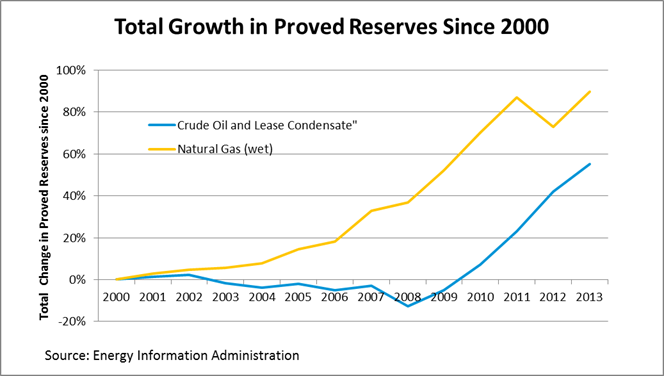
The shale revolution is a classic disruptive technology advance that has priced the green movement out of the competitive market. Natural gas isn’t $13, but is now close to $3, an 80 percent decline. Oil prices have fallen by nearly half.
Green energy can’t possibly compete with that. Marketing windpower in an environment of $3 natural gas is like trying to sell sand in the Sahara. Instead of letting the green energy fad die a merciful death, the Obama administration only lavished more subsidies on the Solyndras of the world.
Washington suffered from what F.A. Hayek called the “fatal conceit.” Like the 1950s central planners in the Politburo, Congress and the White House thought they knew where the future was headed. According to a 2015 report by the Taxpayers Protection Alliance, over the past 5 years, the U.S. Government spent $150 billion on “solar power and other renewable energy projects.” Even with fracking changing the energy world, these blindfolded sages stuck with their wild green-eyed fantasy that wind turbines were the future.
Meanwhile, the return of $2.50 a gallon gasoline at the pump is flattening the battery car market. A recent report from the trade publication Fusion notes: “electric vehicle purchases in the U.S. have stagnated.” According to auto analysts at Edmunds.com, “only 45 percent of this year’s hybrid and EV trade-ins have gone toward the purchase of another alternative fuel vehicle. That’s down from just over 60 percent in 2012.”
Oil production from 2007-14 grew by more than 70 percent and natural gas production by nearly 30 percent.
Edmunds.com says that “never before have loyalty rates for alt-fuel vehicles fallen below 50 percent” and it speculated that “many hybrid and EV owners are driven more by financial motives rather than a responsibility to the environment.” That’s what happens when the world is awash in cheap fossil fuels.
This isn’t the first time American taxpayers have been fleeced by false green energy dreams. In the late 1970s the Carter administration spent billions of dollars on the Synthetic Fuels Corporation which was going to produce fuel economically and competitively. Solar and wind power were also brief flashes in the pan. It all crash landed by 1983 when oil prices crashed to as low as $20 a barrel after Reagan deregulated energy. The Synthetic Fuels Corporation was one of the great corporate welfare boondogggles in American history.
A lesson should have been learned there–but Washington went all in again under Presidents Bush and Obama.
At least private sector investors have lost their own money in these foolish bets on bringing back energy sources from the Middle Ages-like wind turbines. The tragedy of government as venture capitalist is that the politicians lose our money. These government-backed technologies divert private capital away from potentially more promising innovations.
Harold Hamm, president of Continental, and one of the discoverers of the Bakken Shale in North Dakota tells the story of meeting with Barack Obama at the White House in 2010 to tell him of the fracking revolution. Obama arrogantly responded that electric cars would soon replace fossil fuels. Was he ever wrong.
We don’t know if renewables will ever play a significant role in America’s energy mix. But if it does ever happen, it will be a result of market forces, not central planning.
70 Comments on "The Death of the Green Energy Movement"
shallow sand on Sat, 9th May 2015 9:16 pm
N. I’m talking about strippers being bought by MLP suddenly being 2-4 times, not the shales.
Keep in mind also, N, the shales are declining all the time, and big time in the first couple years.
I know you like to compare these stocks to biotechs or tech growth. As Einhorn said, that is not quite accurate. You are not developing a new drug or technology that can be replicated cheaply en masse and sold for potentially for many years at a profit.
With oil and gas, once it’s produced it’s sold and that’s it. Selling flush at $40 per bbl or $2 mcf is not a good business plan IMO. I understand being cash flow negative to develop a new product/technology. I also understand being cash flow negative to hold acreage by production. I do not understand cash flow negative down space drilling, other than maybe to make wall street happy, which IMO is not a good idea.
ROCKMAN. What is the range of cost per month to operate a 10,000′ oil well. I know there are many variables, but lets just assume we are in the EFS with a 640 jack producing 200 bbl of fluid per day?
Nony on Sat, 9th May 2015 9:22 pm
You’re not just buying the individual wells, dude. You are buying the infill opportunities. That’s different than a stripper well. It’s developable leases.
Nony on Sat, 9th May 2015 9:25 pm
Look at shale gas. Peaker people kvetched about that many more years before LTO. And somehow, it is still profitable to develop shale gas. Several years later.
Nony on Sat, 9th May 2015 9:27 pm
Shallow, as Rock correctly pointed out, for an individual well, it is ALWAYS cash flow negative when you make the initial investment. And the year afterwards, it will typically be positive. Why is it so hard to understand that NPV is the correct metric?
shallow sand on Sat, 9th May 2015 9:28 pm
Another way to look at it. If they are not growing production, but are still cash flow negative, I’d say there is a problem.
We will find out that with the shale oils pretty soon. They are guiding flat to slight lower production through year end. Will be interesting to see if they can at least become cash flow neutral with flat to declining production.
Marm made a point with me awhile back about break even. I define it as how much it costs per barrel to keep production flat. However, it can be defined many ways, therefore for that and other reasons, I have turned away from that and am looking at cash burn in relation to production growth. I don’t think burning over a billion dollars to bump BOE about 13,000 per day, as CLR did the first four months this year, is breaking even.
shallow sand on Sat, 9th May 2015 9:32 pm
N. I understand PV very well. And when PV10 is less than long term debt, in my view, you are insolvent.
I know there is value in the infill locations. So why burn them when prices are at multi year lows?
rdberg1957 on Sat, 9th May 2015 11:01 pm
Solar and wind aren’t going to replace fossil fuels, but they may reduce the rate we use them and that will help with climate change and depletion. I don’t believe that they are complete solutions, but they may give us a bit more time to make changes.
Nony on Sat, 9th May 2015 11:37 pm
shallow, they have massively slowed down what they are burning. Rig count is down to half. and some operating rigs (e.g. with cancellation penalties) are drilling holes that are waiting for completion.
If a hole is being completed now, it’s because the case remains positive for it.
Oh…and the price is in contango, but not massively so. So, it’s not lke being able to wait for wonderful things in the future.
Dredd on Sun, 10th May 2015 5:01 am
I see Nony is on 100% wind power a la blowhards of Oil-Qaeda (aka Murder By Poison, Inc.).
rockman on Sun, 10th May 2015 7:05 am
Shallow – “What is the range of cost per month to operate a 10,000′ oil well.” I’m sure you’ve got a good handle on your LOE. From what I hear most EFS wells won’t be commercial much beyond 5 or 6 years due to pumping and, especially, water disposal costs. And that was the talk when oil prices were much higher.
shallow sand on Sun, 10th May 2015 7:53 am
ROCKMAN. We know our LOE of course, and things can vary.
From what I read, EFS wells from 2009-2010 are typically producing 10-30 bopd. Are the pumping units running on produced gas or electricity, which makes a huge difference?
I will keep scanning the auctions and maybe order some LOS on some interests for sale.
As payout is a long way off on new shale wells, seems my questions are relevant, but are not answered. I’ll keep looking.
I do know the 100 to 1 examples I used to give still hold. Would be pretty tough for anyone to be drilling and completing $60-100 thousand wells right now that would have an EUR of 2,000-8,000 barrels to be making money. In fact, tough to make money on wells making 1/10 to 1/3 bopd when oil at $90-100. So I assume the 100/1 does not apply to LOE? However, a downhole repair on a 1000′ usually runs about $1,000 and I did read an article that Bakken down hole such as pump change or tubing job costs $75,000-100,000. So that is close. Plus, 1000′ can be run in and out in 1/2 a day. Assume much more down time on 10,000′ hole.
Nony on Sun, 10th May 2015 9:09 am
Shallow:
They probably do have issues at 60. Especially if they drilled wells that needed 100 to work. But that doesn’t mean it wasn’t rational to drill them at the time.* And a commodity business with high up front capital, that was growing 30% per year should not have been expected to be free cash flow positive.
Bottom line, I think it makes no sense to conflate the high investment at 100 with the real issues at 60.
And the relavent metric is NPV. And a shale oil field has different dynamics than an existing stripper well. (infill options, rate of decline, up front investments, etc.)
Everything I hear when these guys do conference calls shows people who think in terms of NPV. Heck the rapid, huge drop in wells (faster than expected by the press or EIA) shows operators that are rational.
And to a certain extent, it doesn’t really even matter if some entities have BKs. All that matters is the exploitation of the resource. And that will be done based on prices and costs and amounts of oil.
Look at natural gas. Peakers like Rogers and Berman clucked about how it was a façade and all that. and some hear like to point fingers at Chesapeake or others that overinvested at the peak. But the bottom line with gas is that it continues to flow and flow massively and at low prices.
Now I don’t expect the same for oil, because LTO just isn’t as attractive as shale gas. But the insight here is that peakers and amateur analyzers like Berman were massively wrong. 5 years later and we are nowhere near his expected pricing of 8+ for nat gas. We’re below 3. And that’s with massive increase in volume (not a demand drop causing price to go down!)
*what’s really relevant is the expected price averaged over the production (essentially futures curve versus production). However, I’m just not being pedantic to note it. And FWIW, the high decline of shale wells actually lowers the price risk (because return is mostly soon).
*
Nony on Sun, 10th May 2015 10:42 am
I guess I’m too lazy to analyze all the financial statements and I do appreciate your doing it Shallow. But bottom line, I figure eventually everything is rational. And peakers tend to be conspiracy theorists. I doubt that production was growing 1MM bpd+ at $100 because it lost money on an NPV basis.
And shale crashed the price worldwide. So now there is an adjustment. Big deal. And thank God for shale…or we would have been at 150 or 200. That’s some real “POD”.
Mike989 on Sun, 10th May 2015 12:35 pm
The Right is TOTALLY Blind to Reality.
Solar Energy has just gone GEOMETRIC in it’s Growth rate. Smart people don’t fight geometric curves.
Speculawyer on Sun, 10th May 2015 12:41 pm
Renewables = 84% of New Electricity Generation Capacity in 1st Quarter of 2015
http://cleantechnica.com/2015/05/10/renewables-84-of-new-electricity-generation-capacity-in-1st-quarter-of-2015/
Yeah . . . green energy is ‘dead’. Sure.
Steven Moore is quite the Jackhole.
Apneaman on Sun, 10th May 2015 1:01 pm
New Electricity Generation is a PR term used so as to avoid the net amount. Once you know that then it becomes clear that it will never be scaled up, but at least privileged white folk will fee better for a bit. Then there is the fact that when the oil age ends so do renewables. Also it is not green. It as just as toxic and polluting as any other industrial process. The only thing green about not really renewables is the conscience of the privileged few who can afford it. It’s mostly a status symbol. So, one more time on this site for the renewable cheerleaders, what is your response to the massive amounts of toxic pollution? Anyone want to answer? No one has yet. I asked this question on Robertscribblers site one too many times and got banned. Lefties are just as much in denial. Elon’s box of magic batteries is going to save us all? What does hero boy Elon say to the toxic waste issue?
The dystopian lake filled by the world’s tech lust
http://www.bbc.com/future/story/20150402-the-worst-place-on-earth
James Wimberley on Sun, 10th May 2015 2:01 pm
rdberg1957: “Solar and wind aren’t going to replace fossil fuels, but they may reduce the rate we use them …”
Why not? How else would you decribe the massive Dubai solar plant with a <6c/kwh LCOE? Fossil guys (all guys of couse, because Manly) don't get the learning curves of manufacturing technologies. There is no reason wht solar PV should in the medium run quit its 22% leaming rate, which at 40% installation CAGR translates to a 10% annual drop in system cost. Fraunhofer are predicting a 1.5c€/kwh LCOE by 2050, and that is conservative. Onshore wind already beats NG in the US Midwest, at under 4c/kwh pre-tax breaks. Within a few years, it be impossible for any fossil fuel to match wind or solar for prime load electricity generation, and it will get better (or worse from the gas pespective) from then on. Of course, you wil still need NG plants for backup – but at 20% capacity factors that isn't going to need a lot of gas.
For oil, destruction of the transportation market by evs has only just begun, but the sales CAGRs are even higher, and the pace of improvement in batteries is spectacular. Urban air pollution, and the support of well-coonected electric utilities, guarantees continued favourabl policy. Amsterdam has just decided to stop buying ICE buses. Mene mene tekel upharsin.
Apneaman on Sun, 10th May 2015 2:27 pm
James Wimberley, how much mining is done with EV’s? How much heavy transport? Express it in a percentage. ?% ?%
Nony on Sun, 10th May 2015 4:04 pm
speculawyer, I wonder if that source is properly accounting for natural gas new capacity (or is netting out all fossil fuels). Also, wonder if the capacity for renewables indicates peak load rather than average expected load.
Nony on Sun, 10th May 2015 4:05 pm
obviously sun and wind are highly variable and not 24-7 sources.