
Peak Oil is You

Donate Bitcoins ;-) or Paypal :-)


Page added on September 1, 2013

What Syria tells us about world oil supplies

I’ve been watching old episodes of The West Wing, the acclaimed television series about life and work in the West Wing of the White House. In one sequence of shows, bombers kill two U.S. congressmen and a former chairman of the Joint Chiefs of Staff who are on a fact-finding mission to Gaza. Pressure mounts from both political parties in Congress, from the public and even from the president’s own staff for a retaliatory military strike.
But the president doesn’t like his options, and he delays. Violence will just beget more violence. Is there a way to bring the bombers to justice without killing innocent civilians and entangling the United States directly in the Israeli/Palestinian conflict as a combatant rather than a broker for peace?
Today, the real president of the United States has the opposite problem. He is getting pressure from many in Congress and the public NOT to make a military assault on Syria. Even the British Parliament rejected a call from Prime Minister David Cameron to join any U.S. military action in Syria. For obvious reasons, Americans are leery of involvement in yet another war in the Middle East. So, why is this president–the same one who opposed the Iraq war when he was a state senator in Illinois–drawing up plans for a military strike?
The ostensible reason is the use of chemical weapons by the Syrian military. President Obama called this heinous act a violation of “international norms.” But in a war that has already taken 100,000 lives would “international norms” have been better observed if Syrian soldiers had simply gunned down everyone instead?
I believe that the Syrian regime’s use of chemical weapons is merely a pretext for American intervention despite all the hoopla about the president’s rather vaguely worded “red line” warning about chemical weapons to Syria last year. (Need I recount the simmering conflicts and resulting tragedies around the world in which the United States chose NOT to intervene?) One always suspects that oil is the real issue when it comes to the Middle East. So, let’s see if that’s the case here.
According to the U.S. Energy Information Administration (EIA) in 2010 before the civil war drove down oil production, Syria was the 34th largest oil producer in the world–behind Thailand, but just ahead of Vietnam. Syria’s oil production of 367,100 barrels per day (bpd) represented about one half of one percent of world oil production–small in the overall picture. But it is more instructive to see what Syria’s neighbors produce. (All oil production and ranking numbers are based on EIA figures for crude including lease condensate which is the definition oil.)
Oil producers in Syria’s neighborhood ranked against all other countries in the world as of 2012 are as follows: Saudi Arabia (2nd, behind Russia), Iran (5th), Iraq (7th), Kuwait (8th), Egypt (25th), Turkey (54th), Israel (95th), and Jordan (96th). (In the age of jet warfare I am tempted to include the United Arab Emirates (8th) and Qatar (19th).) Turkey is more important than it seems because two major oil pipelines run through the country, one originating in Azerbiajan and the other originating in Iraq, that country’s largest crude oil export line.
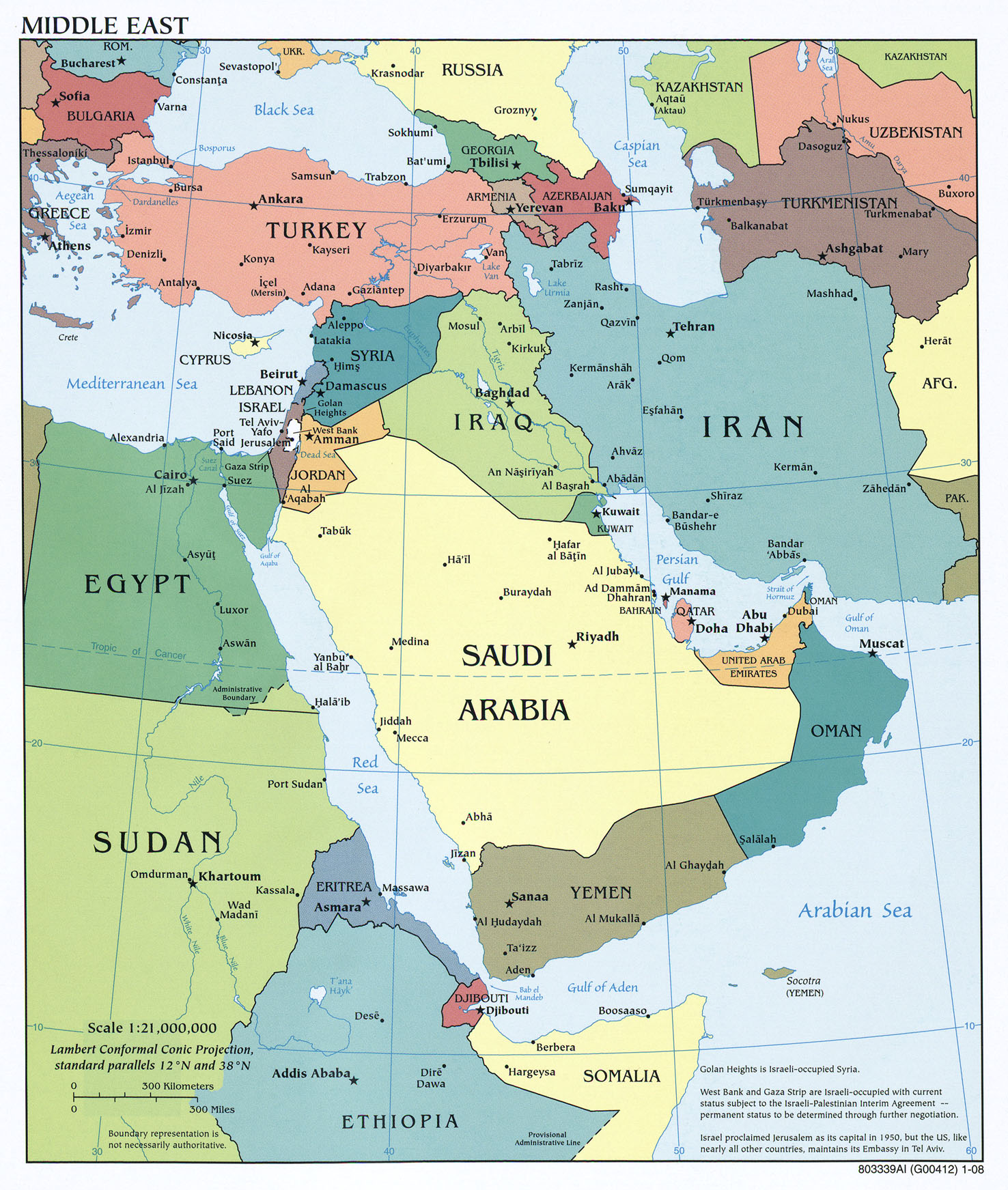
The general idea that Syria’s neighbors hold the keys to a lot of oil certainly comes as little surprise to anyone with a cursory knowledge of the Middle East. But, the salient fact about the Syrian conflict is that it is a civil war. So, why is an American president so concerned about a war within the country?
That question leads to a second and even more salient fact. This civil war has now become a proxy for the Shia-Sunni split in the Muslim faith. Don’t think: Catholics and Protestants in the United States. Rather think: Catholics and Protestants in Northern Ireland where a wide range of nonreligious issues sparked violence between the two groups for decades.
The split isn’t just between countries that are predominantly Shia and predominately Sunni. It is, as Syria is showing, a split within many Arab nations which have citizens of both sects. So, there is not only the potential for conflict between nations in the Middle East, but also for the spread of civil unrest and civil war to other nations in the region. Iraq continues to demonstrate that this fear is not just hypothetical as bombings perpetrated in the name of minority Sunnis continue to vex a country which has experienced a long civil conflict between Shia and Sunni after the U.S. invasion.
The spread of that kind of chaos would be very bad for oil supplies. Witness what has happened to Syrian oil production. It has fallen from 367,100 bpd in 2010 to just 157,200 bpd as of the end of last year. That’s a decline of 57 percent in two years. That kind of decline in Middle East oil production would have catastrophic effects on an already iffy world economy, one absolutely dependent on oil for its smooth functioning.
The United States, as it turns out, has already been aiding the rebels for some time. The idea behind the aid may have been that the current regime might fall quickly, and the United States and its allies would have a solid relationship with those who take over.
With the stalemate continuing it’s not obvious what strategy will work best to achieve America’s number one goal in the region: stable oil production. One think tank academic even suggested that an ongoing stalemate was in America’s best interests. Clearly, he doesn’t believe the Shia-Sunni split will lead to conflict between or within other countries, at least on a scale that would prove troublesome.
But, there is one final consideration. After all we’ve been hearing about American energy independence, about growing domestic oil production, and about America being able to disengage from oil-exporting dictatorial regimes in the Middle East and elsewhere, the president seems as engaged as ever in the region.
There are three reasons for this: First, right now the United States imports just under half its oil needs. We produce a little over 7 million bpd and consume about 14 million bpd. Second, no realistic nonindustry assessment of future U.S. oil production suggests we’ll stop needing substantial imports. Third, oil is traded in a world market, and its price is determined by world supply and demand. Any disruption in Middle Eastern oil supplies would lead to much higher prices which would ripple through the U.S. economy no matter how much we produce domestically.
The worldwide concern over Syria tells us that oil supplies remain tight and consuming nations remain very concerned about disruptions to supply. The oil price continues to hover near all-time highs when compared to the average daily price in 2011 and 2012, both record years. As the United States prepares plans for intervening militarily, there is not only much at stake in human terms, but also most assuredly in terms of critical oil supplies.
6 Comments on "What Syria tells us about world oil supplies"
bobinget on Sun, 1st Sep 2013 8:55 pm
In all the excitement over Syrian proxy wars there were three other oil related stories you may have overlooked.
<<Gunmen opened fire on the motorcade of Yemen's Prime Minister Salem Basindwa on Saturday, but he escaped unhurt, an aide said.
Ali al-Sarari, an adviser to the premier, said the attack happened in the evening in Sanaa while Basindwa was returning home from his office.
Sarari said Basindwa's guards identified the license plates of the car used in the attack and security forces were trying to track it down after the assailants fled the scene.
Yemen’s Information Minister Ali Al Amrani said his convoy also came under fire Friday.
U.S. allied Yemen is grappling with a host of challenges, foremost of which an al-Qaeda threat, as it tries to restore state control over the country after months of turmoil in 2011 that saw long-serving President Ali Abdullah Saleh step down.(snip)
<<Several people were killed in a mortar attack at an Iranian dissident camp in Iraq early Sunday morning, according to security and Iraqi government sources.
Accounts differ about how many people died, and it was not immediately clear who fired the mortars. The Paris-based National Council of Resistance of Iran said members of its Mujahedeen-e-Khalq (MEK) affiliate died early Sunday in a raid early that it blamed on Iraqi security forces. Spokesman Shahin Gobadi says as many as 34 were killed.
The MEK told Reuters news agency in an emailed statement that Iraqi security forces machine-gunned some members of its camp, who had their hands tied behind their backs.
Ali al-Moussawi, a spokesperson for Iraq’s prime minister, told The Associated Press that a preliminary investigation suggests some camp residents died as a result of infighting. He denied that Iraqi forces were involved.
Iraq’s government considers the MEK’s presence in Iraq illegal and wants its followers to leave. It has previously launched deadly raids on the camp northeast of Baghdad. (snip)
AFRICA:
<<<At least 24 members of a vigilante group in northeastern Nigeria have been killed in an ambush during a botched attempt to arrest Boko Haram members, security officials said.
The officials said fighters from the rebel group wearing army uniforms ambushed more than 100 vigilantes on Friday.
"They were ambushed even before they got to the Boko Haram camps," one of the youth vigilantes Masta Moh'd, who was not present during the attack near the town of Monguno in Borno state, but had heard from several of the survivors, told the Reuters news agency on Saturday.
He said more than 100 of the vigilantes had participated in the raid, which turned sour when the fighters, seen as the main security threat to Africa's top energy producer, ambushed them as they entered the town's outskirts.
Officials claim another 34 people are missing after the attack.
A member of the government's mixed military and police Joint Task Force, who declined to be named, confirmed the death toll from the incident as 24.
(snip)
bobinget on Sun, 1st Sep 2013 9:06 pm
In order to get US military assistance you must be an oil producer. Unless of course you are Israel. Unless…..
<<>> (snip)
We don’t see the US military going into the DRC
but we do see activity in South Vs northern Sudan.
bobinget on Sun, 1st Sep 2013 9:06 pm
left off above;
(Reuters) – A new Israeli offshore natural gas field has estimated reserves of 1.8 trillion cubic feet (tcf), the companies developing the field said on Sunday.
The Karish field, about 100 km (62 miles) off Israel’s coast, was the latest in a series of discoveries in recent years in the eastern Mediterranean, though it is much smaller than the nearby Tamar and Leviathan fields that turned Israel into a potential gas exporter.
It also holds an estimated 12.7 million barrels of condensate, the Israeli partners in the project, Delek Drilling and Avner Exploration, said.
The 1.8 tcf estimate, given in a resources report by petroleum consultants Netherland, Sewell & Associates, is similar to a preliminary estimate made by Texas-based Noble Energy, which is leading the development of the well.
The announcement came as Israel is settling on its export policy. The government last month decided Israel would keep most of its reserves for domestic use and allow 40 percent to be sold abroad, though some lawmakers are still trying to get the export quota lowered.
“This is further proof of the strength of Israel’s energy market and the importance of continued exploration – because if you search, you find,” Avner chief executive Gideon Tadmor said.
BillT on Mon, 2nd Sep 2013 2:59 am
“…America’s number one goal in the region: stable oil production…”
Really? ouldn’t diplomacy work better? How did Iraq make oil more available to the US? Fact: It didn’t. for over 10 years, it has decreased the supply and now it will go to China.
No, it is still about the petro dollar, not oil directly. And the US is losing that battle now that China, Russia, Japan, India, Brazil, etc are all trading in other currencies.
Feemer on Mon, 2nd Sep 2013 6:41 pm
Syria in my opinion is not purely about oil. Although the outcome of the war will effect how stable the region is, which does effect oil production. If Assad wins, hezbolla and Iran have a serious ally. Not only that, Iran can buy weapons from Syria, which buys weapons from Russia. Russia wants to keep selling weapons to Syria, so it will veto any Security council vote. If we intervene and topple Assad, then Syria becomes a haven for Al Qaeda and all of Assad’s weapons (including the chemical weapons) fall into their hands. If we do attack, Iran says it will retaliate and attack Israel, and close the strait of Hormuz, cutting off 20% of oil (~17 million barrels). Unfortunately, Iran could actually hold the strait for quite awhile, what with its mines and rockets along the coast.
Sticky Ricky on Wed, 4th Sep 2013 5:03 am
American wars in the middle east were predicted years ago by peak oil and Olduvai proponents. Now we debating what the wars are about because they choose to slap a chemicals weapon ban label or whatever on the box? It’s funny how clear things are in the past but when they actually happen we then wonder why. It’s no surprise that it’s happening. It is downright alarming as it suggest shortages are imminent. Why else would the US waste so much resources over there. No matter how you dress it up any US involvement is directly or indirectly about oil. I don’t think people are really aware how important oil is.