
Peak Oil is You

Donate Bitcoins ;-) or Paypal :-)


Page added on July 8, 2015

What Greece, Cyprus, and Puerto Rico Have in Common

We all know one thing that Greece, Cyprus, and Puerto Rico have in common–severe financial problems. There is something else that they have in common–a high proportion of their energy use is from oil. Figure 1 shows the ratio of oil use to energy use for selected European countries in 2006.
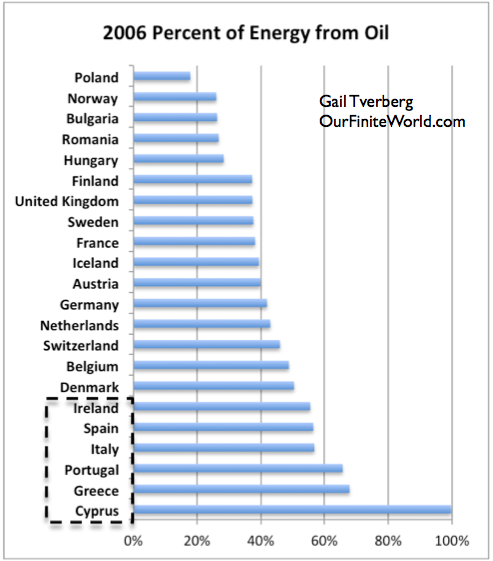
Greece and Cyprus are at the bottom of this chart. The other “PIIGS” countries (Ireland, Spain, Italy, and Portugal) are immediately above Greece. Puerto Rico is not European so is not on Figure 1, but it if were shown on this chart, it would between Greece and Cyprus–its oil as a percentage of its energy consumption was 98.4% in 2006. The year 2006 was chosen because it was before the big crash of 2008. The percentages are bit lower now, but the relationship is very similar now.
Why would high oil consumption as a percentage of total energy be a problem for countries? The issue, as I see it, is competitiveness (or lack thereof) in the world marketplace. Years ago, say back in the early 1900s, when countries built up their infrastructure, oil price was much lower than today–less than $20 a barrel (even in inflation-adjusted dollars). Between 1985 and 2000 there was another period when prices were below $40 barrel. Back then, the price of oil was not too different from the price of other types of energy, so an energy mix slanted toward oil was not a problem.
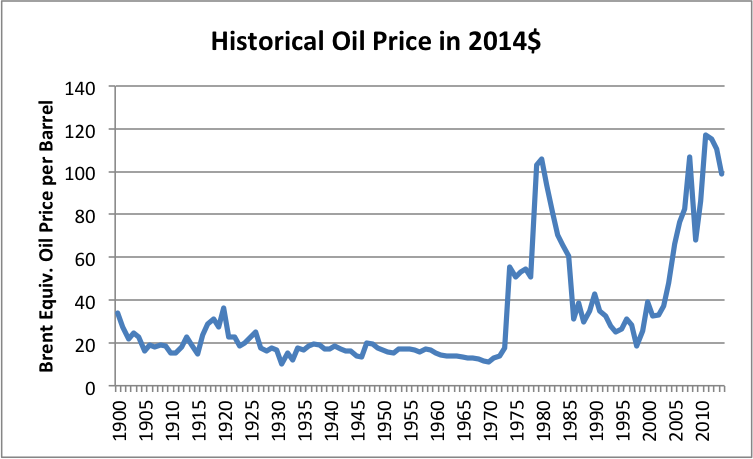
Oil prices are now in the $60 barrel range. This is still high by historical standards. Furthermore, much of the financial difficulty countries have gotten into has occurred in the recent past, when oil prices were in the $100 per barrel range.
While countries with a large share of oil in their energy mix tend to fare poorly, at least some countries with a preponderance of cheap energy fuels in their energy mix have tended to do very well. For example, China’s economy has grown rapidly in recent years. In 2006, its share of oil in its energy mix was only 23.0%, putting it below Norway but above Poland, if it were included in Figure 1.
Let’s look a little at what it takes for an economy to produce economic growth, and what goes wrong in countries with high energy costs. I should mention that high energy costs can occur for any number of reasons, not just because a country’s energy mix includes a large proportion of oil. Other causes might include a high percentage of high-priced renewables or high-priced liquefied natural gas (LNG) in a country’s energy mix. The reason doesn’t really matter–high price is a problem, whatever its cause.
What Is Needed for an Economy to Grow
The following reflects my view regarding what is needed for an economy to grow:
1. A growing supply of energy products, either internally produced or purchased on the world market, is needed for an economy to grow.
The reason why a growing supply of these energy products is needed is because it takes energy (human energy plus supplemental energy) to make goods and services.
The availability of today’s jobs is also tied to the use of supplemental energy. High-paying jobs such as operating a bull-dozer, producing large quantities of food on a farm using modern equipment, or operating a computer, require supplemental energy in addition to human energy. While jobs can be created that use little supplemental energy to leverage human energy (for example, manual accounting without electricity or computers, growing food without modern equipment, or digging ditches with shovels), these jobs tend to pay very poorly because output per hour worked tends to be low.
To obtain growth in the number of jobs available to workers, a growing supply of energy products to leverage human energy is needed. Looking at the world economy, we can see that historically, growth in energy consumption is highly correlated with economic growth.

In fact, we tend to need an increasing percentage growth in energy supply to produce a given percentage growth of GDP because the y intercept of the fitted line is -17.394, rather than 0.000. Back in 1969, 1.0% growth in the consumption of energy products produced 2.2% GDP growth. The fitted line implies that recently, the amount of GDP growth associated with one percentage growth in energy consumption is only 1.2% of GDP. This poor result is taking place, despite all of our efforts toward increased efficiency. Thus, as time goes on, we need more and more energy growth to produce the same level of GDP growth. This is a rather unfortunate situation that world leaders don’t mention. They tend to focus instead on the fact that the growth in GDP tends to be at least a little higher than the growth in energy use.
2. This growing energy supply must be inexpensive, in order to be able to create goods that are competitive in the world market.
Human energy is by its nature expensive energy. Humans require food, water, clothing, and housing to support their biological needs–we are not adapted to eating entirely uncooked food, or to living in climates that get very cold in winter, unless we have protection from the elements. Thus, wages must be high enough to cover these costs.
Cheap supplemental energy provides a great deal more leveraging power than expensive supplemental energy. If we can leverage human energy with cheap energy such as wood or fossil fuels, it is easy to bring down the average cost of energy. (This calculation is made on a Calorie or Btu basis, for the sum of the energy provided by human labor plus that provided by supplemental energy.) If we are dealing with supplemental energy that is by itself high-cost, it is very difficult to bring down this weighted average cost. This is why high-cost oil, or for that matter high-cost supplemental energy of any kind, is a problem.
If human energy can be leveraged with increasing amounts of cheap energy, it can produce an increasing amount of goods and services, ever more cheaply. In fact, this seems to be where economic growth comes from. These goods and services can be shared with many parts of the economy, including government funding, wages for elite workers, wages for non-elite workers, payback of loans with interest, and dividends to stockholders. If there are enough goods and services produced thanks to this increased leverage, all of the various parts of the economy can get a reasonable share, and all can adequately prosper.
If there is not enough to go around, then there are likely be shortfalls in many parts of the economy at once. It is likely to be hard to find good paying jobs, for ordinary “non-elite” workers. Governments are likely to find it difficult to collect enough taxes. Governments may lower interest rates, or may take other steps to make it easier for businesses to continue their operations. Even with lower interest rates, debt defaults may become a problem. See my post, Why We Have an Oversupply of Almost Everything. The entire economy tends to do poorly.
Ayres and Warr provide an illustration of how an increasingly inexpensive supply of energy can lead to greater consumption of that energy–in this case electricity–in their paper Accounting for Growth: The Role of Physical Role of Physical Work.
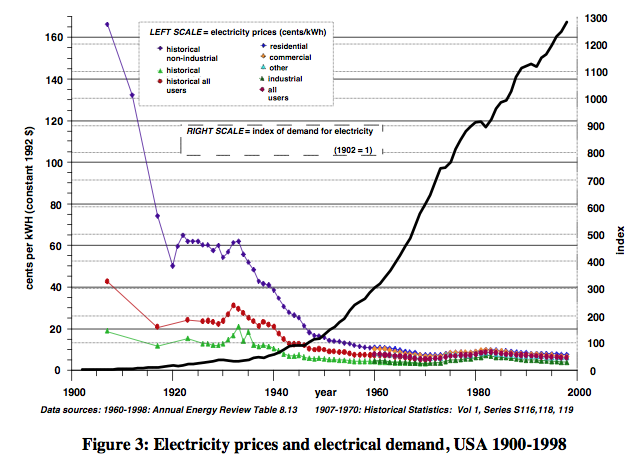
There is a logical reason why falling energy prices would lead to rising use of an energy product. If a person can afford to buy, say, $100 worth of energy and the cost is $1 per unit, the person can afford to buy 100 units. If the cost is $5 per unit, the person can afford to buy 20 units of energy. If it is the energy itself that aids growth in economic output (by moving a truck farther, or operating a machine longer), then lower energy prices lead to more energy consumed. This higher amount of energy consumed in turn leads to more economic output. This greater economic output is frequently shared with workers in the form of higher wages because of the workers’ “higher productivity” (thanks to the leveraging of cheap supplemental energy).
When it comes to the cost of energy production, there are “tugs” in two different directions. In one direction, there is the savings in costs that technology can provide. In the other, there is the trend toward higher extraction costs because companies tend to extract the cheapest resource of a given type first. As the inexpensive-to-extract resources are exhausted, the cost of resource extraction tends to rise. We can see from Figure 2 that oil prices first began to spike in the 1970s. After some temporary “fixes” (shifting much electrical production away from oil to cheaper fuels, shifting home heating from oil to other fuels, and starting new extraction in Alaska, Mexico, and the North Sea), the problem was more or less solved for a while. The problem came back in the early 2000s, and hasn’t really been solved. Thus, most of the tug now is in the direction of higher costs of production.1
Once oil prices rose, Greece and other countries that continued to use a high percentage of oil in their energy mix were handicapped because their products tended to become too high-priced for customers. Wages of customers did not rise correspondingly. Potential tourists could not afford the high cost of airline tickets and cruise ship tickets, because these prices depended on the price of oil. Even when oil prices dropped recently, airline companies have not reduced airline ticket prices to reflect their savings.
Because of the high-cost energy structure, manufacturing costs have tended to be high as well. With fewer tourism jobs and few possibilities for making goods for exports, the number of good-paying jobs has tended to shrink. Without enough good-paying jobs, Greek demand for fuel products of all kinds dropped rapidly. (Demand reflects the amount of goods a person wants and can afford. Young people without jobs live with their parents, and thus do not buy new homes or cars, lowering consumption.)
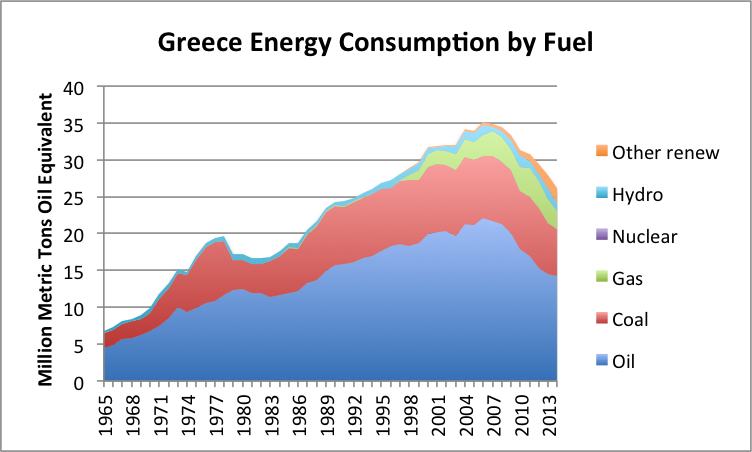
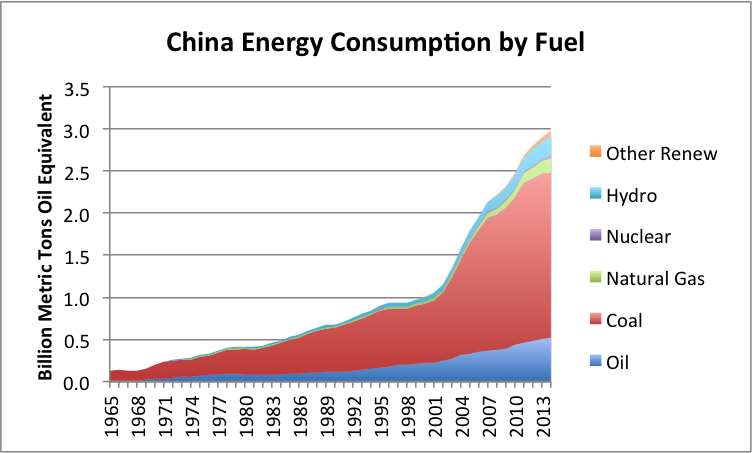
Other countries that were positioned to add huge amounts of inexpensive energy were able to continue to continue to grow. The country that did this best was China. It was able to cheaply and rapidly ramp up its coal supply, once it entered the World Trade Organization in 2001. If Greece now adds production of goods, it needs to be able to compete in price with China and other goods-producers.
3. If the energy supply that a country plans to use is cheap, it doesn’t matter whether the energy supply is locally produced or not.
If the energy supply that a country is locked into using is expensive, then using locally produced high-priced energy is “less bad” than using imported energy, but there is still a problem.
If a growing supply of cheap energy is available, this can be used to leverage local human labor to produce inexpensive goods. This works well, regardless of whether the fuel is imported or not. Because imported energy “works” in such a situation, many island nations (including Cyprus and Puerto Rico) were able to develop their economies using oil as the energy base. These island nations typically did not have natural gas available, unless they imported expensive LNG. Coal and nuclear were also difficult to use, because power plants of these types are built on too a large scale to be suitable for on an island. But oil generally worked well, even if imported.
Greece includes 227 inhabited islands, and thus is faced with many of the problems of an island nation. Back when oil was cheap, oil was an easy solution. It could be used for electricity and for many processes that require heat, such as baking bread, dying cloth, making bricks, and recycling metals.
If a county is using imported oil, once oil becomes high-priced, there is essentially nothing that can be done to fix the problem. Devaluing the currency doesn’t work, because then oil becomes higher-priced in the new devalued currency. As a result, it still is prohibitively expensive to make goods, even after the devaluation. In fact, devaluing the currency also tends to make other imported energy products, such as LNG and solar PV panels, more expensive as well.
With respect to previously purchased renewables, the ongoing cost is typically the debt payments for the devices used to generate this energy. How devaluation will affect these payments depend on the currency the debt is in. If these debt payments are in the country’s own currency, then devaluing the currency will not affect the payments (so devaluation won’t help reduce costs). If debt payments for renewables are in another currency (such as the dollar or Euros), then devaluing the currency will increase the cost, making the loans more difficult to repay.
Even for an oil exporter like Saudi Arabia, high-priced oil is a problem, for a number of reasons:
- If the oil exporter uses some of its oil itself, the revenue that would have been gained by selling this oil abroad is lost. The government may be able to purchase the oil for essentially the cost of extraction, but it loses the extra revenue that it would gain by selling the oil abroad. This revenue could be used to fund government programs and new oil investment.
- The countries that import this high-priced oil tend to find their economies depressed, leading to less use of the oil. Thus, oil exports tend to become depressed.
- The price of oil may fall (and in fact has fallen, and may fall more), because of low demand. With low prices, it becomes difficult for exporters to collect enough revenue for government projects and investment in new supply.
The reason why locally produced high-priced oil is “less bad” than imported oil is because jobs related to producing the oil tend to stay in the country. This is a plus, in itself. If there is a currency devaluation, wage costs and other local costs will be lower, making the energy product less expensive to produce. Unfortunately, production costs (including taxes needed to support government services) may still be above the market price, because of depressed demand.
4. Debt helps increase demand for goods. But to make the debt repayable, these goods need to be made with low-priced energy products.
Ramping up debt for a country helps, but only if, with this debt, the country is able to profitably sell more goods and services in the world marketplace. Greece seems to have added debt, but wasn’t able to use this debt to create goods and services that could be sold cheaply enough that their prices would be competitive in the world market.
China clearly has been willing to add huge amounts of debt to support all of its new industry and new homes it has built with the coal it has been extracting. There is no doubt that the growth in China’s debt has played a major role in extracting growing quantities of coal. Now China’s coal consumption is slowing for a number of reasons including overbuilding of factories, too much pollution, and higher cost of coal production. China’s slowdown in energy consumption is leading to a slow-down in economic growth, and may even lead to a hard crash.
Greece has added a lot of debt in recent years, but this debt has not been used for ramping up the use of a new cheap supply of energy. Much of Greece’s debt seems to be for purposes such as bailing out banks. This doesn’t really tell us what is/was wrong with the economy to begin with. I would argue that high-priced fuel tends to make it difficult to make any kind of goods or services inexpensively enough to compete in the world market, and this is at least part of the problem. The result of this is that companies, no matter what they invest debt in, have a difficult time being profitable.
The Greek government tries to cover up the country’s problems with programs that are funded by debt. Hidden subsidies may be occurring in several government-owned energy-related firms: Public Power Corporation of Greece (Greece’s largest electric utility), Hellenic Petroleum, DEPA Natural Gas, and ADMIE Grid Operating Company. There have been proposals to privatize these companies because they are poorly run. Whether or not they are poorly run, I expect that it will be very difficult to run them profitably, simply because of the inherent high-cost nature of the products they produce and workers’ lack of disposable income. This problem reflects the high cost of the underlying products they are producing.
There have been some proposals to try to get energy costs down, including a proposal to install a new lignite coal-fired electric power plant. There is also a plan to connect four of the islands to the electric grid, so that the islands won’t have to depend on oil-fired electricity. Even if these changes are made, it is not clear that Greece’s energy costs will be low enough to produce goods that are competitive in the world market. For one thing, airplanes and cruise ships operate using oil, not electricity produced by lignite, so will not be affected by additional inexpensive lignite electricity production.
From everything I can see, Greece’s debt needs to be written off. There is no way that the country can change its system to repay it. Greece can perhaps repay a little new debt, if it is channeled to support low-cost energy production to substitute for current high-cost energy.
Conclusion
Most people don’t understand that our world economy runs on cheap energy. High-priced energy is not an adequate substitute, even if the high-priced energy is “low carbon” or claims to have a reasonably high EROEI (Energy Return on Energy Invested) ratio. Our world economy is sensitive to prices and costs, even if the current “politically correct” discussion ignores these matters.
Economies that are part of our current system can’t get along without energy supplies, either. Humans have used supplemental energy since our hunter-gatherer days, when we learned to control fire. In fact, the use of large amounts of supplemental energy seems to be the way we are now able to support a world population of 7+ billion people.
Given that the world economy runs on “cheap” energy, adding expensive energy production, no matter how “green” it may appear to be, does not solve a country’s financial problems. In fact, it likely tends to make its financial problems worse. There is no way that high-priced energy will produce goods and services that are competitive in the world market. In fact, it is doubtful that high-priced energy will return a high enough “profit” to pay its own way, in terms of having the ability to pay suitable taxes to support required government services, such as schools and roads. High-priced energy is instead likely to need government subsidies, both for initially building the devices and for helping citizens pay the ongoing cost of electricity.
Greece clearly has a lot of problems besides its high-energy cost, including excessive pensions and inefficiently operated state-owned companies. To some extent, I expect that these other problems reflect the difficulty of creating goods that can compete profitably in the world economy. If there is no way businesses can successfully compete in the world economy, I can see why leaders would do whatever they could to keep the system operating. This might mean adding more debt, keeping staffing at government-operated companies at higher levels than needed, and providing overly generous pension programs.
The thing that Greece has going for it is a relatively warm climate and a history of doing well with relatively little supplemental energy. Ancient Greece was known for its philosophy, literature and theatre, music and dance, science and technology, and art and architecture. Northern Europe, because of its cold climate, was not able to do very much until it added peat moss and coal as supplemental energy. Once these cheap supplemental energies were added, Northern Europe was able to industrialize, while Southern Europe lagged behind. If we are running into obstacles now with respect to fossil fuels, perhaps the advantage will again go back to people who live in warm enough climates that they can mostly live without supplemental energy.
28 Comments on "What Greece, Cyprus, and Puerto Rico Have in Common"
Plantagenet on Wed, 8th Jul 2015 2:42 pm
Greece, Cyprus and Puerto Rico all have HUGE potential wind resources. Greece and Cyprus also may have giant NG fields.
If their governments weren’t so screwed up, they would be leasing and developing these energy resources and growing rich.
Davy on Wed, 8th Jul 2015 2:47 pm
Gail, what about corruption? I think that is the biggest issue for the decay we are seeing.
Nony on Wed, 8th Jul 2015 3:05 pm
Island countries tend to have more oil use as opposed to natural gas because of the cost of transport. LNG may not be competitive with fuel oil. And it takes a lot to justify a subsea pipeline.
Cyprus is probably lacking a pipeline to the rest of the Euro NG network.
Ireland does have one for North Sea gas and has some onshore gas in Cork, but still the capacity is limited.
Greece is obviously not an island, but is a bit off the beaten track, down at the bottom of the Balkans. Probably not well tied into the network. Yeah, there are some lines, but what is the capacity? Also, given the topography of the country, would not be surprised if the distribution off the main lines is limited.
For either Greece or Cyprus, if they develop their offshore fields, that may lead to more internal consumption, at the expense of fuel oil.
I have looked at gas supply to a reasonably big island in the past. It is a big investment decision. Puerto Rico probably lack NG pipeline (or onshore sources). Hawaii is an easy similar example.
PR and HI are also impacted by Jones Act.
Plantagenet on Wed, 8th Jul 2015 3:12 pm
Hi Nony
Welcome back. Hope you’re having a great summer.
We both forget to mention SOLAR power. Greece, Cyprus and PR should be building out their solar grids like crazy.
Westexasfanclub on Wed, 8th Jul 2015 3:32 pm
There is no money left for building out solar grids. They are paying back their debt. As money is enrgy – there goes your energy investment…
Plantagenet on Wed, 8th Jul 2015 3:43 pm
@fanclub
You didn’t understand my posts.
Countries like Greece have huge wind and solar resources, and possibly large submarine NG fields.
They should hold LEASE sales on these resources like the US does. The government leases the land to private developers and earns revenues from the leases. Private companies develop the oil, NG, solar, etc. The government then taxes the revenue earned by the private company. Its a win-win.
I can see why a hard left government in Greece might not understand that idea, but I would’ve thought you’d get it.
Richard Ralph Roehl on Wed, 8th Jul 2015 3:44 pm
What do Greece, Cyprus and Puerto Rico have in common?
A culture of malfeasance and institutional corruption… and a semi-illiterate population that eschews accountability. I could continue… but I don’t want to piss people off.
Oh wait. My criticism sounds like a description of Amerikans. What a coincidence!
apneaman on Wed, 8th Jul 2015 4:25 pm
RRR, sound like Canada too. We have come/fallen a long way in one short decade.
tahoe1780 on Wed, 8th Jul 2015 4:46 pm
Interesting that much of the money lent to Greece by Germany and France is routed right back to those economies…
http://www.lepointinternational.com/it/politica/europa/550-the-submarine-deals-that-helped-sink-greece-.html
http://www.sott.net/article/298524-Greek-military-spending-the-real-cause-for-its-economic-collapse-not-public-spending kickbacks
http://www.theguardian.com/world/2012/apr/19/greece-military-spending-debt-crisis
brianr on Wed, 8th Jul 2015 5:06 pm
Puerto Rico has at least one wind farm near the coast on the South East part of the island. The South Coast is perpetual sunshine. In all the times I’ve traveled to my house in Ponce, I don’t think I’ve ever seen but a few wispy clouds. As far as corruption goes, with my few contacts in the Puerto Rican government in San Juan, it seems remarkably rather honest, albeit slow to issue permits. I’ve been restoring a Neo Classical mansion, and not a single local or San Juan agency or department has ever given the slightest indication that they needed some “grease” to speed up the process. It seems to be the same price for everyone. Yes, there’s a lot of poverty, and I would guess that the educational system is inadequate, but all the Puerto Ricans I’ve met and come to know are honest and hardworking. Puerto Rico has clean air, lots of water in the mountains, fertile soil, plenty of inexpensive labor and real estate, nice people, and so I think they have a chance of surviving the worst of what is coming to us all.
BobInget on Wed, 8th Jul 2015 5:31 pm
Puerto Rico is losing its best people to New Jersey.
MSN Fanboy on Wed, 8th Jul 2015 5:37 pm
You Sir, are a Solar Windmill Plant!
Ahh there! Stick it to the Plant!
Love You!
BobInget on Wed, 8th Jul 2015 5:38 pm
2006 is nine years ago.
2014 maybe, give Gail a pass.
I lived in Old San Juan for a winter. Sold US auto parts overnight delivery out of Miami. Did good till all my customers began buying direct.
Makati1 on Wed, 8th Jul 2015 8:45 pm
brianr, I am glad to hear that Puerto Rico is not much different from the one I visited in the mid 70s. I thought it would be a good place to live then and it sounds like a good place to live now.
I would guess that the IMF and WB, not to mention the TBTF banks, had a hand in it’s loan problems. They are the West’s Mafia for 3rd world countries. Now they have turned on the West.
Jimmy on Wed, 8th Jul 2015 10:27 pm
As recently as 2012 Cyprus still gets approx 96% of electricity from oil sources of energy.
http://data.worldbank.org/indicator/EG.ELC.PETR.ZS
World Bank has some good charts on oil, coal and natural gas powered electricity generation.
Jimmy on Wed, 8th Jul 2015 11:42 pm
Here’s an article with some 2014 energy consumption numbers on Greece. Oil is still over 50% of the energy mix.
http://euanmearns.com/greek-tragedy/
Energy crunch induced collapse is creating more and more failed states every year. Greece only has one hope: a natural gas life -ine from Russia.
Speculawyer on Thu, 9th Jul 2015 10:53 am
And you know what they also have? A good opportunity to install lots of solar PV and wind turbines so they can get off that expensive oil.
Of course, they lack the access to capital to do it now. :-/
It is wise to move to renewables when you can so that you don’t get slammed when fossil fuels spike up.
solarity on Thu, 9th Jul 2015 11:08 am
Puerto Rico (and possibly Cyprus) should be able to grow tons of sugar cane, like Brazil and Hawaii. All vehicles in HI currently run on 80/20 flex fuel, (as mandated by the state).
Makati1 on Thu, 9th Jul 2015 9:07 pm
solarity, so PR should destroy their country to grow sugar to run vehicles they don’t need? Typical capitalist mindset. lol. And Hawaii is not a good example of ‘independence’.
“Hawaii’s largest imports are crude and petroleum oil, with a total 2013 estimated value of slightly over $3 billion. Hawaii also imports aircraft, passenger vehicles, coal, semiconductors, jewelry, precious metals and propane.
Hawaii’s exports include aircraft parts, light oils and petroleum, ferrous scrap, fresh shrimp, aluminum waste and scrap, cocoa preparation, stainless steel scrap and paintings and drawings… Because of its remote location in the Pacific Ocean, consumer product prices are higher, since so many goods must be imported… When Hawaii became a U.S. territory in 1898, its exports included sugar and fresh fruits, but as of 2013, sugar is not among Hawaii’s top exports, and the only fresh fruit Hawaii exports in large numbers are papayas.”
“No longer exports large amounts of sugar.” Instead, it is wasted as fuel.
joe on Fri, 10th Jul 2015 2:19 pm
People here really don’t get it. Greece was a problem created on purpose by those negotiating the deal the Greek government. The Greek liquidity crisis and IMF default happened because the previous Greek governmemt accepted a forced loan from the ECB TO BAIL OUT CYPRUS. The Irish paid their taxes and almost ended up in the same position as the Greeks, it’s because capitalism must have eternal growth, that includes physical as banks lend to construction, then it needs sucker to get loans to buy houses, then it gives them credit to fill their new houses with crap. Thats it. All governments use deficits to stimulate initial collateral to get the snowball rolling, when the credit crunch came in 08, the US had the same problem as Greece, the US though simply printed money and spent it all on stocks and bailouts, Greece can’t do that because it’s a part of a new emerging country call the EU. The EU is still not sure how to manage itself, and this will not be the last time this happens either. It’s as much a learning curve for the banksters as for anyone, and it seems they are still going to get the deal they wanted, even after the fake no vote. They don’t listen to nation states anymore, it happened in Ireland, France, and now Greece.
apneaman on Fri, 10th Jul 2015 10:46 pm
“Tsipras Has Just Destroyed Greece”
“This is basically the same proposal as that was just rejected by the Greek people in the referendum…This makes absolutely no sense. The Tsipras Government has just:
renegotiated itself into the same position it was in two months ago;
set massively false expectations with the Greek public;
destroyed the Greek banking system, and
destroyed what was left of Greek political capital in EU.
If this deal gets through the Greek Parliament, and it could given everyone other than the ruling party and Golden Dawn are in favour of austerity, then Greece has just destroyed itself to no purpose.”
http://www.nakedcapitalism.com/2015/07/tsipras-has-just-destroyed-greece.html
Boat on Fri, 10th Jul 2015 11:15 pm
Rule #1 when living in a capitalist country. Don’t borrow money if you can’t make a payment. #2 Don’t look for another loan if you can’t pay back the one you took out. #3 Suck it up and take it like a man. Leave your country in good shape for the next generation.
Northwest Resident on Sat, 11th Jul 2015 1:38 am
apneaman — It looks bad for Tsipras. But not as bad as it does for the European Union. Buying a little more time, that’s what Tsipras caved in to. That’s all that’s left, not just for Greece, but for most of the rest of the world too. These days, every policy decision, every propaganda theme, every move at any high level is just dedicated to one goal — to buy a little more time. Personally, I’ll be glad if Greece capitulates and signs up for EU (German) demands. Sure, that will mean Greeks are totally screwed, but aren’t we all? This will slow their descent a little, and temporarily avoid a total EU meltdown and all the contagion that goes with it. Anyway, China is the big domino in the line-up, teetering precariously. I truly admire how TPTB are keeping it all going, despite all odds. They must be working long hours, sweating bullets, waking up in cold sweats from their short fitful sleeps. Greece is a sideshow to the main event, just one of many. Hope you have a lot of popcorn on hand — I sure do. This show is just getting started.
joe on Sat, 11th Jul 2015 1:58 am
China placed forced loans on its own companies, it stopped most selling and flooded the markets with money. ‘Free’ market capitalism at its best. This only the beginning of a world where nobody stands up to bankers and monied interests. Read Dickens, that’s the future they want, when people have total control over their property and people ‘live within their means’. I wouldn’t even be all that worried about the debt system if they shared more of the profit, now days the only way an unskilled worker can make extra money is to work themselves to death or to turn to crime of some form. The banking system supports usury which is immoral and in more sustainable (so called middle ages) times it was against the law. But I guess people are doomed to make the same mistakes until there are no more people.
Apneaman on Sat, 11th Jul 2015 2:07 am
It’s a pickle for sure NWR. Same as climate change and global dimming. If/when enough industrial pollution halts, with in a matter of a week or two the temperature will shoot up. Some of the estimates are as much as 1.5 degrees C from where we are currently. That will be hellish, but convenient for popping the pop corn.
Life Ain’t Easy
https://www.youtube.com/watch?v=Lvlf7FnEbHs
Davy on Sat, 11th Jul 2015 2:40 am
N/R, I am reading everything I can on finance now and what I am seeing is a focus on China. It appears the Chinese “May?” have stopped the hemorrhaging of the market by unprecedented actions.
The real issue is not so much broken equity markets. The issue is the knock on effect to overall growth that was already suffering from housing bubble deflating, exports dropping, and deleveraging local governments.
This is now systematic and endemic. China is clearly at the cusp of descent. This means the world is. Forget Greece because Greece is the size of Michigan. The EU is notorious about kicking the can down the road politically and economically. We are talking a country the size of the US and EU economically and double the US & EU in population in descent.
This is the end game economically in my mind. What I can’t tell you is the long or short of it. Since the markets globally are rigged this could play out for some time financially before the tensions force a global collapse. I am leaning towards a position it will take two or more conditions to bring globalism down. We will need some kind of peak oil dynamic and this financial mess. To make it more powerful throw in a geopolitical war.
Anything could happen at this point because this is clearly uncharted waters. I say this because some believe we are near a collapse. I am saying this could drag on 10 years with pressures building or it could happen tomorrow. What is clear there is probably no hope of getting out of this mess. If you are cornucopian then you are delusional.
BTW would you trust a country like China with a currency that practices these unprecedented actions? No. So much for the Asian and Brick banks. Not much talk about them lately. I am no fan of what the US did or the dollar but I will spit in the face of Asiaphile agendas here.
joe on Sat, 11th Jul 2015 7:39 am
Agreed. The conditions around the previous global unrest was all about which western imperialist power would be able to exploit middle east, Asia, and Africa. The issue today is how does the nation’s which have come out the other side of that 100 yr period work together without ideology to exploit their real enemy, poor people. China is an example of a nation which is much like greece now in that it faces a serious question about the point of nationhood, China stamped all over the reformers in 1989, then went all out to reform, ie it would only reform on communist party terms, not anyone else’s. It’s an example of what can be done when a nation has power over its own currency. The down side is that China is now becoming a ‘developed’ economy. There’s only so many mag – lev trains to build to Tibet. Eventually there is a point where supply outstrips demand, in market terms it’s called overheating. All China really has to do is to let it’s currency increase in value, but given that it’s a rich nation without freedom it’s simply not flexible enough to be able to absorb the changes as they happen, for example, people still need permits to live in Beijing, in a downturn people would be able to pick up property cheaply, but instead they are forced to spend their money in London because there is less red tape! Without reform then all the market games in the world won’t help and we really will have not moved far from 1989.
joe on Sat, 11th Jul 2015 8:46 am
Also noted in the so called Greek u turn is that they will reduce defence spending by 300mln a year, who will defend all those Greek Islands from ISIS infiltrators and millions of illegal immigrants walking from Africa to Europe? Germany will either have to man up, take a hair – cut or send troops to defend Europe, they broke it, they bought it.