



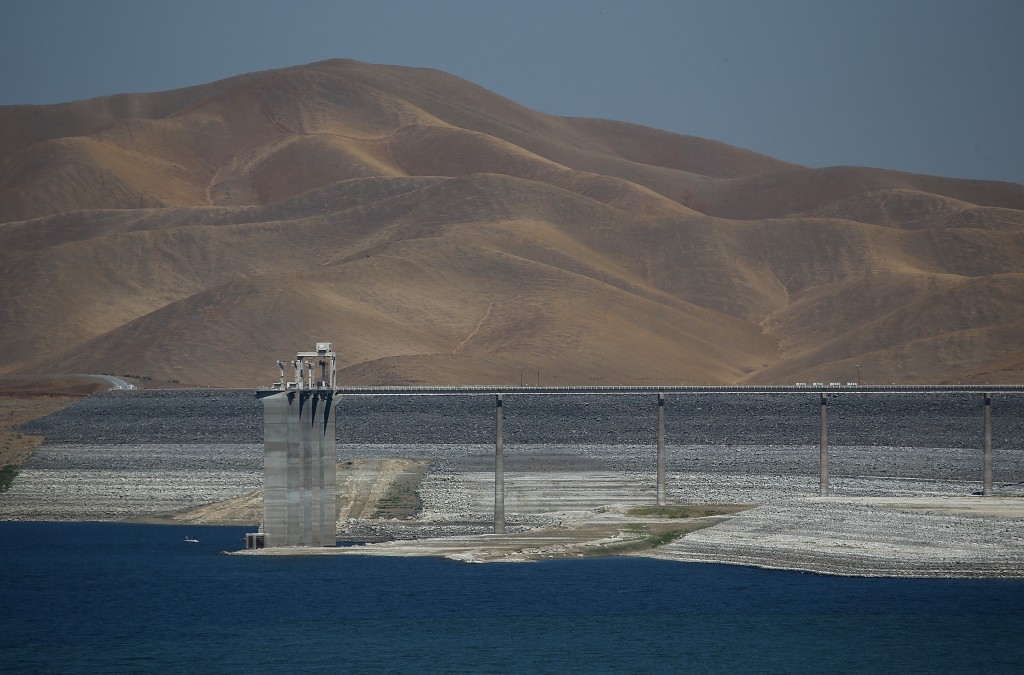
The Hamilton Project at Brookings and the Stanford Woods Institute for the Environment recently hosted a forum on the water crisis in the US. This resulted in the release of two interesting new discussion papers – “New Directions for US Water Policy” – charting feasible paths for improving water management in the US in the face of increasingly scarce water supplies. Especially the American West is continuing to experience a widespread and severe drought straining crucial water-supply systems. This does not bode well in light of long-term projections of rising water demand in combination with the potential for climate change-induced increased variation in precipitation. The Hamilton Project staff led by Melissa S. Kearney – with Benjamin H. Harris, Brad Hershbein et alia – compiled in a paper nine economic facts about water in the US, which serves as a good point of departure for a solution-focused discussion on this important topic. “While many Americans seldom think about water, many businesses are becoming concerned about future supplies,” the Hamilton Project states.

Source: The National Drought Mitigation Center 2014 via The Hamilton Project / Brookings | Stanford Woods Institute for the Environment
In general, prices for water vary across the US and the system for delivering that water is highly fragmented. Given the overall importance to the economy, three facts about water in the US stand out: While 50 per cent of water withdrawals in the US are used for power generation, 80 per cent of California’s freshwater withdrawals go to agriculture with the domestic use of water per capita being the highest in the driest states.
In the first discussion paper titled “Shopping for Water: How the Market Can Mitigate Water Shortages in the American West” the authors – Peter W. Culp of Squire Patton Boggs, Robert Glennon of the University of Arizona, and Gary Libecap of the University of California (Santa Barbara) – call for the implementation of market-based solutions in order to “increase flexibility and resilience in water management.” The following five proposals and/or guidelines aimed at promoting markets for water trading and mitigating water supply challenges are detailed in the paper for state and local governments to consider:
- Reform opaque legal barriers to water transactions and short-term water transfers.
- Establish basic water-trading institutions such as water banks and exchanges.
- Support reliability-enhancing mechanisms for mitigating risk related to water-supply disruptions due to growing variability and uncertainty in water supply.
- Improve the management of precious groundwater resources.
- Strengthen the role of the federal government to promote interstate and interagency cooperation as it pertains to water management as well as encourage essential state-level better data gathering on water source use; in the American West via The Bureau of Reclamation.
In sum, the most salient point the authors make is that “[w]ater trading offers a means of managing growing demands, adapting to increasing uncertainty in the face of climate change, and generating accurate price signals that drive incentives for increasing efficiency, while preventing or mitigating harm to third parties and the environment.”
The following graphic gives an overview of opaque legal rules and doctrines that can be characterized as not only impeding common sense measures to transfer water rights in most Western states, but also creating perverse incentives regarding the use of water.

Source: The Hamilton Project / Brookings | Stanford Woods Institute for the Environment
Thus, it indeed appears that putting water management on a more market-based footing – i.e. expanding water trading – could be an important step toward overall more efficient water management. Optimizing the currently poorly designed water rights system by allowing for certain water trading could ensure that water conservation is rewarded and not ‘penalized’ thereby discontinuing those seemingly perverse incentives and leading to a productive use of our water supply.
In a policy brief related to the above discussion paper, The Hamilton Project underscores that “traditional approaches are inadequate in the face of increasingly unreliable water supplies,” and adding that “[r]ather than using markets, the historical solution to water scarcity challenges in the United States has been to increase the supply of water – for example, by additional pumping of groundwater – and to reduce demand – for example, by strengthening conservation measures.”
In a second discussion paper entitled “The Path to Water Innovation” the authors -Newsha K. Ajami and Barton H. Thompson Jr., both of Stanford University, and David G. Victor of University of California (San Diego) – identify three factors that in particular present barriers to greater water innovation: first, the underpriced nature of water with significant ramifications across the water supply chain; second, a combination of a plethora of opaque regulations that vary by jurisdiction and the inadequate implementation of available next-generation water technologies; finally, a lack of access to sufficient capital required for innovation due to strained public budgets and the difficulty of obtaining low-yield bonds.
So, what is the takeaway?
Most importantly, advocating for market-based solutions has to go hand in hand with as accurate as possible accounting – i.e. determining water availability and respective use by industrial sector – of both water withdrawals and consumptive use to guarantee long-term sustainability. If water needs exceed local water supply, it has to be legally possible to reach into other water sources (via water transfers) because water shortages can severely impact the proper functioning of both critical man-made and natural infrastructure systems.
Note, power plants (e.g. use of freshwater for cooling) and hydropower dams may not be able to operate at their full capacity. However, in the name of sustainability and pertaining to water transfers, stringent and effective federal oversight is required in order to both prevent the spread of water scarcity and prevent further degradation of freshwater ecosystems. Moreover, limits, water use restrictions and even outright bans on water transfers from one watershed or aquifer to another should be instituted if it is determined – using state-level data on water source use – that water sources are likely to drop to levels endangering local economies and ecosystems (i.e. ‘overdraft’) within the respective groundwater basin. In this respect, perhaps the most important point is that authorities in charge not only need to determine how much water use is too much but also who gets to use the water. This is an indispensable feature of a sustainable and durable water governance system. The premise here is that there is a difference between the right to use water – often tied to a property right – and the ownership of water. In any event, government authorities have to tighten the screws and exert their ultimate legal control for the good of the public – to be distinguished from the corporate good alone. It often seems elected officials need to be reminded of that fact. In a democracy, this happens through elections.
Dave Thompson on Thu, 30th Oct 2014 9:46 am
How well does the market work if it does not rain?
penury on Thu, 30th Oct 2014 10:40 am
“, perhaps the most important point is that authorities in charge not only need to determine how much water use is too much but also who gets to use the water.” Or perhaps the most important point, is who determines the authorities who will make the decisions. When potentially billions of dollars and hundreds of million lives are under discussion whom do you trust to render a fair, honest, and totally non= self serving decision? Are these the same people who reulate the current system?
bobinget on Thu, 30th Oct 2014 11:01 am
Dave, I hope to have good news for N. California,
Southern Oregon. Bad news for ‘Trick or Treaters’ .
http://www.accuweather.com/en/weather-news/east-faces-cold-halloween-stor/36303863
I know, I know, one rainstorm a drought buster does not make.. At this point though, we are desperate.
Just because the US has no LR energy policy doesn’t mean we can’t have better water use.
Here’s an example. Near my farm we have a man made
irrigation water collection lake. As you can imagine,
‘our’ lake is almost empty with virtually no overhang for next year. Several irrigators suggested we dig out
fifty years of silt in order to take the lake back to its
1950’s capacity. Historians nixed the idea on the grounds we might disturb all that mud..
The day will come when (Emigrant) Lake will overflow
and cause flooding. Why? Because our irrigation
people are not about to give up a year of their lives fighting for environmental studies and chicken shit
officials. There are at least two D 8’s and several major back-hoes sitting idle while the lake has but 60% of its
original capacity.
It will rain/snow again. The trick will be to store it.
We need laws. I would vote Republican if one came along who diid not deny Climate Change and stated a policy that did something about times of feast and famine that are already upon us.
(during the 1930’s farmers donated their energy and machinery to digging miles of ditches, damming up
ravines to hold snowmelt for summer. Today, we would all be fined or worse for directing precipitation)
paulo1 on Thu, 30th Oct 2014 1:14 pm
Don’t plan on buying it from Canada. (Just saying, because we hear that one once in awhile and I wouldn’t discount some under-the-table payoffs to Canadian politicians to make it happen.)
Float the idea of putting in solar water pumps to divert some of ol’ Miss.
When the shouting stops try real conservation and relocation of snowbirds and other tourists who have no business living in a freaking desert.
Kenz300 on Fri, 31st Oct 2014 1:17 am
Finite resources meets endless population growth…
zaphod42 on Fri, 31st Oct 2014 12:16 pm
Our current laws evolved from years of water wars, and wound up with a complex structure of riparian rights, mostly from state level legislation. Given the history of deregulation, I fear that what is being suggested would result in a situation far worse than the problems created by those regulations.
Consider whether you want Standard Water of Texas selling you water, or whether your city water might just be a better deal.
As for those folks who live in a dessert – listen to Sam Kinison, “… get a U-Haul.”
casino on Mon, 28th Sep 2020 2:30 pm
The post is really superb. It’s varied accessory information that consists during a basic and necessary method. Thanks for sharing this text. The substance is genuinely composed. This web log is frequently sharing useful actualities. Keep sharing a lot of posts.카지노사이트