
Peak Oil is You

Donate Bitcoins ;-) or Paypal :-)


Page added on February 6, 2017

U.S. East Coast Has a Growing Appetite for Foreign Oil

-
Imported crude oil is cheaper than domestic alternative
-
Start of Dakota Access Pipeline to make Bakken less attractive
U.S. East Coast refineries, which have thrived for a few years on a boom of production from the Bakken shale play in North Dakota and eastern Montana, are increasingly looking abroad to supply their needs.
Last year through November, the region imported 884,000 barrels a day, which would be the highest full-year total since 2011, data from the U.S. Energy Information Administration show. Angola, Nigeria and Brazil have increased shipments to the East Coast this year. Rising supplies overseas made imported oil cheaper than domestic for the first time since 2013, data from the U.S. Energy Information Administration show. Canada is usually the leading importer to the region.
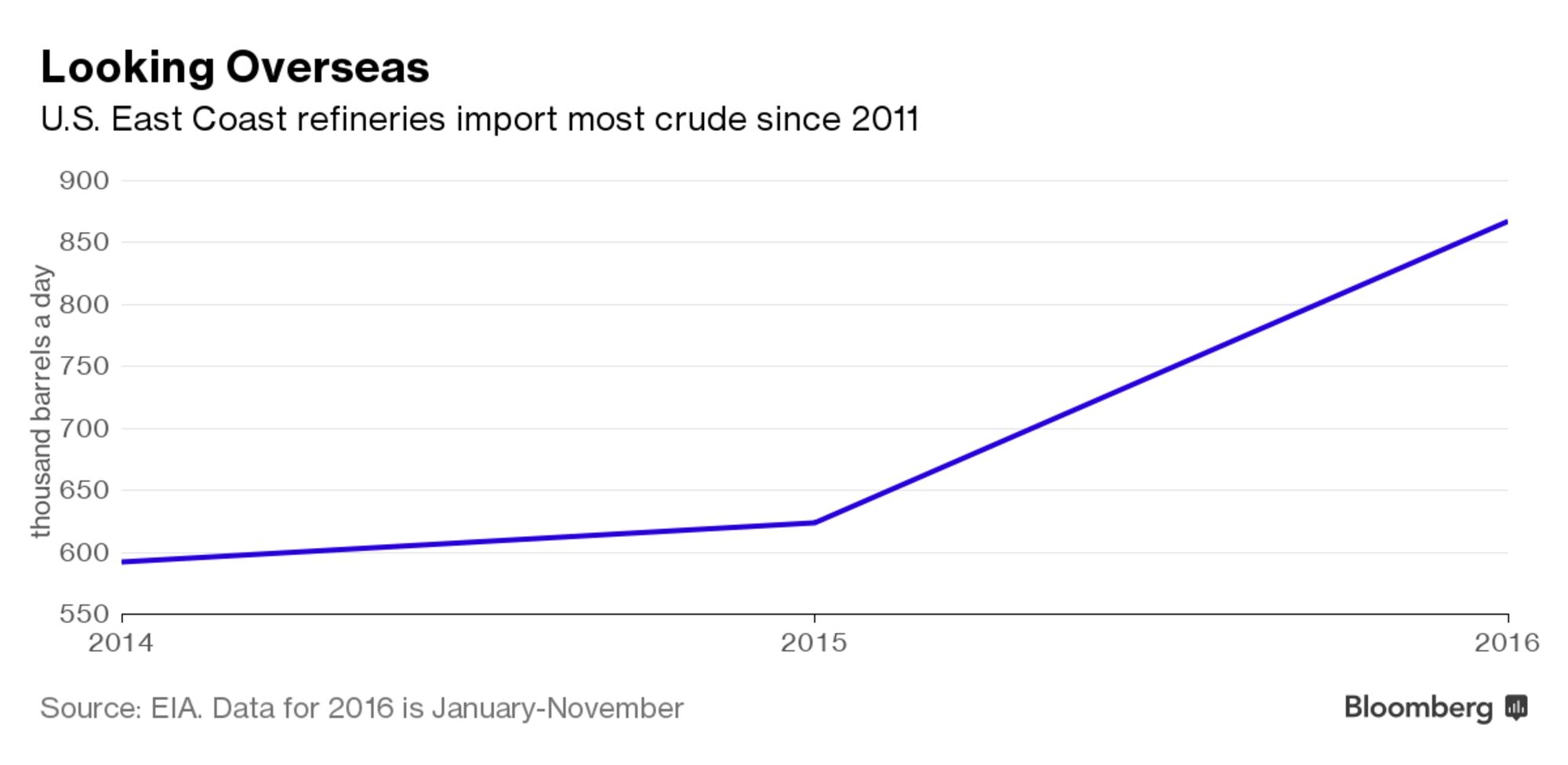
The price switch opened the doors for refineries like PBF Energy Inc., Philadelphia Energy Solutions and Phillips 66 to boost imports, says Andy Lipow, president of Lipow Oil Associates LLC in Houston. He said the new Dakota Access Pipeline, one of the energy projects supported by President Donald Trump, will make the East Coast even more reliant on imports.
The 1,172-mile line developed by Energy Transfer Partners LP may start moving crude June 1, according to a person familiar with the matter. It will connect the Bakken to Patoka, Illinois. Existing pipelines can take oil from Patoka to refineries in the Midwest and on the Gulf Coast, not to the East Coast. The East Coast relies mostly on rail to get Bakken oil.
“When the Dakota Access Pipeline starts, you will see less availability of Bakken in the East Coast and more imports coming,” Lipow said in a phone interview. “It will be more economical to ship Bakken oil to the Gulf Coast by pipeline than rail it to the East Coast.”
Brazilian Oil
Angola, Nigeria and Brazil produce the light to medium grades that make up the bulk of imports in the region, Gurpal Dosanjh, an analyst for Bloomberg Intelligence, says by phone from New York.
“Brazilian production has increased quite a lot because of offshore production,” he said. “We should see these supplies keep coming.”
Tankers carrying 2.5 million barrels of Brazilian oil are on their way for delivery to East Coast refineries, ship-tracking data show. This would be the most since at least 2002, according to data from the EIA. The vessels are set to deliver Sapinhoa, Ostra and Iracema grades into Philadelphia, where refiners including Philadelphia Energy Solutions and PBF Energy Inc. have bought Brazilian oil.
Philadelphia Energy Solutions and Phillips 66 declined to comment on their oil purchases. PBF didn’t return calls or e-mails seeking comment.
Front-month West Texas Intermediate closed at $53.01 a barrel Monday on the New York Mercantile Exchange, up 72 percent in the past year. Prices have held in the $50-$55 range this year since the Organization of Petroleum Exporting Countries and other producers like Russia agreed in November to cut production.
Those higher prices should spur rig counts and boost U.S. production, which may eventually prompt East Coast refineries to import less, John Auers, executive vice president at energy consultant Turner Mason & Co., said in a phone interview from Dallas. If the U.S. implements a border adjustment tax on imports from Mexico, for example, the East Coast refineries would look to domestic supplies again.
“Certainly if a BAT is enacted, that would magnify the decline,” he said. “With or without a BAT, I think the overall imported volume may fall with higher output in the Bakken.”
5 Comments on "U.S. East Coast Has a Growing Appetite for Foreign Oil"
Nony on Mon, 6th Feb 2017 8:26 pm
Nice article. Makes sense.
Oil producers (or the middlemen they sell to) are looking for they best price and they will move who they sell to very readily if they get a better price elsewhere. DAPL opening up will allow Bakken producers on rail to the East to get better prices by piping to Illinois instead.
This has no impact on net imports because foreign oil will get pushed out of the Gulf to make up for that brought in on the East. Or light oil at the Gulf will be exported to other countries. (It won’t be shipped up the Atlantic Coast, expect for Canada, because of the Jones Act, which makes it cost a lot to ship by ocean around the US.)
Actually there will be a slight decrease in net imports, but this is just a secondary effect based on more production from the Bakken because of better prices possible. But the main effect will be a wash.
makati1 on Mon, 6th Feb 2017 8:58 pm
A lot of “IFs” and “Maybe’s” here. lol
Sucker bait. Net oil use remains the same, or less. Wait until summer and oil for heating drops…
GregT on Mon, 6th Feb 2017 10:21 pm
“Bloomberg Intelligence”
An oxymoron if there ever was one.
“one of the energy projects supported by President Donald Trump, will make the East Coast even more reliant on imports.”
I’m surprised that Mikey is allowing this crap to be printed. Him and Donald go way back.
brough on Tue, 7th Feb 2017 5:46 am
What stats. are bloomberg using to get such a nice staight line on their graphs ??
Cloggie on Tue, 7th Feb 2017 8:01 am
The US East Coast refuses to buy oil from the Heartland.
Sabotage of Trump’s “buy American” policy?