
Peak Oil is You

Donate Bitcoins ;-) or Paypal :-)


Page added on February 4, 2014

U.S. Crude Oil Exports, Really? – A Look at the UK
Last week the U.S. Senate’s Energy Committee held the first hearing in decades on the question of whether exporting US crude oil, prohibited by law since the 1970s, should be allowed again. Attendees heard proponents say that allowing crude exports would hold prices down with opponents claiming the opposite case.
To be clear, these would not be net crude oil exports. Of the 19+ million barrels a day that we consume at present, we import roughly 7.5 million barrels of crude per day and export roughly 2.5 million b/day of petroleum products (diesel and propane, for example). And even the US EIA admits we’ll be importing millions of barrels of crude oil for decades, in fact indefinitely.
So this is really an intramural fight: US oil producers want to be able to export while refiners and most users want to keep the crude at home. As Senator Ron Wyden, Chairman of the Energy Committee, said in his remarks, don’t expect this argument to be resolved quickly.
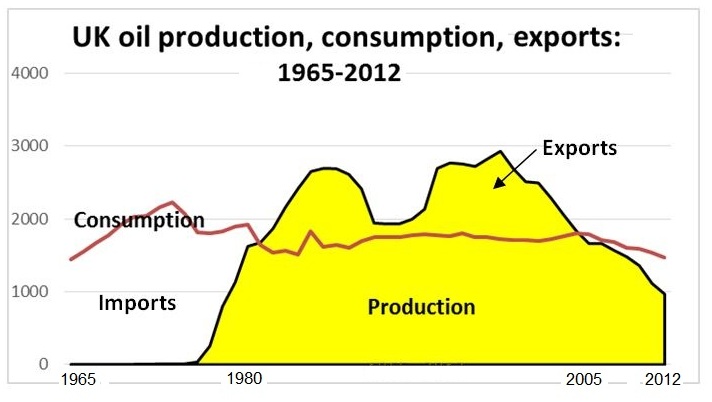
Here’s a related thought experiment. It involves the UK crude oil situation between 1980 and today, shown in Figure 1 below. After joining the exclusive club of Top 20 world oil producers in 1978, two years later the UK’s oil producers joined the ranks of oil exporters. Over the next 25 years they exported roughly ¼ of their total oil production, earning around $20+ per barrel most of those years. But after production peaked in 1999, within six years the UK was back to importing oil, at an average price approaching $100 a barrel. Imports have grown back to ½ million b/d, which is 1/3 of total consumption.
My question to the Brits: if you could turn the clock back, would you allow all your oil to be produced at the maximum possible rate, earning the amount of export dollars you did, if it meant that within a generation you would be back to being an oil importer paying roughly five times as much per barrel? In other words, how did the buy-high sell-low plan work for you? And were those exports in your best long-term national interests? Didn’t think so…
There are almost as many differences as there are parallels between the UK and US circumstances. But they share a bottom-line question: is it in the USA’s best long-term national interests to produce unconventional shale oil sufficiently fast that we end up exporting some of it overseas? Didn’t think so…
Fig. 1: The UK exported oil for 25 years from 1980 through 2005, shown above as the amount produced above the consumption line. Exports peaked at 1.2 million barrels a day in 1999, the same year that production peaked at 2.93 million b/d. imported roughly a half-million b/d in Data is from BP (2013).
Steve Andrews is a former energy consultant and a contributing editor for Peak Oil Review.
5 Comments on "U.S. Crude Oil Exports, Really? – A Look at the UK"
Stilgar Wilcox on Wed, 5th Feb 2014 1:30 am
This is a purely political move in an effort to delude Americans not familiar with our importation of 7.5mbd of crude a day, of a falsehood, that the US is (now thanks to fracking) a net oil producer.
Although it may seem like a politically ‘feels good to be American’ type ploy, it sends the wrong message to consumers that oil supply is no problem, just tee off at the pumps; buy ICE’s.
thylacine on Wed, 5th Feb 2014 2:32 am
Isn’t 20:20 hindsight a great thing? Back in the late 70’s and early 80’s the UK economy was a bit of a basket case – high inflation, massive unemployment, declining heavy industries etc. The chance to get some export earnings was leapt on and the can was kicked firmly down the road, with the country enjoying another generation of prosperity. Now the chickens are coming home to roost – sad, but I’m not sure it could have played out any other way.
When comparing prices between then and now, it would be more useful to discount the values relative to a stated point – that way you compare apples with apples.
rockman on Wed, 5th Feb 2014 12:50 pm
What a conundrum (don’t get to use that fun word enough). Some very old sayings are still as relevant today…such as “Having your cake and eating it to”. As pointed out the UK needed that export revenue. The companies also needed it to justify their efforts in the N. Sea. Limiting exports would have left more oil in the ground but it would have also discouraged drilling as well as reducing govt income. So a choice was made. And now folks want to criticize that choice. I’m sure some of those critics weren’t around when that choice was made and others who were may have supported it because it favored them at that time.
So now the complaint is they should have saved it for folks today. By that same logic shouldn’t they be arguing that some of the current production be saved for future generations? But that would require removing the self-serving attitude they are criticizing others for having back in the 90’s.
I didn’t save the numbers but there’s an interesting bit of math out there: while the N Sea may be producing fewer bbls of oil today the current revenue stream to the industry and govt is greater now than during the 90’s: fewer bbls but selling for a much higher price. The interesting aspect of this thread and the one about US exports is that the same folks that argue against the UK and US exporting oil would likely be the most vocal opponents of other countries, such as Canada and Norway, if they chose to reduce their exports to consuming nations in order to preserve some resources for future generations. IOW they can’t keep their cake because we want to eat it.
You obviously can’t have your cake and eat it to. But there’s nothing stopping folks from bitching about. LOL.
DC on Wed, 5th Feb 2014 6:09 pm
rm, your statement that things have for the UK are ‘better’ now, or because the UK is wringing more dollars out of few barrels has to be taken with a (few) grains of salt. Money isnt energy, money doesn’t power industrial economies, oil does. However, as much utility as money has, it doesn’t exist in a vacuum either. Inflation eats away at monies value as well. Are the ‘brits’ making more in inflation adjusted dollars, or are they just making more dollars?
Oil in traded in US toilet paper of course, and we all what the US has been doing about that lately….
Flooding the world with trillions in ‘liquidity’ to keep its banks solvent has had a side effect of inflating all commodities. I am sure its had an effect on N.Sea revenue just like everyone else. And lastly and most importantly, the North Sea is not owned by the british people, but by private for-profit corporations. Britain gets to levy a few taxes on the resource and collect a few fees, but the resource itself, is the private property of oil corporations. So to suggest the ‘UK’ benefits from an inflated dollar revenue stream is not an accurate reflection.
rockman on Wed, 5th Feb 2014 9:10 pm
DC – True but remember the N. Sea oil production in the English sector belongs to the Brit govt and that’s who gets those royalty $’s. And those $’s help run the country. And the more $’s they have the more $’s they have to spread around. And while a fist full of $’s doesn’t have the Btu content of a bbl of oil it’s still more revenue going into the pockets of NS operators who England is hoping will develop more reserves.
But again the decision to exploit and export England’s share of the NS was made in a different time frame under different financial conditions. As someone mentioned hindsight is great. Except to be honest one needs to also consider the condition of the England economy in the 90’s to decide if the effort was justified under those existing conditions. Today lots of folks are enamored with the surge in US shale production. But just like the NS of the 90’s should there be govt restrictions to developing these trends today when those reserves might be more needed in 15 or 20 years? Should the govt ban all product exports so we would have more available domestically years down the road? Lots of folks might say no. But those future folks, in their time, might disagree as strongly as some do now about the NS surge in the 90’s.