
Peak Oil is You

Donate Bitcoins ;-) or Paypal :-)


Page added on September 20, 2012

The Goals of Energy Policy

OurEnergyPolicy.org and Sandia National Laboratories recently released The Goals of Energy Policy, a report detailing our recent collaboration to clarify and improve the national energy policy discourse. We feel that this report, based on a survey of nearly 900 energy and energy policy professionals, has significant implications for policymakers and policy professionals working to craft and build consensus around energy policy.
Too often U.S. policymaking is guided by “either-or” scenarios. These polarized approaches may make good cable TV and high drama politics, but they rarely result in solutions to complex problems. Energy policy is no different.
A look at public opinion polling in energy suggests that we might be asking the wrong questions. Public opinion researchers looking at energy policy typically ask respondents to pick their #1 priority – the policy goal they value most among two or more goals – even if the value several goals simultaneously. In the case of energy policy, these “which of the following is most important to you?” questions tend to center on forcing a choice between promoting energy development (ostensibly an economic goal) and protecting the environment.
But is this the right question? Policymaking is a balancing of priorities, not pursuing one at the expense of all others. Knowing that a percentage of the electorate values one policy goal over another, without knowing the degree of that preference or why, isn’t helpful to policymakers, isn’t moving America forward on energy, and isn’t making the national discourse on energy policy any smarter or more productive.
These observations led OurEnergyPolicy.org and Sandia National Laboratories to team up to determine if energy and energy policy professionals think of energy in these “either-or” terms, or if there’s room for common ground or “trading space” on the issues.
Our survey asked three key questions of nearly 900 energy professionals:
How should the U.S. allocate its efforts across the following three energy policy priorities?
- Energy Supply Security: Assure a supply of energy for the U.S. that protects our national security interests.
- Economics & Job Creation: Assure a cost for energy that sustains U.S. economic stability and growth.
- Environment & Climate: Minimize the environmental impacts of energy supply, distribution and use.
Is another energy policy priority needed?
If yes, how would you allocate 100 points across the three original priorities and the fourth, self-selected priority?
Our results – detailed in The Goals of Energy Policy: Professional Perspectives on Energy Security, Economics and the Environment – were both surprising and encouraging.
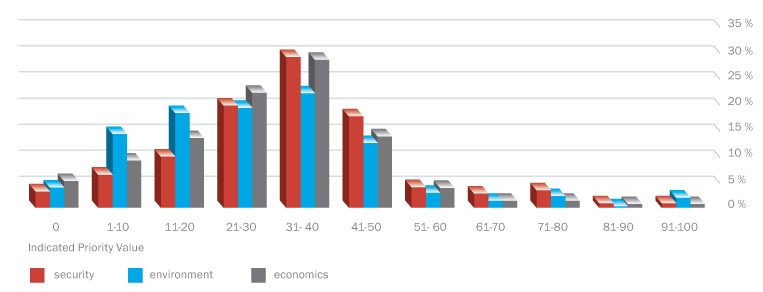
- The vast majority of respondents emphasized that a balance among policy priorities is critical
- Only 3% of respondents were single issue advocates, or put all of their effort toward a given policy goal
- Fewer than 15% of respondents completely devalued any one goal
- When given the chance to allocate effort between three key policy goals, the average respondent allocated 37 points to Energy Supply Security, 32 points to Economics & Job Creation, and 31 points to Environment & Climate
- Fifty-eight percent of respondents said these three goals are the goals of energy policy. 42% offered a fourth goal of their own choosing, tending again to express a more-or-less balanced distribution of effort toward the four goals.
Gender, age, and geographic distribution appear to play a role in how the energy professionals responded:
- Men constituted 80% of our sample, and tended to value Energy Supply Security as the highest priority and the Environment as the lowest priority. This tendency was stronger among older men.
- Women considered Environment & Climate the highest priority and placed Energy Supply Security as the lowest.
- Energy Supply Security rated highest among respondents from Arkansas, Louisiana, Oklahoma and Texas; Environment & Climate was given the highest priority in the Pacific and in New England; and Economics & Job Creation was the highest priority in the Midwest.
There’ s clearly more work to be done in this area – this was by no means a random sample, as we were interested in the perspectives of experts – and we’re looking forward to this effort’s next phase. Nonetheless, the clear message from energy and energy policy professionals is that any path to America’s energy future that doesn’t achieve these three goals simultaneously is going to have a hard time earning their full support.
The common ground around the desire for balance revealed in The Goals of Energy Policy suggests that our policymakers would do well to stop focusing on “either-or” propositions – which are evidently an obstacle to building consensus on the energy solutions America needs – and begin pursuing a more balanced approach to our energy challenges.
6 Comments on "The Goals of Energy Policy"
DC on Thu, 20th Sep 2012 9:43 pm
Energy Supply Security: is a euphemism for more wars and supporting dictatorships, over the desires and votes of the people actually living there. Oilgarchs are the only candidates Washington allows in its vassal states. See: LIbya for recent example.
Economics and Job creation: Means more cars, and more suburban sprawl(in order to facilitate more gas consumption). It does not matter if such ‘growth’ is no longer or doable or practical, that model is the only game in town.
Environment & Climate: An irritant to the Fossil-fuel cartel. Lip service must be paid to the idea, and even some actual money spent on empty propaganda to the effect, but the idea of actually protecting the environment is to be fought fiercely in the backroom, even while mouthing platitudes in press releases and glossy TV spots.
Arthur on Thu, 20th Sep 2012 10:15 pm
If the US is concerned about energy supply security, here is a bargain:
http://www.mymoinfo.com/Analysis-Inventory-mountain-adds-to-pain-for-Chine/9050097?newsId=166727
5 gigawatt worth of solar panels, value 4.5 billion $, are rotting away in China. Maybe Bernanke can print this money and become the proud owner of these panels.
DC on Thu, 20th Sep 2012 10:45 pm
Exactly, and here in North America, you really..really have a hard time finding affordable DIY systems capable of delivering decent power levels to end-users. Its gas-oil-coal all the way. No one is really retailing such systems in my province. The (very) few that are, hideously expensive.Yet I read about the US and Canada and the EU blocking such systems by the container ship load.
So much for our commitment to ‘green energy’!
Kenz300 on Thu, 20th Sep 2012 10:56 pm
Every country needs to develop plans to become more energy self sufficient. That means diversifying our sources of energy and types. Wind, solar, wave energy, geothermal and second generation biofuels made from algae, cellulose and waste all need to be part of the energy mix.
Diversify…diversify…diversify
DMyers on Fri, 21st Sep 2012 3:17 am
Give me energy security, and I’ll owe my soul to the Company Store. Deal?
SOS on Fri, 21st Sep 2012 3:05 pm
More news from the thriving, yea right, alternative energy center:
Suntech Power Holdings Co Ltd , the world’s largest maker of solar panels whose shares hit a high of $90 in early 2008, runs the risk of being booted out by the New York Stock Exchange.
The company did not meet the exchange’s price criteria for continued listing as the average closing price of the stock was less than $1 over the last 30 trading days as of September 10, Suntech said in a statement on Friday.
Suntech shares were down 5 percent at 96 cents on Friday morning.