
Peak Oil is You

Donate Bitcoins ;-) or Paypal :-)


Page added on September 14, 2012

The Arab mess — and America’s dilemma
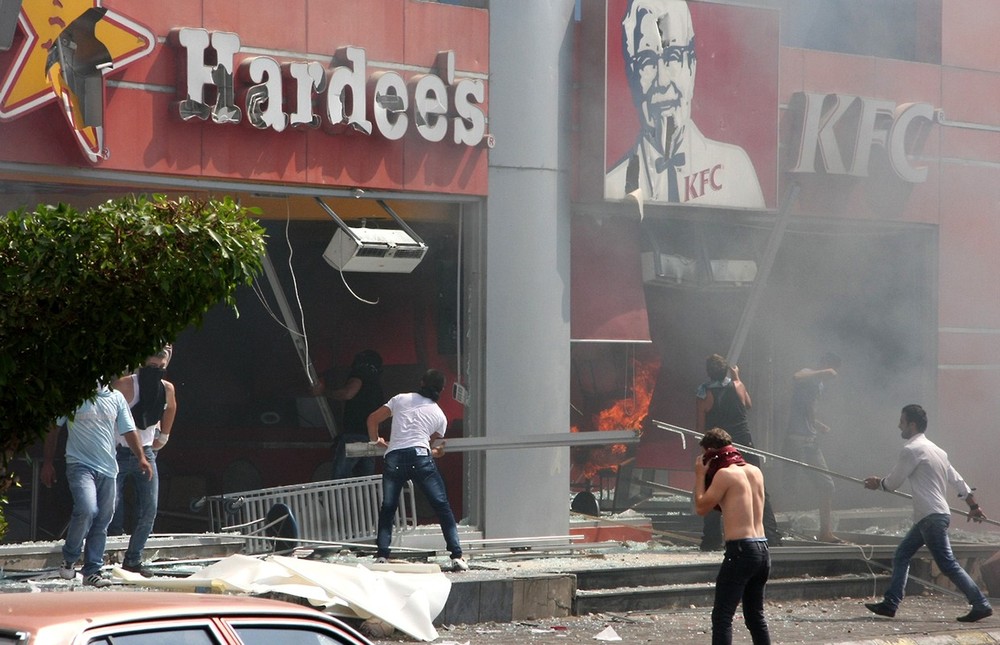
This week’s terrorist attack on the U.S. consulate in Benghazi, Libya — which claimed four American lives, including that of our superb ambassador, Christopher Stevens — reflects a much broader and deeper long-term problem for our national security: The Arab world as a whole is a massive failure. It is failing big, it is failing fast, and thanks to technology’s ability to disseminate information quickly and widely, perceptions of that failure are spreading like a fast-moving cancer. The implications for regional and global security are profound. Just a few of the many problems that must be addressed:
Widespread poverty
Lots of things fueled the Arab Spring — anger at repressive governments, corruption, lack of opportunity. But what was its initial spark? Food prices. One-fifth of the Middle East lives on less than $2 a day, and massive price hikes (exacerbated in part by rising temperatures and water shortages) proved to be the tipping point. The price of some staples doubled between 2007 and 2008, touching off regional riots, and lingering animosity fueled the broader political uprisings that began in 2011. “The food-price spike was the final nail in the coffin for regimes that were failing to deliver on their side of the social contract,” Jane Harrigan of London’s School of Oriental and African Studies tells The Economist.
Demographic time bomb
Much of the Arab world is young and out of work. A United Nations report in 2009 pointed out that half the population is under the age of 24. Unemployment is sky high — 30 percent across the region — so there are literally tens of millions of young people on the streets with little to do. One thing they are doing? Reproducing. The region’s population, about 310 million, is growing faster than that of any region in the world except for sub-Saharan Africa. Population growth rates are several times that of the United States, which is just 0.9 percent, says a CIA study:
· In Yemen, ground zero for al Qaeda on the Arabian Peninsula (AQAP), the population growth rate this year is 2.75 percent.
· Saudi Arabia — the rigidly orthodox country that produced 15 of the 19 September 9/11 hijackers: 1.5 percent
· Iraq: 2.3 percent
· Libya: 2.0 percent
· Egypt: 1.9 percent
· Iran: 1.2 percent
· Gaza Strip: 3.1 percent
In contrast, the developed world is growing much slower: The U.S. is below 1 percent, and in the European Union, the rate is just 0.2 percent.
“The Arab world is, potentially, a big, ticking time bomb,” one U.S. government analyst tells me. “But it’s also an opportunity. Hopefully all those young people can be given a chance to contribute economically and help build a stable and open civil society.”
Lack of development
It is difficult for those young Arabs to “contribute economically” given the widespread lack of opportunity. In the last two decades, Eastern Europe, Asia, Latin America, and even parts of Africa have cast off the shackles of the past to embark on reform and invest in growth. Not the Arab world. The Economist notes that the average company in the Middle East is more than a decade old — a sign that entrepreneurship is non-existent. Take energy out of the mix, and the region is cut off from global trade, accounting for less than 1 percent of the world’s exports. As any westerner who’s tried to do business there knows all too well, red tape, corruption, and cronyism are rampant.
Absence of civil rights and civic engagement
The Arab world also lags in a variety of characteristics that often divide developed nations from undeveloped ones: literacy rates, access to clean water, women’s rights, higher education, and health care, to name but a few. There is too little upward mobility, too much repression, and a pervasive sense of hopelessness — the Arab Spring not withstanding. “The widening mismatch between aspirations and capabilities makes action on governance an urgent matter,” points out a World Bank study.
So, what does all of this have to do with the crappy low-budget movie that’s being blamed for setting off this week’s unrest? The protests were used as a cover for the terror attack (on 9/11 no less) — but I’m of the view, which I hope isn’t overly naïve, that hypersensitive Muslims in the Arab world might not focus so much on perceived slights to their religion if their broader sense of alienation, hopelessness, and desperation weren’t so severe. Put another way, there’s a causal relationship between their bitterness and our security. It’s the latter that we should ultimately be concerned with.
So, what should we do?
Most citizens in the Middle East yearn for democracy — specifically more free speech and open, competitive elections, says a July Pew Global survey. A golden opportunity for America, right? So far, it hasn’t worked out that way: “The United States is not seen as promoting democracy in the Middle East. (For example), in newly democratic Tunisia, only about 30 percent believe the American response to the political upheaval in their country has had a positive impact.”
Assuming a more positive image of the United States benefits our national security, America essentially has two options. We can deepen our engagement with the Arab world in a more benign way, deploying more soft power (aid, educational exchanges, helping build functioning civic institutions, etc.), and we can ease up on things that are fueling anti-Americanism, like unilateral, unapologetic drone strikes, and “Made in the U.S.A.” tear gas canisters given to allies to control their citizens.
No one opposes the former, in theory, though “foreign aid” is often a popular target of budget cutters (it’s only 1 percent of federal spending). As for the latter, U.S. national security needs require the maintenance of robust anti-terror capabilities in the region, and, given the strategic importance of everything from keeping the oil flowing through the Strait of Hormuz to countering Iran to supporting ongoing operations in Afghanistan, a sizable and visible U.S. military presence is a strategic necessity.
11 Comments on "The Arab mess — and America’s dilemma"
Arthur on Fri, 14th Sep 2012 10:15 pm
Japan has no resources whatsoever, Korea likewise. Nevertheless, Japan has the second economy in the world. The Arab world is nowhere in comparison. And never will be. The modern western world has declared real explanations for this phenomenon beyond the pale. Let’s bury the West before it buries us.
Science sans conscience on Fri, 14th Sep 2012 10:43 pm
This could mean that intelligence and civility have peaked in the Middle East, probably since the 1970s, as it is happening in the West now.
BillT on Fri, 14th Sep 2012 11:09 pm
This is some more pro-Empire propaganda as if the rest of the world is going to hell because they are not greedy bastards like the West. Westerners better take a look around and see reality in their own country. ALL of the above mentioned negatives are present or soon will be.
It would not surprise me if, in the future, the murder of the ambassador and his assistants was not proven to be the work directly or indirectly of our own CIA. What a great false flag! After all, what is 4 people, or 4,000, to get more profits for the M.I.C.?
Keith_McClary on Sat, 15th Sep 2012 5:32 am
How about not propping up corrupt brutal dictators, kings, emirs and sultans who give you military bases ans oil concessions?
Arthur on Sat, 15th Sep 2012 6:22 am
It is difficult to understand for us rational westerners, but I think that these uprisings are real, no false flags, although it is likely that this movie was produced with the intent of instigating violence, after the creators noticed the effect of the Danish Muhamed cartoons. Islam is the only thing these masses have and ever will have. Desacrate it and you destroy their civilization. And that is exactly the intent of the vile rulers of the west: Islam cannot be integrated into the NWO, hence it needs to be destroyed. But this is not going to happen as every peaker knows, as the west is walking on it’s last legs.
Ken Nohe on Sat, 15th Sep 2012 7:27 am
Soon everyone will regret the not so nice but ruthless and stable dictatorship of the Middle East. What will replace them will be closer to hell on earth for these people and headache for the rest of us.
Ken Nohe on Sat, 15th Sep 2012 11:35 am
Now about the video; I spent the 15 mn to see it and my reaction like most Westerners is “What is this “s***”! But on second thoughts it is probably wrong. The video is in fact very well crafted, not as a movie of course (It is crap and there is no movie). But as a piece to offend, it is almost perfect. Plenty of sensitive buttons are pushed. Irritating “historical” facts if there are such things are turned into ridicule. A very good match into the combustible straw of the Middle East. It would be just perfect for the US to then go there “to protect its interest”… Perfect! Bin Laden, wherever he is, must be praying they do!
Ham on Sat, 15th Sep 2012 12:33 pm
As any westerner who’s tried to do business there knows all too well, red tape, corruption, and cronyism are rampant.
This implies such things do not occur in the west.
How interesting, it is their fault obviously.
Want to know how much depleted uranium is lying around in Iraq? Libya? I’m sure there are references widely available.
Any more news on finding out Presidential candidates tax returns?
Arthur on Sat, 15th Sep 2012 12:59 pm
Indeed Ken, even Hillary might soon miss the good ol’ Colonel. All these half secular, half socialist, half Baath-ish countries are going to be replaced by something that resembles the Khalifat, a pure religion based society. With strong (negative) opinions about the desirability of the Infidels (that’s us) on their turf.
Ken Nohe on Sat, 15th Sep 2012 3:09 pm
Yes, half Khalifat, half Somalia this time. The Jews may soon wonder if the sliver of land they “received from God” was a gift or a curse! A billion of unemployed, angry young men waiting for provocations. They will need walls on top of the walls!
Arthur on Sat, 15th Sep 2012 5:43 pm
I kindly advise our chosen friends to set up shop elsewhere. The north coast of Alaska comes to mind, I am sure that is still available. Maybe mrs Palin can be helpful here, so she has other people to wave to than the Russians. Alternatively, maybe the Dutch can create an artificial island next to Manhattan, on the condition that ‘New York’ gets it’s original name back, Nieuw Amsterdam. My gut feeling tells me that the second option is likely preferred, due to the proximity of Wallstreet and hence the one percent. Birds of a feather… This has the additional advantage that we in Europe can sleep a little easier as the Israeli nukes will be removed in that scenario.