



It’s a secret of the vast U.S. Treasury market, a holdover from an age of oil shortages and mighty petrodollars: Just how much of America’s debt does Saudi Arabia own?
But now that question — unanswered since the 1970s, under an unusual blackout by the U.S. Treasury Department — has come to the fore as Saudi Arabia is pressured by plunging oil prices and costly wars in the Middle East.
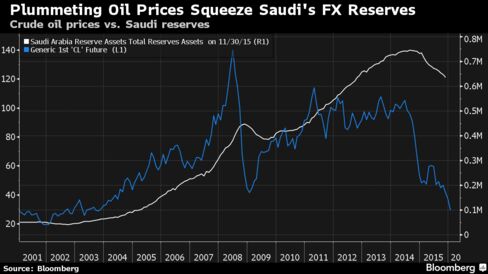
In the past year alone, Saudi Arabia burned through about $100 billion of foreign-exchange reserves to plug its biggest budget shortfall in a quarter-century. For the first time, it’s also considering selling a piece of its crown jewel — state oil company Saudi Aramco. The signs of strain are prompting concern over Saudi Arabia’s outsize position in the world’s largest and most important bond market.
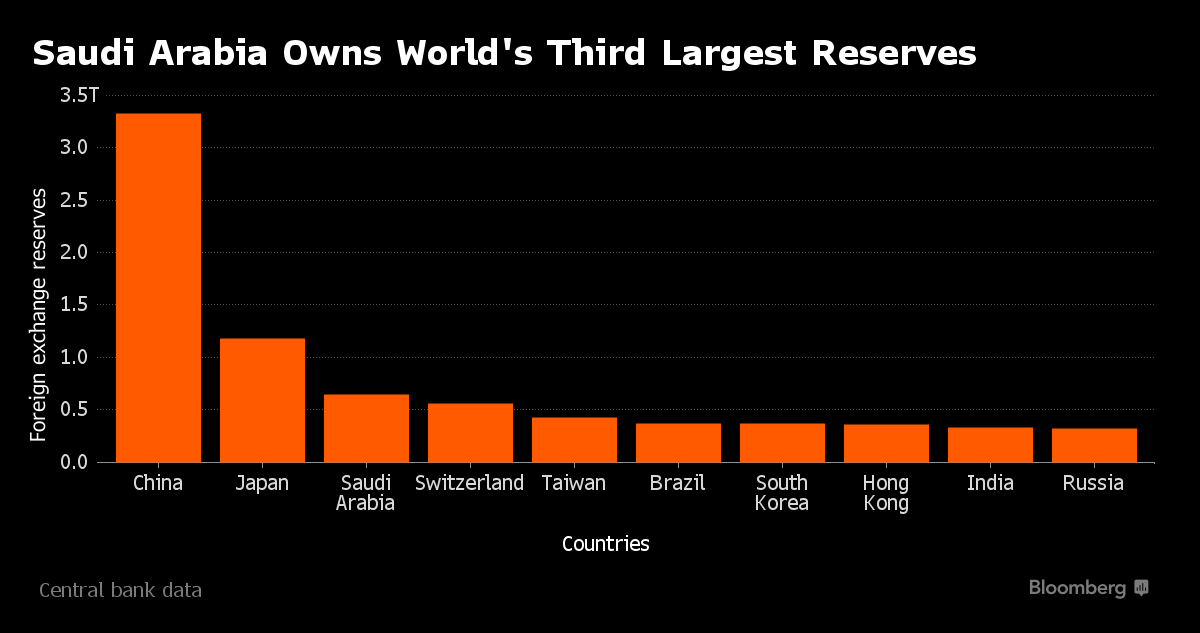
A big risk is that the kingdom is selling some of its Treasury holdings, believed to be among the largest in the world, to raise needed dollars. Or could it be buying, looking for a port in the latest financial storm? As a matter of policy, the Treasury has never disclosed the holdings of Saudi Arabia, long a key ally in the volatile Middle East, and instead groups it with 14 other mostly OPEC nations including Kuwait, the United Arab Emirates and Nigeria. For more than a hundred other countries, from China to the Vatican, the Treasury provides a detailed breakdown of how much U.S. debt each holds.
“It’s mind-boggling they haven’t undone it,” said Edwin Truman, the former Treasury assistant secretary for international affairs during the late 1990s, and now a senior fellow at the Peterson Institute for International Economics in Washington. Because relations were rocky and the U.S. needed their oil, the Treasury “didn’t want to offend OPEC. It’s hard to justify this special treatment for OPEC at this point.”

For its part, the Treasury “aggregates data where more detailed reporting might disclose the positions of individual holders,” spokeswoman Whitney Smith said in an e-mail.
While that position is consistent with the International Investment and Trade in Services Survey Act, which governs disclosures of investments made by foreign persons and governments, and shields individuals in countries where Treasuries are narrowly held, it hasn’t kept the Treasury from disclosing figures for a whole host of other countries — large and small.
They range from the $3 million stake held by the island nation of the Seychelles, to the $69.7 billion investment from the oil-producing economy of Norway, and those of China and Japan, which are both in excess of $1 trillion.
Representatives for the Saudi Arabian Monetary Agency, known as SAMA, and the nation’s finance ministry declined to comment.
Apart from the kingdom itself, only a handful of Treasury officials, and those at the Federal Reserve who compile the data on their behalf, have a clear picture of Saudi Arabia’s U.S. debt holdings and whether they’re rising or falling.
For everyone else, it’s a guessing game.

The special arrangement, born out of the 1973 oil shock following the Arab embargo, is just one small concession among many that successive U.S. administrations have made over the years to maintain America’s strategic relationship with the Saudi royal family — and its access to the kingdom’s deep reserves of oil.
The exception extends to 12 other countries in the Treasury’s oil-exporter group, all from the Middle East or Africa. Based on aggregate data released this week, that group has trimmed its stakes by a few billion dollars since March and held $289 billion as of November.
Because its holdings are believed to be the largest, Saudi Arabia’s moves have drawn scrutiny, particularly as other central banks in emerging markets sell Treasuries to raise cash in defense of their currencies. (The Treasury doesn’t break out private and public holdings, but its disclosures say about two-thirds of foreign holdings are held by official institutions such as central banks.)

Those sales have had a small, but visible impact on America’s funding costs. According to Deutsche Bank AG, selling by foreign central banks since March has added 0.3 percentage point to yields on 10-year Treasuries, which ended Thursday at 2.03 percent.
SAMA’s own figures show reserve assets held in foreign securities have fallen by a record $108 billion in 2015. The Saudi central bank, which doesn’t disclose separate figures for Treasuries, owned $423 billion in overseas securities as of November.
“I come down on the side of thinking there should be more transparency,” said Jeff Caughron, chief operating officer at Baker Group, which advises community banks with more than $45 billion in investments. But at the same time, “the Treasury is constrained by political sensitivities and that comes into conflict with market participants that crave more transparency. It’s an understandable conflict.”
And events in recent months, from President Barack Obama’s landmark nuclear deal with Iran to Saudi Arabia’s execution of a prominent Shiite cleric who challenged the royal family, underscore just how sensitive U.S.-Saudi relations have become. The longstanding rationale for the alliance has also been undercut by America’s domestic oil boom, which has made it far less dependent on Saudi exports.
Whatever the political considerations, some analysts speculate Saudi Arabia may actually be trying to hold onto its Treasuries as part of a strategy to bulk up on dollar assets amid the deepening turmoil in global financial markets.

“You need dollars if you’re an oil producer, you want to make sure you have dollars on your balance sheet,” said Sebastien Galy, Deutsche Bank’s director of foreign-exchange strategy, who suggests SAMA could be raising cash by liquidating riskier investments such as stocks, real estate and private equity. Holding dollars also makes sense as a hedge against the plummeting price of oil, which is priced in the U.S. currency.
Figures from SAMA suggest the kingdom might be reallocating some of its reserves into short-term, liquid assets to help the finance ministry meet budget commitments and defend its 30-year-old currency peg of 3.75 riyals to the dollar.
The central bank has increased foreign currencies and deposits held abroad by 7 percent in the first 11 months of 2015, while at the same time reducing foreign securities, consisting of equities and longer-term debt, by 20 percent.
That cash has become key. Oil’s slump to less than $30 a barrel, from more than $100 two years ago, has eroded the petrodollar-fueled wealth that quadrupled per-capita income since the late 1980s and provided Saudi Arabia with the largess to offer free health care, gasoline subsidies and routine pay increases.

“When SAMA is required to raise liquidity for the Ministry of Finance, you’d see deposits and cash go up and they’d liquidate other assets,” said Khalid Alsweilem, SAMA’s former head of investment. “They know when the Ministry of Finance will spend all their riyals. So they prepare certain amount of cash available based on such expectations.”
Alsweilem, who spent 20 years at SAMA and now advocates for fiscal reforms as a fellow at Harvard University’s John F. Kennedy School of Government, says market watchers may overestimate how much money the central bank actually allocates to Treasuries.
SAMA isn’t a typical central bank because it acts as a quasi-sovereign wealth fund, he said. As such, it aims for higher returns as a buffer against falling oil revenue and invests in a wide array of risky assets, which explains why it has only recently started to become more transparent, Alsweilem said.
To hear Peterson Institute’s Truman tell it, more clarity by central banks is long overdue — particularly when it comes to the U.S. Treasury.
“In the old days at the Treasury and central banks, transparency wasn’t the word of the day” and politics made special treatment a non-issue, he said. Now, “it’s simply a legacy issue. You want to deal with it sooner or later.”
makati1 on Fri, 22nd Jan 2016 5:36 pm
A lot of words and pictures saying nothing. Nothing new for Bloomberg.
Clarity is never going to happen. Like auditing the Fed or inventorying the gold (if any) in Fort Knox, reality would destroy the illusion that the Us is still solvent and not a 3rd world banana republic.
jjhman on Fri, 22nd Jan 2016 5:52 pm
The really freaky thing in this article, and I’ve seen it elsewhere, is KSA selling off some of Aramco. Does that mean they think that cash in the bank today is worth more than oil in the ground. If so can we expect to hear that the great Ghawar is dying? If so all hell will break loose.
But of course that wouldn’t come out until the money changed hands.
Boat on Fri, 22nd Jan 2016 6:11 pm
mak,
Russia, China and Japan are likely sources for a leading world currency. They ain’t to stable dude. I will give you the world deserves a stronger currency after the 2007 recession due to the US mismanagement. To bad all three of these other leading countries are worse at it.
Xerxes on Fri, 22nd Jan 2016 8:13 pm
jjhman, I agree it seems very strange. I also think it’s weird how this story is being presented so casually as if it’s just another business deal that happens every day.
GregT on Fri, 22nd Jan 2016 8:17 pm
Boat,
The USD was chosen as the world’s reserve currency in 1944 for two main reasons;
1: The US was the worlds foremost industrial powerhouse.
2: The USD was backed by gold.
Neither of those two criteria have remained in place since the 70s when US oil production peaked, the US was no longer the leading manufacturer in the world, and Nixon slammed shut the gold window. Since
then the entire world has been paying a hidden tax on every single USD in circulation, which has allowed the United States to live far above it’s means. Countries around the world have been very aware of this fact, and have been working towards replacing the USD with something else that more fairly represents the citizens of the world, not only the USA.
Boat on Fri, 22nd Jan 2016 10:04 pm
GregT,
Your exactly right. But at this time there is no trust of fairness or it would happen. That was the point I was making.
GregT on Fri, 22nd Jan 2016 11:09 pm
You’re Boat, not your.
You are a complete comedy of errors Boat. If you choose to continue to communicate like a complete moron, how do you expect anybody to take you seriously at all?
twocats on Fri, 22nd Jan 2016 11:15 pm
Neither of those two criteria have remained in place since the 70s when US oil production peaked, the US was no longer the leading manufacturer in the world, and Nixon slammed shut the gold window. [GregT]
Can’t ignore the influence of the petrodollar both on global finance and on US foreign policy decisions.
GregT on Fri, 22nd Jan 2016 11:23 pm
I also should have mentioned one of the other main reasons twocats, the US wasn’t reduced to rubble during WW2, and as usual, the bankers funded both sides of that war. Both the destruction, and the rebuilding. The lives lost were merely collateral damage. Nothing personal, only business.
makati1 on Sat, 23rd Jan 2016 1:26 am
GregT, not only the destruction and rebuilding, but they sold all kinds of metals, ores, machines, etc to BOTH sides, the UK and the Germans, until The UK started to sink American shipping that tried to land in German territory/ports. We may never have entered the European war if that had not happened. Many Americans became billionaires during those years. That is not something you will be taught in American schools, or read in American literature of the time, because it shows the dirty dealings that were prominent even then, by the American elite 1%. The trash at the top.
theedrich on Sat, 23rd Jan 2016 2:44 am
The entire existence of Saudi Beheaderland depends on its oil. As this depletes, the ruling ragheads will lose relevance in the world. Everyone who has been paying attention knows this, and the top murderers there are more aware of it than anyone else. That is why they are frantically trying to counter Iran and its Shiite surrogates while there is still time.
In America, where the grimy truth about this and everything else in the world is obscured with Christianity-based smoke and mirrors, the political system has become stalemated on the issue of the Iran-Arabian struggle. We are sending all kinds of sophisticated military toys to the headchoppers of Riyadh, but their IQs are too low to wield them properly other than using them to slaughter civilians en masse in Yemen. The Iranians, while not exactly being angels of light, are far more intelligent and, with an economy far more diversified, rightly hold the Arab Sunnis with contempt.
But even given the inexorably depleting Saudi oilfields, the kingdom retains its ace in the hole: Israel, which is able to wag the big U.S. dog. Since the Zionists hate Iran, and have at least twice already come close to nuking Iran’s nuclear facilities (and thereby the world economy through a resulting war), the Sauds believe that, through Yidland, they can manipulate America into preserving their Middle Eastern dominance forever. Meanwhile they continue to spread their Wahhabism to every Mohammedan outpost in the world, including in America.
Maybe it is temporarily a good thing that we have a POTUS who hates Whites; he considers megabuck Jews as the ultimate in evil Whitism, and so is keeping nuke-loaded IsItReal from blowing up the world, despite American Christian cretins who worship an odd Jewish god. We may be assured that such naïfs will continue to keep their heads in the sand as long as possible, until the Ghawar is merely a memory.
joe on Sat, 23rd Jan 2016 9:55 am
I think selling all or part of Aramco would involve doing it via some third party company which Saudi controls. These guys don’t believe in sharing anything. They don’t allow freedom of worship, how do you think they will allow infidels access to their oil supply information?
I think people have these funny ideas that countries like Saudi get to have a say. If they were so strong, why have they wars on almost every border? Saudi couldn’t be weaker. If they cut oil supplies all their competitors move in, and the price still drops! If someone like isis gets its claws into Arabia proper, then oil prices will really move.
Baptised on Sat, 23rd Jan 2016 12:07 pm
I think this whole flooding the oil market by Saudi’s is to pull down some U.S. treasury bonds. With the likes of Trump or Hillary as the next prez.. They have a rite to be nervous about U.S. Plus their is no turning back from the fact that, their is a very slow turning to China & Russia for power. Countries that make things rise to the top and the 1%er’s will move to the power just like a leech always does.
Boat on Sat, 23rd Jan 2016 1:36 pm
Baptised,
So the increased production by the US, Russians, Iraq and soon to Iran is geared to help the Saudi’s? You need new holy water.
makati1 on Sat, 23rd Jan 2016 7:33 pm
Baptised, you have a good hold on reality, it seems. Many see the coming failure of the Empire and are using any excuse to dump their USTs while they still have some value. Like any avalanche, the dump will start with small amounts until…
Also, you are correct about the 1%. They have no country allegiance or patriotism. Power and money is their god and that is moving East where some real growth is still happening. That a few are buying property in the Us with stolen funds only proves that they were not too intelligent in the first place, not that the Us is a safe haven for wealth. Now, it appears, the Chinese have even cut off that avenue and even the high end property growth will fizzle out.
Baptised on Tue, 26th Jan 2016 11:23 pm
Boat you did not get what I was saying at all. It may have been my wording.But I meant nothing like what you say. We sure live in interesting times.