
Peak Oil is You

Donate Bitcoins ;-) or Paypal :-)


Page added on February 7, 2015

Rich In Oil, Venezuela Is Now Poor In Most Everything Else
Simon Nobile, 72, runs the Capri pasta factory in the capital Caracas, which was founded by his Italian-born father in 1940. Capri’s two plants crank out 11 million pounds of pasta per month.
They could produce nearly twice that much. However, Nobile says a government policy designed to help the poor forces him to sell half of his inventory for just five cents a pound.
“There is no incentive because price controls mean that you lose money. So the more you produce, the more money you lose,” he says.
Another headache is securing the grain to make pasta, says Angie Mendible who works in Capri’s import department. Venezuela does not produce wheat.
Even so, Mendible says that each time the company wants to buy a shipment from the U.S. or Canada, it must first apply for a government certificate stating that … Venezuela does not produce wheat.
“It takes 35 days to get this certificate,” Mendible says. “Then we have to apply for permission to buy U.S. dollars. That can take another 90 days.
Venezuela is facing a major economic crisis that continues to worsen. The country is hugely dependent on oil exports, and prices are now less than half of what they were last summer.
The good news is that subsidized gasoline in Venezuela costs less than two cents a gallon, the cheapest in the world.
The bad news is that almost every other part of the economy is in trouble. There are shortages of many basic goods and supermarket shelves are often empty. Imports have been slashed. There’s no official inflation rate, but most estimates put it 50 percent a year or higher.
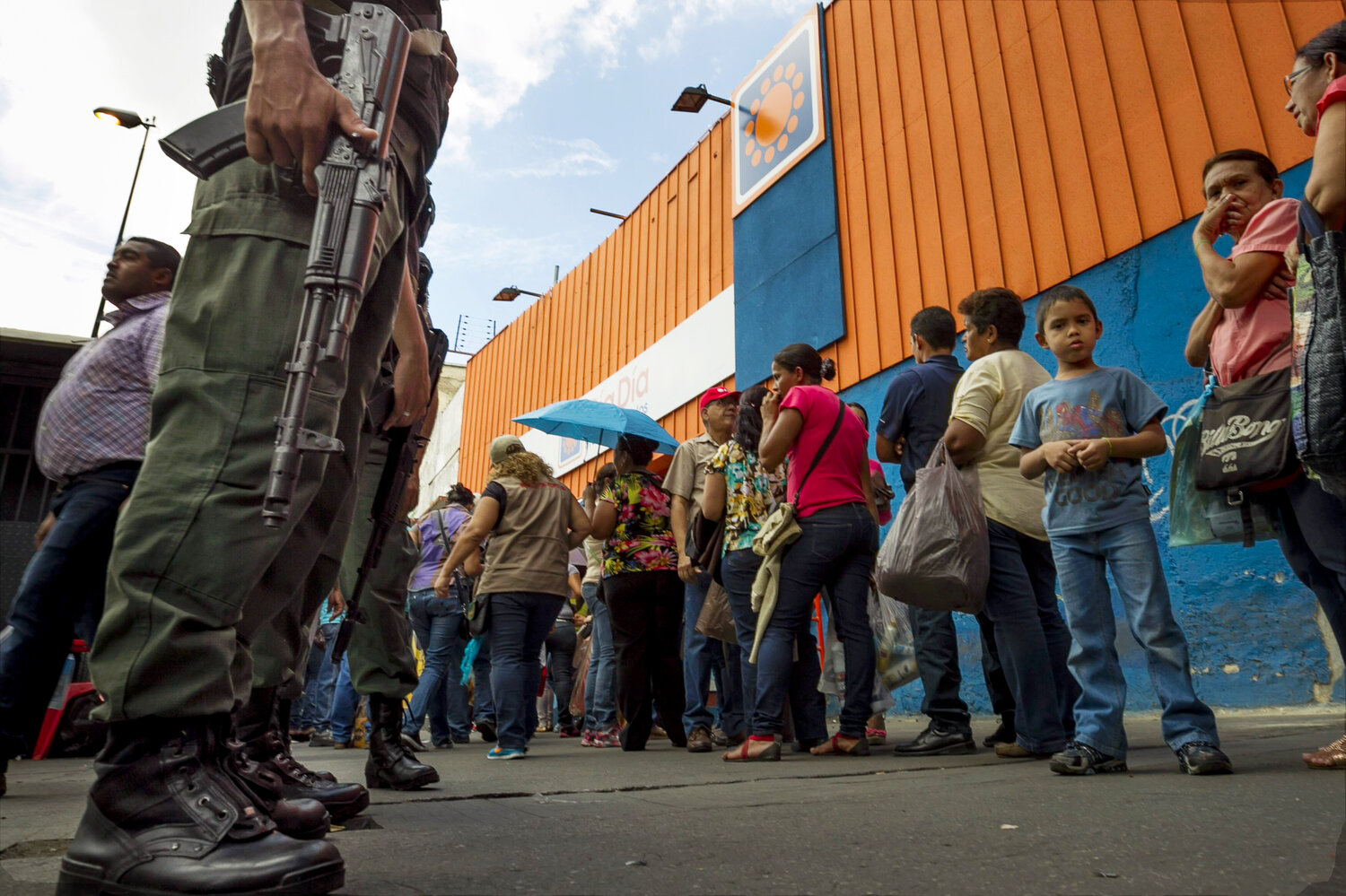
Shoppers queue outside the supermarket ‘Dia a Dia’ in Caracas, Venezuela, on Tuesday. The government took over stores of supermarket chain after alleging that it was hoarding food. According to many economists, government controls are making the economic crisis worse.
Miguel Gutierrez/EPA/Landov
Economists say the country’s economic woes date back to the 1999-2013 rule of Hugo Chavez, who took a dim view of capitalism and nationalized hundreds of companies.
Chavez imposed many government regulations and under his rule, private businesses faced a much tougher time. Between 1999 and 2007, the last year for which government figures were available, the number of Venezuelan manufacturers fell from 12,000 to 7,000.
Chavez’ His successor, President Nicolas Maduro, claims the current food shortages are the result of hoarding and price speculation by the private sector and he has responded by imposing even more controls.
In defending these policies, Ramon Lobo, a ruling party congressman, says that before the Chavez revolution the private sector had grown too powerful and could make or break presidents.
But Ismael Perez, president of the Venezuelan Chamber of Industries, says government intervention has backfired because very few top officials have any business experience. He recalled a meeting to deal with a recent toilet paper shortage caused by distribution snafus.
Instead of addressing the bottlenecks, Perez said, a government minister proposed building toilet paper factories in each of Venezuela’s 32 states.
Other analysts say Maduro has an authoritarian streak and wants to control all sectors of Venezuelan society.
But the resulting bureaucracy is ruining the economy, says Jorge Redmond, president of Chocolates El Rey, which produces and exports chocolate.
“When Chavez came to power there were four steps one needed to take in order to export a container of chocolate. Today it’s 90 steps,” he says. “And there’s 19 different ministries involved in this series of permissions. It’s a mess.”
Redmond claims the government is out to punish the private sector because many business leaders, himself included, support Venezuela’s political opposition.
“In other countries, the governments have a sort of an alliance with the private sector to create a process of development,” he says. “That doesn’t exist because there is a complete mistrust on the part of the government toward the private sector. We’re just have to be watched.”
Back at Capri, Nobile tells me that after a half century making pasta, he’s never seen a tougher business climate. But at least Capri is still standing. There used to be 40 pasta companies in Venezuela. Now there are only five.
8 Comments on "Rich In Oil, Venezuela Is Now Poor In Most Everything Else"
Plantagenet on Sat, 7th Feb 2015 7:01 pm
Cuba was the wealthiest country in Latin America and now, thanks to decades of socialist economics, it ranks down near Haiti.
Venezuela adopted socialism on the cuban model less then a decade ago, and already its people are plunged into poverty—and that is in spite of Venezuela being oil-rich petro-state.
Amazing!
Davy on Sat, 7th Feb 2015 7:30 pm
Planter, of all the countries in the world Cuba is probably the most prepared socially for a collapse of BAU. Cuba also has the advantage of a warm climate and as an Island defensible.
Plantagenet on Sat, 7th Feb 2015 8:11 pm
Daver
There are a small number of desperately impoverished countries that wouldn’t see their living standards materially change if BAU collapsed. Cuba, Haiti, Niger, etc.
These countries are economic basket cases now, and would continue to be economic basket cases if BAU collapsed
Apneaman on Sat, 7th Feb 2015 10:10 pm
Plant is a coprophiliac peanut picker.
Cheers!
fred1 on Sun, 8th Feb 2015 2:42 am
I second that Apneaman and might add in a complete wanker!!! why the f##k does anyone respond to his drivel
Go Speed Racer on Sun, 8th Feb 2015 3:19 am
Wow scope that picture. Those big fat Venezuelan pigs look almost as fat as the dumb stupid rude ugly food-stamp welfare-check monster drink pack O cigarettes meth-head Americans. Check out that purple beer belly. Look at all those fat Venezuelan butts. Well, hopefully their corrupt bankrupt government will put them on a long overdue starvation diet. Now lets do the same for the fat Americans, maybe the next recession will get them to lose 150 pounds.
adamx on Sun, 8th Feb 2015 3:48 am
The most hilarious, but true, sentence:
“In defending these policies, Ramon Lobo, a ruling party congressman, says that before the Chavez revolution the private sector had grown too powerful and could make or break presidents.”
That’s the situation in the US, where banks and business interests make or break politicians. It seems that the alternative is politicians making or breaking businesses, which is just as terrible.
Authoritarianism through the private sector or socialized authoritarianism. Either way somebody in an office calls the shots while the people on the streets take what they can get.
Davy on Sun, 8th Feb 2015 7:40 am
Adam, let’s face it BAU is unholy. Globalism is concerned with growth and efficiency for the few at the expense of the many. People are not the concern of BAU leadership money is the concern. In that respect the sooner it ends the better.
The downside of my spiritual feelings is BAU is needed to transition out of BAU. All of you doomers and preppers here have to agree there is never enough prep. I need at least 2 more years to get my long term effort done. In any case all my prep may be in vain. I have a decent location for collapse but by no means immune to a destructive collapse. There is no way to know how this is going to shake out.
Venezuela is a canary of what is ahead. Watch Venezuela closely. Venezuela tried to decouple from BAU and we see the results. Their decouple was with failed Chavez economics. IMA some of which Putin is embracing with his Russia. A foreign policy that sucks money away from the vital oil sector is dangerous. A foreign policy that thinks it can transcend oil’s economic limitations id failed. This has left Venezuela exposed to an oil price drop and social programs that can’t be supported.
Venezuela no longer has the money to spit in the face of BAU. I do admire this failed economic and social movement for its basic focus on social justice. Yet all such movements are corrupted in the end. BAU and civilization’s basic foundation is corruption and always has been.
If you understand POD ETP of oil then you see oil prices will never recover long term. They may spike but it will be speculative perturbations in a trend down a descent cycle. We are at the end of growth in diminishing returns of catch 22 predicaments. This is a death trap of no escape.