


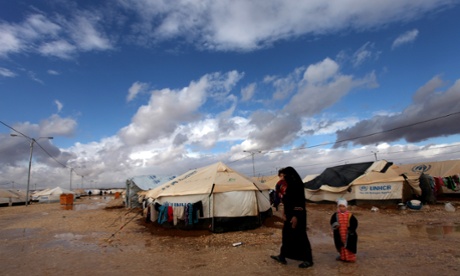
The civil war in Syria has been devastating, generating a death toll fast approaching 100,000, while uprooting millions of civilians from their homes.
But as the US and Russia signed an unprecedented accord on Wednesday in search of a political solution to an increasingly intractable conflict, its underlying causes in a fatal convergence of energy, climate and economic factors remain little understood.
The UN high commissioner for human rights has offered a conservative under-estimate of the death toll at about 70,000 people – accompanied by over 1 million Syrian refugees in neighbouring countries and more than 2 million people internally displaced. According to another independent study, about 79% of confirmed victims of violence in Syria have been civilians.
Although opposition fighters have been implicated in tremendous atrocities, international observers universally confirm the vast bulk of the increasingly sectarian violence to be the responsibility of Bashir al-Assad’s regime.
Yet the conflict is fast taking on international dimensions, with unconfirmed allegations that rebel forces might have used chemical weapons following hot on the heels of US-backed Israeli air strikes on Syrian military targets last weekend.
But the US, Israel and other external powers are hardly honest brokers. Behind the facade of humanitarian concern, familiar interests are at stake. Three months ago, Iraq gave the greenlight for the signing of a framework agreement for construction of pipelines to transport natural gas from Iran’s South Pars field – which it shares with Qatar – across Iraq, to Syria.
The Memorandum of Understanding (MoU) for the pipelines was signed in July last year – just as Syria’s civil war was spreading to Damascus and Aleppo – but the negotiations go back further to 2010. The pipeline, which could be extended to Lebanon and Europe, would potentially solidify Iran’s position as a formidable global player.
The Iran-Iraq-Syria pipeline plan is a “direct slap in the face” to Qatar’s plans for a countervailing pipeline running from Qatar’s North field, contiguous with Iran’s South Pars field, through Saudi Arabia, Jordan, Syria and on to Turkey, also with a view to supply European markets.
The difference is that the pipeline would bypass Russia.
Qatar, Saudi Arabia and Turkey have received covert support from Washington in the funneling of arms to the most virulent Islamist elements of the rebel movement, while Russia and Iran have supplied arms to Assad.
Israel also has a direct interest in countering the Iran-brokered pipeline. In 2003, just a month after the commencement of the Iraq War, US and Israeli government sources told The Guardian of plans to “build a pipeline to siphon oil from newly conquered Iraq to Israel” bypassing Syria.
The basis for the plan, known as the Haifa project, goes back to a 1975 MoU signed by then Secretary of State Henry Kissinger, “whereby the US would guarantee Israel’s oil reserves and energy supply in times of crisis.” As late as 2007, US and Israeli government officials were in discussion on costs and contingencies for the Iraq-Israel pipeline project.
Syria’s dash for gas has been spurred by its rapidly declining oil revenues, driven by the peak of its conventional oil production in 1996. Even before the war, the country’s rate of oil production had plummeted by nearly half, from a peak of just under 610,000 barrels per day (bpd) to approximately 385,000 bpd in 2010.
Since the war, production has dropped further still, once again by about half, as the rebels have taken control of key oil producing areas.
Faced with dwindling profits from oil exports and a fiscal deficit, the government was forced to slash fuel subsidies in May 2008 – which at the time consumed 15% of GDP. The price of petrol tripled overnight, fueling pressure on food prices.
The crunch came in the context of an intensifying and increasingly regular drought cycle linked to climate change. Between 2002 and 2008, the country’s total water resources dropped by half through both overuse and waste.
Once self-sufficient in wheat, Syria has become increasingly dependent on increasingly costly grain imports, which rose by 1m tonnes in 2011-12, then rose again by nearly 30% to about 4m in 2012-13. The drought ravaged Syria’s farmlands, led to several crop failures, and drove hundreds of thousands of people from predominantly Sunni rural areas into coastal cities traditionally dominated by the Alawite minority.
The exodus inflamed sectarian tensions rooted in Assad’s longstanding favouritism of his Alawite sect – many members of which are relatives and tribal allies – over the Sunni majority.
Since 2001 in particular, Syrian politics was increasingly repressive even by regional standards, while Assad’s focus on IMF-backed market reform escalated unemployment and inequality. The new economic policies undermined the rural Sunni poor while expanding the regime-linked private sector through a web of corrupt, government-backed joint ventures that empowered the Alawite military elite and a parasitic business aristocracy.
Then from 2010 to 2011, the price of wheat doubled – fueled by a combination of extreme weather events linked to climate change, oil price spikes and intensified speculation on food commodities – impacting on Syrian wheat imports. Assad’s inability to maintain subsidies due to rapidly declining oil revenues worsened the situation.
The food price hikes triggered the protests that evolved into armed rebellion, in response to Assad’s indiscriminate violence against demonstrators. The rural town of Dara’a, hit by five prior years of drought and water scarcity with little relief from the government, was a focal point for the 2011 protests.
The origins of Syria’s ‘war by proxy’ are therefore unmistakeable – the result of converging climate, oil and debt crises within a politically repressive state, the conflict’s future continues to be at the mercy of rival foreign geopolitical interests in dominating the energy corridors of the Middle East and North Africa.
But whoever wins this New Great Game, the Syrian people will end up losing.
As other oil exporters in the region approach production limits, and as climate change continues to wreak havoc in the world’s food basket regions, policy makers should remember that without deep-seated transformation of the region’s political and economic structures, Syria’s plight today may well offer a taste of things to come.
Dr Nafeez Ahmed is director of the Institute for Policy Research & Development and author of A User’s Guide to the Crisis of Civilisation: And How to Save It among other books. Follow him on Twitter @nafeezahmed
Arthur on Mon, 13th May 2013 9:20 pm
The Guardian will never let the truth seep into their pages when the darker side of Israel is concerned.
Here is the reason why the US paid proxy mercenaries to do the dirty work and set Syria on fire:
http://en.wikipedia.org/wiki/A_Clean_Break:_A_New_Strategy_for_Securing_the_Realm
“A Clean Break: A New Strategy for Securing the Realm (commonly known as the “Clean Break” report) is a policy document that was prepared in 1996 by a study group led by Richard Perle for Benjamin Netanyahu, the then Prime Minister of Israel.[1] The report explained a new approach to solving Israel’s security problems in the Middle East with an emphasis on “Western values”. It has since been criticized for advocating an aggressive new policy including the removal of Saddam Hussein from power in Iraq, and the containment of Syria by engaging in proxy warfare and highlighting their possession of “weapons of mass destruction”.”
Environment/climate has nothing or peak oil/energy has little to do with. The US attack Syria by proxy because Syria is an ally of Iran and functions as a link between Teheran and Hezbollah. Syria is first, Iran next. The main reason is geopolitical, global control via control of the Gulf.
The good news is that currently Assad has the upper hand. But actually, Assad losing would not be too bad either, because Turkey would take over the Middle East, which is just as bad for the prospects of the NWO, because Turkey just poses as a western satrap, but in reality is using the western purse to reinstall the Ottoman empire. Which is extremely bad news for Israel, that could easily end up AGAIN as a Turkish province, once Pax Americana will retreat. What Erdogan wants is for the US to invade Syria for a couple of trillion $, hang around for a few years and then withdraw, leaving a wrecked Syria up for grabs for Turkey, that will install a satrap muslim Brotherhood regime. Western Iraq, Jordan, parts of SA and Palestine will be next. Erdogan insists that Assad is using chemical weapons.lol It was probably Turkey itself behind that car bomb attack in a Turkish border town.
All that US foreign policy will achieve in the ME is the creation of the segregated muslim empires: a Sunni and a Shi’ite one, with both zero affinity for the West.
Beery on Mon, 13th May 2013 10:13 pm
So Arthur, you’re claiming The Guardian is in the pocket of the zionists now? The Guardian?
That’s like saying ‘The Nation’ is a Tea Party rag.
Arthur on Tue, 14th May 2013 12:06 am
“The Guardian is in the pocket of the zionists now?”
Make that Anglosphere as a whole.
The Guardian will give you that inconsequential left-wing humanitarian comment about the ‘plight of the Palestinians’, not the heavier geopolitical NWO stuff. Too ‘Protokollish’. After all we are no conspiracy theorists, now are we? That’s Hitler and we are all glad we are not like that.
Plantagenet on Tue, 14th May 2013 12:20 am
Its silly to discuss the civil war in Syria without even mentioning that at its core is a religious war between Shia Alawite Moslems and Sunni Moslems that has been going on in the Middle East for the last 1400 years.
Arthur on Tue, 14th May 2013 12:21 am
http://www.youtube.com/watch?v=yw_v3hqtCl0
Dutch mainstream prime time television documentary about the Israel lobby in the US, made by leftwing public broadcaster VPRO. Most of it is English spoken. Paints the picture of an iron grip the zionists have over the US. I doubt if anything like this would ever be broadcast in Anglosphere, other than on David Duke’s youtube channel.
Arthur on Tue, 14th May 2013 12:24 am
http://www.youtube.com/watch?v=BbyBL3-ZOsM
Carl Bernstein, the jewish journalist who brought down the Nixon government… in 0:17 he says who was behind the Iraq invasion. And it is not different in the case of Syria, the topic of this thread.
BillT on Tue, 14th May 2013 1:07 am
Well said, Arthur. The ‘religious war’ Planet mentioned IS real, except, it is between the Jews and the Muslims … both of whom serve the SAME God.
Others on Tue, 14th May 2013 1:59 am
Seems we dont have as much natgas as we thought.
http://www.pennenergy.com/articles/pennenergy/2012/01/u-s–shale-gas-reserve.html
BillT on Tue, 14th May 2013 4:39 am
A bit off topic, but…
“… The overwhelming majority of that Russian uranium comes from a 20-year-old agreement called “Megatons to Megawatts” that allows weapons-grade, highly enriched uranium (HEU) to be converted to reactor-grade, low-enriched uranium (LEU).
By December 2012, “Megatons to Megawatts” had produced 13,603 metric tons of LEU for US consumption and provided the fuel for nearly half of the US electricity generated from nuclear power.
In December 2013, that agreement expires, and Russia will be free to put its uranium out on the open market and demand higher prices. With 17 nuclear reactors in China and 20 in India – not to mention Japan, France, Germany, and others all vying for nuclear fuel – competitive bids are poised to drive prices higher, and early investors stand to make spectacular gains…”
NOTE: 40% of the US fuel uranium comes from Russia.
DC on Tue, 14th May 2013 8:13 am
That reporter clearly has no idea who or what is behind the US-backed attempt to topple the Syrian govt. Is throwing out terms like peak oil and CC just code for who is really behind the violence there? Or a ham-fisted attempt to avoid stating the obvious? If Peak Oil=US and say, CC=France, Britain, then yes, that would make some sense.
And WTF is this?
Q/, international observers universally confirm the vast bulk of the increasingly sectarian violence to be the responsibility of Bashir al-Assad’s regime.
What international observers would those be? The UN? LoL!, the corporate western media?, US state-dept controlled faux-NGOs? I get force fed a steady diet of US propaganda about whose ‘fault’ things are, but most of those ‘observers’ either work for the US or are majority funded by. IoW-not credible at all.
Arthur on Tue, 14th May 2013 10:23 am
http://www.independent.co.uk/news/world/middle-east/the-civil-war-in-iraq-has-already-begun-politician-claims-conflict-has-started-and-warns-it-will-be-worse-than-syria-8601732.html
Iraq is by no means pacified either. In the first four months of this year already 1500 people died in ‘sectarian’ violence. The country has no future and will fall apart, just like all the other constructs and leftovers of the colonial era. Turkey and Iran are going to divide the Middle East between them.
Arthur on Tue, 14th May 2013 10:27 am
http://www.historyonmaps.com/ColourSamples/cbig/OttomanEmpire1800.jpg
Here the Ottoman empire of 1800. Something similar might emerge, less Turkish, more fundamentalist islamic and Iran will take both sides of the Gulf (and most of the oil), supported by Russia and China.