
Peak Oil is You

Donate Bitcoins ;-) or Paypal :-)


Page added on May 15, 2015

It’s time for a new political and economic system
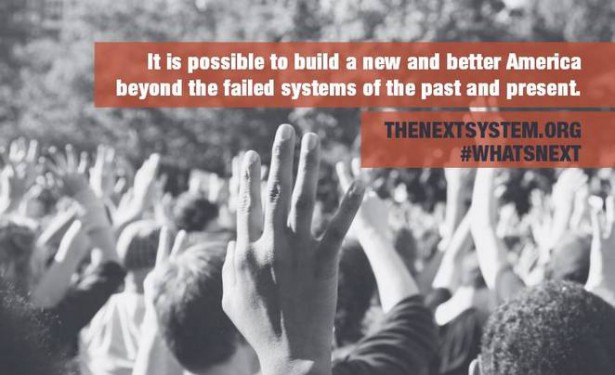
Our society’s institutions are in crisis — with looming ecological collapse, historic concentration of capital, incarceration rates far beyond those of any other country, the diminishing civil liberties that come along with a permanent “war on terror,” and a political process bought and paid for by the rich and powerful. The Next System Project, or NSP, hopes to explain how we arrived here, provide competing visions for where we can and should go, and detail specific proposals for how we can begin to go there.
The project, which launched at the start of April, begins with the premise that our long-term political and economic problems require more than policy changes that alleviate symptoms — like those proposed in the newly released liberal agenda, “Rewriting the Rules,” backed by economist Joseph Stiglitz and Sen. Elizabeth Warren — without focusing on root causes. The NSP will bring together academics and grassroots activists, as well as policy analysts and advocates, to develop and begin to implement genuinely democratic political and economic institutions capable of producing lasting and shared prosperity.
Gar Alperovitz, a political economist and the project’s co-chair, has been focused on developing a new American political economy for a long time. After publishing his early work on the decision to drop the atomic bombs, Alperovitz turned his attention more explicitly to our political economy, believing that our economic and foreign policies are driven by the institutional capitalist requirement for ever-expanding markets and access to raw materials.
Alperovitz has since developed an alternative political-economic model, called the “Pluralist Commonwealth” — different (plural) institutions of democratized (common) wealth — that seeks, rather than growth and expansion, to preserve individual liberty and to sustain communities and the environment. So far, the most successful implementation of the model is the Mondragon Corporation-inspired Evergreen Cooperatives, a network of worker-owned and community-controlled coops that have brought economic development to Cleveland’s impoverished inner city by tapping into the purchasing power of local “anchor institutions,” like hospitals and universities.
I recently had the chance to speak with Alperovitz about the NSP’s inspiration, the types of solutions it plans to promote, and the efforts already underway that it seeks to amplify.
Can you describe the goals of the NSP?
Here’s our starting point: If you don’t like corporate capitalism or state socialism, then what do you want — and how do we get there? Rather than elevating one model or another, we have two broad goals. First, to begin to raise our conversation beyond projects and elections. Both are important, but we’re trying to say that the problems we face are systemic. Second, if systemic change is required, which I think it is, then what is the nature of the system that we would actually want to live in that is different from the old state socialist model or the corporate capitalist model. Because if we had that clear vision, it might also inform our strategy for how to get there.
And it has an emphasis on combining research with popular education and grassroots action?
We hope to have a wide range of discourse — conferences, study groups, academic work on pieces of the puzzle that nobody has done yet. This is time to really open the door intellectually and with experiments on the ground that open up new political-economic directions that we can learn something from. And we want to stimulate people to work in this arena. We want people to realize this is a really important problem and to open this debate far and wide. We were surprised by the broad range of people who were willing to say, yes, we have to deal with the system, not just electing one candidate or another.
What surprised you?
What’s surprising is that more moderates and liberals signed and said it’s time to talk about the systems issue. Well-known liberals like Robert Reich and Jeffery Sachs signed the founding statement, people who would identify as being on the left, but certainly not as radical as Richard Wolff or Noam Chomsky — both of whom also signed. So did Bill McKibben and a broad range of environmentalists. Also, Daniel Ellsberg, the whistleblower.
It is interesting that you identify liberty as a value the current system is unable to fulfill. Can you elaborate on that?
The anarchists and the genuine conservatives pointed out long, long ago that state socialism would develop a power structure that was going to destroy liberty. And people didn’t listen. You need to take off your hat to both the anarchists and the conservatives who were really way ahead of the socialists and the liberals on that question. The anarchists have urged different forms of representation that preserve communities and individual activity within them.
How is liberty threatened today?
One aspect is time spent at work. Time could become freedom to do whatever you want to do. Liberty is also connected with stability and security. If we had a guaranteed job system, or if you had a job as long as you were willing to work, no matter what you did or said politically, it gives you enormous degrees of freedom that you don’t have now. Thirdly, governments with scale happen to be imperial — like the one that rules this continent. Bringing government close to home — cities, states, regions — is another way to get at liberty denied by big government.
Can you explain why you think we need a new system and new institutions rather than new policies?
The traditional model since the New Deal has been that you have major corporate power and agricultural power; people often leave that out, but the farm groups and lobbies have been much more powerful than the population they represent, which is perhaps 2 percent. Corporate and business power was on one side with labor on the other — the economist John Kenneth Galbraith used to call the institutional strength of the unions “countervailing power.” But the American labor movement was never that strong. And it’s getting weaker everywhere. The basic structure that kept American capitalism somewhat stabilized was this model, which had some capacity to repair the damages that the corporate system was building — some social programs, some welfare programs, some unemployment programs. That whole structure is simply decaying before our eyes.
And what role does ideology play in sustaining the current system? Can you speak to your experience opposing President Carter’s austerity approach to inflation with the consumer advocacy group you helped to create, Consumers Opposed to Inflation in the Necessities, or COIN.
In the 1970s, there was an overwhelming and successful conservative attempt to blame the inflation problem on wages or monetary policy and excess spending, when it was almost self evident that it was largely sectoral — energy, health, food and housing costs were the dominant sources of inflation. So we attempted to challenge that by putting together COIN. There was a lot of success raising the issue. We tried to get the Carter administration to take a different view, but they were obviously not in a position to do anything serious. The inflation went on, which paved the way for [Federal Reserve Chairman Paul] Volcker’s extreme policy — at one point it raised interest rates to 17 or 18 percent and created massive layoffs and wage cuts.
And why were the lobbying attempts unsuccessful?
Those in the Carter administration had all been brought up on standard traditional economics and did not feel comfortable attacking those interests. They would have had to go after the oil industry and a number of agricultural programs; the housing issue they could have done, but that would have entailed lowering the interest rate, not raising it. The standard interest groups bolstered the Carter administration’s fear while at the same time the Republicans attacked them ideologically. They were just cornered. Had they been very bold, which they were not, they might have opened up the direction we are talking about. Aside from the strictly political power questions — which are very real — there are certainly questions about the role of economic ideas and ideology.
You have been writing about alternative political-economic systems for decades. Why launch the NSP now?
It’s been clear to me that we are facing a systemic crisis for a very long time. The notion that we might have the chance to launch it became evident as we began to see where the trends were going, and the slow build up of the so called “New Economy Movement,” which I’ve been involved with as well. What has become evident — and Occupy helped crystalize it — is that the pain levels are so high, and the political system is so hijacked that something is about to break open. The pain levels have been there all along. What was new with Occupy was the articulation — putting the 1 percent and 99 percent on the table — and it also produced political activism around economic issues for the first time in a long time.
How do you think Occupy, and its symbolic importance regarding political activism around economic issues, has contributed to the countless local economic experiments being conducted around the country, like those associated with the New Economy Coalition?
One of the little told stories of the Occupy movement is the following: People say it disappeared. People prior to the Occupy events, isolated individuals, did not know other individuals who were equally isolated had these feelings and views. People met each other in Occupy events. If you look at the basis for activism now in many parts of the country in the new economy movement, those people met others with whom they could form organizational and social bonds in order to act in a new way during the Occupy movement. The New Economy Coalition is one organization. People are doing projects all around the country. If you peel back, a lot of the people got activated and found each other at the time of the Occupy movement.
So projects are something you have supported and pursued, obviously, through your activism. But you are also critical of what you have called “projectism,” which I will translate as the failure to see beyond individual projects or groups of projects to a strategic systemic approach.
Projects are absolutely critical; you can’t move without them. The question is whether we are building a strategy that aims at a systemic change. A lot of activism is framed as projects, and thinking through whether A leads to B and B to C is a very important kind of thinking that needs to be done by activists. What strikes me is I think most people haven’t thought seriously about really winning. A lot of activism is, rightly, protesting or trying to fix a problem or correct an injustice. A much larger question is: How do we win? And if we won, what do we want? And I think that’s a critical psychological issue.
And the emphasis on clear analysis that can be understood by mainstream audiences?
It’s important that the project begins to give people, beyond just activists on the left, the sense that we can talk about this. We’re not going to move the ball unless we get a much broader group of people talking about this. I always think about whether I could explain it to the people who I grew up with. You ought to be able to explain it to citizens. Tolstoy put it this way: If you can’t explain it to your fellow peasant, that’s your problem, not his.
Can you explain your belief in community as the foundational unit of a political system that is actually participatory and democratic?
Like I wrote in “Cold War Essays,” one of the most powerful sources of the problems we face internationally is that systems, like American capitalism, must expand. Capitalism has an inherent necessity of expanding, seeking markets, investment abroad, outlets, and control of other communities in trade policies. If the system doesn’t expand it collapses. If you want systems that are peaceful and do not inherently produce conflict, you must alter the nature of the expansionary element. That means you have to move away from capitalism — there’s also an ecological imperative to do this. That leads you to systems that are not entirely based on markets. The starting point for my whole vision is this need to develop systems that both foster community and are not inherently expansionary.
You consistently return to economic planning as necessary for any system seeking stability, for both the entire economy and for communities. Can you explain our current system of backdoor corporate planning?
Every area you look at, either tax or regulation or loans or loan guarantees or combinations of those strategies bolster or don’t bolster certain directions in the economy. So the idea that we have a free market in the economy and that there is open competition is absolutely absurd. If you look at the oil industry, for example, it’s supported by special tax programs that give it a particular direction.
The way it’s organized, lobbyists have found ways to get these programs out of the government. As you know I worked in both houses of Congress at one point. The way in which the lobby system works — this is very well known and most people close to the political process just take it for granted.
What would democratic planning look like?
You are going to have to have national economic planning for the big areas — for example, energy, climate impact, transportation. Right now we let the free market control where the major air transport goes. What that means is a city like Cincinnati loses its transportation, then it loses its business. The same thing is going to happen to Cleveland, which is ridiculously inefficient, as well as inhumane. A planning system needs to begin to coordinate that.
How can we do this?
Partly we need to build up local experience through participatory budgeting and planning. That is a whole area for activists to work on.
We also need a theory of how to do it at the national level. Making it explicit — for example, if we want to deal with climate change, saying here are all of the implications captured in an economic plan. Similarly, if we want to stabilize communities, and so on. And then we should debate it back and forth.
Given our country’s size, the region becomes an important political unit in your work. Can you explain this?
Most people haven’t faced this question or wanted to face it. The country is almost obviously too big for the government to be a genuinely democratic institution — it’s almost 3,000 miles from corner-to-corner with 318 million people.
Now, most states are too small, economically. The most logical solution is something bigger than a state and smaller than a continent — a region. Most European societies are radically smaller than the United States. You could drop Germany into Montana. Large scale gives control to elites — and to money and media. So, at some point, any serious model that wants to be democratic is going to have to decentralize where decisions are made. California, New York, Texas could probably do it on their own — they are regional scale units. That’s a whole set of questions that have to be put on the agenda.
In your writing on democratic planning, you often confront the tension between the need for action and its centralizing tendencies, and participatory democracy and the decentralization needed to make it a reality. How can this apparent contradiction be overcome?
First, you have to have inclusive units that include everybody — community models, not just worker-ownership models.
The second piece is using both planning and markets. Using Cleveland and the Evergreen Cooperatives as an example, you’ll see that the big institutions — hospitals and universities — both of which have a lot of public money, buy from worker-owned companies that are embedded in the community structure. That’s a planning system, using the purchasing power of these institutions, a lot of which is public money — Medicare, Medicaid — to help stabilize companies that are owned by the community and workers. It’s not just a free market system.
How can markets be used?
You want some sort of mix of planning and markets, because you want to challenge the planning systems, which can get rigid. If you take this model to the national level, then the government, using just one example, would support mass transit and high-speed rail as one element of its transportation system. That would mean there are a lot of public contracts to build that. They could purchase the goods from worker and community-owned companies. You could have several of them that are quasi-competitive, so that the planning system can be efficient.
What are the basic types of alternative political-economic models that could achieve this?
Most of the models have an element of worker-ownership in them. It’s not the only thing, but it does change the ownership of capital. I think it’s a mistake to say that’s the only element — I don’t agree with some theorists who think that the system is going to be just adding up worker-owned companies.
Another model is a city-ownership model. For instance, in Boulder, Colorado, they have municipalized a private electricity utility. So that’s a different strategy that emphasizes a community model at the city level. Now, you can put both together — I believe in a pluralist system that will include several different models.
A third model is neighborhoods. It’s particularly important for the United States, where neighborhoods are often organized around race. The work we’ve done in Cleveland is a combination of neighborhood ownership and worker ownership.
And you write about the problems that come with economic entities that achieve scale, even if they are worker-owned.
When you get to the larger scale and economies of scale become available, even worker coops develop power relationships because they have to. If somebody else is in the game who can cut costs by polluting, even good guys in the coop will lose their jobs and their company if the other group is able to undercut them. Especially, if you invest in new equipment that can lower your cost, if somebody else does that in another company, you must do the same thing, otherwise you will be out of business. They have to grow; they have a growth dynamic, as well as a cost cutting dynamic, built into the model. So when you get to significant scale — and that changes in different industries — worker coops, in a market economy, have very similar forces operating against them that any company in a private economy has.
How can problems of scale be overcome?
First I want to say that worker coops make sense on a smaller scale and are doable.
One way to address scale is to build a culture of community that internalizes externalities, through, for example, community-wide ownership. That is to say, a community-wide ownership system can decide to pollute, but it pollutes itself. So it must make the choice of what to do. Whereas a company, worker owned or not, may like to not pollute, but if it pollutes, it’s polluting the community, not just itself, and it might do that because of cost competition.
How can some of these different ownership models begin to be implemented right now?
I think we are going to see a lot of this. We’re already seeing activity at the city government level. Several city governments — New York, Madison — are beginning to pick up on supporting worker ownership. Some states — Vermont and Ohio — have supported worker-owned companies. That’s a step forward.
How can local government be used as a resource for this type of change?
It’s not just funding. People don’t realize, a worker-owned coop is a “business.” In the United States, there are enormous subsidies and laws and national government policies in support of business. For progressives and people on the left, the light bulb needs to come on that almost all of this could be used for worker businesses.
For example, with the Cleveland model, once the city officials realized they wanted to help, they could begin to use all of the existing tools for this direction. And the mayor often looks good if he or she does this. People are often in opposition and they don’t realize there are a lot of opportunities in government where politicians would look very good if they helped.
And what about the role for anchor institutions, like with the Cleveland Model?
The other strategy is big institutions that have a lot of money in them and can’t move — like hospitals and universities. Medicare and Medicaid, educational money, etc. They buy a huge amount of goods and services. They can be requested, or pressed, or organized to help support these new directions. That’s what’s going on in Cleveland, of course. In many cities, actually, but Cleveland has done the most dramatic work.
What kind of potential exists for activists to tap into these resources and to use them to attain much-needed economic development for marginalized communities?
One thing they can do is use city government purchasing power. They have to procure from somewhere. They could buy from a worker coop.
Another area is government housing programs that the city government manages. And they could do it in a way that supports, not only low-income housing, but either cooperative housing, or housing structures focused on land trusts that control housing prices. Using community land or housing trusts, you can get people into housing. The typical situation is that when housing prices go up, people get priced out. The first owner makes a lot of money, but then the affordable housing disappears. In a land trust situation, the owners can recapture the cost that they put in. It’s happening in different places, but it’s very difficult to do. You have to learn about it and get tough in your organizing strategies.
Tax incentives, tax abatements, loan guarantees, loans, special zoning, public-private ventures, and other economic “tools” to encourage business development. We regularly use taxpayer money to achieve economic goals.
Where can you see this project going?
Many other movements began small — the women’s movement, the anti-war movement during the Vietnam era, the early environmental movement, and certainly with civil rights. The conservatives were absolutely nowhere in the 1940s. Radical conservatives were talking to themselves, but then they got serious about building a movement that could reach well beyond their narrow ranks. I think that’s what we’re talking about.
38 Comments on "It’s time for a new political and economic system"
Rodster on Fri, 15th May 2015 7:52 am
Nothing will change until you CHANGE the way money works. It’s that simple and why NOTHING will change. The world no longer operates under capitalism but BANK-ISM.
The Banks run the entire world and elect their governments puppets who do their bidding.
rockman on Fri, 15th May 2015 7:59 am
Interesting ideas. Now they just have to be put forward by those with the power to implement them. Which, obviously, isn’t the folks who have developed the plan. Yes: small movements can grow big…if the they are ultimately pushed by majority who, in turn, can push the politicians in the same direction. IOW until the majority is fully onboard with such changes nothing will change regardless of how vocal and adamant the minority might be.
Remember all the nightly coverage of the Occupy Wall Street movement. Hear about much change in that neighborhood these days? It doesn’t take much common sense to develop a good plan. Implementation ability of that plan is what’s typically missing.
Dredd on Fri, 15th May 2015 8:01 am
“It’s time for a new political and economic system” – Geoff Gilbert
Agreed.
Free of the government dogma: “Oil is the lifeblood of America’s economy” (The Peak of The Oil Lies – 2).
ghung on Fri, 15th May 2015 8:30 am
Rock: “Interesting ideas. Now they just have to be put forward by those with the power to implement them.”
As I’ve said, those who have the most ability to change things have little incentive to do so. They like things pretty much the way they are, and most of the rest of us have little wiggle room. Most folks need some sort of upheaval to jerk them out of their comfort zones, even if those comfort zones aren’t so comfortable. That’s why it usually takes a big reset of things for big change to occur.
Most of us are fully involved in preserving the status quo, even if it means deluding ourselves.
paulo1 on Fri, 15th May 2015 8:34 am
re: “conferences, study groups, academic work on pieces of the puzzle that nobody has done yet.”
Sorry, the only real change will occur when the system failures bring people onto the streets with burning tires and real menance…when people starve the beast and disregard authority and their edicts. The cities will see the protest crowds and violence and the rural areas will work around authority in one way or another.
I am not advocating these actions, all I am saying is that vested interests will not give up their power, money, and influence. They’ll ride this baby down.
I think it will be another economic collapse in conjunction with climate change that will shake off apathy.
regards
Davy on Fri, 15th May 2015 8:35 am
Rod, nothing will change until food and fuel shortages collpase BAU. Included in that is the end of capitalism and global fiat money.
Any thought of reform within BAU are nothing more than hopium of the anti-establishment. BAU cannot degrowth or change basic structures without collapse. There are no alternatives to BAU that resemble BAU or anything close.
The nearest example would be dispersed martial law environment. Add in a destroyed economy similar to post WWII European economies right after the war. Follow up this picture without aid and resources to rebuild. Then you get the BAU alternative the anti-establishment craves but don’t realize the reality of.
BAU anti-establishment is under the same BAUtopian spell as everyone else just with the hopium of their boys running the show instead of the banksters. IMA the anti-establishment are incapable of leading anything more than a boy scout troop for lack of experience and structures IOW anarchy.
penury on Fri, 15th May 2015 10:16 am
I do think that a change of government and monetary system is coming, Be prepared the new system will probably be called “Anarchy”.
Rodster on Fri, 15th May 2015 11:13 am
“Be prepared the new system will probably be called “Anarchy”.
——————————————
I think it will be called tyranny and oppression. Something tells me this is all headed to a global currency (IMF/SDR) and a one world government which is what the Elite (Henry Kissinger, Mikhail Gorbachev, Ted Turner George Soros and others) have been wanting to happen for decades.
Dredd on Fri, 15th May 2015 11:42 am
The new system-archetecture released by right-wing luddites in congress is focused on reaping the job opportunities generated by SLR (Will This Float Your Boat – 9).
GregT on Fri, 15th May 2015 11:46 am
Anarchy: a utopian society of individuals who enjoy complete freedom without government
But of course we have been lead to believe by TPTB that the true meaning of Anarchy is: A state of lawlessness or political disorder due to the absence of governmental authority
Rodster is most probably correct in his prediction; TPTB will not allow the people the freedom to self determination, and tyranny and oppression will be the means by which they will attempt to maintain control. The DC oligarchs are still pursuing their NWO, but it certainly looks like they will be shut down by the BRICS, and other nations. They will not give up without a fight though, expect more wars to break out as time goes on. Maybe even the war to end all wars, or perhaps even mankind himself.
J-Gav on Fri, 15th May 2015 3:48 pm
Rod – “Nothing will change until …” Exactly what I’ve been saying for a dozen or so years.
As regards further comments, all interesting, I sincerely doubt any new ‘system’ will be called ‘anarchy,’ although if it was real ‘anarchism,’ even without the name (impossible to use today), I would welcome it whole-heartedly (just a question of allowing people’s talents to rise to their natural level of expression).
Oh, however I don’t agree, Rod, that it will be ‘called’ “tyranny and oppression” but yes, that is most likely what it will resemble. It’s much more probably it will be called ‘saving us from Terrists, Rooskies, etc. In any case, totalitarian is what it will attempt to be by whatever means deemed necessary.
Rodster on Fri, 15th May 2015 3:48 pm
“The DC oligarchs are still pursuing their NWO, but it certainly looks like they will be shut down by the BRICS, and other nations.”
It appears the BRICS are in on the NWO game as well. In fact the Chinese and Russians have both asked the IMF for a inclusion wrt the IMF/SDR. The AIIB is another con job and is another way to put pressure on the IMF to include the Yuan and give it a larger piece of the IMF/SDR pie.
GregT on Fri, 15th May 2015 4:17 pm
The difference Rod?
The US oligarchs’ NWO is a unipolar world. Russia and China have both made it very clear that they are willing to work together to achieve a multipolar NWO system, which would include the US. They are not going to allow the US to achieve unipolar global dominance. The west would have been much better served if our leaders weren’t so inherently greedy. What is now coming down the pipes is going to be especially devastating to the US and her ‘allies’. We voted in the governments that we deserve.
Rodster on Fri, 15th May 2015 4:24 pm
“Russia and China have both made it very clear that they are willing to work together to achieve a multipolar NWO system, which would include the US. They are not going to allow the US to achieve unipolar global dominance.”
Of course not, it’s all part of the plan to destroy the West including the US to bring it into alignment with the NWO. The US is the final piece of the puzzle in order to achieve the NWO one world govt.
GregT on Fri, 15th May 2015 4:27 pm
The NWO is a US corporatist/globalist construct.
https://www.youtube.com/watch?v=txukr5zgHnw
GregT on Fri, 15th May 2015 4:31 pm
Putin says Russia will never succumb to unipolar world order
http://www.presstv.com/Detail/2015/02/07/396584/Russia-opposes-unipolar-world-order
GregT on Fri, 15th May 2015 4:33 pm
BRICS signals end of unipolar world
http://www.crescent-online.net/2013/05/brics-signals-end-of-unipolar-world-tahir-mustafa-3775-articles.html
Apneaman on Fri, 15th May 2015 4:36 pm
Nothing will change by talking and marching once in awhile and signing online petitions. In fact, TPTB sponsor/fund most of that shit, AKA-gatekeeping, to keep the semi aware sheep thinking there is still “HOPE” to change the system within the system. The system is fucked and will be the death of everyone starting at the periphery and working towards the center. There is going to more violence. Think of the people of Baltimore or Ferguson or Yemen or Syria or Ukraine or Libya or Iraq etc and see where they fit (step #) in the OVERSHOOT behavioral loop.
Step 1. Individuals and groups evolved a bias to maximize fitness by maximizing power, which requires over-reproduction and/or over-consumption of natural resources (overshoot), whenever systemic constraints allow it. Differential power generation and accumulation result in a hierarchical group structure.
Step 2. Energy is always limited, so overshoot eventually leads to decreasing power available to the group, with lower-ranking members suffering first.
Step 3. Diminishing power availability creates divisive subgroups within the original group. Low-rank members will form subgroups and coalitions to demand a greater share of power from higher-ranking individuals, who will resist by forming their own coalitions to maintain power.
Step 4. Violent social strife eventually occurs among subgroups who demand a greater share of the remaining power.
Step 5. The weakest subgroups (high or low rank) are either forced to disperse to a new territory, are killed, enslaved, or imprisoned.
Step 6. Go back to step 1.
The above loop was repeated countless thousands of times during the millions of years that we were evolving[9]. This behavior is inherent in the architecture of our minds — is entrained in our biological material — and will be repeated until we go extinct. Carrying capacity will decline[10] with each future iteration of the overshoot loop, and this will cause human numbers to decline until they reach levels not seen since the Pleistocene.
http://www.dieoff.org/
JuanP on Fri, 15th May 2015 4:54 pm
I remember laughing till it hurt reading the news about those ignorant retards, naive fools, and delusional fantasists of the Occupy Movement. I was always 100% certain that they would achieve nothing, and that is exactly what happened.
The system has too much inertia and it can’t be changed, fixed, or improved. Things will simply keep getting worse for the rest of our lives and we will not live to ever see things get better. Anyone reading these words who thinks he/she will live to see things improve in any way before they die, is simply living in denial, which I can easily understand since reality is truly grim.
The future sucks, get used to it!
Perk Earl on Fri, 15th May 2015 5:22 pm
“There is going to more violence. Think of the people of Baltimore or Ferguson or Yemen or Syria or Ukraine or Libya or Iraq etc and see where they fit (step #) in the OVERSHOOT behavioral loop.”
That post nailed it Ap. I pasted in the above because the violence is rising worldwide. The number of refugees is going to rise to outrageous heights. As diminishing returns reduces fiscal capability to cope with these people we are already seeing circumstances in which they are being turned away. The desperation has reached a point for many of them that the fear of drowning in an over-packed boat is less endangering to them than the alternative of daily fears of lethal persecution.
And we aren’t even to the point where people are migrating to get away from flooding coasts. Imagine the people of Bangladesh trying to move inland to India and coming up against that giant long fence India built to stop them. There could be some really horrific scenes coming down the pike.
TPTB change course? Nada! Change the very system that allowed them to rise to their powerful and wealthy status? Not happening.
The is the beginning of the big unwind. In some distant future there will be a band of youths with mythical stories of what it was like when there were the hi-scrapers and think every wandering man is Captain Walker. Mad Max II? III? But maybe there will be some Bartertown using pig methane to run generators for electricity. “Let the games begin!”
Apneaman on Fri, 15th May 2015 5:47 pm
The Occupy Movement was mostly about those young folks wanting the same slice of pie their parents and grand parents had. They were basically reformers. I do not necessarily disagree with them in principal (they have been fucked), but as a group they possessed little understanding of overshoot or the seriousness and proximity of climate disruption. Referring to my post above they are a subgroup at step #3.
“Step 3. Diminishing power availability creates divisive subgroups within the original group. Low-rank members will form subgroups and coalitions to demand a greater share of power from higher-ranking individuals, who will resist by forming their own coalitions to maintain power.”
They were mostly left leaning from middle class back grounds (lots a whiteys) so they were not violent (yet) and thus not given the worst treatment. The more threatened TPTB feel the harsher the treatment. I expect to see the Ferguson’s and Baltimore’s to show up in more and varied locals.
http://www.dieoff.org/
Apneaman on Fri, 15th May 2015 6:00 pm
“Step 3. Diminishing power availability creates divisive subgroups within the original group. Low-rank members will form subgroups and coalitions to demand a greater share of power from higher-ranking individuals, who will resist by forming their own coalitions to maintain power.”
There are many examples of higher-ranking individuals “forming their own coalitions to maintain power” in the last 15 years. Here are but a few.
Massive Security State
Regulatory capture
Corporate Personhood
ALEC-American Legislative Exchange Council
TPP-Trans-Pacific Partnership
TTIP-Transatlantic Trade and Investment
John Kintree on Fri, 15th May 2015 8:16 pm
I like the idea of ratifying the Universal Declaration of Human Rights and the Earth Charter through a global referendum.
Apneaman on Sat, 16th May 2015 12:40 am
I’m guessing we will see a return to an old, tried and true, system of rule with built in mechanisms for freeing up resources, reducing population and restoring eco systems.
Why Genghis Khan was good for the planet
Laying waste to land scrubbed 700m tonnes of carbon dioxide from the atmosphere
http://www.theguardian.com/theguardian/2011/jan/26/genghis-khan-eco-warrior
Genghis Khan, environmentalist
https://www.youtube.com/watch?v=UcNk59r4MLs
Boat on Sat, 16th May 2015 7:06 am
Any large group because of scale has to have representatives that meet to accomplish agendas. Who has time or money for such work. The guy making $10 at Walmart? The US system is fine. It will always be abused and have a wac-a-mole solution for problems. People on average see opportunity if their smart enough and want to work hard enough.
Apneaman on Sat, 16th May 2015 7:33 am
“Who has time or money for such work.”
Perfect description of ceding ones responsibilities as a citizen. Which of course cedes your rights. Been going on for a few generations now, so it’s the majority view/excuse. It’s certainty not exclusive to America, but I think I here some founding Fathers puking in their graves.
Boat on Sat, 16th May 2015 8:09 am
So working voting and paying taxes would make our founding fathers puke. Maybe it’s the abuses of the system that would have them puke. You can’t legislate greed Any endeavor by large groups of people will always have detractors with other agendas. Politics is always messy. One votes his version of the mess if he can. Mostly no party or politician matches my own version. I don’t think that view comes close to ceding any rights, just a more mature look at reality.
apneaman on Sat, 16th May 2015 8:49 am
Working voting and paying taxes are the bare minimum of responsible citizenship. Obviously, in the century of self,working voting and paying taxes was transformed into the height of responsible citizenship. I pay my taxes became a get out of jail meme a long time ago. So fucking what? What person, other than the elite, has not paid taxes throughout the history of civilization? How many untold billions paid taxes and never got to vote on anything or have any chance of bettering their position? Rights were never freely given but many lives and much blood was so some of us could have them…..for a bit. How many people talk up the founding fathers or their grandpa serving in WWII, but won’t even so much as send a damn email to a politician because the game is on and their tired and they already voted and they paid their taxes and shouldn’t those sacrifices of others years ago have assured that that is all they should ever have to do forever even though a modest reading of history clearly says otherwise? Granted we have been propagandizes to a level that would embarrass Orwell (especially Americans), but the people, for the most part, played along because of greed, generational amnesia and being spoiled. Most in the West have been privileged and expect it – think it is a god given or universal secular right. TPTB always use the masses, but they have really grabbed a lot of power in the last 30 years and majority mostly watched it with barley a whimper or a care. How did they pull that off?
The Century of the Self is a British television documentary series by Adam Curtis, released in 2002. It focuses on how the work of Sigmund Freud, Anna Freud, and Edward Bernays influenced the way corporations and governments have analyzed, dealt with, and controlled people. (part 1)
https://vimeo.com/48842811
apneaman on Sat, 16th May 2015 3:28 pm
Could things possible be more backward and absurd?
………………………………….
GOP and Coal Launch War on America
“A perfect example of reality emerged this week when Patriot Coal declared bankruptcy 18 months after emerging from bankruptcy. According to an industry analyst, the reasons for its demise were “a union strike, infrastructure failures, fatal accidents and persistently weak coal markets.” Environmental regulations, aka the War on Coal? Not mentioned.
About those weak markets: the coal industry world wide expanded its capacity feverishly when prices were high a few years ago. They glutted the market, drove down prices, and bankrupted themselves (that’s why Patriot went into bankruptcy the first time). Then the natural gas industry discovered fracking and did the same thing — glutting the market, driving prices down, and simultaneously shooting itself in the foot and cutting the throat of the coal industry. Natural gas prices got so low that every power company that could do so, converted its generators to gas, and coal’s share of that market drops from half to 39%.”
http://www.dailyimpact.net/2015/05/16/gop-and-coal-launch-war-on-america/
apneaman on Sat, 16th May 2015 3:31 pm
Global Warming — Living In La-La Land
“”Let’s review the craziness, shall we? This post was spurred, in part, by the unsurprising revelation that Obama’s Interior Department will permit Royal Dutch Shell to drill in the Chuchki Sea off the north coast of Alaska. Those of you who have been around for awhile will remember a post I wrote called JFC! (you know what that stands for). That post dealt with the absurdity of drilling in the warming Arctic to get more fossil fuels which will be used to further warm the Arctic—this is a positive feedback, if you view humans as part of nature, not separate from it.
http://www.declineoftheempire.com/2015/05/global-warming-living-in-la-la-land.html
John Kintree on Sat, 16th May 2015 9:33 pm
One of the principles of the Earth Charter is to internalize the full environmental and social costs of goods and services in the selling price.
John Kintree on Sat, 16th May 2015 9:52 pm
I would like vote on that in a global referendum.
apneaman on Sun, 17th May 2015 4:09 am
I finally figured out our problem – too little Neanderthal DNA left in us. Were too human. Or maybe it’s the other way round.
…………………………………….
Early European may have had Neanderthal great-great-grandparent
Genome of 40,000-year-old jaw from Romania suggests humans interbred with Neanderthals in Europe.
“One of Europe’s earliest known humans had a close Neanderthal ancestor: perhaps as close as a great-great-grandparent.”
“All humans who trace their ancestry beyond sub-Saharan Africa carry a sliver of Neanderthal DNA — around 1–4% of their genomes”
http://www.nature.com/news/early-european-may-have-had-neanderthal-great-great-grandparent-1.17534
Davy on Sun, 17th May 2015 6:12 am
John K, the principals of the Earth Charter are not realistic. All the principals relate to BAU continuation. Many of the principals would involve actions considered degrowth and fundamental change. This will destroy BAU. Try to reform the banking system and you have collapse. There is no way in hell to reform the banking system and avoid the economy grinding to a halt. Once the economy grinds to a halt food, fuel and vital resources go into shortage and or not available. People start dying from starvation and exposure. The same is true of agriculture. Mass famine would start if you made the necessary changes to agriculture.
We can start these fine principals but once put in motion BAU is dead. The same is true for the green movement of reducing carbon. BAU is done when we try to degrowth carbon. Economies cannot slow down and go into reverse without the whole game stopping and with it the global system of economies of scale with global production and distribution ending quickly. It is that simple. The math is clear.
The BAUtopian spell is all-powerful now. Only the fringe of modern thought will even entertain these thoughts that involve mass die off and rebalance of consumption. Yet, they are as basic to science as it gets. The realities are so basic as to be too basic for the experts to understand. The basics of overshoot and collapse will not fit into goal seeking exponential forecasts and pear reviewed reports by the BAUtopian establishment. It is taboo to publish anything mainstream that points to collapse. This collapse is not IF it is when. This is too much for greens, earth charter type organizations, and the traditional the powers that be.
The true ideas and focus would completely change everything. Growth principals are diametrically opposed to descent. This is a paradigm shift or a pole shift. It is as basic as right is wrong and wrong is right in a sense. It is that profound of a shift. Many of you that have read this far may be fascinated but unbelieving with what I just said or just dismissive. BAU holds that kind of spell on all of us.
All of us should do some kind of prep at this point to at least buy of some time to adjust and mitigate the fall we have little understanding of. Who knows how, when, and where this shit storm will unfold. It will unfold globally and the locals that are completely unsupportable for multiple reasons will be the first to disappear. Large mega urban concentrations of people are very much at risk. Countries with excessive population needing global support are at risk. The list is longish as is the ideas to adjust and mitigate.
The earth charter cannot even begin to address the coming shit storm. The earth charter could be amended to include mitigation and adaptations policies. Policies of hybrid salvage of BAU with required reintroduction of the pre-fossil fuel practices, technology, and tools would go a long way. The earth charter principals should include a mention of dysfunctional systems, economic abandonment, irrational policies, and shortages and how that will disrupt all activity. Most of all the earth charter should mention hospices for the dead and dying because so many people are going to die in the initial die off as to be one big ass hospice situation.
People are going to starve. Old people will not get medication and end of life medical support. The very young and disabled will die in the normal natural selection nature used to exert on our population. Infant and very young mortality will be high. This is what the earth charter needs to talk about. If they did who would read the earth charter. Few people would read it so they chose to print what people want to hear. That is fantasy and delusional thinking of a bright new future if and only if we could find some way to have our cake and eat it. Is that not all BAU reform is? Have BAU but end BAU’s worst. It don’t work that way. Nature will do what she always has done and we are part of nature.
Boat on Sun, 17th May 2015 9:59 am
apneaman So blank what? Capitalism mixed with democracy has brought the most healthy number of humans alive at one time in the history of civilization. You scoff at those who are a part.
Most in the West have been privileged and expect it
Who told you that. Seems to me you have to work for what you get in capitalism. Seems to me you didnt grow up working in the fields and factories and are proud of long hrs and efforts to provide for our families.
Davy on Sun, 17th May 2015 11:14 am
Boat, ooh, most is better? What about the most comfortable and happy humans for the equivalent of the time frame of a popcorn fart. What about the other 4BIL those comfortable and happy humans are feeding on like a parasitic host. Cat piss Boat, that is some pretty non-impressive reasoning. IMA along with the complete destruction of a global ecosystem and climate. Boat, you still crowing like cock rooster?
apneaman on Sun, 17th May 2015 12:20 pm
That’s right Boat. I scoff at the arrogant cancerous Apes every fucking day. It helps me to feel superior 🙂
apneaman on Sun, 17th May 2015 12:36 pm
Boat, free yourself and embrace your true nature.
https://www.youtube.com/watch?v=eEep67akIn4