
Peak Oil is You

Donate Bitcoins ;-) or Paypal :-)


Page added on September 4, 2012

How to Organize, Finance, and Launch Local Energy Projects
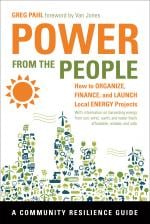
Is it possible to “relocalize” energy? This is a critical question that must be addressed if we are to achieve true global resilience.
In our brand new book (September 4, 2012), Power From the People, energy expert Greg Pahl decisively argues that the answer is YES.
Power From the People is the second book in our Community Resilience Guides series, The book illustrates how communities across the country are already generating their own energy at the local level. From citizen-owned wind turbines to co-op biofuel producers to community-wide initiatives combining multiple resources and technologies, Pahl outlines the steps necessary and plan, organize, finance and launch community energy projects.
The book showcases over 25 real-life examples of local energy projects, offering a range of challenges and solutions that can be adapted and reapplied.
It’s been said that we must leave fossil fuels before they leave us. Power From the People shows how that might be done. We’re very excited about this, our latest publication. Take advantage of the special Friends of Post Carbon discount: Buy the book today directly from Chelsea Green Publishing with discount code PFTP.
by Greg Pahl
Foreword by Van Jones
“Greg Pahl’s Power from the People is an inspirational guide to the burgeoning community-power movement. His case studies of people who are making a difference are often tales of endurance and survival, but also powerful testaments to the human spirit. Bravo to Pahl and Power from the Peoplefor explaining how feed-in tariffs have produced a community-power revolution in Europe and how they can do the same here in North America.”—Paul Gipe, author of Wind Power, advocate, and renewable energy industry analyst
More than ninety percent of the electricity we use to light our communities, and nearly all the energy we use to run our cars, heat our homes, and power our factories comes from large, centralized, highly polluting, nonrenewable sources of energy.
It doesn’t have to be that way. In Power from the People, energy expert Greg Pahl explains how American communities can plan, finance, and produce their own local, renewable energy that is reliable, safe, and clean.
Pahl uses examples from around the nation and the world to explore how homeowners, co-ops, nonprofits, governments, and businesses are already putting power in the hands of local communities through distributed energy programs and energy-efficiency measures.
Renewable, community power is a necessary step on the path to energy security and community resilience, particularly as we face peak oil, cope with climate change, and address the need to transition to a more sustainable future.
This book—the second in the Chelsea Green Publishing Company and Post Carbon Institute’s Community Resilience Series (http://www.resilience.org/guides)—also profiles numerous communitywide initiatives that can be replicated and scaled broadly.
About the Author

Greg Pahl
Greg Pahl is the author of numerous books on energy and also writes for Mother Earth News and various other publications on biodiesel, wind power, wood heat, solar energy, heat pumps, electric cars, and a wide range of other topics related to living in a post-carbon world.
His books include Biodiesel: Growing a New Energy Economy (2005, Chelsea Green), Natural Home Heating: The Complete Guide to Renewable Energy Options (2003, Chelsea Green), The Complete Idiot’s Guide to Saving the Environment (2001, Macmillan/Alpha Books), and The Unofficial Guide to Beating Debt (2000, IDG Books).
Greg Pahl is the author of numerous books on energy and also writes for Mother Earth News and various other publications on biodiesel, wind power, wood heat, solar energy, heat pumps, electric cars, and a wide range of other topics related to living in a post-carbon world.
His books include Biodiesel: Growing a New Energy Economy (2005, Chelsea Green), Natural Home Heating: The Complete Guide to Renewable Energy Options (2003, Chelsea Green), The Complete Idiot’s Guide to Saving the Environment (2001, Macmillan/Alpha Books), and The Unofficial Guide to Beating Debt (2000, IDG Books).
Pahl has been involved in environmental issues for more than twenty-five years. In the 1970s he lived off the grid in a home in Vermont with a wind turbine atop an 80-foot tower that provided for his electrical needs. He is a founding member of the Vermont Biofuels Association as well as the Acorn Renewable Energy Co-op. Pahl attended the University of Vermont and was a military intelligence officer in the US Army during the Vietnam War.
He lives in Weybridge, Vermont.
Greg’s Upcoming Events
- Greg Pahl at Ilsley Public Library
75 Main Street, Middlebury VTSeptember 26, 2012, 7:00 pmGreg Pahl will be at Middlebury’s Ilsley Public Library on September 26 at 7:00pm to read from his new book, “Power from the People,” and answer questions about community-supported power and how that contributes to resiliency. The event will take place in the library’s Lower Room.
- Greg Pahl at the 2012 Renewable Energy Vermont Conference and Expo
Sheraton Hotel, Burlington VTOctober 1, 2012, 12:00 pmGreg Pahl will speak at the 2012 Renewable Energy Vermont Conference and Expo at the Sheraton in Burlington on October 1 and 2. Greg will have 15 minutes to present during one of the hour and 15 minute sessions. There will be three speakers and one moderator for each session.
- Greg Pahl at Galaxy Bookstore
Galaxy Bookstore, 41 Main Street , Hardwick VTNovember 6, 2012, 7:00 pmGreg Pahl will discuss his new book, “Power from the People: How to Organize, Finance, and Launch Local Energy Projects,” at the Galaxy Bookstore on November 6 at 7:00 PM. Books will be available for sale and signing at the event.
- Greg Pahl at Phoenix Books
191 Bank Street, Burlington Vermont 05401November 13, 2012, 7:00 pmGreg Pahl will be discussing his new book, “Power from the People,” at Phoenix Book’s Burlington Store on November 11 at 7:00 PM. Greg will share stories of communities that have been successful at creating community-run sustainable energy projects. Come ask Greg your questions for launching your own community energy project and pick up a signed copy of your own to use as a guide!
- Greg Pahl at Local Living Festival
, Canton NYApril 27, 2013, 12:00 pmGreg Pahl, author of “Power from the People,” will be leading a workshop on how communities can plan, finance, and produce their own local and renewable energy that is reliable, safe, and clean at the 2013 Local Living Festival in Canton, NY. More details on time and location to come!
One Comment on "How to Organize, Finance, and Launch Local Energy Projects"
kervennic on Wed, 5th Sep 2012 11:27 am
Why do we need electric cars. People have biked and walked before the 50 s.
I have no car, only bike, even in the countryside far from town, and i am not superman.
And if bike are proven to be unsustainable as a technology, i am ready to go back to horse riding.
How those peudo green people can support such a waste of metal and energy as a car or even a tractor.
Have they investigated how aluminium or stainless still is produced today. Do they know about batteries, how much material is available.
Do we need more waste metal in our lakes and rivers, do we need to loose all our fish and eat GMO soja to let the western middle age man and women grow their belly fat in peace ?