
Peak Oil is You

Donate Bitcoins ;-) or Paypal :-)


Page added on April 22, 2019

How To Bury the Fossil Fuel Industry

Keen eyes browsing through the Green New Deal resolution introduced by Rep. Alexandria Ocasio-Cortez (D-N.Y.) and Sen. Ed Markey (D-Mass.) in February might have noticed a concerning similarity between that document and the Paris climate agreement: Neither mentions fossil fuels.
To be clear, the Green New Deal is probably the best shot we have at planetary survival. Its sweeping call to get to net-zero emissions (or as close as possible) by 2030 while raising Americans’ standard of living is wildly ambitious, smart politics and firmly in line with the scientific consensus on global warming. But February’s resolution, essentially a statement of principles, couldn’t be expected to include every last detail of what is needed. Indeed, avoiding certain contentious fights for now—like those over negative emissions technologies, nuclear energy and carbon taxes—may be a shrewd move on Ocasio-Cortez and Markey’s part. But there’s one massive fight that will be impossible to avoid if we hope to achieve the goals of the Green New Deal: the one with the fossil fuel industry.

Just 100 fossil fuel producers, including both privately held and state-owned companies, have been responsible for some 71 percent of global carbon emissions since 1988. The business model of that industry is to find, dig and burn as many fossil fuels as possible. By 2050, projected new oil and gas development in the United States—barring new regulations or a drastic change in the price of oil—would unlock enough carbon to release the equivalent of the lifetime emissions of 1,000 coal-fired power plants (in 2017, the United States had 359 coal plants). Most of this would come from new drilling in the Permian basin in Texas and New Mexico and the Appalachian basin in Ohio, Pennsylvania and West Virginia.
The Intergovernmental Panel on Climate Change, meanwhile, paints a very different picture of what needs to happen. Without the wide-scale deployment of technologies to capture and store carbon dioxide from fossil fuel plants and the atmosphere—which may or may not even be feasible—global coal, oil and natural gas usage will, by 2050, have to decline by 97, 87 and 74 percent, respectively, to cap warming at 1.5 degrees Celsius. That decline ought to happen fastest in places like the United States, whose centuries of fossil-fueled economic growth should enable bringing massive amounts of renewable energy online more quickly than poorer countries. The stubborn, well-documented link between rising economic growth and rising greenhouse gas emissions also means that emissions are likely to rise outside the Global North as those economies grow and people consume more. To allow space for that to happen—that is, to avoid imposing some draconian limit on new consumption in the poorest parts of the world—emissions in wealthier countries should reach net zero by around 2030.
To get there, we will need to dramatically scale up the amount of solar and wind in our energy mix, while electrifying huge parts of the economy to run on them. Any Green New Deal will mean investing heartily to decarbonize carbon-intensive sectors like steel, cement, shipping and airlines, for which no-carbon alternatives do not currently exist. That would involve reducing demand for certain services and activities through better supply-chain management, improving existing energy efficiency and dedicating research toward decarbonization technologies at a massive scale. The Energy Transitions Commission has estimated that this massive lift would cost less than 0.5 percent of global GDP by mid-century.
Massive investments in public transit and energy-efficient affordable housing would go a long way toward decreasing the carbon footprints of our cities and towns. National fuel-efficiency and renewables standards, like the one in place at the state level in California, could require utilities and car companies to ramp up clean power usage or face harsh penalties.
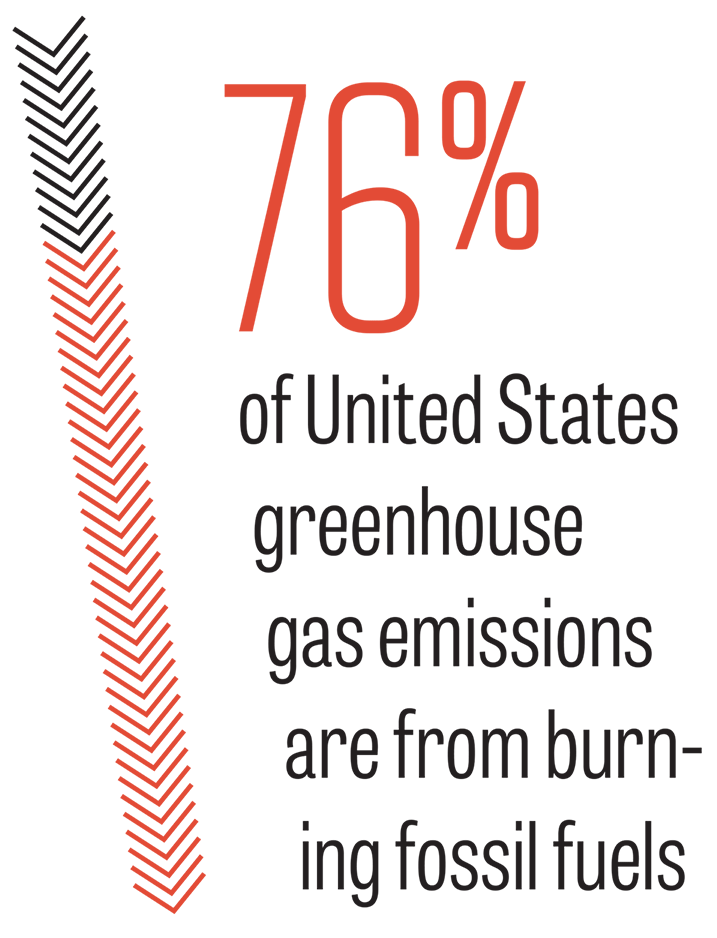
Yet simply adding more renewables to the grid won’t be enough to drive down fossil fuel usage to the extent needed. Even as solar and wind have gotten cheaper and more widespread in the last several years, the share of energy they generate nationwide has remained largely flat. Fossil fuel usage and extraction have each continued to increase and show few signs of slowing down—particularly as the United States becomes a net exporter of fossil fuels. In other words, the good isn’t out-competing the bad. In such a context, placing real constraints on coal, oil and gas companies is the only way to ensure we can reach our climate goals.
There are more straightforward places to start. One would be by ending the roughly $20 billion in subsidies the U.S. government hands over to the fossil fuel industry each year at the state and federal levels, including longstanding tax giveaways. (Permanent tax breaks to the fossil fuel sector are seven times greater than those awarded to renewables.) In banning new offshore drilling exploration, the United States would follow the example already set by New Zealand. And a Green New Deal could move to end the practice of leasing federal lands and waters to drillers, as well as granting permits for the kind of new infrastructure that allows companies to export oil and gas abroad. These handouts to the fossil fuel industry are so extensive that the Stockholm Environmental Institute has estimated that as much as half of new oil and gas development would be unprofitable without them. Removing the perverse incentives that keep them afloat should be a no-brainer.
But more dramatic action may be needed—the industry’s record of funding disinformation and lobbying to tear up even basic regulations suggests it will not disappear willingly. To hasten the transition to net-zero emissions, researchers at the Next System Project have suggested the U.S. government could bring U.S.-based fossil fuel industries under public ownership by buying up 51 percent of their shares—investors could sell these voluntarily, or else be made to compulsorily—then moving swiftly to curtail production.
Of course, cutting off new extraction overnight would leave workers and communities that depend on fossil fuel employment in a lurch, and cause arguably catastrophic ripple effects throughout the U.S. economy if alternatives were not at the ready.
The U.S. government could bring U.S.-based fossil fuel industries under public ownership by buying up 51 percent of their shares, then moving swiftly to curtail production.
Whatever ownership structure is in place, living up to the values embodied in a Green New Deal will require a managed decline of the fossil fuel industry, in which the first priority is ensuring a dignified quality of life for extractive sector employees—not golden parachutes for C-suite executives.
Barely out of the gate, the Green New Deal is already attracting the ire of fossil fuel industry executives and the various dark money think tanks and politicians they fund. They’ve begun fabricating price tags for the program out of whole cloth. Coal, oil and gas interests will paint whatever plan is eventually produced as an assault on fossil fuel workers out to crater the U.S. economy. So why not battle them head-on?
53 Comments on "How To Bury the Fossil Fuel Industry"
Gaia on Mon, 22nd Apr 2019 5:12 pm
America should return California, New Mexico, Arizona and Texas to Mexico, return Louisiana to the French, return Alaska to the Russian Federation.
Gaia on Mon, 22nd Apr 2019 5:37 pm
Also, Hawaii should be returned to the Native Hawaiians, Guam, Puerto Rico should break away.
Kevin Cobley on Mon, 22nd Apr 2019 5:49 pm
Carbon taxes are critical to this process, it’s clear that “regulation” is equivalent to raising prices on carbon or a carbon tax.
Carbon taxes are more cost effective than “regulation” as it allows the consumer to make their own choices in how reductions in fossil fuel use are achieved.
The US people clearly need to re-educate themselves on what taxation is, it’s clear their belief system that “taxation is theft” is a major problem in the US.
Gaia on Mon, 22nd Apr 2019 5:56 pm
To wipe out the national debt (trillions of USD), Americans should simply stop paying property and income taxes. End of story.
Darrell Cloud on Mon, 22nd Apr 2019 5:58 pm
If you shut down oil, you end transport in the United States. Without transport, the blue archipelago that is the blue teams’s fan base will eat itself in a matter of weeks.
China will be grateful, that will allow them to run their car culture a while longer.
Gaia on Mon, 22nd Apr 2019 8:21 pm
Time for Canada to beef up our border security along the US-Canada border.
Cloggie on Tue, 23rd Apr 2019 7:31 am
“America should return California, New Mexico, Arizona and Texas to Mexico, return Louisiana to the French, return Alaska to the Russian Federation.”
…And Quebec to France, most of Anglo-Canada to England and Vancouver to China. And then there are the Eskimo’s.
Deal, mr Canadian?
Defund GIC on Tue, 23rd Apr 2019 7:43 am
+1 on tax protest; just stop underwriting this massive clusterfuck.
Sissyfuss on Tue, 23rd Apr 2019 8:42 am
” The Green New Deals sweeping call to get to net-zero emissions by 2030 while raising Americans’ standard of living is wildly ambitious.” No, I would call that both impossible and delusional. In a country whose DNA demands growth in its standard of living, the GND is antithetical and blasphemous. Americans will be dragged kicking and screaming into the new paradigm of scarcity and environmental decay while the developing world parrots our Bacchanalian path to oblivion. There are no solutions to predicaments, only unravelings.
Anonymouse on Tue, 23rd Apr 2019 3:19 pm
And Palestine should be given back to the Palestinians, right CLoggJude. Oh, I bet that one is off the table with cloggenkike here. Too close to home.
Btw, you know even less about Canada, than you do about science, technology, or history even. It is embarrassing to watch you even try.
The only deal you need to make cloggedanus, is with a psychiatrist that works cheap.
Gaia on Tue, 23rd Apr 2019 3:30 pm
All of the world’s monarchies should be abolished and the royal families should pay property and income taxes (by 99.99%).
!?! on Wed, 24th Apr 2019 2:12 pm
The laws in the world are nothing but the manipulation and oppression of the low-income and middle-class by the rich. Capitalism is theft.
Davy on Fri, 26th Apr 2019 6:14 am
Here you go Antius, helium, solar, and compressed air:
“Lighter-Than-Air” Autonomous Blimp Designed For “Ultra-Endurance” Flights Reaches Milestone”
https://tinyurl.com/y2pztrko zero hedge
“The Phoenix, an “ultra-long endurance autonomous aircraft,” uses helium to rise into the air and then moves forward by “inhaling” and compressing air. Solar cells line the aircraft’s wings, indicating there are no limits on how long it could remain air bound.”
“This system allows the Phoenix to be completely self-sufficient,” he adds in a statement. “Vehicles based on this technology could be used as pseudo satellites and would provide a much cheaper option for telecommunication activities. Current equivalent airplanes are very complex and very expensive. By contrast, Phoenix is almost expendable and so provides a user with previously unavailable options.”
Cloggie on Fri, 26th Apr 2019 11:39 am
100% solar feed-back tariff in Holland extended with three additional years until 2023:
https://nos.nl/artikel/2282099-met-zonnepanelen-opgewekte-stroom-blijft-aftrekbaar.html
My panels will be paid-off by that time, because of the 100% compensation, boiling down to that 1 kWh delivered by my panels to the grid is just as valuable (in money terms) as a kWh delivered to me by the grid.
After that, free electricity till the day I pass away.
Cloggie on Sat, 27th Apr 2019 12:34 pm
Audi, VW & Tesla: autonomous driving is rapidly coming closer.
https://deepresource.wordpress.com/2019/04/27/autonomous-driving-update/
Anonymouse on Sat, 27th Apr 2019 2:08 pm
After that, free electricity till the day I pass away.
That day cant come soon enough CloggJude.
Davy on Sat, 27th Apr 2019 2:14 pm
shut up annoy, you can’t measure up to a pimple on cloggo’s ass. I may not care for cloggo but he does say something with substance that can be debated. You are a mother fucking stalker who thinks he is humorous.
Anonymouse on Sat, 27th Apr 2019 2:38 pm
Speaking of pimples on goats asses, look everyone, its the exceptionaltard. Riding in on his white donkey, to rescue poor cloggjudes ‘honor’. Again.
IoW, no asked you, shit for brains.
Cloggie on Sat, 27th Apr 2019 3:22 pm
It’s saturday, so no need to be on-topic.
My personal upcoming Eurovision Songfestival 2019 ranking:
1. Greece
https://www.youtube.com/watch?v=ulQoRPcQVDc
2. Holland
https://www.youtube.com/watch?v=Eztx7Wr8PtE
3. Norway
https://www.youtube.com/watch?v=3EmUmbhDRiY
4. Switzerland
https://www.youtube.com/watch?v=6PxoMWtAC7M
All the bookmakers agree (and they seldom are very wrong):
1. Holland 27%
2. Russia 14%
3. Switzerland 8%
4. Sweden 7%
Yeah!
https://eurovisionworld.com/odds/eurovision
All-time country score: Ireland!
https://www.statista.com/statistics/688308/top-10-countries-with-the-most-eurovision-song-contest-wins/
Gossip:
Australia for the first time in the 5 times it participated, has send A WHITE ARTIST! Yeah!
Should America participate? Justin Timberlake made a guest appearance, a few years ago, which was seen as a trial balloon.
https://escxtra.com/2019/03/21/why-america-shouldnt-participate-in-eurovision-a-series/
A lot of Americans actually DID participate:
https://wiwibloggs.com/2018/07/04/happy-4th-of-july-we-salute-17-americans-who-sang-at-the-eurovision-song-contest/
One of my favorites was the girl from Hartford, participating for Austria:
https://www.youtube.com/watch?v=XKpqQplDVP0
The Eurovision Songfestival is now one of the largest, if not THE largest television event in the world, even broadcasted live in China. No wonder that the EBU is contemplating setting up the event in the US as well, with artist from 50 states competing:
https://eurovoix-world.com/eurovision-america-being-considered-ebu/
Cloggie on Sat, 27th Apr 2019 3:24 pm
All American participants Eurovision Songcontest:
https://wiwibloggs.com/2018/07/04/happy-4th-of-july-we-salute-17-americans-who-sang-at-the-eurovision-song-contest/
makati1 on Sat, 27th Apr 2019 6:29 pm
Anon, that picture made me laugh. “A Missouri Jackass riding a white donkey! LMAO!
The Truth Shall Set You Free on Sat, 27th Apr 2019 8:57 pm
DavySkum outclassed yet again:
Speaking of pimples on goats asses, look everyone, its the exceptionaltard. Riding in on his white donkey, to rescue poor cloggjudes ‘honor’. Again.
IoW, no asked you, shit for brains.
Davy on Sat, 27th Apr 2019 10:58 pm
Heeeee Haaaawww
Cloggie on Sun, 28th Apr 2019 2:26 am
“Bury the fossil fuel industry”-latest:
Drastic reduction of the installation cost of onshore wind: the Lagerwey self-climbing crane. No longer necessary to bring huge cranes to the installation site, but instead use the developing wind-tower itself as a crane:
https://deepresource.wordpress.com/2019/04/28/lagerwey-self-climbing-crane-on-display-in-hamburg/
makati1 on Sun, 28th Apr 2019 3:03 am
Still dreaming, Cloggie? Smoke and mirrors and bullshit. The financial system behind ALL of the renewables are already creaking and soon will crash to the ground. No more government subsidies. No more “renewables”. It’s called capitalism and profit. Debt is winning the race, not wind and solar.
Cloggie on Sun, 28th Apr 2019 3:23 am
It will begin in either the South China Sea or Iran or both…
…and it will end here:
https://www.youtube.com/watch?v=ss3YOYS4C6Y
Still dreaming, Cloggie? Smoke and mirrors and bullshit. The financial system behind ALL of the renewables are already creaking and soon will crash to the ground.
This is such an American attitude, you share with your favorite adversary empire dave, namely the idea that somehow, money and debt is the most important category in the world and that if a financial system crashes, it is the end of the world.
It isn’t.
Identity, people and their talents are crucial. Take the Germans: utterly destroyed in 1945. This wasn’t just a financial collapse, but a total collapse of society. Yet, they stood up and already 10 years later they had their…
https://en.wikipedia.org/wiki/Wirtschaftswunder
Now they have the per capita most intense economic and technological system in the world (after the Dutch.lol – D(e)ut(s)ch)
You and dave are projecting your own sense of despair regarding America, as expressed by the gentleman in the video above, onto the rest of the world… “cosy, we are going to collapse all together”.
Or something.
In reality, money is relatively unimportant, race is far more important. But Americans like you and empire dave were duped by your oligarch owners into thinking that it didn’t matter. And the reason why they did that was not some fake humanitarianism, but the idea that they could use the huge American resources to put the entire world into one big bag, owned by them.
The few years are going to show that race matters very much. And now you are facing the ruin of your society and you are a refugee in the Philippines, a guy without a country he can call his own.
https://www.youtube.com/watch?v=oqrI8Qrigr8
“This is a white lash!”
“After the break”, North-America will look much like South-America. It is even possible that it happens like it happened to the USSR, without a drop of blood spilled. But don’t bet the farm on it. The oligarchs likely won’t let go of their property that easily.
Cloggie on Sun, 28th Apr 2019 3:46 am
Still dreaming, Cloggie? Smoke and mirrors and bullshit. The financial system behind ALL of the renewables are already creaking and soon will crash to the ground. No more government subsidies. No more “renewables”.
Strange, how do you explain this?
https://deepresource.wordpress.com/2019/04/28/2018-50-increase-installed-solar-power-in-the-netherlands/
And this?
https://deepresource.wordpress.com/2019/04/20/holland-2018-3-economic-growth-1-5-less-energy-use/
Dutch debt counter: minus 350 euro per second:
http://www.destaatsschuldmeter.nl/
Dutch national debt: 52%
https://www.daskapital.nl/5152542/hopsa-staatsschuld-knalt-nog-harder-omlaag-dan-verwacht/
That’s what you get if you invest in agriculture or high-tech, rather than useless navies, carriers and jets.
On top that, the political right is winning rapidly in Europe and has no intention of letting in more Muslim time bombs, meaning we will keep our own lands.
#DestroyTheLeft
JuanP sock on Sun, 28th Apr 2019 5:28 am
juanpee posted this
The Truth Shall Set You Free on Sat, 27th Apr 2019 8:57 pm
Not Davy on Sun, 28th Apr 2019 5:29 am
JuanP posted this
Davy on Sat, 27th Apr 2019 10:58 pm
Davy on Sun, 28th Apr 2019 5:56 am
“This is such an American attitude, you share with your favorite adversary empire dave, namely the idea that somehow, money and debt is the most important category in the world and that if a financial system crashes, it is the end of the world.”
Come on cloggo, capital allows asset formation. You are an uneducated blowhard who thinks these big euro projects self-organize because of a super human population. You criticize me about finance and economics because I moderate and neuter your comments that are agenda based and do not hold water. So many of your economic/finance comments are based upon looks and the size of the number in relationship to your Euro chauvinism. These cherry picked numbers for show usually have deeper significance and deeper relationships related to the interdependence of globalism. You are a fraudulent commenter.
Davy on Sun, 28th Apr 2019 6:07 am
“Dutch debt counter: minus 350 euro per second: Dutch national debt: 52%”
AND THIS:
“Households Debt in Netherlands decreased to 102.70 percent of GDP in the third quarter of 2018”
https://tinyurl.com/yxtcqxb3 trading economics
Netherlands is 121% debt to GDP of nonfinancial corporations. You rank near the top cloggo:
https://tinyurl.com/y2ajerfq McKinsey
Davy on Sun, 28th Apr 2019 6:25 am
“The Great Financial Crisis Ten Years On: China’s Past Role & Current Risks”
https://tinyurl.com/yyde65xa hidden forces podcast via zero hedge
“The problem is that China generated a tremendous amount of money and credit since the GFC, in particular, and therefore risks a major devaluation in the value of the RMB should the country no longer be able to get the foreign exchange reserves it needs through a sustainable current account surplus. They are, at the moment, running a negative current account, a negative fiscal balance (of roughly 9% of GDP), their foreign exchange reserves are declining for the first time ever, while the country’s external debt has doubled in the last five years, increasing by an average of $70 billion per quarter since the beginning of 2017. More than half of this debt is short-term, which means it needs to be constantly rolled over. Up until the Fed paused it’s tightening cycle, the rising interest rates coupled with new tariffs on Chinese goods were creating a pincer-like effect on China’s economy and on its ability to maintain its peg, forcing it to fund more of its dollar needs through borrowing at ever higher interest rates. China cannot maintain a credible peg between the RMB and the USD when its money supply is growing, by some calculations at more than 10x that of the United States over the last 10 years.”
Cloggie on Sun, 28th Apr 2019 6:29 am
Batteries or hydrogen, is that all there is to it in driving the e-vehicle of the future?
Perhaps there is a third competitor: super-capacitors.
https://deepresource.wordpress.com/2019/04/28/supercapacitors-as-competitors-for-hydrogen-and-batteries/
Cloggie on Sun, 28th Apr 2019 6:40 am
“Households Debt in Netherlands decreased to 102.70 percent of GDP in the third quarter of 2018”
That’s mortgage and mortgage IS NOT debt, but has a counter value in stone. I already have explained why the Dutch have higher mortgages than elsewhere, because they can afford it because of its exceptional scheme of tax deduction of mortgage interest: completely tax-deductable. Almost nobody else has that.
Regarding Dutch corporate debt, here is a Dutch accountancy report, refering to exactly the same McKinsey report, drawing completely opposite conclusions. Dutch corporate debt is internationally relatively low:
https://www.onlineaccountantsmkb.nl/aktueel/nederlandse-bedrijven-hebben-relatief-lage-schuld.html
“Nederlandse bedrijven hebben relatief lage schuld”
(Dutch corporations have relative low debt)
Reason: our self-styled financial genius empire dave compares corporate debts to Dutch GDP. But a real expert compares corporate debt with the value of Dutch corporations and all of a sudden the picture changes completely.
Busted.lol
Davy on Sun, 28th Apr 2019 6:45 am
“China Tries to Muscle in on Dollar as Dominant ‘Payments Currency,’ But It’s a Thankless Slog”
https://tinyurl.com/yxrtjvw7 wolf street
In terms of global reserve currency, the renminbi (RMB) has a share of only 1.9%, in fifth place, and barely ahead of the Canadian dollar, but miles behind the US dollar (61.7%) and the euro (20.7%). Over the past two years, the RMB has made only microscopic headway as a reserve currency. And as an international payments currency, the RMB has failed similarly to crack the co-hegemony of the dollar and the euro. “With more than 1,900 financial institutions now using the RMB for payments with China and Hong Kong, the internationalization of RMB carries great strategic significance” for banks and financial institutions, gushes SWIFT (Society for Worldwide Interbank Financial Telecommunication), which tracks the progress of the RMB as payment currency. But in March 2019, the RMB had a minuscule share of merely 1.22% for international cross-border payments by value (cross-border payments from one Eurozone country to another Eurozone country are excluded). This minuscule share put the RMB in 8th position, just behind the Swiss franc: https://tinyurl.com/y37jwcy7
“On one hand, its internationalization was supported by major trends, such as: The growth of cashless payments, “mainly driven by the digital giants Alipay and WeChat Pay” “The far-reaching Belt & Road Initiative” “The globalization of Chinese banks and their adoption of SWIFT gpi” “The progress of China’s Cross-border Interbank Payment System (CIPS).” On the other hand, there was this: “Despite these trends, there are a number of critical success factors necessary for widespread adoption of the RMB.” And that’s where it gets tough. The headwinds the RMB faces “in the short term” include “capital controls imposed by the Chinese government” and “ongoing concerns over
Davy on Sun, 28th Apr 2019 6:47 am
“That’s mortgage and mortgage IS NOT debt”
“Regarding Dutch corporate debt, here is a Dutch accountancy report, refering to exactly the same McKinsey report, drawing completely opposite conclusions. Dutch corporate debt is internationally relatively low:”
LMFAO, “mortgages are not debt”????
LMFAO, “drawing completely opposite conclusions.” well, explain it dumbass and not in dutch.
FRAUD
makati1 on Sun, 28th Apr 2019 6:55 am
Davy and Cloggie are in a race to see who is the most delusional. So far it is a tie but Davy seems to be moving ahead. Stay tuned…
makati1 on Sun, 28th Apr 2019 7:03 am
Cloggie lives in a postage stamp country with the population of Metro Manila and a land surface barely above the rising sea level. About like “The Mouse that Roared”. lol
https://en.wikipedia.org/wiki/The_Mouse_That_Roared
Davy on Sun, 28th Apr 2019 7:07 am
‘Davy and Cloggie are in a race to see who is the most delusional. So far it is a tie but Davy seems to be moving ahead. Stay tuned…”
Translation: I am pushing 80 and unable to enter a serious debate so I will puke a one liner and act smart. DEMENTIA
Davy on Sun, 28th Apr 2019 7:09 am
“Cloggie lives in a postage stamp country with the population of Metro Manila and a land surface barely above the rising sea level”
You live on an Island with 100MIL with the space of the state of Arizona that can support 10MIL minus fossil fuels. Your GDP is roughly what my state of Missouri is but with 16 times the population. DEMENTIA
Cloggie on Sun, 28th Apr 2019 7:10 am
“LMFAO, “mortgages are not debt”????”
You are really dumb, aren’t you.
Dutch cumulative mortgage debt is lower than the cumulative value of Dutch homes. In street language: they are not under water.
If I have a home that is worth 200k and I have 100k mortgage and I sell it for 200k I have 100k in my pocket. So where is the debt?
In 2017 mortage/homevalue was 41%, perfectly acceptable.
https://www.elsevierweekblad.nl/economie/achtergrond/2018/01/hypotheekschuld-stijgt-naar-recordhoogte-579977/
Real debt is when I play poker with 10$ in my pocket and I leave the casino with 1000$ debt. That’s REAL DEBT.
“LMFAO, “drawing completely opposite conclusions.” well, explain it dumbass and not in dutch.”
I already did, slow-brains. What is it you don’t understand about the English sentence “Dutch corporate debt is relatively low in international (western) comparison”?
Cloggie on Sun, 28th Apr 2019 7:15 am
“Cloggie lives in a postage stamp country with the population of Metro Manila and a land surface barely above the rising sea level”
GDP-ranking
17-Netherlands 912B 13 million ethnic Dutch
…
38-Philippines 331B 100 million ethnic Philipinos
https://en.wikipedia.org/wiki/List_of_countries_by_GDP_(nominal)
I’ll prefer my “poststamp country” any time of the day over your shithole refuge.
https://www.youtube.com/watch?v=c4EmGmCpknE
German competence, but more upbeat, sexy and with flair.
Davy on Sun, 28th Apr 2019 7:35 am
“LMFAO, “mortgages are not debt”????” You are really dumb, aren’t you.”
Cloggo, mortgages are debt instruments please show me otherwise, dumbass
“Dutch cumulative mortgage debt is lower than the cumulative value of Dutch homes. In street language: they are not under water.”
Wow, I hope so or you are a country of dumbasses. You are still near the top of the list and household debt includes other types of debt which of course you ignore.
“If I have a home that is worth 200k and I have 100k mortgage and I sell it for 200k I have 100k in my pocket. So where is the debt?”
OOPs, except value is relative but debt isn’t. You are sounding like a flipper now.
“I already did, slow-brains. What is it you don’t understand about the English sentence “Dutch corporate debt is relatively low in international (western) comparison”?”
No, FRAUD, you didn’t, you didn’t say shit other than to restate your empty conclusion. You need to show why McKinsey is wrong and your hkighly bias Dutch gov is right????
Davy on Sun, 28th Apr 2019 7:42 am
cloggo, BTW, what about all the funds Northern Europe has loaned to the south that the North will never see. LMFAO. OOPS…HAIRCUT. explain that away in dutch.
Cloggie on Sun, 28th Apr 2019 7:58 am
“BTW, what about all the funds Northern Europe has loaned to the south that the North will never see. ”
Peanuts, 3.1 billion.
The Greek crisis has been solved, next year they begin to pay back the loan. 2041 last tranche:
https://www.trouw.nl/home/het-heeft-even-geduurd-maar-de-grieken-gaan-hun-schuld-aan-nederland-aflossen~aeccf9e3/
I have quite a lot of young Greek collegues though as a consequence. Good people. I hope they score high at the Eurovision song festival, next month:
https://youtu.be/ulQoRPcQVDc
Davy on Sun, 28th Apr 2019 8:28 am
Sorry Cloggo, wrong numbers but your numbers just make it worse. Goggle the ECB funding mechanism for its quantitative easing program. The figure is in the
neighborhood of $1TRL. Euroland is awash in debt and bad debt.
Cloggie on Sun, 28th Apr 2019 8:36 am
“The figure is in the neighborhood of $1TRL”
EU gdp is ca. 20 trillion.
Two weeks of work.
Yawn.
We’re all going to eat our babies now.lol
Cloggie on Sun, 28th Apr 2019 8:43 am
Actually $23T, that is the euro equivalent.
https://en.wikipedia.org/wiki/Economy_of_the_European_Union
US $21.5T
https://en.wikipedia.org/wiki/Economy_of_the_United_States
joe on Sun, 28th Apr 2019 10:00 am
“ECB ends €2.5tn eurozone QE stimulus programme
https://www.bbc.co.uk/news/business-46552147”
Get your facts right.
Of course this debt purchase programme is balanced by debts in nations within just the Eurozone. These debts probobly can’t be repaid through economic growth of an organic nature. Not without totally liberalising the socialist systems in place. Market reforms of the type required to actually pay back this money haven’t been done and have in fact been actively resisted in countries like Italy whoes right wing and populist parties have joined forces to stop the gutting of Italian pensions and infrastructure funds and border security to Soros flunkies
The Euro’s $2.7 Trillion Italy Problem
“https://www.bloomberg.com/news/articles/2019-04-04/the-euro-s-2-7-trillion-italy-problem”
None of this of course really matters. In a usury system the currency HAS to fail.
Bad money replaces good. So the things must get worse not better otherwise the economy can’t grow. As for EU growth, I never trust the figures of a statistic that includes prostitution as legitimate part of the services sector.
Cloggie on Sun, 28th Apr 2019 10:22 am
Japan..253
USA….105
UK……85
EU……80
China…48
National debt to GDP ratio in %
https://tradingeconomics.com/country-list/government-debt-to-gdp
“The Euro’s $2.7 Trillion Italy Problem”
This is absolutely not a “euro problem”.
The high Italian deficit is a direct consequence of Italians avoiding to pay taxes. Some call that corruption, other libertarianism-in-action.
The consequence is that these so-called poor Italians have 2.5 higher median net worth than Americans.
The counter balance is that Italians have a mortgage quote of something like 15%. They put their avoided tax euro’s into paying off their own real estate.
Italians have ZERO financial problems and neither does the euro have an “Italy-problem”. All it takes is a politician with balls who takes revenge on its own population for decades of tax avoidance and imposes a forced mortgage of say 20,000 euro on every home and all problems are solved. Of course they won’t do that but instead start to beg the EU for loans… which they correctly won’t get.
One solution would be that Italy leaves the euro and that Italy resorts to its old Lira-practice of printing: 10% inflation per year, effectively increasing the budget of the Italians state with 10%. But that won’t happen either, since the Italians have more respect for the euro than their own shabby Lira, nobody outside Italy is interested in. Just like the Swiss, who officially are not in the euro either, nevertheless have to arrange themselves with the euro. At least foreigners accept CHF, but not Lira. Italians are stuck with the euro, one way or the other.